


The Morning Sixpack stays free because the news that shapes your life should not be hidden behind a paywall. Paid subscribers are not paying for access. They are helping fund the research, writing, and independent voice that goes into every issue. Become a paid subscriber and help keep smart, honest news analysis free for everyone.
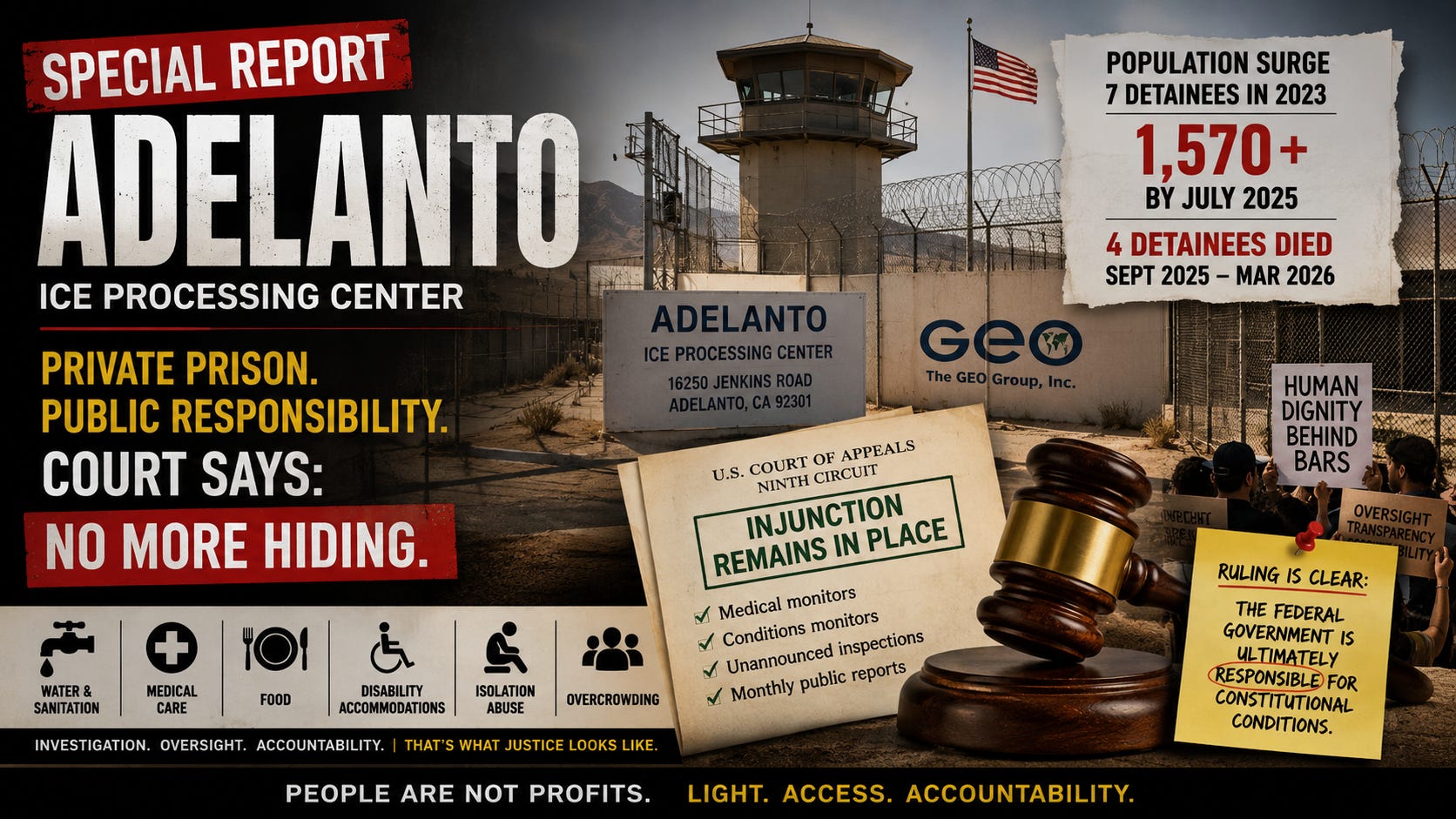
SPECIAL REPORT: Adelanto — The ICE Detention Center the Government Says It Doesn’t Fully Control. A Federal Court Isn’t Buying It.
A private prison company owns and runs it. ICE fills it. California investigators say its population exploded faster than its staffing and medical systems could handle. Four people died there in a matter of months. Now a federal appeals court has made something important clear: Uncle Sam doesn’t get to outsource detention and then outsource responsibility for what happens inside.
There is a place in the Southern California desert called Adelanto.
If you drive northeast out of Los Angeles, past the suburban sprawl and into the high desert of San Bernardino County, you’ll eventually reach a sprawling immigration detention complex capable of holding nearly 2,000 people.
Its official name is the Adelanto ICE Processing Center.
The name makes it sound as though ICE runs the place. It doesn’t.
And here is the fact that should sit at the center of this story: Adelanto is not a prison where people are serving criminal sentences.
It is an immigration detention center.
The people ICE confines there are being held under civil immigration authority — often while the government decides whether they may remain in the United States or will be removed. Some may have criminal histories or prior convictions. Others may not. But ICE is not imprisoning them at Adelanto as punishment for a crime.
That distinction is enormous.
Because the government has taken people who are not serving criminal sentences, placed them behind razor wire in a privately operated detention complex, and made them completely dependent on that system for drinking water, food, medicine, sanitation, disability care, and personal safety.
So when detainees allege they cannot reliably obtain clean water or necessary medical treatment, the question is not simply whether a prison is being run badly.
It is whether the United States is subjecting people in civil custody—people it has chosen to detain rather than release while their immigration cases proceed—to conditions the Constitution does not permit.
That is what makes Adelanto different.
And it is what makes the Ninth Circuit’s latest ruling so consequential.
The facility is owned and operated by The GEO Group, a publicly traded private corrections company that contracts with the federal government. GEO provides the guards, the food service, and the medical care. ICE supplies the detainees and the federal dollars.
That distinction has become the centerpiece of a remarkable legal fight.
Because after a federal judge ordered major changes at Adelanto—including independent medical and conditions monitors who can conduct unannounced inspections—the Trump administration went to the Ninth Circuit Court of Appeals and tried to put the order on hold.
Among its arguments: GEO, not the federal government, controls day-to-day conditions at the facility.
The appeals court’s answer, in essence: That’s still your problem.
On August 20, 2026, a unanimous three-judge Ninth Circuit panel refused to stay the injunction while the government’s appeal proceeds. Reporting on the decision the following day, LAist quoted the panel’s central conclusion: Although a contractor operates Adelanto, the federal government remains “ultimately responsible for ensuring that the conditions of confinement are constitutionally acceptable.”
That may be the most important sentence in this entire story.
But to understand why, you have to understand what Adelanto is, how it got here, and what investigators say has been happening behind its walls.
A private detention center with a federal customer
Adelanto has been part of the federal immigration detention system since 2011.
GEO Group operates it under contract with ICE. According to GEO’s own corporate filings, the Adelanto ICE Processing Center has 1,940 beds, and its contract was renewed for a five-year term running through December 2029.
That makes Adelanto part of a much bigger business.
GEO is one of the country’s largest private detention and corrections companies. Government agencies pay it to house people in custody. More occupied beds generally mean more revenue.
There is nothing secret about that arrangement. It’s the business model.
And Adelanto is a particularly valuable piece of it.
For a while, though, the facility was nearly empty.
COVID-era litigation had sharply restricted new admissions. California’s Department of Justice says Adelanto held just seven detainees in 2023.
Then the restrictions ended. And the population came roaring back.
By early July 2025, according to the California DOJ, Adelanto held 1,570 people. The state found that the rapid increase had “adversely impacted” conditions and described an institution overwhelmed by the influx and unprepared to provide basic necessities consistently.
Seven people. Then 1,570. Same facility. Very different operational challenge.
The surge came faster than the system could handle
California investigators visited Adelanto and the neighboring Desert View Annex on July 8 and 9, 2025.
What they found was not simply a crowded building.
Their report described staffing and medical systems that had failed to keep pace with the population explosion.
Between June 5 and June 8 alone, 621 detainees arrived at Adelanto and Desert View, according to the state.
Investigators reported that detainees did not consistently receive adequate clothing and blankets. Medical and detention staffing was inadequate for the population surge. Detainees said intake medical, dental, and mental-health screenings were not consistently performed. Medical records and interviews showed failures to conduct necessary follow-up care.
And detainees reported being unable to obtain requested appointments or timely treatment—including emergency care.
California Attorney General Rob Bonta’s office was not subtle when it released the findings in May.
The headline of its announcement called conditions in California immigration detention facilities “Cruel, Inhumane, and Unacceptable.”
State investigators said facilities were failing to meet even ICE’s own (low) detention standards as the detainee population surged.
At Adelanto, the consequences were particularly grim.
Four detainees died there between September 2025 and March 2026, according to the California DOJ.
Four deaths in roughly six months.
And those deaths occurred against a backdrop of continuing complaints about medical care, water, sanitation, food, overcrowded intake, disability accommodations, and isolation.
Then the detainees went to court
In January 2026, detained people and advocates filed a class-action lawsuit against ICE, the Department of Homeland Security, and federal officials.
The case is L.T. v. U.S. Immigration and Customs Enforcement.
The plaintiffs alleged that conditions at Adelanto had become so poor that they violated constitutional protections.
They described inadequate medical care.
Unsafe food and water.
Unsanitary living conditions.
Failures to accommodate disabilities.
Punitive isolation.
And a system in which people could struggle to get basic treatment while confined entirely under federal authority.
The government has disputed that broad characterization. DHS has maintained that detainees receive appropriate food, water, medical care, and other services and has argued that many conditions already comply with federal detention standards.
That dispute is important.
A lawsuit contains allegations. Allegations are not automatically facts. But by July, a federal judge had seen enough evidence to intervene.
Judge Sunshine Sykes says: Fix it now
On July 16, U.S. District Judge Sunshine Suzanne Sykes issued a preliminary injunction. A preliminary injunction is not a final verdict after trial. But it is not casual either.
To obtain one, plaintiffs generally must persuade a judge that they are likely to succeed on important parts of their case, that irreparable harm is threatened without immediate intervention, and that other equitable considerations justify relief.
Judge Sykes concluded that emergency relief was warranted.
Her order required improvements involving drinking water, food, sanitation, medical care, disability accommodations, recreation, visitation, isolation practices, hygiene, clothing, bedding, and other conditions.
Then she did something especially consequential.
She ordered independent oversight.
Two monitors are to oversee compliance—including medical care and general conditions—with the ability to conduct unannounced inspections and issue monthly public reports.
People detained at Adelanto are also supposed to have a confidential mechanism for communicating concerns directly to the monitors.
Think about what that changes.
Before, you essentially had two competing narratives.
The government and GEO could say conditions met standards.
Detainees and their lawyers could say they didn’t.
Now an outside monitor can walk in. Check the water. Inspect the housing units. Review medical records. Look at whether medications are actually being distributed. Check whether referrals are happening. Interview detainees. Review isolation practices. See whether disability accommodations exist in reality rather than merely on paper.
And then report to the court. That’s a different ballgame.
The Trump administration tries to stop the order
The federal government appealed Judge Sykes’s injunction on July 31. The case became Ninth Circuit appeal No. 26-4902. The administration also asked the appeals court to pause the injunction while the appeal was being litigated.
Initially, the Ninth Circuit entered a temporary administrative stay while it sorted through the request.
That’s where some of the coverage became confusing.
An administrative stay is not a ruling that the lower court was wrong. It is more like pressing pause while judges review emergency papers.
The real question came next: Would the Ninth Circuit leave Judge Sykes’s order frozen throughout the appeal?
On August 20, the answer arrived.
No.
The three-judge panel unanimously rejected the government’s request.
And its reasoning matters well beyond the procedural mechanics.
“But GEO runs it” turns out not to be much of an escape hatch
One of the government’s problems was the unusual structure of Adelanto itself.
The federal government detains people there, but the GEO Group operates the facility.
That gave federal lawyers an argument: The injunction requires results inside a building that GEO controls day to day.
Translation: We can’t necessarily make the contractor do everything the judge wants.
The Ninth Circuit was not persuaded.
The federal government, the panel said, remains ultimately responsible for constitutionally acceptable conditions.
And the judges pointed out something else: The government isn’t exactly powerless against GEO.
ICE has a contract.
If the contractor isn’t performing, the government can use contractual leverage.
It can withhold payments or impose financial consequences.
It can move detainees.
It can release detainees.
What it cannot do is place people in a private company’s custody on behalf of the United States and then point across the table at the contractor when constitutional violations are alleged.
That’s the part of this ruling that deserves more attention.
Because the government wasn’t merely arguing about whether a water fountain worked or whether one medical appointment was delayed.
It was pressing a much broader institutional question: Who is responsible when the United States deprives someone of liberty inside a privately-operated detention center?
The Ninth Circuit’s answer was straightforward: The United States.
And then the court said something else
The panel also noted that the government did not meaningfully dispute that the types of conditions found by Judge Sykes would be unconstitutional.
That wording matters.
It does not mean the Ninth Circuit has finally determined every factual allegation at Adelanto to be true.
It means the legal proposition itself is not much in dispute.
If people held by the government lack consistent access to potable water and adequate medical care, constitutional problems follow.
The fight is over what conditions actually exist, what remedies are appropriate, and how far a federal judge may go in ordering improvements.
But the idea that privately-operated detention somehow dilutes federal constitutional responsibility?
The Ninth Circuit gave that argument very little room to breathe.
Why the monitors may be the biggest story of all
Federal litigation produces enormous amounts of paper.
Complaints.
Declarations.
Briefs.
Responses.
Appeals.
Orders.
More briefs.
But ultimately, the central question at Adelanto is brutally simple: What is actually happening inside?
That’s why the monitor provisions matter so much.
If independent medical and conditions monitors are given the access Judge Sykes ordered, the court gains eyes and ears that are not controlled by ICE, GEO, or the plaintiffs.
The monitors’ reports could confirm widespread violations. They could show improvements. They could reveal a mixed picture. But they should make it much harder for anyone to win the argument simply by issuing a press statement.
And their access is no longer something the government can postpone merely because it has filed an appeal.
That is what the latest Ninth Circuit ruling changes right now.
The underlying appeal continues. Judge Sykes’s injunction could still eventually be narrowed or overturned.
The Ninth Circuit has not issued a final merits ruling declaring every challenged condition at Adelanto unconstitutional.
But the government wanted the injunction suspended while it fought. It lost that request.
So, absent further intervention from a higher court, the order remains operative.
That means improvements are supposed to happen. And independent oversight is supposed to happen.
There is a bigger story hiding inside Adelanto
Adelanto isn’t simply a story about one detention center in the Mojave Desert.
It is a story about what privatized government power actually means.
The United States decides who is detained.
The United States contracts with GEO.
Taxpayers pay GEO.
GEO owns the facility.
GEO employs the staff.
GEO provides the food.
GEO provides the medical services.
And ICE puts human beings behind the doors.
That arrangement can make accountability wonderfully blurry when something goes wrong.
The contractor can point to the agency.
The agency can point to the contractor.
Everyone can point to a policy manual.
Meanwhile, the person who cannot leave the building doesn’t particularly care whose organizational chart contains the water department.
The Ninth Circuit has now drawn a line through that fog:
You may hire a corporation to operate the jail.
You may contract out the meals.
You may contract out the guards.
You may contract out the medicine.
You may even contract out the building itself.
But when the United States government takes away someone’s freedom, it does not contract away its constitutional obligations along with the linen service.
That is what this latest ruling makes clear.
And that’s why the next chapter at Adelanto may be more revealing than the litigation that got us here.
Because soon the most important people in the story may not be the lawyers. They may be the independent monitors walking through the doors. And once they’re inside, everybody gets a little less room to hide.
I have been passing through that area for over 40 years. At one time we lived at China Lake. There is more than meets the eye going on. Remember, Edwards Air Force Base is where the Atlantis Spacecraft Landed. There are huge listening arrays installed on the mountains there. More recently the large installations of electric substations and wells in a dry arid area that is not largely populated is suspect. Last year a building that I have repeatedly passed by on my way south was being moved into. There were roughly 25 men and women in matching black industrial clothing without any patches or badges milling about in front of the building as well as across the street at an enhanced electrical substation. A 52 foot trailer was being unloaded into the building. It was formerly a gas station about 30 years ago. Then a private quickie store, then empty, then converted to a home and now who knows? I told Judy about this about two years ago.