

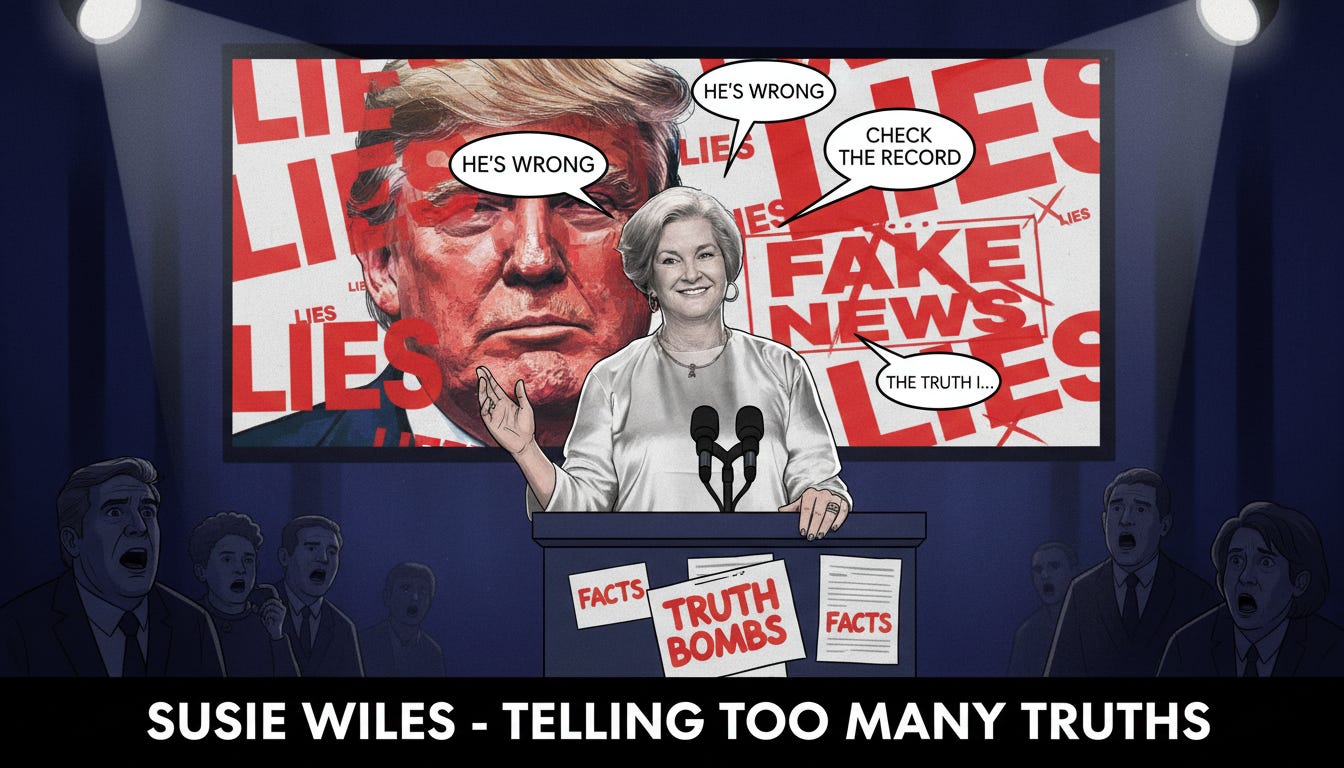
What began as a glossy Vanity Fair profile spiraled into a four-platform meltdown, with reporters, insiders, and longtime observers all describing one thing: a chief of staff who spoke too honestly, a president exposed by his own inner circle, and a West Wing now sprinting to find the fire extinguisher while pretending nothing is burning. And make no mistake—Susie Wiles isn’t on thin ice; she’s skating without skates.
From Lev Parnas’s account, you get the sense that Wiles didn’t just cross a line—she bulldozed it. His reporting captured the panic inside Trumpworld as Wiles tried to retract her own words, with her allies insisting she was misquoted even though the quotes were printed verbatim. Parnas framed it as a full-throttle political crisis: a chief of staff revealing Trump’s volatility, then attempting to claw her way back to safety while the rest of the operation scrambled to clean up behind her.
Over at Zeteo, the tone was surgical. Their breakdown of Wiles’ comments reads like a forensic report on a failing executive branch. They highlight her depiction of Trump as having “an alcoholic’s personality”—a breathtaking statement coming from the person tasked with managing him. They also called out her blistering assessments of the men who orbit Trump: JD Vance as a conspiracy theorist, Elon Musk as “an odd, odd duck,” and Russell Vought as a “right-wing absolute zealot.” When your chief of staff casually trashes the vice president, the tech whisperer, and the budget chief in one interview, that’s not candor. That’s an unforced confession.
Then there’s The Bulwark, which zoomed out and asked the bigger question: what does it mean when the person entrusted to steady the ship starts describing the captain and the crew like this? Their piece read almost like an obituary for functional governance, arguing that Wiles’ comments reveal a political movement staggering toward what they call “quantum suicide”—a multiverse where every decision is a gamble and accountability is something for other people. The subtext was clear: if this is what the loyalists admit publicly, imagine the conversations they’re still hiding.
Finally, Aaron Parnas came in with the chaos report from inside the West Wing—officials racing to defend Wiles they barely believed, furious aides leaking, factions blaming each other, and Trump silent in a way that only signals fury. His piece painted Wiles as someone who accidentally said the quiet part out loud and then discovered, far too late, that there is no quiet part anymore. She exposed Trump’s impulsiveness, his refusal to be constrained, and his fixation on revenge—and now she’s watching her standing evaporate in real time.
Put together, these accounts don’t just tell a story; they form a chorus. The chief of staff to the President of the United States openly described him as volatile, unrestrained, uninterested in governance boundaries, and surrounding himself with ideologues and eccentrics. And once those words hit daylight, the White House responded exactly as you’d expect: disarray, denial, and damage control masquerading as unity.
The real headline? We didn’t learn anything new about Trump—we learned what his own team says about him when they assume no one is listening.
Source: Lev Remembers
Source: Zeteo
Source: The Bulwark
Source: Aaron Parnas
Source: Vanity Fair (Part 1)
Editor: For a crew that claims to speak with one voice, they sure talk like people hiding in separate closets during a house fire. Wiles didn’t just spill tea—she knocked over the entire samovar, and now everyone’s pretending the floor isn’t scalding hot.