


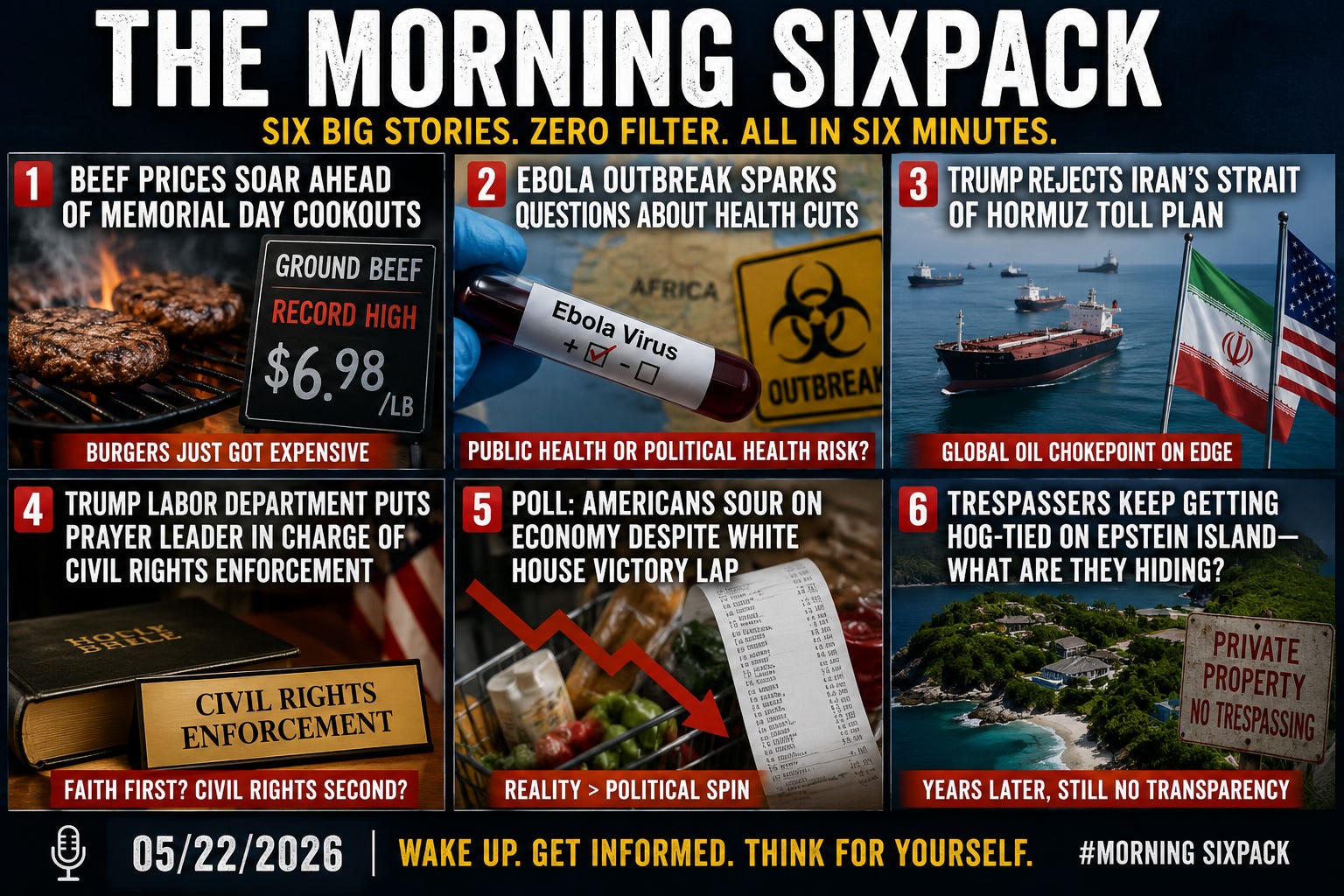
Even the White House can’t spin away the fact that burgers are becoming a budget item.
Memorial Day Cookouts Hit by Record Beef Prices as ‘Beeflation’ Bites Back #Trumpflation
Ground beef just hit a record $6.90 per pound, turning the all-American backyard barbecue into a luxury event for plenty of families.
Americans heading into Memorial Day weekend are getting hammered at the grocery store, where ground beef prices have climbed to an all-time high. According to the Bureau of Labor Statistics, a pound of ground beef now averages $6.90 nationwide after years of shrinking cattle supply and relentless demand. Since January 2025 alone, prices have jumped 24%.
That’s a real political problem for President Donald Trump, especially while his administration is loudly promoting beef-heavy diets through revamped federal nutrition guidelines. Health Secretary Robert F. Kennedy Jr. even bragged that he eats beef “twice a day,” which sounds great until families check the meat aisle and realize they may need to switch to ramen twice a day instead.
Americans consumed roughly $45 billion worth of beef last year, making this more than just another inflation story. The USDA now projects beef prices will rise another 6.3% in 2026, outpacing long-term averages and signaling no immediate relief ahead. Trump himself admitted last year that beef prices were “a little high” during a Fox News interview.
The administration floated several ideas to cool prices, including reopening Chinese markets to U.S. beef exports and easing tariffs on imported beef. But ranchers and industry groups pushed back hard. “We can’t import our way out of this problem,” USCA President Justin Tupper said. Meanwhile, higher diesel prices tied to the ongoing Iran conflict are adding more transportation costs throughout the food supply chain.
Restaurants are already adapting. McDonald’s is leaning harder into chicken offerings because beef costs are crushing margins, while chains like Texas Roadhouse have simply raised menu prices. Translation: whether you’re grilling in the backyard or ordering a burger at a restaurant, somebody’s wallet is getting smoked.
Editor: At this pace, “medium rare” may soon describe how often the average family can actually afford steak night.
Turns out slashing disease surveillance budgets works great—right up until the diseases start surveilling us back.
Ebola Outbreak Sparks Questions About Trump-Era Health Cuts
A fresh Ebola outbreak is reigniting fears that years of public health cuts left the U.S. and global response systems dangerously exposed.
A new Ebola outbreak is drawing renewed scrutiny toward the Trump administration’s reductions in global health and disease-monitoring programs. Critics argue the cuts weakened America’s ability to detect and contain dangerous outbreaks before they spiral into international crises, especially in vulnerable regions where early intervention matters most.
The concerns are hitting as health officials race to contain the outbreak and prevent cross-border spread. Public health experts warn that reduced funding for international disease surveillance, laboratory support, and emergency response coordination can create dangerous blind spots. Ebola outbreaks move fast, and delayed responses tend to end badly.
The Trump administration has defended its approach, arguing that it focused spending more efficiently while pushing allies and international organizations to shoulder more responsibility. But critics say infectious diseases don’t care about budget politics or ideological battles over government spending.
Global health officials also worry the outbreak could expose staffing shortages and coordination problems created by years of instability inside federal health agencies. The COVID era already showed how fragile public trust and emergency infrastructure can become when governments treat preparedness like optional maintenance.
The bigger issue here is that pandemics and outbreaks don’t arrive with warning labels timed around election cycles. The bill for neglect usually shows up later—and with interest.
Editor: Amazing how “government waste” suddenly becomes “critical infrastructure” the minute a virus starts trending. I blame Musk and DOGE and, of course, Trump for hiring those goons.
Nothing calms investors quite like hearing the phrase “other options” while 20% of the world’s oil supply sits trapped in limbo.
Trump Rejects Iran’s Strait of Hormuz Toll Plan as Oil Chokepoint Standoff Deepens
The U.S. and Iran say peace talks are making progress, but the fight over control of the Strait of Hormuz is still threatening global energy markets.
Secretary of State Marco Rubio said Thursday there are “good signs” that a deal to end the Iran war could be approaching, but warned any agreement would collapse if Tehran moves forward with plans to impose tolls on shipping through the Strait of Hormuz. Rubio bluntly dismissed the idea, saying, “No one in the world is in favor of a tolling system. It can’t happen [and] it would be unacceptable.”
Iran, meanwhile, signaled the latest U.S. proposal “has narrowed the gaps to some extent,” according to state-linked media. But negotiations remain tangled around two explosive issues: Tehran’s enriched uranium stockpile and who controls one of the world’s most important shipping lanes. President Donald Trump insisted Thursday that the U.S. has “total control” of the waterway and rejected any payment system tied to passage through the strait.
Located between Iran and Oman, the Strait of Hormuz normally handles about 20% of the world’s oil and liquefied natural gas traffic. Since the war began following U.S. and Israeli strikes against Iran on Feb. 28, shipping activity has nearly frozen. Iran continues blocking the strait while the U.S. maintains a blockade on Iranian ports, creating a geopolitical staring contest with gasoline prices hanging in the balance.
The uranium dispute isn’t helping either. Washington wants Iran to surrender its enriched uranium stockpile over fears it could be weaponized. Tehran refuses, insisting the material is intended for peaceful use. Reuters reported that Iran’s supreme leader, Ayatollah Mojtaba Khamenei, ordered that near-weapons-grade uranium must not leave the country.
Meanwhile, the U.S. military says the USS Abraham Lincoln carrier strike group is maintaining “peak readiness” in the Arabian Sea while enforcing the blockade. Translation: everybody says they want peace while parking warships next to one of the planet’s biggest economic pressure points.
Editor: Nothing says “stable global markets” like two countries arguing over uranium while threatening the gas pump at the exact same time.
Apparently the new strategy for enforcing anti-discrimination laws is making sure everyone bows their head first.
Trump Labor Department Puts Prayer Service Organizer in Charge of Civil Rights Enforcement
The Trump administration quietly handed oversight of a major civil rights office to the same official who organized controversial workplace worship services at the Department of Labor.
Kenneth Wolfe, the head of the Department of Labor’s faith center, is now also running the Office of Federal Contract Compliance Programs, or OFCCP—the agency office responsible for enforcing anti-discrimination rules among federal contractors. The move came quietly after the administration proposed eliminating the office entirely in its 2027 budget.
For decades, the OFCCP acted as one of the government’s biggest civil rights enforcement arms, overseeing companies that collectively employ roughly a quarter of the American workforce. Former Labor Department attorney Keir Bickerstaffe said the office had the power to investigate discrimination patterns, force settlements, and change company policies. Under President Donald Trump, though, the office has been hollowed out by layoffs, resignations, and executive orders targeting diversity, equity, and inclusion programs.
The administration argues it’s restoring “merit-based opportunity,” but critics say it’s effectively redefining civil rights enforcement into the opposite of what the office was created to do. One current Labor Department employee told WIRED the consolidation “inverts the idea of civil rights.” Meanwhile, Wolfe’s background appears centered mostly around communications and speechwriting—not civil rights law.
Wolfe also helped oversee monthly worship services inside the Labor Department during work hours, events that reportedly made some employees uncomfortable. At one gathering, a pastor told staffers that work is “something that God expects us to do.” The administration has simultaneously ramped up efforts focused on “anti-Christian bias,” partnering with the Department of Justice and rolling out tools related to religious discrimination claims.
The broader message here isn’t exactly subtle. Diversity enforcement offices are being dismantled while religious initiatives inside government agencies are getting expanded. Washington is basically swapping compliance audits for prayer circles and hoping nobody notices the difference.
Editor: Nothing says “equal protection under the law” quite like appointing the office chaplain to run civil rights enforcement while shutting the office down at the same time.
Turns out people notice when groceries, rent, insurance, and burgers all cost more at the same time.
Poll Finds Americans Sour on Economy Despite White House Victory Lap
A new American Research Group poll shows voters still aren’t buying the idea that the economy is working for them, even as politicians keep insisting everything is “strong.”
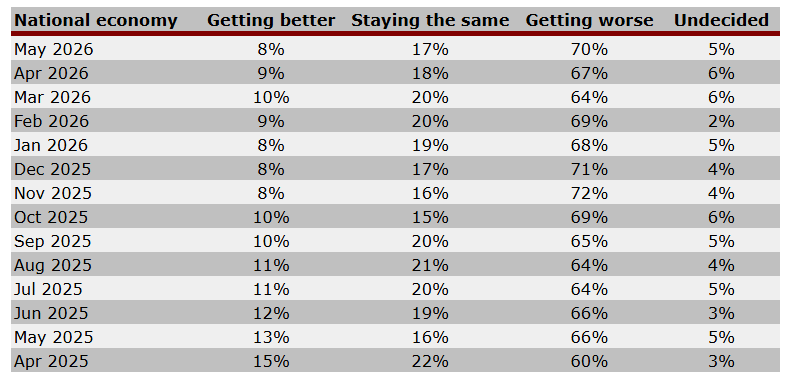
Fresh polling from American Research Group highlights a growing disconnect between official economic talking points and how Americans actually feel about their finances. While Washington debates GDP numbers and stock market gains, voters remain heavily focused on stubborn costs that continue hammering household budgets.
The frustration cuts across everyday life. Food prices remain elevated, housing affordability is brutal in many parts of the country, and basic services—from insurance to utilities—still feel painfully expensive for middle-class families. Even with inflation cooling from earlier peaks, many Americans feel like prices simply locked in at a permanently higher level.
That perception matters politically because voters rarely judge the economy by charts or White House press conferences. They judge it by whether they can comfortably pay bills, afford vacations, or survive a grocery run without feeling financially mugged by a carton of eggs and a pack of ground beef.
The numbers also underscore a broader trust problem. Both parties routinely declare economic victory depending on who occupies the White House, while voters increasingly tune out the spin and rely on their own bank accounts as the final scoreboard.
Presidential approval on the economy has historically been one of the clearest warning lights for incumbents. If consumers stay angry about prices, it won’t matter how many economists insist the fundamentals are “resilient.”
Editor: Americans don’t need an economist to explain inflation—they just need a receipt from Costco.
For a place we’re supposedly told is just “private property” now, authorities seem awfully determined to make sure nobody looks around too closely.
Trespassers Keep Getting Hog-Tied on Epstein Island—and People Are Asking What’s Still Being Hidden
Years after Jeffrey Epstein’s death, his infamous private island is still locked down like a secret military compound, complete with armed confrontations, blindfolds, duct tape, and trespassing arrests.
A bizarre series of incidents on Little Saint James—better known as Jeffrey Epstein’s island—has raised fresh questions about what exactly remains hidden there years after the convicted sex trafficker’s death. According to court filings and interviews obtained by CBS News, multiple trespassers claim they were violently detained by island personnel after attempting to visit the property.
One man, Benjamin Owen, said he was hog-tied, blindfolded, duct-taped, and thrown into what he described as a “dungeon” before police eventually arrived. “I don’t believe I was supposed to leave that island alive,” Owen told CBS News. Another alleged trespasser claimed he was stripped naked during a separate confrontation involving island staff and armed security. Authorities later arrested longtime Epstein associate and former property manager Ann Rodriquez on kidnapping and false imprisonment charges tied to one of the incidents.
The island was purchased in 2023 by billionaire investor Stephen Deckoff through an investment group planning to redevelop the property into a luxury resort. Lawyers for the ownership group describe the trespassers as conspiracy theorists and internet fame seekers. But here’s the obvious problem: Epstein’s island wasn’t just some random celebrity estate. Federal investigations tied it to years of alleged sex trafficking involving powerful people, underage girls, helicopters, private planes, and one of the most protected networks of elites in modern memory.
That’s why this story keeps lingering. The public spent years hearing there were endless files, hidden connections, suspicious deaths, sealed names, and unanswered questions. Yet now, even years later, the island remains heavily guarded while visitors are allegedly getting zip-tied for wandering too close. Fair or not, that only fuels suspicion that authorities and wealthy interests still don’t want people poking around.
Maybe it really is just private security protecting a redevelopment project. But when a property tied to one of the biggest trafficking scandals in American history still operates like a black site years later, people are naturally going to ask: what exactly are they still trying to hide?
Editor: At this point, Epstein Island has less transparency than Fort Knox—and somehow we’re supposed to believe there’s “nothing left to see there.” It’s easier to storm a college campus protest than walk onto Epstein Island with a camera.