



The Morning Sixpack stays free because the news that shapes your life should not be hidden behind a paywall. Paid subscribers are not paying for access. They are helping fund the research, writing, and independent voice that goes into every issue. Become a paid subscriber and help keep smart, honest news analysis free for everyone.
Good morning. Today the bond market sends Washington a bill, Iran proves a threat can be as powerful as an attack, and Mexico’s president finds out what happens when sanctions land on her own side of the table. We also check the world’s shrinking oil cushion, a former CIA official with a basement full of gold, and the billionaire who is aiming his political money at the Senate.
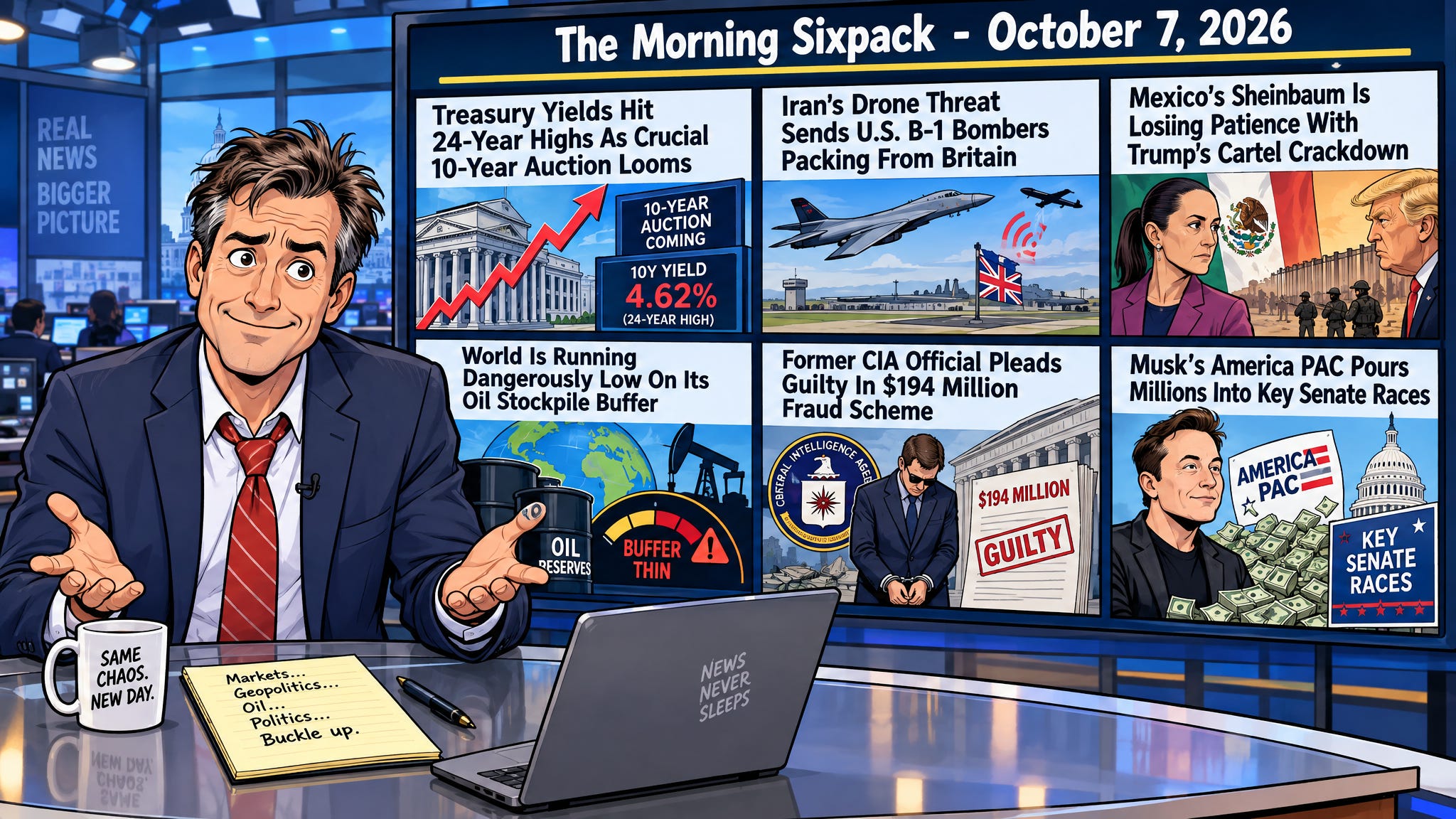
Treasury Yields Hit 24-Year Highs As Crucial 10-Year Auction Looms
U.S. Treasury yields surged Wednesday, with the 10-year yield climbing to 5.35%, its highest level since 2002. The 30-year yield hit 5.724% and the 2-year rose to 4.818%, as investors weigh inflation, rising energy prices, and the government’s growing debt load. The big test comes this afternoon, when Treasury auctions $39 billion in 10-year notes, after a $58 billion 3-year sale Tuesday and ahead of a $22 billion 30-year sale Thursday. The 10-year yield is up about 60 basis points since the end of July while crude has climbed roughly 20%, and France and the U.K. are seeing yields jump too. Add in the New York Fed’s consumer expectations survey and the minutes from the Fed’s September rate hike, and traders have plenty to parse.
Source: CNBC
Iran’s Drone Threat Sends U.S. B-1 Bombers Packing From Britain
The United States quietly pulled a dozen B-1 bombers out of RAF Fairford after intelligence warned Iran might be preparing a swarm-drone attack. The move came just days after Defense Secretary Pete Hegseth said Iran’s military had been “destroyed.” British police searched three cargo vans that approached the base and found only gasoline canisters, and five detained suspects were released on bail. Still, the episode shows how Iran’s drones, proxies, and shipping attacks in the Strait of Hormuz can force Washington to react. Analysts say the move doesn’t meaningfully limit U.S. options, but it adds thousands of miles to any renewed strike and raises questions about base security across Europe.
Source: The Washington Post
Mexico’s Sheinbaum Is Losing Patience With Trump’s Cartel Crackdown
Mexican President Claudia Sheinbaum is taking a harder line as U.S. sanctions and corruption allegations increasingly reach officials tied to her Morena party. After Treasury prepared sanctions on 21 people tied to the Sinaloa cartel, including Carlos Torres, the former husband of Baja California’s governor, Sheinbaum challenged her security officials over freezing the accounts. She ultimately approved the freezes, knowing that refusing would strain relations further. She has also rejected an American request to extradite former Sinaloa Gov. Rubén Rocha, saying Mexico hasn’t seen enough evidence. She is now balancing two difficult goals: showing she’s serious about cartel corruption while resisting any appearance that Washington decides who gets investigated inside Mexico.
Source: The Wall Street Journal
World Is Running Dangerously Low On Its Oil Stockpile Buffer
The global oil market is burning through the inventories it normally relies on to cushion major supply shocks. Saudi Aramco CEO Amin Nasser says fewer than 6 billion barrels remain in commercial inventories, and most of that isn’t practically available. More than 1 billion barrels have already been released since this year’s Middle East crisis began. The International Energy Agency is preparing another 100-million-barrel release, which is roughly one day of global consumption. The U.S. Strategic Petroleum Reserve is at its lowest level since October 1982, and natural gas inventories are depleted too. Executives warn that rebuilding stocks could take years and that a harsh winter could bring a “bloodbath” in gas markets.
Source: Reuters
Former CIA Official Pleads Guilty In $194 Million Fraud Scheme
A former senior CIA official, David J. Rush, pleaded guilty Tuesday to wire fraud in a scheme that cost taxpayers roughly $194 million. Prosecutors say he invented a “highly classified” program to acquire luxury Florida properties he planned to resell, then fabricated a “sensitive government activity” to obtain gold worth more than $40 million. Agents searching his Virginia home found about 300 gold bars, $2 million in cash, and 35 luxury watches. He also admitted giving a foreign official information that identified a secret U.S. source, and he lied about his Navy and college credentials. Rush faces up to 20 years in prison and will be sentenced Jan. 28.
Source: NPR
Musk’s America PAC Pours Millions Into Key Senate Races
Elon Musk’s America PAC has put $21 million of its $26.7 million in 2026 spending into just seven closely watched Senate races. That’s a sharp shift from 2024, when the group spent $261 million, mostly on the presidential race. Now it is focused on helping Republicans hold the Senate, and it is spending far more attacking Democrats than promoting Republicans, including more than $7.6 million against Texas Democrat James Talarico. A Democratic Senate could mean congressional investigations and tougher rules for Musk’s companies. The PAC had just $274,171 in the bank at the end of June but has spent about $31 million since, so its October 15 report should show who paid the difference.
Source: WIRED
That’s your Sixpack for today: a bond market demanding its premium, a threat that moved bombers, a president in a tight spot, an oil cushion wearing thin, a gold-bar fraud, and a billionaire’s targeted bet on the Senate. We’ll see you tomorrow.
Prefer to read The Morning Sixpack? Do that here:


