


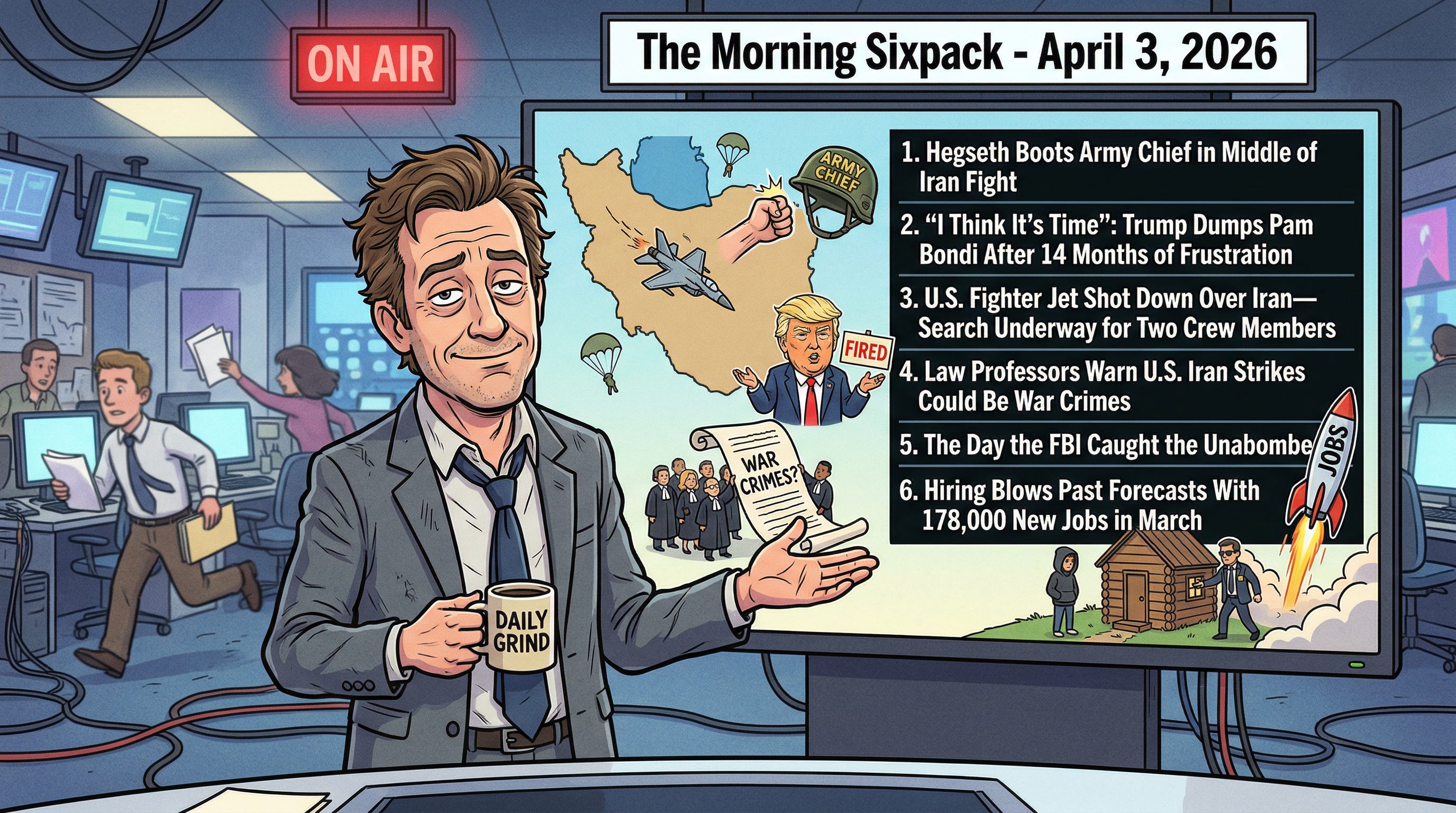
Hegseth Boots Army Chief in Middle of Iran Fight
Defense Secretary Pete Hegseth has forced out Army Chief of Staff Gen. Randy George effective immediately—while U.S. troops are deploying for a possible ground operation in Iran.
Yes, the Pentagon just decapitated the Army’s top leadership during an active war posture.
George, who was expected to serve until 2027, was told to step down and retire on the spot. Two other generals—Gen. David Hodne and Maj. Gen. William Green Jr.—were also removed in the sweep. Pentagon spokesman Sean Parnell called it “effective immediately” and added, “We wish him well in his retirement.”
The move leaves only two remaining members of the Joint Chiefs still in place from when Hegseth took office: Marine Commandant Gen. Eric M. Smith and Space Force chief Gen. B. Chance Saltzman. Since January 2025, Hegseth and the Trump administration have cleared out Gen. Charles Q. Brown Jr., Adm. Lisa Franchetti, Adm. Linda Fagan, Gen. James Slife, and pushed Air Force chief Gen. David Allvin into early retirement. That’s not trimming around the edges—that’s a wholesale rewrite of the brass.
It’s not clear why George was targeted. He had served as Lloyd Austin’s senior military assistant before becoming Army chief in 2023 and was viewed as someone trying to build rapport with the new civilian leadership. Meanwhile, thousands of U.S. soldiers are now in the Middle East as tensions with Iran escalate. Leadership disruptions during wartime aren’t unheard of—but they aren’t routine either.
Behind the scenes, the friction appears personal as well as political. One administration official put it bluntly: “Hegseth can’t fire Driscoll1. So he’s going to make his life hell.” Translation: if you can’t remove the Army secretary, you can make everything around him unstable.
Source: The Washington Post (free)
Editor: Nothing steadies the battlefield like rearranging the generals mid-mission. What could possibly go sideways?
“I Think It’s Time”: Trump Dumps Pam Bondi After 14 Months of Frustration
President Trump fired Attorney General Pam Bondi after months of simmering anger over the Epstein files and unfulfilled promises to prosecute his political enemies.
She learned she was out during a two-mile limousine ride to the Supreme Court.
On Wednesday morning, Bondi smiled beside Trump at the White House and climbed into “The Beast” for what she thought was another routine appearance. Instead, Trump turned to her and said, “I think it’s time,” she later told an associate. Just like that, her 14-month tenure running the Justice Department was effectively over.
The frustrations had been piling up. Trump was angry she couldn’t contain the political fallout from the Jeffrey Epstein files and irritated that cases against figures like James Comey and Letitia James either stalled or collapsed. He had even mused about appointing special counsels to do the job he believed Bondi wasn’t doing fast enough. At one point, he reportedly waved around social media posts criticizing her and called her performance “terrible.”
Bondi tried to appease him—launching probes critics inside DOJ viewed as thin, hanging a banner with Trump’s face on the department’s headquarters, and reopening politically sensitive investigations. It was never enough. The Epstein saga in particular haunted her, especially after she suggested on Fox News that a client list was “sitting on my desk right now to review.” That comment electrified Trump’s base and then boomeranged when no such blockbuster reveal materialized.
Now Trump is floating names like Lee Zeldin and interim Attorney General Todd Blanche, while Bondi heads back to Florida with job offers rolling in. Trump’s farewell was polite by his standards: “Pam Bondi is a Great American Patriot and a loyal friend.” Translation: you’re fired, but we’ll keep it civil.
Source: The Wall Street Journal (free)
Editor: Getting canned in a presidential limo might be a first. At least the ride was smooth—even if the landing wasn’t.
U.S. Fighter Jet Shot Down Over Iran—Search Underway for Two Crew Members
Iranian state media says it shot down a U.S. F-15 fighter jet, and a search-and-rescue mission is now underway for the two crew members.
If confirmed, it would mark the first U.S. jet downed by enemy fire since the war with Iran began.
According to Iranian outlets and a source familiar with the incident, the aircraft was brought down Friday. Iranian state media published images and video that allegedly show wreckage and an ejection seat, suggesting the jet was an F-15.
The U.S. military and the White House have not yet commented. That silence leaves a lot of unanswered questions—where the jet was operating, whether it was on a strike mission, and the condition of the pilots.
The F-15 is a twin-engine, two-seat fighter built for air superiority and deep strike missions. Losing one to enemy fire is not just a tactical setback—it’s a signal that Iranian air defenses may be more capable, or more aggressive, than previously thought.
This is breaking news. If those crew members are on the ground in hostile territory, the clock is ticking.
Source: Axios
Editor: Wars escalate in inches—until they escalate in headlines. A downed jet changes the math fast.
Law Professors Warn U.S. Iran Strikes Could Be War Crimes
More than 100 U.S.-based international law experts say American strikes on Iran—and President Trump’s rhetoric—raise “serious concerns” about potential war crimes.
They’re not just criticizing strategy—they’re questioning legality.
In an open letter published by Just Security, scholars from institutions including Harvard, Yale, Stanford and the University of California warned that recent U.S. actions may violate international humanitarian and human rights law. The signatories pointed to reported strikes on schools, homes and health facilities—including a February 28 attack on an Iranian girls’ school that the Iranian Red Crescent says killed 175 people. The U.S. military has since elevated its investigation after media reports suggested American forces were likely responsible.
The letter also flagged President Trump’s own words. In mid-March, he said the U.S. might strike Iran “just for fun.” This week, he escalated further: “We are going to hit them extremely hard over the next two to three weeks. We are going to bring them back to the Stone Ages, where they belong.” The experts argue such statements, coupled with Pentagon chief Pete Hegseth’s remark about not fighting with “stupid rules of engagement,” deepen concerns about compliance with the laws of war.
The conflict began February 28 when the U.S. and Israel launched attacks on Iran. Tehran responded with strikes on Israel and Gulf states hosting U.S. bases. Since then, joint U.S.-Israeli strikes in Iran and Israeli attacks in Lebanon have killed thousands and displaced millions, according to reporting from Reuters.
This isn’t coming from activists with bullhorns—it’s coming from legal scholars who study armed conflict for a living. Whether their warning changes anything in Washington is another matter.
Source: Reuters
Editor: When law professors start using the phrase “potential war crimes,” that’s not academic chatter. That’s a flashing red light nobody in power seems eager to see.
The Day the FBI Caught the Unabomber
On April 3, 1996, the FBI arrested Theodore Kaczynski at his remote Montana cabin, ending a 17-year manhunt for the “Unabomber.”
It was one of the longest and most expensive investigations in FBI history—and it ended in a one-room shack.
Agents descended on Kaczynski’s isolated property outside Lincoln, Montana, after his manifesto helped investigators zero in on him. The former math professor was accused of mailing bombs that killed three people and injured 23 others from the late 1970s through the mid-1990s. He was later sentenced to life in prison, where he died in 2023.
April 3 has seen its share of history. In 1860, the Pony Express launched from St. Joseph, Missouri, and Sacramento at the same time. In 1882, outlaw Jesse James was shot dead by Robert Ford. In 1948, President Harry S. Truman signed the Marshall Plan to rebuild Europe after World War II.
More recently, April 3 marked Major League Baseball ending its 232-day strike in 1995, Apple releasing the first iPad in 2010, and the explosive release of the Panama Papers in 2016. History doesn’t slow down—it just stacks up.
But the image that sticks? FBI agents pulling a domestic terrorist out of a cabin in the woods after nearly two decades of fear delivered through the mail.
Source: UPI
Editor: The Unabomber wanted to bring down modern society. Instead, he was undone by his own words—and a tip from his brother. Irony has a sense of humor.
Hiring Blows Past Forecasts With 178,000 New Jobs in March
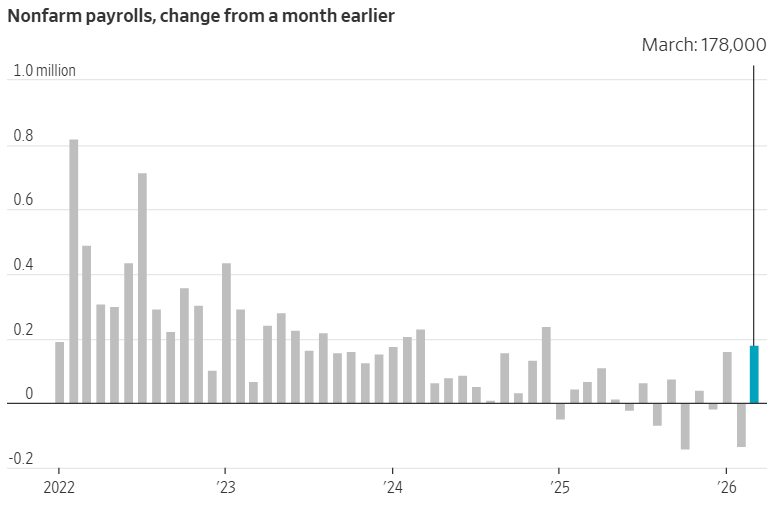
The U.S. economy added 178,000 jobs in March—tripling expectations and snapping back from February’s losses.
Wall Street was bracing for 59,000. Employers delivered three times that.
After a revised loss of 133,000 jobs in February, March came roaring back, according to the Labor Department. Economists surveyed by The Wall Street Journal had expected modest growth. Instead, hiring surged, driven largely by healthcare and social assistance, which alone added about 90,000 jobs.
The unemployment rate dipped to 4.3%. But there’s a catch: the labor force shrank by nearly 400,000 people. Fewer people working or looking for work means fewer counted as unemployed. The labor-force participation rate slid to 61.9%, its lowest level since fall 2021. As Henry McVey of KKR put it, “We should all be rooting for a higher participation rate.”
Other bright spots included leisure and hospitality (+44,000), construction (+26,000), and manufacturing (+15,000). One weak link: the federal government, which shed 18,000 jobs. Over the past six months, the economy has averaged just 15,000 new jobs per month—a sharp slowdown from last year’s pace.
Here’s the bigger twist: thanks in part to tighter immigration policies, the economy now needs fewer new jobs to keep unemployment steady. The so-called “break-even” rate has fallen. That’s one reason the jobless rate has held in the low 4% range even as hiring cooled.
In other words, the labor market isn’t booming—but it’s not buckling either. It’s hanging in.
Source: The Wall Street Journal (free)
Editor: When expectations are low, beating them feels like a parade. But let’s not pretend 178,000 jobs fixes a shrinking workforce. The math still matters.
Let’s also not forget that the department in charge of these stats is not the most reliable source any more.