


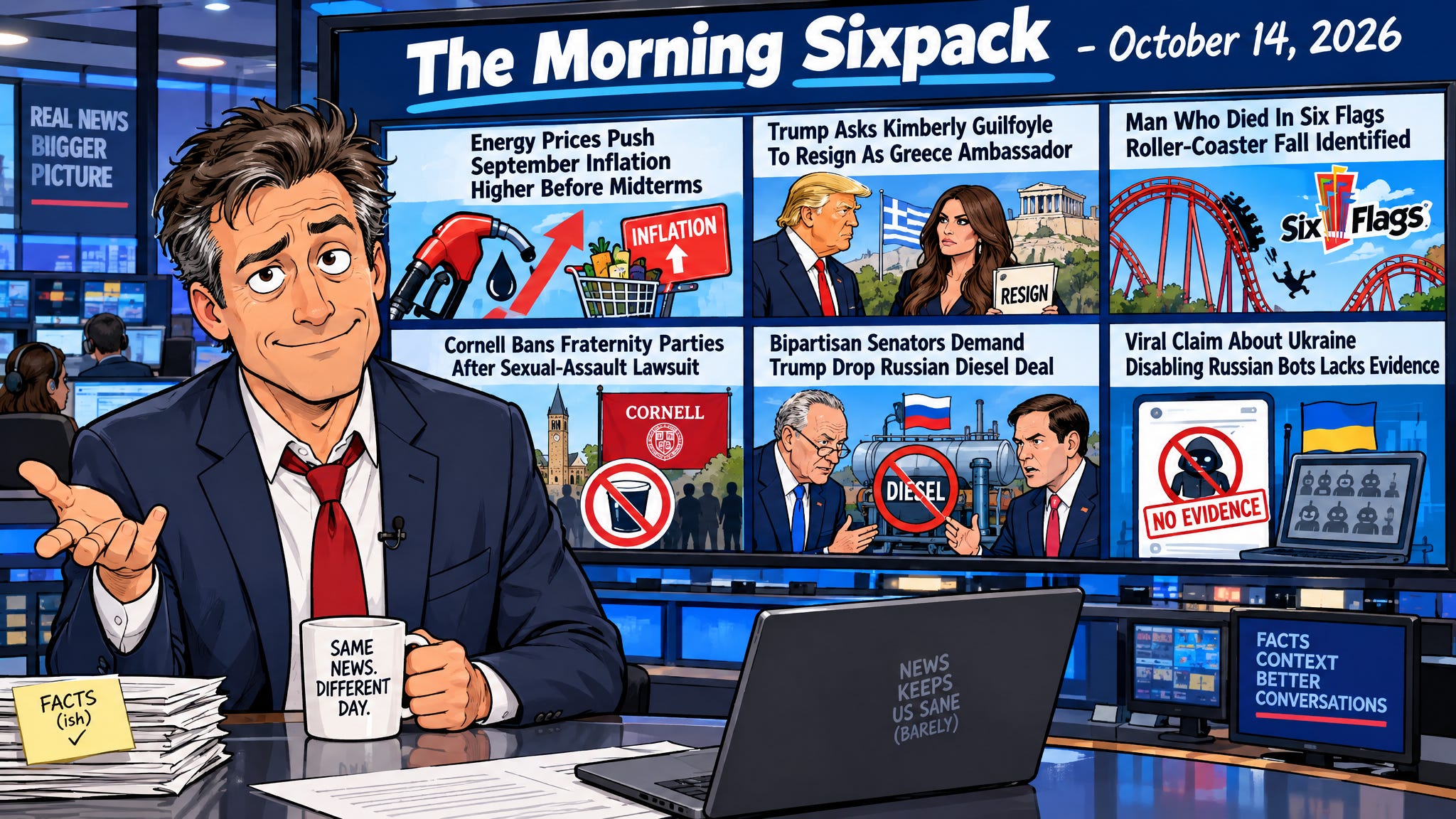
The Morning Sixpack stays free because the news that shapes your life should not be hidden behind a paywall. Paid subscribers are not paying for access. They are helping fund the research, writing, and independent voice that goes into every issue. Become a paid subscriber and help keep smart, honest news analysis free for everyone.
September’s inflation report was powered by energy costs, giving voters another reminder that the price at the pump has a way of showing up everywhere.
Energy Prices Push September Inflation Higher Before Midterms
Inflation reached a 3.7 percent annual rate in September, extending this year’s climb as energy prices surged. The Labor Department’s report, released Wednesday, came in hotter than expected and was the final inflation reading before the midterm elections. Gasoline prices jumped 9.1 percent from August and accounted for more than half of the monthly increase. Core inflation, which excludes food and energy, was 2.6 percent.
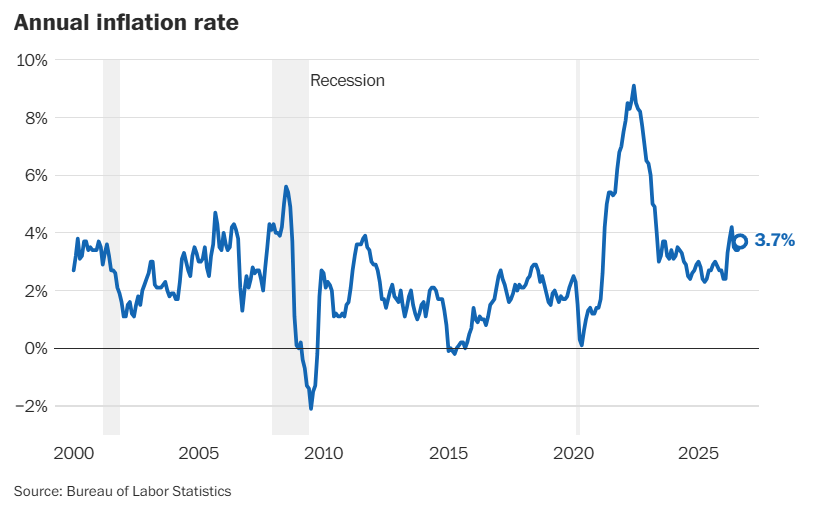
Energy prices have become a political headache for Republicans as affordability remains a central concern for voters. President Donald Trump campaigned on bringing prices down, but gas costs have risen sharply since U.S. and Israeli strikes on Iran. A Financial Times/Focaldata poll released this week found that about 25 percent of registered voters approved of Trump’s handling of the economy. The administration has considered measures including a diesel export ban and sending checks to millions of Americans, but those efforts face obstacles.
Energy prices overall were up more than 20 percent from a year earlier, while fuel oil—a heating source for some households—rose 74 percent. Average gasoline prices topped $4.30 a gallon this week, and diesel remained above $6.20, near a record high, according to AAA. Diesel costs can ripple into prices for food and other goods because it powers farm equipment and refrigerated trucks. “That gets into the price of almost everything else,” said Diane Swonk, chief economist at KPMG.
The report also showed increases in used-car prices, clothing, and airline fares, signs that higher energy costs are affecting other parts of the economy. Inflation has remained above the Federal Reserve’s 2 percent target for more than five years, squeezing household budgets. At the same time, low unemployment and steady employment have helped support spending, which accounts for about two-thirds of U.S. economic output. Some households are drawing down savings or relying more on credit cards to maintain that spending.
The disconnect between continued economic growth and how people feel about their finances has become a campaign issue. Democrats are spending heavily on ads focused on the economy, while wages have struggled to keep pace with prices. The Federal Reserve raised interest rates at its September meeting, and experts expect it may need to raise them again. “Inflation hits 100 percent of households,” Swonk said. “Everybody sees the price of gas.”
Editor: When diesel costs climb, even the groceries get dragged into the campaign—along with the bill.
Source: The Washington Post
Kimberly Guilfoyle’s diplomatic exit followed a string of damaging reports—and an increasingly frantic effort to convince Washington that the texts were fake.
Trump Asks Kimberly Guilfoyle To Resign As Greece Ambassador
President Trump asked Kimberly Guilfoyle to resign as U.S. ambassador to Greece after a series of reports raised questions about her conduct and private interests. The Wall Street Journal reported that Guilfoyle had promoted a Greek construction company while working closely with its top lobbyist, sought $100,000 from a Trump donor before her confirmation hearing, and accepted private-jet travel and luxury hotel hospitality from a shipping magnate. Guilfoyle told White House officials that the donor’s text messages were AI-generated; the officials did not believe her, and the Journal said it verified the messages.
Guilfoyle spent her final days trying to rally support as the stories mounted. People familiar with the matter said she called administration officials and Trump allies, sometimes in the early hours in Athens, and sought help lobbying the White House. She also suspected embassy staff and her security team of leaking information. On Tuesday, the White House announced that Trump had asked her to resign.
The reports put Guilfoyle’s work promoting U.S. natural gas exports under scrutiny. She had helped secure statements of intent from several Balkan and Eastern European countries to buy American gas, particularly through Greek company Aktor and a joint venture with a government-backed energy firm. Albania says it is awaiting a feasibility study, Ukraine’s state energy company says negotiations have ended, and Romania’s state gas company says its memorandum has expired. Aktor’s lawyers say a 20-year agreement with Albania is binding and that talks with Ukraine and Romania may continue.
The controversy also complicated Secretary of State Marco Rubio’s visit to Athens, where he was scheduled to deliver a major speech at the Acropolis. Rubio had recently called Guilfoyle an “incredibly effective advocate” for Trump’s agenda, but his team was blindsided by the latest revelations, according to senior administration officials. In Greece, opposition politicians called for answers about whether she used her position to advance private business interests and sought more transparency around energy and defense agreements.
Guilfoyle announced her resignation on social media, expressing gratitude to Trump and Greece while calling the allegations false. Trump, who had praised her as a longtime friend at a White House event in March, later distanced himself, telling reporters she “wasn’t a member of my family” and had “dated my son a long time ago.” The Journal reported that aides worried the headlines would reinforce concerns about self-dealing weeks before the midterm elections.
Editor: That’s one way to turn a gas-export mission into a diplomatic fire drill.
Source: The Wall Street Journal
A fatal fall from Six Flags’ Goliath is under investigation, and witnesses say the moments unfolded in seconds.
Man Who Died In Six Flags Roller-Coaster Fall Identified
Police identified the man who died Monday after falling from the Goliath roller coaster at Six Flags Over Georgia as 42-year-old Atlanta resident Hassan Jihad Ibn Kariem. Witnesses and employees told investigators that Kariem was ejected from the ride, struck other patrons, and fell beneath the attraction, according to the Cobb County Police Department. Officers found him unresponsive and not breathing when they arrived around 4 p.m. His cause of death has not been disclosed, and officials have not said how many people were injured.
Witnesses described a sudden, frightening fall as the coaster moved beneath them. “It felt like slow-motion, but it happened in an instant,” Nick Mendenhall, who had just ridden with his son, told the Associated Press. Another witness told WXIA Atlanta that Kariem hit the coaster car three times. A rider quoted by NBC News said Kariem was “levitating in the air sideways,” adding, “We made direct eye contact with him.”
Kariem was the information technology manager at Wesley International Academy, where he had also worked as a technology teacher and robotics coach. The school praised his dedication to students and the community, saying he was deeply loved and respected. Atlanta Public Schools also called him a cherished member of the school community and offered condolences to his family. Six Flags and Goliath’s manufacturer, Bolliger & Mabillard, expressed sympathy to Kariem’s loved ones.
The police department’s Major Crimes Unit, Georgia’s Office of the Commissioner of Insurance and Safety Fire, and the coaster’s manufacturer are investigating. Six Flags said it is cooperating and temporarily closed nine other rides across six North American parks “out of an abundance of caution.” Goliath, which opened in 2006, reaches 200 feet and a top speed of 70 mph, according to the park.
Serious injuries on fixed-site amusement rides are rare, according to the International Association of Amusement Parks and Attractions, which estimates the chance of serious injury at one in 15.5 million rides. But fixed-site parks in the United States have no federal safety oversight, and no single agency tracks accidents, injuries, or deaths. The federal Consumer Product Safety Commission does regulate mobile carnival and amusement rides.
Editor: The ride’s statistics can wait. First, investigators need to establish how a passenger came out of the car.
Source: Yahoo News
Cornell is canceling fraternity-house parties for the rest of the academic year after a lawsuit alleged a 2024 sexual assault—two years late, but hardly a small campus issue.
Cornell Bans Fraternity Parties After Sexual-Assault Lawsuit
Cornell University is banning parties at fraternity houses for the remainder of the academic year as it faces scrutiny over its response to an alleged sexual assault in 2024. Last month, a woman identified in a lawsuit as Jane Doe alleged that several men drugged and raped her at a party in a Cornell fraternity house. The allegations have not been established in court.
Cornell President Michael Kotlikoff announced the ban and other measures Tuesday, apologizing to Jane Doe and condemning the alleged assault. “It is clear that women on our campus continue to question whether they are safe,” he said, adding that the university must acknowledge where it fell short and take meaningful action.
Cornell’s Faculty Senate is scheduled to debate Wednesday whether it has confidence in university leaders’ ability to address the crisis. A vote is expected later. Even if a majority votes no confidence, the gesture would be largely symbolic.
Editor: A party ban is immediate. Rebuilding trust after a reported assault—and questions about the university’s response—will take more than one semester.
Source: BBC News
Six senators say Trump’s Russian-diesel plan could break the law and bankroll Putin—while energy experts doubt it will do much for prices at the pump.
Bipartisan Senators Demand Trump Drop Russian Diesel Deal
Six senators from both parties are urging President Trump to abandon his plan to buy diesel from Russia. In a statement Sunday, they said the administration had not consulted Congress or provided the explanation required by law. “The United States should not provide Putin with a financial lifeline while Russia continues to kill Ukrainian civilians,” they wrote.
Trump announced the plan Friday after a call with Russian President Vladimir Putin, describing a series of diesel deliveries totaling millions of tons. He said Russia would immediately supply more than 300,000 tons to the U.S. and global market, with additional shipments planned for November and afterward. The announcement came weeks after Congress passed legislation directing tariffs on major importers of Russian oil or natural gas.
Republican senators Susan Collins, Lisa Murkowski, Thom Tillis, and John Curtis signed the statement, along with Democrats Jeanne Shaheen and Richard Blumenthal. Tillis said there was a legitimate argument that proceeding could violate the law. Congress banned Russian energy imports in 2022, the senators noted, to prevent U.S. purchases from helping fund Russia’s war against Ukraine.
Other Republicans defended Trump’s focus on energy costs. Senator John Barrasso said the president was balancing difficult decisions and described the deal as potential leverage against Putin. He also urged Trump to enforce the sanctions legislation Congress passed last month.
Energy experts say the diesel shipments are unlikely to noticeably lower U.S. fuel prices. Richard Nephew of Columbia University said the announced volume appears smaller than what the country uses in a single day, and argued Russia and Iran may benefit more than American consumers. Trump has blamed high U.S. diesel prices on Ukraine, while the article attributes elevated global energy prices to the U.S.-led war in Iran.
Editor: A deal that may barely move the pump price but pokes a hole in sanctions is a curious way to sell “America First.”
Source: AP News
The claim that Ukraine’s strike on Yandex silenced Russian political bots spread fast—but the evidence mostly points to disrupted web crawlers, not suddenly vanishing trolls.
Viral Claim About Ukraine Disabling Russian Bots Lacks Evidence
Ukrainian President Volodymyr Zelenskyy said a strike on Russian tech company Yandex’s data centers reduced bot activity online, but researchers say there is no solid evidence that Russian political influence accounts went quiet. Zelenskyy made the claim Monday at the Warsaw Security Forum, describing less hate and fewer provocations on social media. It quickly fueled claims that pro-MAGA, AfD, and Reform UK accounts had dropped off after the attack.
The apparent drop in online activity was tied to web crawlers, which automatically browse and index websites—not necessarily political bots. Cloudflare data showed reduced traffic from Yandex servers after the strike, consistent with disruption to the company’s crawlers and search index requests. Researchers note that “bot” can mean either these automated tools or fake accounts and online trolls, a distinction that blurred as the story spread.
Researchers tracking Russian disinformation said they had not seen evidence of a dramatic decline in Kremlin-aligned accounts. Antibot4Navalny reported that the Matroyshka disinformation network remained active after the strikes. The group Vatnik Soup said people had reported seeing fewer pro-Kremlin posts, but cautioned that the change could be coincidence and had not been demonstrated with solid data.
A separate review of 76 AfD politicians and 136 MAGA accounts found ordinary fluctuations in posting after the strikes, according to social media adviser Valdemar Osted. AfD activity ranged from 8 percent below to 5 percent above normal, while MAGA activity was 4 to 10 percent higher. Those results do not support claims of a sweeping bot shutdown.
Researchers say the episode shows how easily “bot” becomes a catchall label for unwanted or suspicious activity online. A 2023 study found that participants tended to overestimate how common bots were and how vulnerable other people were to them. The viral story was appealing because it offered a clear victory over suspected manipulation—but the article’s cited evidence does not establish that Ukraine’s strike silenced political bot networks.
Editor: A disrupted search crawler makes a lousy receipt for a victory over political disinformation.
Source: Mother Jones
Take a look at the Morning Sixpack Archive: