


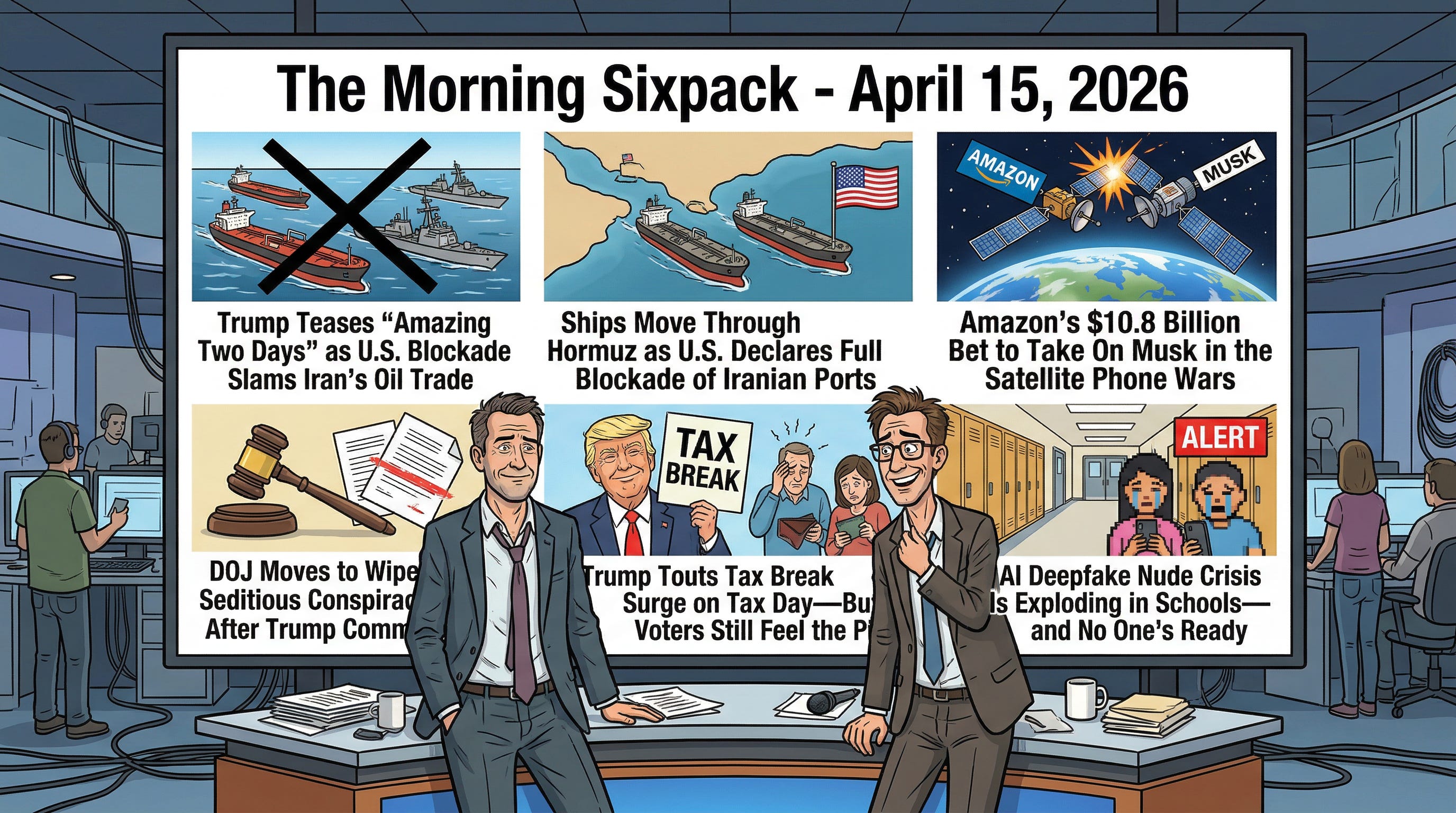
Trump Teases “Amazing Two Days” as U.S. Blockade Slams Iran’s Oil Trade
President Donald Trump says the war with Iran could end “very soon”—even as U.S. forces turn back tankers and choke off Tehran’s maritime trade.
You don’t promise “amazing” diplomacy while your Navy is physically stopping ships unless you think you’ve got leverage—or you’re betting big.
Speaking to ABC and later on Fox Business, Trump said, “I think you’re going to be watching an amazing two days ahead,” adding, “I think it can be over very soon. It will end soon.” The comments come as U.S. and Iranian officials eye a return to talks in Islamabad after weekend negotiations in Pakistan collapsed without a deal. Vice President JD Vance, who led the U.S. delegation, said he felt positive about the trajectory—even with deep mistrust hanging over the room.
But here’s the twist: while Trump talks grand bargains, the Pentagon is enforcing a maritime blockade that has halted seaborne trade in and out of Iran. Eight Iran-linked oil tankers have reportedly been intercepted since Monday. A U.S. destroyer stopped two vessels leaving Chabahar. A sanctioned Chinese-owned tanker was seen reversing course in the Strait of Hormuz. Oil, after dipping, climbed back toward $96 a barrel as markets digested the squeeze.
The nuclear standoff remains the core sticking point. Washington floated a 20-year suspension of Iran’s nuclear activity; Tehran countered with three to five years. The U.S. also wants enriched material removed from Iran entirely. Tehran wants sanctions relief. Meanwhile, the International Atomic Energy Agency chief suggested the length of any moratorium is ultimately a political call—translation: this is about trust, not centrifuges.
And as diplomats shuffle paper, the war grinds on. Roughly 5,000 people have been killed since the conflict erupted in late February, including thousands in Iran and Lebanon. Iran is threatening to disrupt trade flows in the Gulf and Red Sea if the blockade continues. Israel’s parallel campaign against Hezbollah muddies the ceasefire waters. Markets are hopeful. The region is not.
Source: Reuters
Editor: When your peace plan starts with cutting off someone’s oil exports, you’re either closing a deal—or opening another front. Stay tuned.
Next up, MORE on the US blockade that may not be working like President Dumbass is telling you.
Ships Move Through Hormuz as U.S. Declares Full Blockade of Iranian Ports
More than 20 commercial vessels transited the Strait of Hormuz in 24 hours—even as U.S. Central Command says its blockade of Iranian ports is now fully implemented.
Washington is squeezing Tehran at the docks while reopening the world’s most vital oil artery.
Cargo ships, container vessels and tankers are again slipping through the narrow waterway connecting the Persian Gulf to global markets. Traffic remains a fraction of prewar levels, but it’s an improvement in a chokepoint that moves a huge share of the world’s crude. Some ships are reportedly sailing with transponders off to reduce the risk of Iranian targeting.
U.S. Central Command says American forces are maintaining maritime superiority in the Middle East. Eight oil tankers have obeyed U.S. direction to reverse course, according to a U.S. official. No interdictions have been reported—and enforcement is unlikely inside the Persian Gulf itself. The blockade applies to Iranian ports. If you’re not docking in Iran, you can pass.
Diplomacy, meanwhile, refuses to die. U.N. Secretary General António Guterres says U.S.-Iran talks are likely to resume. Pakistan’s prime minister—acting as a key mediator—is heading into meetings across Saudi Arabia, Qatar and Turkey. President Trump told the New York Post that something “could be happening over the next two days.” He also said he wrote to Chinese leader Xi Jinping urging him not to arm Iran, and that Xi replied Beijing wasn’t doing so.
One more twist: a Chinese-owned, U.S.-sanctioned tanker that had exited the Strait of Hormuz before turning back has now returned to the Persian Gulf. The message is clear—Washington controls the pressure valve, but it’s deciding how tight to turn it.
Source: The Wall Street Journal
Editor: This is brinkmanship with binoculars—every tanker tracked, every headline parsed, every “two days” stretched to the limit.
Keep an eye on the markets. Stocks could climb sky-high. Or sink like a Mob-hit dead body.
Amazon’s $10.8 Billion Bet to Take on Musk in the Satellite Wars
Amazon is buying Globalstar in a roughly $10.8 billion deal to supercharge its push into satellite-to-cellphone service.
Jeff Bezos just aimed directly at Elon Musk’s Starlink—and this time it’s about your iPhone signal.
The deal hands Amazon control of Globalstar’s satellites, infrastructure, and—most critically—its spectrum rights, the wireless real estate needed to beam signals straight to smartphones. Amazon plans to roll out its own direct-to-device satellite service starting in 2028, pending regulatory approval. Its Project Kuiper unit, also called “Leo,” already has more than 200 satellites in orbit and approval for more than 7,000 broadband birds.
Globalstar isn’t some fringe player. It’s the satellite backbone behind Apple’s emergency texting and roadside assistance features on iPhones. Now Amazon says it has struck a deal with Apple to power satellite services for iPhone and Apple Watch—and to collaborate on future offerings using its growing network. Translation: Bezos isn’t just chasing Musk in space. He’s going after the device in your pocket.
The competitive backdrop is brutal. SpaceX’s Starlink has around 10,000 operational satellites and more than 650 dedicated to connecting cellphones, with over 12 million users tied into its network. SpaceX has leveraged its Falcon 9 rocket fleet to dominate launches, while Amazon has been writing big checks to United Launch Alliance, Blue Origin—and yes, even SpaceX—to get its satellites up.
Globalstar shareholders can take $90 a share in cash or Amazon stock capped at that value. The deal is expected to close in 2027, and its final price will float with Amazon’s share price. In short, Bezos is spending real money to buy spectrum, speed, and relevance in the next phase of the wireless wars.
Source: The Wall Street Journal (gift)
Editor: When billionaires start buying satellite companies to control your “No Service” moments, it’s not about coverage—it’s about control. Buckle up.
Don’t forget, or downplay, the military implications of all these “ears & eyes in space.”
DOJ Moves to Wipe Jan. 6 Seditious Conspiracy Convictions After Trump Commutations
The Justice Department has asked a federal appeals court to throw out the seditious conspiracy convictions of 12 January 6 defendants whose prison sentences were already commuted by President Trump.
This isn’t about getting them out of jail—they’re already out—it’s about scrubbing the record clean.
After issuing more than 1,000 pardons tied to the January 6, 2021 Capitol riot, Trump chose a different path for a dozen members of the Proud Boys and Oath Keepers: commutations. That move freed them from prison but left their felony convictions intact. Now the DOJ is stepping in to ask the court to toss those convictions entirely.
“The United States has determined in its prosecutorial discretion that dismissal of this criminal case is in the interests of justice,” the U.S. Attorney’s Office in Washington, D.C., said in a Tuesday filing. If the appeals court agrees, the convictions for seditious conspiracy—one of the most serious charges brought after the riot—would effectively vanish.
Among those affected is Stewart Rhodes, founder of the Oath Keepers, whose sentence had been commuted earlier. The broader backdrop is Trump’s campaign pledge to free those charged or convicted in connection with the riot, when protesters stormed the Capitol in an effort to block certification of his 2020 election loss to Joe Biden. On his first day back in office, Trump granted pardons or commutations to more than 1,500 individuals.
If the court signs off, this would mark more than a legal maneuver—it would be a symbolic capstone to Trump’s effort to reframe January 6 in his second term. Supporters call it justice corrected. Critics will call it rewriting history.
Source: BBC News
Editor: First the pardons, then the commutations, now the erase button. Washington doesn’t do small gestures—it does seismic ones.
The Justice Department is now asking a court to erase the seditious conspiracy convictions of 12 January 6 defendants—after Trump already commuted their sentences.
REMINDER: It’s “Tax Day”
More than 53 million taxpayers claimed new Trump-era breaks this filing season, according to Treasury figures released on Tax Day.
The administration is calling it a win—while 7 in 10 Americans still say their taxes are too high.
With the April 15 deadline here, Treasury officials say 6 million filers claimed the “no tax on tips” provision, 21 million used the overtime deduction and roughly 30 million seniors took the enhanced deduction under Republicans’ sweeping tax-and-spending law. The official, speaking anonymously ahead of the deadline, framed the 2026 filing season as a success story.
The White House initially promised that average refunds would jump by at least $1,000. So far, the IRS reports the average refund at $3,462—up 11% from last year’s $3,116, a roughly $350 bump. Treasury has since shifted its messaging, highlighting that refunds are up 24% compared to the four-year average before President Donald Trump took office.
Politics, of course, hangs over all of it. The administration is pushing the tax cuts hard ahead of November’s midterms, hoping pocketbook issues translate into votes. But that message has been competing with rising gas prices tied to the Iran war—an economic reality voters see every time they fill up.
Behind the scenes, the IRS has trimmed its workforce by 27% over the past year amid changes driven by the Department of Government Efficiency. IRS CEO Frank Bisignano is set to testify before the Senate Finance Committee, where he’s expected to defend implementation of the tax law. Democrats, meanwhile, are pressing the agency over disclosures of confidential taxpayer data to Immigration and Customs Enforcement under a DHS information-sharing agreement.
Source: Associated Press
Editor: If you need a spreadsheet to prove you got a tax cut, voters might not feel like they got one. And feelings—especially in an election year—count.
AI Deepfake Nude Crisis Is Exploding in Schools—and No One’s Ready
Nearly 90 schools and more than 600 students worldwide have already been caught up in a surge of AI-generated deepfake nude images.
This isn’t some fringe internet problem—it’s happening in classrooms, hallways and group chats right now.
The pattern is disturbingly simple: photos pulled from Instagram or Snapchat, run through so-called “nudify” apps, then blasted across schools in minutes. The victims—mostly girls—are left dealing with humiliation, fear and the near certainty that the images could resurface indefinitely. One victim put it bluntly: “I’m worried that every time they see me, they see those photos.”
The scale is already staggering—and likely undercounted. Cases have been reported across at least 28 countries since 2023, with incidents spanning North and South America, Europe, Asia and Australia. Some schools have seen dozens of victims at once. One estimate from UNICEF suggests 1.2 million children may have been targeted by sexual deepfakes in just the past year.
What’s driving it isn’t just technology—it’s accessibility. Dozens of apps and websites now let anyone generate fake explicit images in seconds with little skill. Experts say the motivations range from curiosity and peer pressure to revenge and outright harassment. “The goal is not always sexual gratification…it’s humiliation, denigration, and social control,” one researcher noted.
And here’s the uncomfortable truth: schools and law enforcement are behind the curve. Responses vary wildly—some cases lead to criminal charges, others barely get addressed. In some instances, victims have been the ones forced out of school while perpetrators face minimal consequences. Meanwhile, students themselves are organizing protests, pushing for policy changes and forcing platforms to act faster on takedowns.
The bottom line—this isn’t slowing down. As AI tools get better and easier to use, the barrier to entry keeps dropping. And the people dealing with the fallout are kids, parents and teachers who were never prepared for this kind of digital weaponization.
Source: WIRED
Editor: We handed people industrial-strength AI tools and acted surprised when they used them like teenagers. The tech isn’t slowing down… and it’s only going to get worse, unless Congress acts. And we know they won’t.