

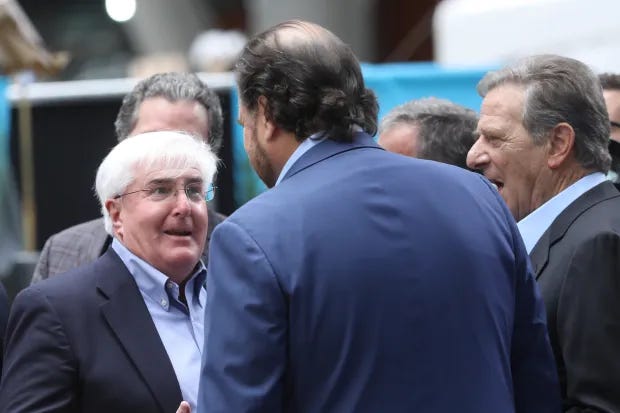
Bold move, Ron Conway. After decades of running in the same elite circles, one of Silicon Valley’s earliest kingmakers just threw up his hands and walked away from Marc Benioff—and not quietly, either. Conway’s resignation from the Salesforce Foundation wasn’t a career move; it was a moral one. You don’t torch a 25-year friendship over “a difference of opinion.” You do it when your buddy starts sounding like a Fox News panelist with a philanthropy arm.
For anyone who’s forgotten, Ron Conway is venture capital royalty. He backed Google, Airbnb, and Meta before they became verbs, nouns, and dystopian metaverses. Benioff, meanwhile, built Salesforce into a cloud-powered empire and crowned himself San Francisco’s benevolent tech messiah—part CEO, part spiritual guru, part guy-who-buys-Time-magazine-for-fun. For years, these two shared champagne at fundraisers for progressive causes.
Breaking Bad…
The Salesforce CEO told The New York Times that he “fully supports” President Trump and wants to deploy the National Guard to San Francisco to deal with homelessness and crime. “The city needs a show of force,” he said, as if the problem were a bad Yelp review away from being solved with bayonets. Benioff also praised Elon Musk’s “efficiency” in government—a phrase that should immediately void your tech ethics warranty.
Conway, who’s sat on the Salesforce Foundation board for ten years, didn’t take the comments lightly. His email to Benioff—obtained by the Times—read like a breakup letter wrapped in heartbreak and disappointment: “It saddens me immensely to say that with your recent comments, and failure to understand their impact, I now barely recognize the person I have so long admired.”
Translation: You’re not the visionary I thought you were; you’re the guy tweeting about law and order from a private jet.
Let’s not forget what the Salesforce Foundation stands for—education and workforce development for disadvantaged youth. They donated $36 million last year alone and have $400 million in assets. The idea of that same foundation’s leader endorsing military patrols in low-income neighborhoods isn’t just tone-deaf—it’s malpractice.
Conway couldn’t square that circle, so he stepped out of it.
A Salesforce spokesperson responded with the usual PR spin about gratitude and contributions, but the damage was already done. This wasn’t just a board resignation; it was an ideological split in Silicon Valley’s upper crust. When one of the Valley’s most respected angel investors ghosts you in public, it’s not “amicable.” It’s a warning shot to every tech exec drifting rightward under the banner of “common sense.”
Benioff isn’t alone in this political pivot. A growing crowd of once-blue venture capitalists and startup founders are now sidling up to Trump 2.0, citing “business pragmatism” as if tax cuts and deregulation were a moral compass.
What’s really happening is a full-scale identity crisis in tech: the same people who used to write op-eds about “making the world a better place” are now fine with strongmen, censorship, and troops on Market Street—as long as their stock options stay in the green.
The irony is brutal. Salesforce’s annual Dreamforce conference—supposedly about innovation and progress—was the backdrop for this ideological meltdown. While Benioff was praising Trump’s “show of force,” his own show of unity was collapsing from within. Conway’s exit stripped away the last fig leaf of Benioff’s moral branding.
And here’s the kicker: Benioff still owns Time. The man who claimed ignorance of “Trump’s attacks on the press” literally owns one. You couldn’t make that up if you tried.
Source: TechCrunch
Nothing like a billionaire enlightenment guru rediscovering his inner mall cop. Guess money really can buy everything—except self-awareness.