


China’s latest space ambitions are no longer centered solely on rockets, astronauts, or even tourists. Instead, Beijing is aiming much higher — and far quieter. Its new priority is to move the engines of artificial intelligence off the planet entirely, building vast space-based data centers that could redefine how and where AI is powered.
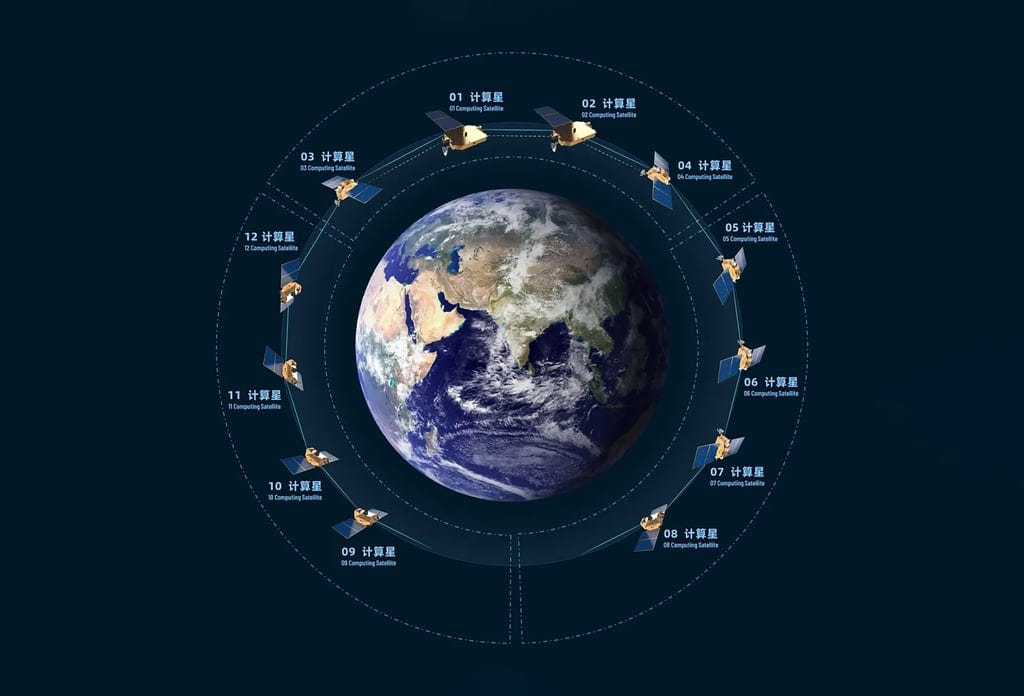
At the center of this vision is a simple but radical idea: put computation in orbit.
Chinese state planners and aerospace executives say future satellites will do far more than observe Earth or relay signals. They will process massive volumes of data in space, powered by continuous solar energy, unburdened by Earth’s land, water, and energy constraints. The result would be orbital computing platforms capable of supporting AI workloads at unprecedented scale.
According to plans outlined by the China Aerospace Science and Technology Corporation, these orbital systems would function as spaceborne intelligence hubs — collecting, storing, and analyzing data without sending it back to Earth. That approach could dramatically reduce latency, energy consumption, and dependence on terrestrial infrastructure.
(Technical note: Decisions will be sent to Earth. The data will remain onboard the hubs. It’s brilliant. Another entity—i.e., the United States—will have immense difficulty getting AT the data.)
Why Space Is Becoming the New Home for AI
The logic is increasingly compelling:
Unlimited solar power: Satellites can harvest constant sunlight, eliminating the enormous electricity demands that strain Earth-based AI data centers.
Cooling advantages: The cold vacuum of space offers natural thermal management, one of the biggest challenges for high-density computing on Earth.
Strategic autonomy: Processing data in orbit reduces reliance on undersea cables, foreign cloud providers, and vulnerable ground facilities.
Scale without borders: Space removes geographic and regulatory constraints that limit where data centers can be built.
Chinese researchers have described this model as a way to support future applications ranging from real-time Earth observation AI to autonomous satellite networks, and eventually even deep-space exploration systems that can think and adapt without waiting for instructions from Earth.
A Quiet Counter to U.S. Tech Dominance
While China rarely frames the initiative in confrontational terms, the geopolitical subtext is clear. The United States currently dominates global cloud computing and AI infrastructure, with companies like SpaceX already operating massive satellite constellations.
By moving AI infrastructure into orbit — and keeping it under state-aligned control — China could sidestep traditional chokepoints in global computing and data flows. Analysts see this as a long-term play for technological sovereignty, one that blends civilian innovation with strategic resilience.
Not Just Science Fiction
Although the concept sounds futuristic, Chinese officials describe it as an incremental evolution. Early versions would involve smaller orbital computing platforms, gradually expanding into interconnected networks of satellites capable of handling complex AI workloads.
Space tourism and deep-space missions may capture headlines, but inside China’s space program, AI infrastructure is becoming the real prize — invisible to most people on Earth, yet potentially transformative for how intelligence, data, and power are distributed in the decades ahead.
In this new space race, the ultimate frontier may not be the Moon or Mars — but the cloud itself, lifted into orbit.