


The Morning Sixpack stays free because the news that shapes your life should not be hidden behind a paywall. Paid subscribers are not paying for access. They are helping fund the research, writing, and independent voice that goes into every issue. Become a paid subscriber and help keep smart, honest news analysis free for everyone.
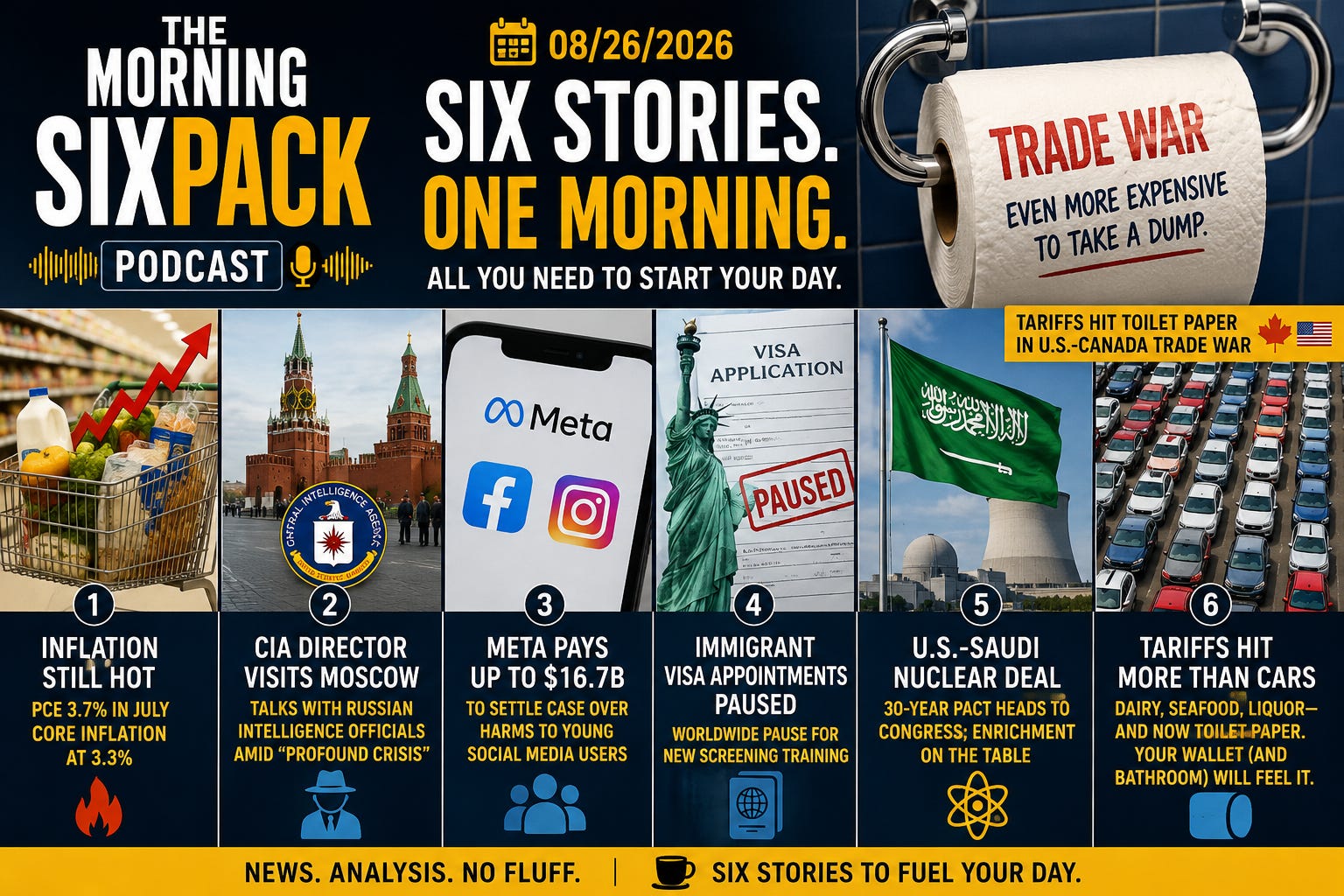
July inflation came in hotter than the Fed would like, leaving policymakers with a 3.7% headline rate, 3.3% core inflation and precious little room for a victory lap.
Fed’s Favorite Inflation Gauge Is Still Running Hot—and Rate Relief Can Wait
The Federal Reserve’s preferred inflation gauge rose 0.2% in July, pushing the annual PCE inflation rate to 3.7%, a tenth of a point hotter than economists expected. The core measure, which strips out food and energy and matters more for the Fed’s longer-term thinking, climbed 0.2% for the month and 3.3% from a year ago.
Inflation may be moving slowly, but at 3.7%, it’s still nowhere near the Fed’s 2% finish line.
There were some friendlier numbers underneath the hood. Goods prices slipped 0.1%, helped by a 2.7% drop in gasoline and other energy goods and a 0.9% decline in furnishings and durable household equipment. Services were the problem child again, rising 0.3%, including a 1.2% jump in financial services and insurance and a 0.3% increase in housing. Personal income rose 0.4% while consumer spending increased 0.2%, both beating expectations.
Markets got the message. Stock futures pulled back after the report while Treasury yields moved higher, with both the 10- and 30-year yields recently reaching levels not seen since 2007. Investors are juggling persistent inflation, federal debt, and deficit concerns, and questions about how committed the Fed will remain to getting inflation all the way back to 2%. So far, so bad.
Treasury Secretary Scott Bessent has announced stepped-up government debt buybacks, although traders aren’t exactly lining up to declare that problem solved. His $4 Billion buyback was a tear drop in the ocean.
That leaves Fed Chair Kevin Warsh and company with an awkward September meeting ahead. Markets put the odds of a September move at only about one in three, with December viewed as the more likely window for a rate hike. Before then, Fed officials gather at Jackson Hole, where Warsh speaks Friday. Inflation isn’t exploding, but it isn’t surrendering either—and anyone waiting for easy money to ride over the hill may want to bring lunch.
Editor: The Fed wanted 2%, got 3.7%, and now gets to spend Jackson Hole explaining why “still too high” remains monetary policy’s longest-running series.
Source: CNBC
CIA Director John Ratcliffe quietly went to Moscow for intelligence-level talks as Washington asked Ukraine to hold off striking key Russian cities until the Americans were safely out of town. They didn’t. LOL.
CIA Director Makes Rare Moscow Trip as Trump Plays Down Secretive Russia Talks
CIA Director John Ratcliffe made a rare visit to Moscow for talks with Russian intelligence officials as U.S.-Russia relations remain deeply strained by the war in Ukraine and increasingly complicated by the war with Iran. President Donald Trump dismissed the significance of the trip as “sort of semi-routine,” although intelligence chiefs popping into Moscow aren’t exactly collecting frequent-flyer miles.
Washington reportedly asked Ukraine to suspend strikes on Moscow, St. Petersburg, and parts of northern Russia until the U.S. delegation had left.
Kremlin spokesman Dmitry Peskov said Ratcliffe did not meet Russian President Vladimir Putin, though Putin was briefed on the intelligence contacts. Peskov declined to reveal what was discussed and said U.S.-Russia relations remain in a “profound crisis.” Russian state media reported that a U.S. military aircraft landed at Moscow’s Vnukovo airport Tuesday and departed later the same day.
The secrecy is part of the point. Russia security expert Andrei Soldatov told the Associated Press that visits like Ratcliffe’s do not “happen every year.” Intelligence channels between Washington and Moscow have survived even the worst stretches of the relationship, providing a way to communicate when American or Russian lives—or other urgent national-security interests—are at stake.
Former CIA Director William Burns used those channels in 2022 to warn Moscow against using a nuclear weapon in Ukraine. So far, so good.
The possibilities surrounding Ratcliffe’s trip stretch well beyond Ukraine. Russia has deepened its relationship with Iran, signing a comprehensive strategic partnership treaty in 2025, while Tehran supplied Russia with Shahed drones and licensed their production there. AP previously reported that Russia provided Iran information that could help Tehran target U.S. military assets. Soldatov suggested Ratcliffe’s visit could have involved protecting American personnel and facilities in the Middle East or attempting to influence Moscow’s relationship with Tehran. Nobody is saying publicly what happened in that room—which usually means the room mattered.
Editor: When the CIA director flies to Moscow, Ukraine temporarily adjusts its target list (maybe), and the Kremlin calls relations a “profound crisis,” “semi-routine” is doing enough heavy lifting to qualify for overtime.
Source: Associated Press
Meta agreed to pay up to $16.7 billion and overhaul how teenagers use Facebook and Instagram, apparently discovering that voluntary safety tools work better when they’re not so voluntary.
Meta Agrees to Pay Up to $16.7 Billion—and Put Teen Social Media on a Leash
Meta has agreed to pay up to $16.7 billion to 51 U.S. states and territories and impose major new restrictions on teen Facebook and Instagram accounts, ending a federal trial over allegations that its platforms failed to adequately protect young users. About $12.7 billion is guaranteed, while the rest depends partly on whether TikTok, YouTube, and Snap implement comparable safeguards.
For Meta, billions of dollars apparently became the cheaper option than letting this trial keep talking.
Pending court approval, teen users will face a default two-hour daily limit across Facebook and Instagram, with parental approval required to disable it. The apps will also be blocked for teens between midnight and 6 a.m., notifications will be muted during designated school hours, and users will receive prompts after every 15 minutes of continuous screen time. Parents can switch teens to chronological feeds, turn off autoplay, and control other settings, while like and reaction counts will be hidden by default and cosmetic-surgery and extreme-makeup filters will be disabled for teens.
Of course, we know Meta (Facebook) will make the controls so hard to find and they will move them around from time to time and they will also change the settings you made without your consent or knowledge. They do it now. NOTHING will really change.
The settlement arrived less than a quarter of the way through a federal trial expected to last 19 days. States alleged Meta violated federal children’s privacy laws by collecting data from users under 13, while several states also accused the company of misleading parents and using harmful design practices.
Meta denied the allegations.
The company had already lost state trials in California and New Mexico earlier this year, resulting in nearly $1 billion in penalties, while Meta estimated the federal case could potentially expose it to more than $1 trillion in damages. Meta said, “Ensuring teens have a safe and productive experience on our platforms is an absolute imperative for Meta.”
The settlement also comes with an independent auditor, stronger parental-supervision tools, and a prohibition against making false or misleading statements about safety features. That matters because testimony showed just how little traction some of Meta’s voluntary safeguards received: Less than 1% of Instagram’s weekly teen users had activated its Take A Break feature months after launch, and adoption was still only 1.8% two years later. Meta is now urging TikTok and YouTube to adopt similar protections, which is one way to turn a very expensive settlement into an industry-wide suggestion box.
Editor: Funny how quickly “user choice” evolves into default limits, parental controls, and independent auditors when $16.7 billion enters the group chat.
However, to be completely fair, $16.7 billion is a drop in the bucket for Meta. It’s not even a slap on the wrist.
Source: WIRED
The Trump administration has paused immigrant visa appointments worldwide for consular training, putting legal immigration interviews on hold while officials learn a tougher screening playbook.
Trump Administration Hits Pause on Immigrant Visa Interviews Worldwide
The Trump administration has paused immigrant visa appointments at U.S. embassies and consulates worldwide while State Department personnel undergo new training aimed partly at identifying applicants considered likely to rely on public benefits. The move applies to immigrant visa appointments—not all U.S. visas—and comes amid a broader administration crackdown that has increasingly reached legal immigration channels.
For people following the rules to immigrate legally, the waiting room just got a lot more crowded.
The State Department said visa-service appointments are being adjusted while consular officers undergo the global training initiative, but officials did not provide a timeline for when normal scheduling will resume. According to the Financial Times, applicants who already had interviews scheduled have received notices saying their appointments are being rescheduled and that new dates will be provided later (i.e., probably never).
The move follows a legal setback for the administration just days earlier. A federal judge struck down a policy that had suspended immigrant visa issuance for applicants from 75 countries, ruling that Secretary of State Marco Rubio had exceeded his statutory authority. President Donald Trump says his broader immigration crackdown is intended to strengthen domestic security, while critics and human-rights organizations argue that administration policies have violated due-process and free-speech protections and encouraged discrimination.
The administration has also tightened legal immigration through visa and green-card revocations, tougher scrutiny of applicants, and higher fees for some work visas. The State Department says its new training is intended to ensure applicants are evaluated “comprehensively and consistently.”
How long that consistency takes to arrive at embassies around the world remains unanswered—which is a fairly important detail when your immigration interview just vanished from the calendar.
Editor: Nothing streamlines legal immigration quite like globally rescheduling the people who already had appointments. The paperwork apparently wasn’t adventurous enough.
Source: Reuters
Trump has sent a 30-year Saudi nuclear agreement to Congress that could eventually allow uranium enrichment inside the kingdom—but only if Riyadh first normalizes relations with Israel, a condition added after the deal was already negotiated and signed.
Trump Sends Saudi Nuclear Deal to Congress—with Israel as the Last-Minute Catch
President Donald Trump has formally submitted a landmark 30-year civilian nuclear agreement with Saudi Arabia to Congress, opening a fight over whether the deal could strengthen American nuclear companies while weakening decades of U.S. efforts to keep uranium-enrichment technology from spreading across the Middle East. The agreement would give U.S. companies a central role in building Saudi nuclear infrastructure and shut out foreign competitors.
The combustible part is uranium enrichment: The agreement could eventually allow it on Saudi soil.
Under the deal, the United States and Saudi Arabia would conduct a two-year study on whether an American-built enrichment facility in the kingdom makes commercial sense. If the study says yes, U.S. companies could build and operate the facility under restrictions designed to keep sensitive technology away from Saudi hands.
Critics aren’t buying the reassurance.
Andrea Stricker of the Foundation for Defense of Democracies said Congress should reject a deal that “opens the door to uranium enrichment on Saudi soil—even in a U.S.-operated plant.”
Then there’s Trump’s additional condition: Saudi Arabia must normalize relations with Israel and join the Abraham Accords before the nuclear agreement moves forward. According to the Wall Street Journal, that requirement was announced only after the nuclear deal had already been negotiated and signed.
“The President’s position has not changed that the agreement will only move forward if Saudi Arabia joins the Abraham Accords,” an administration official said.
Saudi Arabia had moved toward normalization during the Biden administration, but backed away after Hamas’s October 2023 attack and Israel’s subsequent military campaign in Gaza.
Congress now gets its turn, although stopping the agreement won’t be easy. Lawmakers would need to pass a joint resolution against it and muster a two-thirds majority to override a potential presidential veto. Saudi Arabia argues civilian nuclear power would help meet domestic energy needs and free more oil for export. Washington sees a potential bonanza for American nuclear companies. And everybody gets to debate whether putting uranium enrichment into this particular Middle Eastern equation qualifies as strategic foresight or geopolitical juggling with the good china (puns!).
Editor: A Saudi nuclear program, domestic uranium enrichment, and an Israel normalization requirement added after the paperwork was signed. Apparently the Middle East needed a deal with more moving parts.
Source: The Wall Street Journal (free)
The U.S.-Canada trade war is coming for toilet paper, booze, dairy, seafood, and cars, proving once again that tariffs have a remarkable ability to find their way from a politician's podium to your wallet—and now your butt.
US-Canada Trade War Hits Toilet Paper—Because Apparently Taking a Dump Needed to Cost More
Canada will impose retaliatory tariffs of 25% to 50% on nearly 900 American products beginning September 8, while Washington has slapped its own tariffs on Canadian goods—and toilet paper and tissues are caught squarely in the cross-border fight. Paper products are particularly vulnerable because American manufacturers depend heavily on Canadian raw materials, while the U.S. imported $328 million worth of toilet paper from Canada in 2024.
So yes, after the Taylor Farms explosive-diarrhea episode, it just got even more expensive to take a dump. Timing, as they say, is everything.
The bathroom battle is only one aisle in an increasingly expensive trade war. Canadian whiskey brands including Crown Royal and Canadian Club face a 50% U.S. tariff, while many Canadian provinces have kept American alcohol off store shelves in retaliation. Dairy is getting hammered from both directions, too: The U.S. has imposed a 50% tariff on nearly all Canadian dairy products except cheese, while Canada is hitting American dairy with 50% tariffs and U.S. cheese with 25%. Apparently continental friendship now ends somewhere between the liquor cabinet and the refrigerator.
Cars, seafood, and manufacturing supply chains aren’t escaping either. Canada is imposing a 25% tariff on American fish and seafood, including frozen lobster, while Canadian cars and auto parts face a 25% U.S. tariff that Trump has threatened to double to 50% if there’s no agreement by January 1, 2027.
That’s particularly messy because the American auto industry is deeply integrated with Canadian suppliers. Canadian Prime Minister Mark Carney has promised to answer U.S. tariffs “dollar for dollar,” turning one of the world’s most intertwined trading relationships into an increasingly elaborate game of economic whack-a-mole.
U.S. Trade Representative Jamieson Greer insists consumers shouldn’t worry. “The fundamentals are good,” he said. “I don’t think this is going to affect anything.”
Wut? Consumer taxes of 25 percent and more on FOOD will affect a LOT! What a dunce.
Did you know? Americans already use an average of 141 rolls of toilet paper per person annually—the world’s highest consumption—so this particular trade dispute has considerable downside.
Editor: First explosive diarrhea, now tariffed toilet paper. At this rate, the Morning Sixpack bathroom beat is going to need its own correspondent—and a direct line to Costco.
Source: The Guardian