


The Morning Sixpack stays free because the news that shapes your life should not be hidden behind a paywall. Paid subscribers are not paying for access. They are helping fund the research, writing, and independent voice that goes into every issue. Become a paid subscriber and help keep smart, honest news analysis free for everyone.
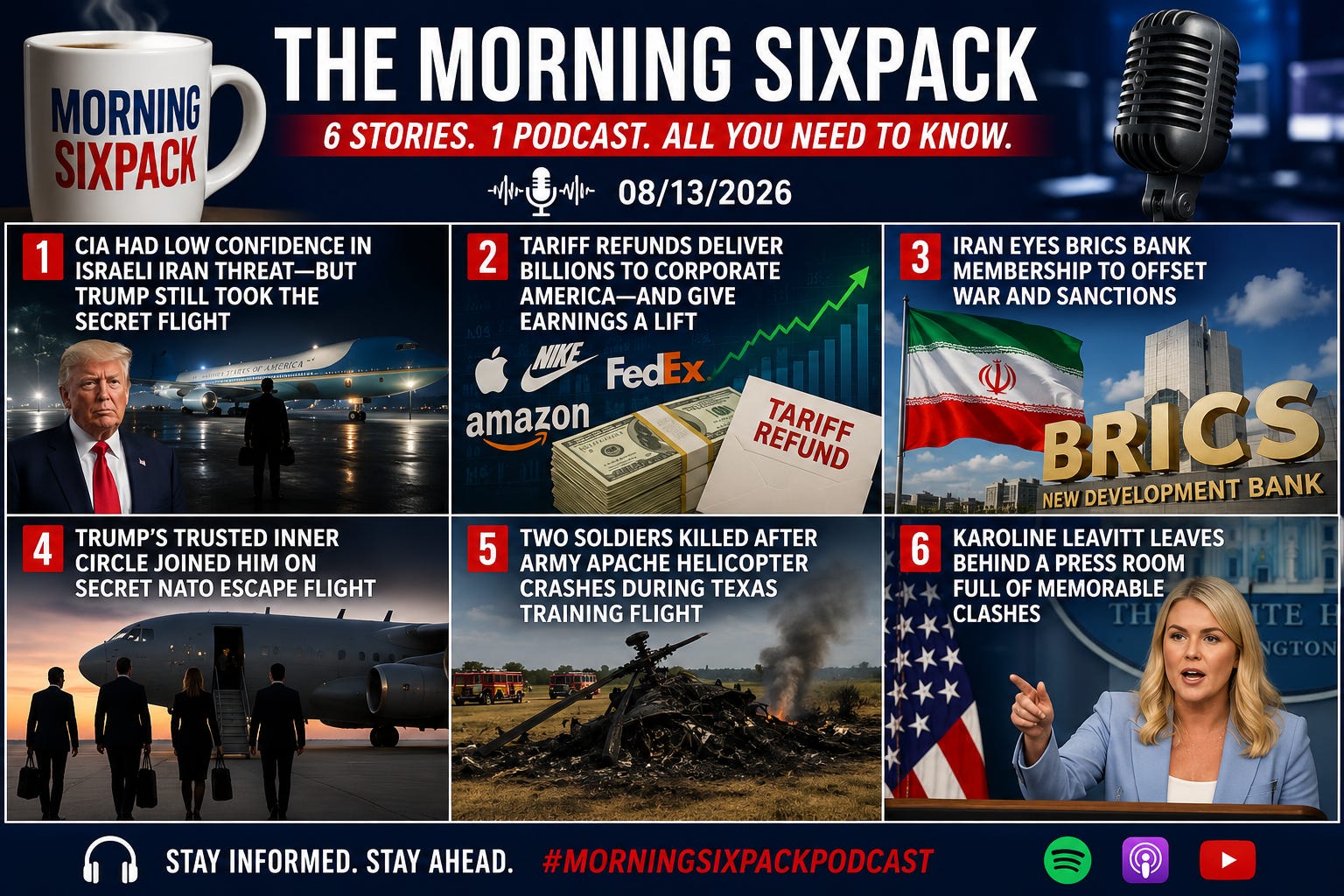
Israel warned of an Iranian threat to Trump, but U.S. intelligence reportedly wasn’t convinced—and the Secret Service treated it like the threat was real anyway.
CIA Reportedly Had Low Confidence in Israeli Iran Threat—But Trump Still Took the Secret Flight
U.S. intelligence officials reportedly viewed Israeli warnings of an imminent Iranian assassination plot against President Donald Trump with skepticism, yet the Secret Service carried out an elaborate deception operation anyway.
When it comes to protecting the president, “low confidence” intelligence is still enough to justify maximum security—especially when it comes from the lying Netanyahu government.
According to a Washington Post report, Israeli intelligence warned the CIA of a potential Iranian plot to assassinate Trump during the NATO summit in Turkey. But current and former U.S. officials told the newspaper that CIA analysts found the intelligence unconvincing and relayed those doubts to senior Trump administration officials.
One official described the reporting as “Israeli-derived, not U.S.-generated, and viewed as low confidence.”
Despite those reservations, the Secret Service executed an extraordinary security plan. Trump initially boarded the traditional Air Force One before secretly leaving the aircraft, riding across the airport in a catering truck, and departing aboard a military C-32A transport plane headed to Britain. F-16 fighter jets reportedly escorted the flight. Trump later confirmed the decision came from the Secret Service, saying,
“It’s really just up to Secret Service. I just follow what they like to do. They wanted me to go on a different flight, a different plane, equal safety. … I do what they say.”
The report also says some U.S. intelligence officials questioned whether Israel’s warning was intended solely to share intelligence or also to influence U.S. policy toward Iran and Turkey. Officials cited by the Post said some viewed the intelligence as fitting a broader pattern in which Israeli reporting is sometimes seen as shaping presidential decision-making as much as informing it.
The White House declined to directly address how the intelligence was assessed but emphasized that Trump has faced multiple threats, including from Iran, and that every appropriate security measure was taken. Given three previous assassination attempts or plots involving Trump, officials said the Secret Service wasn’t willing to gamble on whether this warning would turn out to be credible.
Source: Washington Post
Editor: Intelligence agencies are paid to question intelligence. The Secret Service is paid to assume the worst. Those two jobs don’t always produce the same answer—and that’s by design. It doesn’t really explain the Secret Service’s terrible perfomances in past assassination attempts.
Billions in tariff refunds are flowing to major corporations faster than expected—and suddenly those earnings reports look a whole lot better.
Tariff Refunds Deliver Billions to Corporate America—and Give Earnings a Lift
More than $9.6 billion in tariff refunds has already been reported by S&P 500 companies, providing an unexpected boost to corporate earnings and, in a very few cases, refunds for customers.
It turns out the government can move quickly—at least when it’s sending money back to big companies.
The Wall Street Journal reports that more than 40 S&P 500 companies have disclosed roughly $9.6 billion in tariff refunds following the Supreme Court’s decision striking down a major portion of President Donald Trump’s emergency tariffs. At least $2.1 billion has already been paid out in cash, with companies saying the refund process has moved far faster than many expected.
Among the biggest winners so far are Apple, which reported nearly $2.2 billion in refunds, Nike with $986 million, FedEx at about $800 million, Amazon with $640 million, and General Motors with $500 million. Apple alone said the refunds added 11 cents per share to its latest quarterly earnings—about 5% of its total earnings for the quarter.
Not every company is simply pocketing the money. FedEx says it will pass its refunds back to customers, while Costco says it intends to return the benefit “in some form” comparable to the tariff costs shoppers absorbed. Amazon also says it will refund customers where it can directly trace tariff costs and otherwise use the money to help keep prices low. Meanwhile, companies like Caterpillar note that while the refunds help, they still expect to pay billions in remaining tariffs this year.
The refunds stem from the Supreme Court’s decision invalidating tariffs imposed under the International Emergency Economic Powers Act. U.S. Customs and Border Protection has accepted nearly $129 billion in refund claims for processing, with roughly $100 billion already moving through the Treasury for payment. The wave of reimbursements is becoming an unexpected bright spot in corporate earnings season while companies continue adjusting to the evolving tariff landscape.
Source: The Wall Street Journal (free)
Editor: Funny how “corporations will eat the tariffs” turned into “corporations are getting refund checks.” Economics always has a way of making political talking points expire. And yet, we the people (i.e., consumers) are left holding the bag.
Note that once the tariff refunds have been fully paid out that corporations will—all of a sudden—be unprofitable and will need a bailout and/or tax cuts. Mark. My. Words.
Iran is looking east for economic lifelines as sanctions and war continue to hammer its economy—and BRICS is the next stop.
Iran Eyes BRICS Bank Membership to Offset War and Sanctions
Iran says it will soon seek membership in the BRICS New Development Bank, hoping to unlock new financing as Western sanctions and the ongoing war continue to squeeze its economy.
When Washington closes one financial door, Tehran goes shopping for another.
Iranian Central Bank Governor Abdolnasser Hemmati announced Thursday that the country plans to join the BRICS New Development Bank (NDB), according to Iranian state media. Speaking ahead of next month’s BRICS Summit in India, Hemmati said Tehran is pursuing closer monetary cooperation with fellow BRICS nations as it looks to strengthen economic ties outside the Western financial system.
The NDB, created by Brazil, Russia, India, China and South Africa, finances infrastructure and development projects across emerging economies. While the bank told CNBC it could not confirm Iran’s membership, officials noted that all United Nations member states are eligible to apply and must complete a formal accession process before becoming members.
Membership would allow Iran to seek financing for projects ranging from transportation and sanitation to digital infrastructure and urban development. That’s particularly significant as years of U.S. sanctions—and the war with the United States and Israel—have fueled soaring inflation, a collapsing currency, and slowing economic growth. China remains Iran’s largest trading partner, purchasing more than 80% of the country’s exported oil in 2025.
President Donald Trump has repeatedly criticized BRICS as promoting “anti-American” policies and has warned of 25% tariffs on imports from countries that directly or indirectly purchase Iranian goods or services. Iran’s move underscores its effort to deepen economic relationships with countries that are less likely to participate in Western sanctions.
Source: CNBC
Editor: BRICS keeps adding members while the West keeps adding sanctions. Whether this becomes a genuine financial alternative or just another geopolitical club is the trillion-dollar question.
Trump’s inner circle during the secret flight wasn’t made up of Cabinet heavyweights—it was the aides he trusts most.
Trump’s Trusted Inner Circle Joined Him on Secret NATO Escape Flight
President Donald Trump reportedly handpicked a small group of trusted aides—including longtime assistant Natalie Harp—to accompany him when he secretly switched aircraft after the NATO summit in Turkey.
When security gets serious, titles matter less than trust.
According to reports, Trump slipped off the traditional Air Force One by boarding an airport catering truck before transferring to a military Air Force C-32A for the flight to Britain. The extraordinary operation was carried out after the Secret Service deemed an alleged Iranian assassination threat credible enough to warrant a deception plan.
Among those accompanying the president were personal aide Natalie Harp, Deputy Chief of Staff Dan Scavino, and Oval Office Operations Director Walt Nauta (you know, the guy caught hiding classified documents at Mar A Lago). Several senior administration officials—including Secretary of State Marco Rubio, Treasury Secretary Scott Bessent, senior adviser Stephen Miller, and other top White House staff—remained aboard the larger aircraft with the White House press corps.
Sitting ducks, you might say.
Speaking publicly about the operation for the first time, Trump made clear the decision wasn’t his. “It’s really just up to Secret Service. I just follow what they like to do,” Trump told reporters. “They wanted me to go on a different flight, a different plane, equal safety. … I do what they say.” He later added, “The plane that I was on was at greater risk... because that would be the plane that I think that they would be more likely to go for.”
How can our POTUS be so stupid?
The unusual operation has prompted questions from congressional Democrats, who argue that if the primary aircraft was considered too dangerous for the president, officials owe an explanation about the risks faced by everyone else—including White House staff and the traveling press—who remained aboard. The White House has not publicly detailed how the passenger list for the secret flight was chosen.
Source: Irish Star
Editor: Every administration has an inner circle. This episode offered an unusually public look at who makes the cut when the stakes are highest—and who gets left on the decoy.
A routine Army training mission turned deadly when an Apache helicopter crashed in Texas, killing both crew members and igniting a wildfire.
Two Soldiers Killed After Army Apache Helicopter Crashes During Texas Training Flight
An Army AH-64 Apache helicopter crashed during a routine training mission near Fort Hood, Texas, killing both crew members and sparking a wildfire that forced nearby evacuations.
Training flights are designed to prepare for danger—not become the danger themselves.
The helicopter went down Wednesday in a field near Fort Hood, according to military officials and the Bell County Sheriff’s Office. Both soldiers aboard were killed in the crash. The impact also ignited a brush fire that prompted the evacuation of several nearby homes, although authorities said no buildings were struck by the aircraft.
Officials said the Apache was conducting a routine training flight when it crashed. The cause has not been determined, and Fort Hood’s Criminal Investigation Division is leading the investigation. Military leaders have not released the identities of the two soldiers pending family notification.
Bell County Sheriff’s Office spokesman Cliff Coleman described the wreckage as severe. “You could tell it was a violent crash,” he said after arriving at the scene. Photos showed firefighters working around the burning debris as smoke continued rising from the crash site.
Acting Fort Hood commander Brig. Gen. Ethan Diven offered condolences, saying, “Our immediate priority is securing the site and supporting the initial response efforts. Our thoughts are with the crew and their families as we await further information.” The AH-64 Apache has been a cornerstone of the U.S. Army’s attack helicopter fleet since entering service in 1984.
Source: AP News
Editor: Military aviation remains one of the most demanding jobs anywhere. Even routine training carries real risks—and tragedies like this are a sobering reminder of the price service members sometimes pay far from any battlefield.
Karoline Leavitt didn’t just deliver the administration’s message—she often turned White House briefings into verbal sparring matches with reporters.
Karoline Leavitt Leaves Behind a Press Room Full of Memorable Clashes
As Karoline Leavitt prepares to leave the White House, her tenure will be remembered as much for confrontations with reporters as for delivering the administration’s message.
Love her or hate her, nobody ever accused her of making White House briefings boring.
TIME looked back at some of Leavitt’s most memorable exchanges with the press as she prepares to step down as White House press secretary at the end of the month. President Donald Trump announced her departure Wednesday, praising her work and saying she will remain one of his top outside advisers while spending more time with her family.
Among the most notable moments was a 2025 exchange with an Associated Press reporter over tariffs. After being challenged on whether tariffs are effectively taxes on importers, Leavitt fired back, “I think it’s insulting that you’re trying to test my knowledge of economics... I now regret giving a question to The Associated Press.” In another briefing, she dismissed a question about peaceful protests ahead of Trump’s military parade by replying, “Of course the President supports peaceful protests. What a stupid question.”
Her combative style also surfaced during questions about Commerce Secretary Howard Lutnick, ICE enforcement, and former President Joe Biden’s autopen controversy. During one briefing she ended the session after criticizing reporters for focusing on Epstein-related questions instead of what she viewed as administration accomplishments. In another, she told a journalist questioning ICE statistics, “You’re a leftwing hack. You’re not a reporter.” CNN’s Kaitlan Collins also became a frequent target, with Leavitt once telling her, “You’re a reporter—you should find out.”
Supporters viewed Leavitt’s approach as standing up to a hostile press corps, while critics argued the exchanges reflected the administration’s increasingly adversarial relationship with the media. Either way, she exits having become one of the most recognizable—and polarizing—press secretaries in recent memory.
Source: TIME
Editor: Every press secretary defends the administration. Few make the briefing room itself part of the story quite as often as Karoline Leavitt did.