


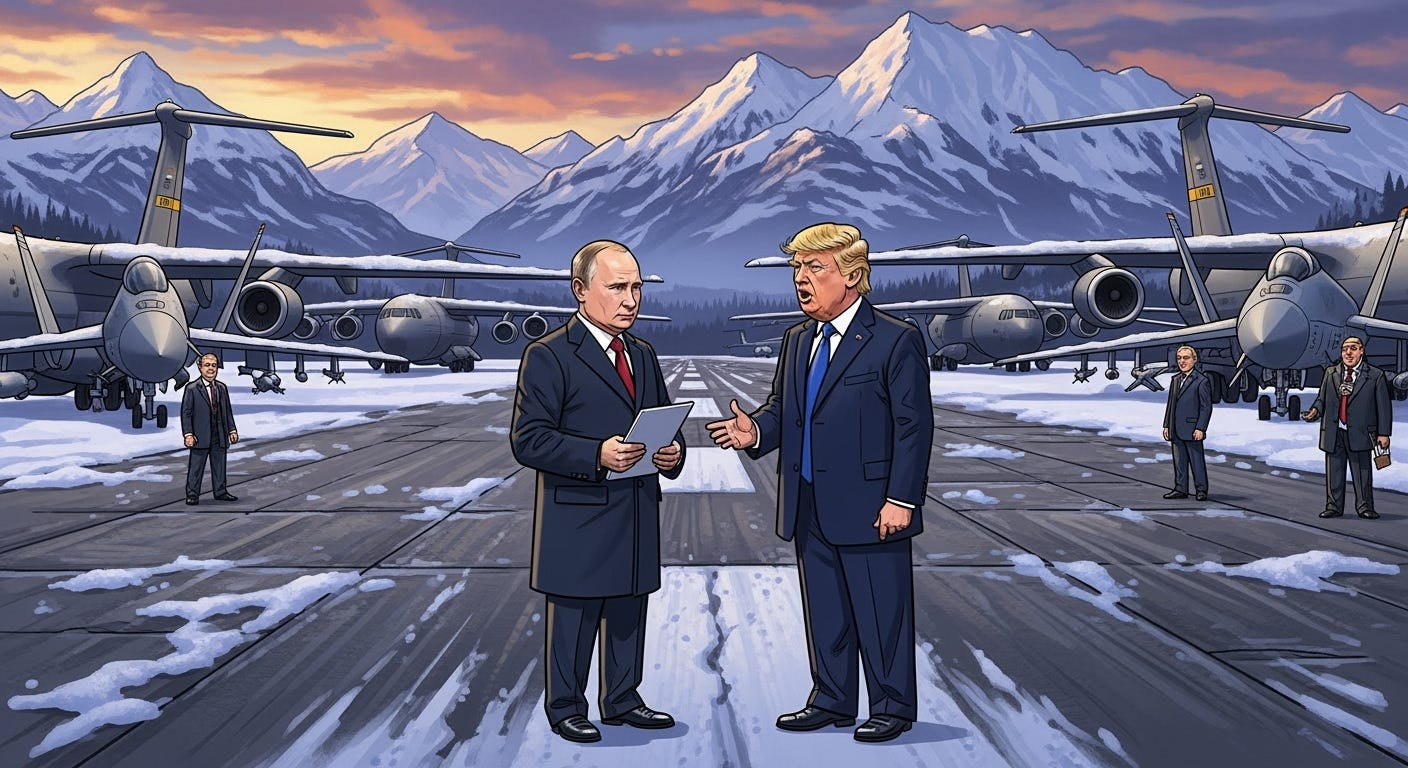
Somewhere near Anchorage, Alaska, two men are about to decide whether the future of Ukraine is written in peace treaties… or in crayon.
One is Donald Trump, who still believes his instincts can bend geopolitics to his will. The other is Vladimir Putin, who plays the long game so well he could teach it as a master class—assuming you’re okay with the syllabus including a chapter on annexation.
This is their first face-to-face since Putin unleashed the full-scale invasion of Ukraine in 2022, and it’s happening at a military base with Cold War history. You can practically smell the nostalgia—jet fuel, razor wire, and just a hint of mushroom cloud.
Trump’s public pitch? A grand bargain: Putin agrees to a cease-fire, Ukraine gets a seat at the table, and Trump gets to play “deal of the century” with Volodymyr Zelensky in Alaska. The subtext? Territorial concessions, security guarantees, and U.S. arms sales to Kyiv—all wrapped up in the reality TV drama of a joint presser.
Putin’s pitch is different: Keep Trump friendly, stall until the world stops paying attention, and walk away with both the land and the narrative. He’s dangling trade and arms-control talks like shiny bait, knowing full well that Trump likes the idea of “bigger deals” that make him look presidential. If Ukraine peace talks are an obstacle to that, well, obstacles can be ignored.
The risks here aren’t theoretical. Without a summit strategy aligned with Kyiv and Europe, Trump’s meeting could become “Yalta 2.0”—a re-run of 1945’s spheres-of-influence handshake, except this time the map redraw happens over an Alaskan coffee table. Experts like Torrey Taussig, who worked on European affairs in the Biden White House, are openly warning: This won’t bring the war closer to an end unless it’s tightly coordinated.
And let’s not forget the optics. Hosting Putin on U.S. soil—without concrete concessions—hands him a PR win before anyone even sits down. Former officials are calling it a major concession, not a clever gambit. Heather Conley of the American Enterprise Institute flat-out says Putin “has already won before the meeting gets started.”
The background noise matters, too. Trump just hit India with 50% tariffs for buying Russian oil but backed off secondary sanctions on China and others. That kind of inconsistency is a gift to Putin, who has mastered the art of reading Trump’s bluster as opening bids rather than final ultimatums. Even John Bolton—who’s hardly a card-carrying member of the Resistance—thinks Putin’s best move is to rekindle the “old magic” Trump feels they had.
There’s also the “Putin factor” in the room: The man is notorious for dragging meetings into long historical rants about why Ukraine isn’t a real country. Trump, who prides himself on cutting through noise, may find himself trapped in the Kremlin leader’s conversational bear hug. In 2018, Trump even took Putin’s word over U.S. intelligence on election interference—a moment that still makes security officials twitch.
And while Trump has shipped lethal arms to Ukraine in the past, his relationship with Zelensky is notoriously uneven. Earlier this year, he publicly berated the Ukrainian president in the Oval Office. Now he’s offering him an invitation to Alaska—but only “if it’s a good meeting.” That’s not exactly the language of a committed ally.
If this feels more like a poker game than a peace summit, that’s because it is. Trump is betting on instinct and optics; Putin is betting on time and terrain. Unfortunately for Ukraine, history suggests Putin is much better at cashing out slowly than Trump is at walking away from a bad deal.
Source: The Wall Street Journal
Diplomacy is just poker where one guy’s holding aces and the other’s trying to bluff with a business card.