


The Morning Sixpack stays free because the news that shapes your life should not be hidden behind a paywall. Paid subscribers are not paying for access. They are helping fund the research, writing, and independent voice that goes into every issue. Become a paid subscriber and help keep smart, honest news analysis free for everyone.
Congress is heading home early for campaign season while an impeachment resolution, Epstein-file fight, and other unfinished business remain on the table.
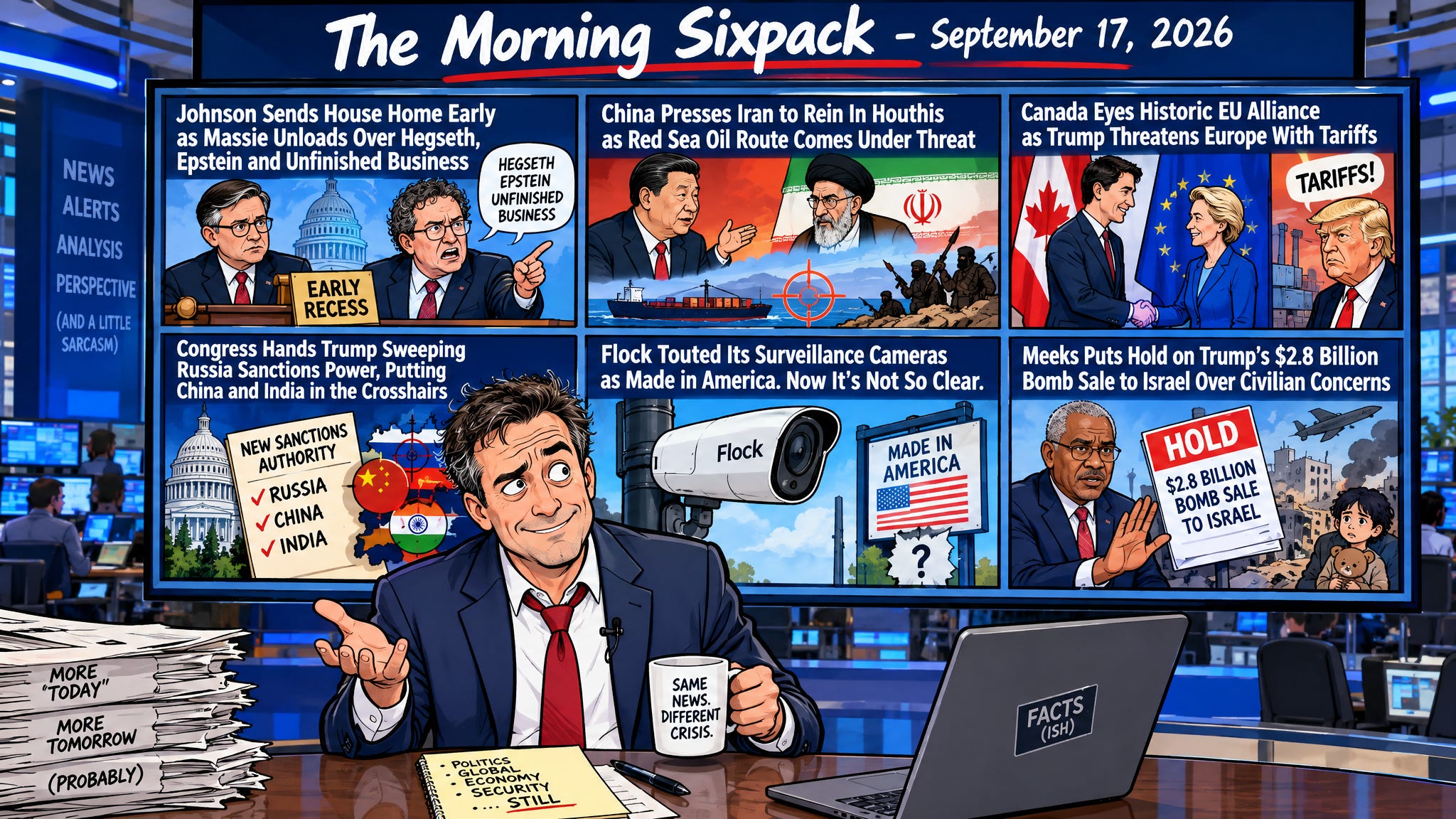
Johnson Sends House Home Early as Massie Unloads Over Hegseth, Epstein, and Unfinished Business
House Speaker Mike Johnson sent lawmakers home early Wednesday to campaign for the midterms, defending the House’s record even as Republican Rep. Thomas Massie blasted the decision and pointed to unfinished fights over the Iran war, Defense Secretary Pete Hegseth, and the Jeffrey Epstein investigation. Johnson says lawmakers will remain on 48-hour notice to return if necessary.
“We’re calling off Congress? And we’re in the majority?” Massie demanded from the House floor.
Massie used an hourlong floor speech to attack Johnson’s leadership and argue Congress should remain in Washington. Among the matters left without votes were Massie’s resolution seeking Hegseth’s impeachment over actions connected to the Iran war and his effort to force the release of additional Epstein-related files. “I’m trying to get justice for the Epstein survivors,” Massie said. “I’m trying to stop a war.” Johnson countered that “the House has done its job” and dismissed the Hegseth impeachment effort as “a stunt.”
Johnson points to hundreds of bills passed during the session and major legislation signed into law, while critics point to the chamber’s shortened calendar. AP reports that, by one tally, 28 House days were canceled this year while four were added—a net reduction of 24 scheduled days. Before leaving Wednesday, lawmakers also passed legislation including sanctions on Russia (see below). Johnson called this Congress one of the most productive in decades; Democratic Leader Hakeem Jeffries, by contrast, characterized the Republican majority as “do-nothing.” Jeffries should know… takes one to know one.
For Massie, who lost his Republican primary and is nearing the end of his House tenure, the confrontation became something of a final broadside against congressional leadership. He criticized U.S. involvement in Iran and Hegseth’s actions, while Johnson defended the secretary. “I’m not playing this game,” Massie said. “I am going to tell people what is going on up here.” The voters will get their turn soon enough; Congress, meanwhile, gets an early trip home.
Editor: Congress can argue over whether this session was historically productive or chronically abbreviated. The calendar, at least, is considerably less argumentative: Lawmakers are going home early.
Source: Associated Press
China is asking Iran to help put the Houthi genie back in the bottle after Saudi Arabia came calling—which is what happens when two critical oil routes start looking like geopolitical tollbooths.
China Presses Iran to Rein In Houthis as Red Sea Oil Route Comes Under Threat
China has privately urged Iran to use its influence over Yemen’s Houthis after Saudi Arabia appealed to Beijing for help, as the group’s rapid advance around the Bab el-Mandeb Strait threatens shipping and another crucial Middle East energy route. The request puts Beijing in an awkward spot: Iran is a major strategic and economic partner, but China also depends heavily on Gulf oil and trade.
With traffic through the Strait of Hormuz already severely disrupted, trouble at Bab el-Mandeb could squeeze two of the Middle East’s most important energy arteries at the same time. Reuters reported that only three commercial vessels transited Hormuz Wednesday, compared with 12 the previous day and a recent 10-day average of about 17.
According to three Iranian sources cited by Reuters, Beijing wants Tehran to use its influence with the Houthis to prevent the conflict from spreading further across the Red Sea. China’s foreign ministry publicly called for dialogue and said it does not want regional tensions spilling further into Yemen and the Red Sea. The Iranian sources said Beijing did not threaten economic consequences if Tehran declined to act.
China has some serious leverage. It has been Iran’s largest trading partner for more than a decade and remains the principal buyer of Iranian oil; Chinese purchases accounted for more than 80% of Iran’s seaborne oil exports in 2025, according to Kpler data cited by Reuters. But Beijing also has enormous interests elsewhere in the Gulf. “Iran can disrupt Hormuz. But at some point that leverage begins hurting the very power Tehran increasingly depends on,” Middle East Institute analyst Alex Vatanka told Reuters.
Whether Iran actually leans on the Houthis remains unclear. Tehran reportedly responded that regional stability depends on ending the U.S.-Israeli war against Iran, while the Houthis’ territorial gains have strengthened their ability to threaten Red Sea shipping. China helped broker the 2023 restoration of diplomatic relations between Iran and Saudi Arabia; now Riyadh is effectively asking Beijing to demonstrate how much influence came with all that diplomacy.
Editor: China wanted cheap Iranian oil, booming Gulf trade, and the prestige of Middle East diplomacy. Now everybody would like Beijing to come downstairs and deal with the kids. This, by the way, is Saudi Arabia’s response to asking Trump for help and getting the cold shoulder. So now they’re becoming more aligned with China and less with the US. Guess what happens next?
Source: Reuters
Canada is flirting with a closer European alliance while Trump threatens tariffs if he doesn’t like the arrangement—international dating now requires Trump’s approval.
Canada Eyes Historic EU Alliance as Trump Threatens Europe With Tariffs
Canadian Prime Minister Mark Carney welcomed the EU’s proposal for Canada to become its first “associate member,” setting up a potentially historic realignment of transatlantic relations as President Donald Trump threatens additional tariffs if he views the arrangement as hostile to U.S. interests. (He does. He’s already suggested it.) Carney told the European Parliament that Canada welcomes the EU’s ambition while emphasizing cooperation on trade, defense, technology, energy, and economic security.
Canada is effectively telling Washington that it intends to decide for itself whom it trades with and how closely—and Europe is holding the door open. Trump called the proposed arrangement “laughable” and threatened trade sanctions against Europe, while Carney argued that greater Canadian resilience would make the country a stronger partner for the United States.
European Commission President Ursula von der Leyen proposed the unprecedented “associate member” status Wednesday, saying she wants to elevate EU-Canada relations to “the highest level possible.” The details remain to be negotiated—the EU does not currently have a formal associate-membership category—but von der Leyen outlined cooperation spanning defense industries, critical minerals, artificial intelligence, energy, quantum computing, cybersecurity, and the Arctic. (Greenland…)
Carney made clear that Canada isn’t proposing some new superpower club designed to take on Washington. Instead, he described an alliance intended to make Canada and Europe less vulnerable to economic coercion and external pressure. “An alliance strong enough so that no one can dictate our choices,” Carney told European lawmakers. Any final agreement would still require negotiation and approval through the relevant Canadian and European processes.
The two sides already have a substantial foundation: Their CETA trade agreement has helped increase bilateral goods trade by 75% in less than a decade, according to von der Leyen. What’s being discussed now goes considerably further—toward what she calls an “Alliance for the Future.” The precise meaning of “associate member” remains to be written, but Canada and Europe have unmistakably started down the road.
Editor: Nothing says “Canada and Europe are free to make their own trade arrangements” quite like threatening them with tariffs for making their own trade arrangements.
Source: CNBC
Congress just handed President Trump a bigger sanctions toolbox aimed at Russia—and China and India may discover that buying discounted Russian oil can come with a very expensive American tax.
Congress Hands Trump Sweeping Russia Sanctions Power, Putting China and India in the Crosshairs
Congress has approved the Lindsey O. Graham Sanctioning Russia and Iran Act of 2026, giving President Donald Trump authority to impose tariffs of up to 100% on major purchasers of Russian energy while expanding sanctions targeting Moscow’s energy and defense sectors. The House passed the measure 262-159 Wednesday after the Senate approved it 86-11 in August, sending the legislation to Trump’s desk.
The potentially enormous consequence: China and India, Russia’s two biggest crude customers, could face steep U.S. tariffs—but the legislation gives Trump discretion over whether and how aggressively to use that power. That distinction matters: Passage of the bill does not automatically slap a 100% tariff on Indian or Chinese goods. This is yet again, Congress ceding even more power to the Executive branch.
Named for the late Sen. Lindsey Graham, the legislation targets Russia’s energy and defense industries, government officials, and the so-called “shadow fleet” of tankers used to circumvent sanctions. It also extends sanctions involving Iran. Supporters argue the measure gives Washington additional economic leverage against Moscow over its war in Ukraine; opponents raised concerns about granting the president broad tariff authority and the possibility of higher costs for American consumers.
India has already warned Washington about potential consequences. Its government said it has explained to U.S. officials the possible effects on bilateral relations and international energy markets and pledged to protect its energy and trade interests. China has likewise opposed efforts to penalize its trade with Russia. The timing makes the equation more complicated: Disruptions to Middle Eastern energy supplies have increased the importance of alternative crude sources for Asian importers.
The real question now moves from Capitol Hill to the White House. The legislation creates potentially powerful economic weapons, but their impact depends heavily on how Trump chooses to deploy them. Russia has already said the new sanctions, if signed, would complicate efforts to reach a settlement in Ukraine. In other words, Congress has loaded the tariff cannon; what happens next depends on whether—and where—the president fires it.
Editor: Nothing simplifies an already strained global oil market quite like adding the possibility of 100% tariffs on two of the planet’s largest energy buyers. Economists everywhere just reached for the extra-strength antacid.
Source: Al Jazeera
Flock spent years telling customers its license-plate cameras were made in America; now WIRED says the company’s current marketing no longer says where they’re assembled, while import records show a growing stream of components arriving from Asia.
Flock Touted Its Surveillance Cameras as Made in America. Now It’s Not So Clear.
Flock Safety once advertised its controversial license-plate cameras as “made in the USA” and later “designed & manufactured in the U.S.,” but WIRED reports that current marketing materials no longer identify where the cameras are assembled. The change comes as Flock faces growing scrutiny over the nationwide network of cameras used by police and other agencies to track vehicles.
Tens of thousands of cameras are watching American roads, but WIRED couldn’t determine where Flock is currently putting them together. Import records reviewed by WIRED show Flock increasingly receiving commodity cameras, radar systems, and other components from Primax Electronics in Thailand. Primax is headquartered in Taiwan and operates manufacturing facilities in several countries, including China and Thailand. Flock told WIRED that all products it builds comply with National Defense Authorization Act requirements.
Flock’s manufacturing story has changed considerably. Early prototypes used cameras pulled from Android phones purchased through Alibaba, while later cameras were assembled by Flock employees in Atlanta. Marketing from 2019 called them “manufactured in the United States”; in 2020, Flock said “made in the USA”; and in 2021 it specified assembly by “Flock Safety in Atlanta, GA.” Final assembly later shifted to contract facilities operated by East West Manufacturing in North Carolina and Plexus in Wisconsin, according to a source cited by WIRED, while many components continued coming from Asia.
The supply-chain questions matter because Flock’s technology has already generated a fierce privacy debate. Police say automated license-plate readers can help deter and solve crimes, while critics point to documented cases involving improper tracking and data-sharing concerns.
Cris van Pelt of the anti-Flock project Have I Been Flocked told WIRED: “If any part of the supply chain is compromised, we would never know. That’s a much bigger problem than where the final product is assembled.”
Flock has been clearer about its new Alpha surveillance drone, announcing a Smyrna, Georgia, facility to assemble drones and solar panels. But for its signature license-plate cameras, WIRED found no current answer to the basic question of final assembly location. Wherever the cameras are screwed together, the larger issue increasingly confronting Flock is transparency—about its hardware, its supply chain, and the enormous surveillance network those little black boxes have become.
Editor: Orwell’s Big Brother is here.
Source: WIRED
House Foreign Affairs Committee ranking Democrat Gregory Meeks has put a hold on a proposed $2.8 billion sale of heavy bombs to Israel, saying the administration hasn’t provided sufficient assurances about their use around civilians.
Meeks Puts Hold on Trump’s $2.8 Billion Bomb Sale to Israel Over Civilian Concerns
Rep. Gregory Meeks has refused to clear the Trump administration’s proposed $2.8 billion sale of 40,000 2,000-pound bombs to Israel, citing unresolved questions about compliance with U.S. law and protections for civilians. Meeks, the ranking Democrat on the House Foreign Affairs Committee, announced the hold Wednesday.
The hold creates a congressional obstacle for one of the largest proposed U.S. transfers of heavy bombs to Israel in years, although reporting indicates the administration has options for proceeding despite Meeks’ objection. The proposed package would largely be financed through the U.S. Foreign Military Financing program, according to UPI.
Meeks said he remains committed to Israel’s security but has concerns about the proposed transfer.
“The Trump administration has not provided sufficient assurances that these weapons will be used by the Netanyahu government in accordance with U.S. law and with appropriate protections for civilians. I therefore will not clear this sale at this time,” he said.
His committee statement specifies concerns about potential use in densely populated areas of both Gaza and Lebanon.
The dispute revives a long-running debate in Washington over 2,000-pound bombs and civilian casualties. The Biden administration paused a shipment that included the weapons in May 2024 amid concerns about their potential use during Israeli operations in Rafah. Trump ordered the previously withheld bombs released shortly after returning to office in January 2025. The newly proposed package reportedly includes MK-84 bombs, BLU-117s, and penetrator warheads.
For now, Meeks’ action means the proposed transfer faces additional scrutiny rather than an outright cancellation. His stated position is that Israel has legitimate defense needs while Congress has a responsibility to examine whether U.S.-funded weapons will be used lawfully and with civilian safeguards. The administration’s next move will determine whether that congressional objection changes the sale or becomes another procedural hurdle on the way to completing it.
Editor: A $2.8 billion shipment of 40,000 massive bombs probably deserves at least a little more paperwork than “trust us.”
Source: UPI