



The Morning Sixpack stays free because the news that shapes your life should not be hidden behind a paywall. Paid subscribers are not paying for access. They are helping fund the research, writing, and independent voice that goes into every issue. Become a paid subscriber and help keep smart, honest news analysis free for everyone.
Cornell students packed a campus protest demanding accountability over the university’s handling of an alleged 2024 fraternity gang rape, while somebody apparently decided the administration building also needed to hear the message.
Cornell Erupts Over Alleged Fraternity Gang Rape as Students Demand President Resign
Cornell University is facing an escalating campus revolt over its handling of allegations that multiple fraternity members sexually assaulted a student in 2024, with protesters demanding greater transparency, tougher consequences, and the resignation of President Michael Kotlikoff.
No criminal charges have been filed, but the controversy has now moved from university disciplinary proceedings to a state-led criminal investigation—and straight into the center of campus life.
Students, faculty, and others filled a plaza outside Cornell’s student center wearing purple ribbons and carrying signs including “support survivors, expel rapists” and “Justice 4 every Jane Doe.” Protesters later marched to the university’s administration building, which had been vandalized overnight with graffiti and damaged glass. Cornell spokesperson Kyle Kimball said the university was investigating and that “damaging property is not the answer.”
The woman identified in court records as Jane Doe alleges she was pressured into drinking and taking drugs before being sexually assaulted by multiple members of the Chi Phi fraternity in October 2024. She has sued Cornell, seven former students, the fraternity, and others. Lawyers for two former students denied their clients participated in a sexual assault, while some accused students reportedly told Cornell investigators the sexual activity was consensual. Jane Doe told investigators: “I felt like bait. I felt like lions around me. It just was a totally debilitating place to be in.”
Cornell has shut down the Chi Phi chapter and says it expelled some students and suspended others, but protesters say that isn’t enough. New York Gov. Kathy Hochul appointed the state attorney general to take over the reopened criminal investigation and called for an independent review of Cornell’s response. Kotlikoff subsequently apologized in a video and pledged greater transparency and a commitment to “finding the answers our community deserves.” For Cornell, the question is no longer whether this controversy will disappear—it’s whether students will believe anything short of outside scrutiny can produce credible answers.
Editor: Cornell can scrub graffiti off a wall in an afternoon. Restoring trust after students conclude the institution protected itself first is going to require considerably more elbow grease.
Source: AP News
Russia has quarantined several hospitals after the death of a plague-lab worker, and U.S. officials are asking Moscow for details—which is not a sentence engineered to improve anyone’s Tuesday morning.
Rubio Presses Russia for Answers After Plague Lab Worker Dies
Secretary of State Marco Rubio is calling on Russia to disclose more information about the death of a laboratory worker that U.S. officials are investigating for a possible connection to pneumonic plague.
The combination of a deadly infectious disease, a laboratory worker, and limited information from Russia has Washington paying very close attention.
The worker was employed at a Russian institute dedicated to studying plague, according to The Washington Post. The CDC and other U.S. agencies are trying to determine what happened, while Russian authorities have reportedly placed several hospitals in the area under quarantine. Rubio said, “It’s incumbent upon Russia to obviously share more information with the world.”
Speaking to reporters in Iceland, Rubio invoked the experience of the coronavirus pandemic while explaining the concern. “Anytime you hear that there’s some disease that infected someone in a lab anywhere in the world, you’re going to be concerned about it, especially given recent events not so long ago.” Rubio declined to address a report that Russia’s FSB security service was involved in the response.
For now, there’s a considerable amount officials apparently don’t know—including whether the worker’s death was actually caused by pneumonic plague. “We just don’t have all the information yet,” Rubio said. That uncertainty is precisely why Washington wants Moscow talking, because “mystery death at a Russian plague laboratory” is one of those phrases where additional information is generally preferable to creative imagination.
Editor: Nothing says “we could use a few more details” quite like plague, laboratory, death, and Russia appearing in the same news alert. Moscow might want to circle back before everyone’s browser history becomes medieval.
Source: The Washington Post
France spent decades treating cheap debt like a permanent feature of the national landscape; now interest rates are rising, more than $1 trillion comes due by 2030, and the bond market has finally located the invoice.
France’s $1 Trillion Debt Reckoning Has Bond Markets Reaching for the Alarm
France is staring at a potentially brutal debt squeeze, with borrowing costs near their highest levels in decades, nearly 120% debt-to-GDP, and more than $1 trillion in government debt coming due by 2030.
The era of “magic money” is ending, and France has picked an exceptionally expensive time to discover that budgets eventually require math.
France’s 10-year borrowing cost has climbed toward 5%, while the government is preparing to sell a record roughly $380 billion in debt next year. Meanwhile, the cost of servicing the national debt is projected to jump 59% by 2030 and could eventually exceed military spending. As French asset manager Kevin Thozet put it: “France has been this free rider in Europe for years, if not decades. It has gotten away with fiscal murder.”
The problem was decades in the making. France hasn’t balanced its budget since 1974, and Emmanuel Macron’s government piled on spending during the yellow-vest protests, Covid pandemic, and European energy crisis. Macron even supplied the governing philosophy: “Whatever it costs.” But when tax revenues later missed forecasts and officials confronted tens of billions of euros in budget holes, political paralysis made serious cuts increasingly difficult. Macron’s 2024 decision to dissolve parliament ultimately left the National Assembly fractured among competing blocs and made fiscal reform even harder.
Now the bond market is applying pressure politicians have repeatedly avoided. France’s deficit has remained above 5% of GDP for three years, and the OECD estimates debt could reach 200% of GDP by 2050 without spending cuts. Investors say a full-blown debt crisis isn’t inevitable, but the arithmetic is getting uglier: Interest costs are expected to exceed economic growth, creating what Thozet calls a “snowball effect.” France spent years asking the state for “magic money.” The bond market’s response appears to be: Magic trick over.
Editor: France managed to make borrowing money feel free for so long that paying it back now seems almost culturally offensive. Unfortunately, bond traders are notoriously resistant to baguettes, slogans, and creative accounting.
Source: The Wall Street Journal
Oil is moving through the Strait of Hormuz again, but much of it is crude while the diesel that actually moves trucks, groceries, and the economy remains painfully scarce.
Hormuz Oil Is Flowing Again, but America’s Diesel Crisis Isn’t Going Anywhere
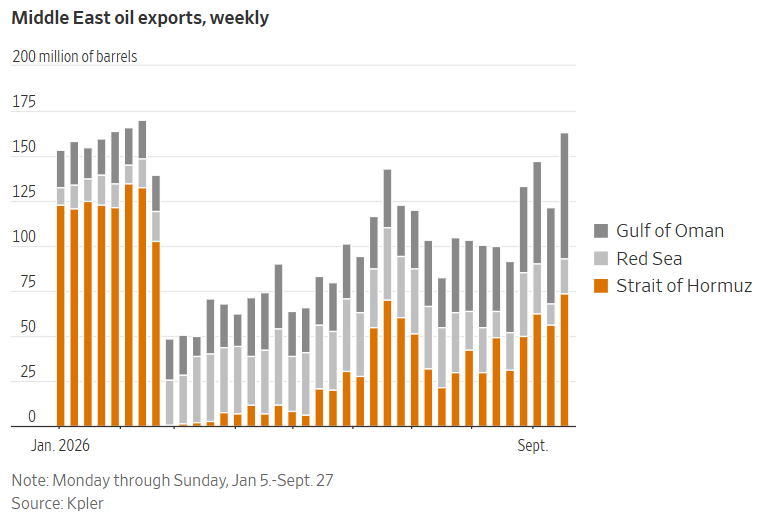
Crude-oil shipments through the Strait of Hormuz have rebounded to roughly three-quarters of prewar levels, but damaged Middle Eastern refineries have left the world desperately short of diesel—and U.S. drivers are paying record prices.
America has plenty of oil moving again; unfortunately, you cannot pour crude into a semitruck and call it economic policy.
The national average for diesel hit a record $6.53 a gallon late last month, while California reached an eye-watering $8.44. The problem is refining: Missile and drone strikes and other war-related outages have knocked refineries across Saudi Arabia, Kuwait, the United Arab Emirates, Iraq, and elsewhere offline. As energy analyst Andy Lipow put it: “Consumers don’t buy crude oil. They buy gasoline, jet fuel and diesel.”
Crude shipments through Hormuz recently averaged 10.3 million barrels a day, about 76% of their prewar level, but refined products such as gasoline and diesel accounted for just 11% of overall oil flows. President Trump has temporarily authorized tax-exempt dyed diesel for highway use, deferring the federal diesel tax of 24.4 cents a gallon through year-end, while the Group of Seven agreed to release 100 million barrels of crude and fuel from emergency reserves. U.S. oil executives are also reportedly pushing the Navy to prioritize escorts for tankers carrying refined fuels instead of crude.
The bad news is that there’s no quick refinery-reset button. Analysts say a full recovery could stretch well into 2027 as damaged infrastructure is repaired and hundreds of millions of barrels lost during the war are replaced. Iran has also launched new attacks on vessels around Hormuz, threatening the recovery in shipments. So, yes, the oil is flowing again. But until considerably more of it comes out the other end of a refinery as diesel, the world’s fuel headache isn’t going away.
Editor: We spent years obsessing over whether oil could get through Hormuz. Turns out we forgot the annoying little detail where somebody has to turn the stuff into something your delivery truck can actually burn.
Source: The Wall Street Journal
President Trump published Sen. Tom Cotton’s private cellphone number to millions of followers because Cotton opposes year-round daylight saving time—apparently even the clocks are now capable of starting a Republican civil war.
Trump Doxxes Tom Cotton as Daylight Saving Time Feud Erupts Inside GOP
President Donald Trump publicly posted Republican Sen. Tom Cotton’s cellphone number while urging supporters to pressure him over legislation allowing states to adopt permanent daylight saving time, rattling Senate Republicans and turning a dispute about clocks into an intraparty brawl.
When the president is publishing the private number of the Senate Intelligence Committee chairman over daylight saving time, “spring forward” suddenly feels like the least disruptive part of the story.
Cotton, the third-ranking Senate Republican, opposes the Sunshine Protection Act because he says permanent daylight saving time could leave children traveling to school in darkness during winter. Sen. Roger Wicker backed those concerns, saying there is more Senate opposition than Trump may realize. Majority Leader John Thune has also opposed the proposal, while Sen. Rick Scott is pushing for a vote during the lame-duck session.
Cotton didn’t back down after Trump posted his number. “No one likes changing the clock, me included, but Congress has enacted permanent Daylight Savings Time multiple times before and repealed it each time once Americans experienced absurdly late sunrises in the winter,” he wrote. The fight also lands as Cotton seeks reelection and is viewed as a possible future Senate GOP leader, though speculation quoted by The Hill that Trump may be trying to influence a future leadership contest remains just that—speculation.
Republican reaction ranged from uncomfortable to exceptionally colorful. Wicker said he “wouldn’t have advised” publishing Cotton’s number, while Sen. John Kennedy praised Cotton but described Trump as tempestuous and said the president “can go from zero to a--hole in about three seconds.” Trump previously pulled a similar stunt on Lindsey Graham in 2015. Eleven years later, Washington has apparently advanced from arguing about policy to changing your cellphone number because somebody disagrees about changing the clocks.
Editor: Congress has spent decades proving it can turn almost anything into a crisis, but needing a new phone number because of daylight saving time deserves some kind of achievement badge.
Source: The Hill
Saudi-backed forces have retaken key territory around the Bab el-Mandeb Strait as Yemen’s civil war roars back to life, while the Houthis answer with claimed missile and drone attacks on Saudi Arabia—because apparently one strategic shipping chokepoint in flames wasn’t enough.
Yemen War Explodes Again as Saudi-Backed Forces Battle Houthis for Vital Shipping Chokepoint
Saudi-backed Yemeni forces have recaptured several key areas around the Bab el-Mandeb Strait from Iran-backed Houthi rebels, escalating a revived civil war around a waterway that carries roughly 12% of global trade.
With fighting already hammering energy markets and shipping routes across the region, another major Middle Eastern chokepoint is now sitting squarely in the crossfire.
Government-aligned forces retook Dhubab and other towns near the strait during a major offensive backed by Saudi air power, according to Yemeni officials. The Saudi-led coalition said 100 fighter jets were supporting the operation and that hundreds of Houthi targets had been destroyed. The Houthis, meanwhile, claimed missile and drone attacks against Saudi oil, airport, and military targets, including King Khalid International Airport in Riyadh and an oil refinery in Rabigh.
The United States has provided intelligence sharing, target identification, and planning assistance to the Saudi-led campaign, officials told the AP, while Secretary of State Marco Rubio said Saudi Arabia and Yemen’s internationally recognized government “have a right to defend themselves.” Pakistan and Turkey also agreed with Saudi Arabia to deploy military forces to the kingdom under their defense pact, although details on troop numbers and timing weren’t announced.
The offensive, dubbed “Yemen Dawn,” follows recent Houthi territorial gains and effectively revives a civil war that had settled into a four-year ceasefire. The human cost is already severe: The latest violence has killed at least 959 people, wounded more than 4,200, and displaced roughly 174,000 inside Yemen, according to international agencies cited by AP. Now Saudi-backed forces say they ultimately want to retake Sanaa. That turns this from another regional flare-up into something potentially much larger—and gives global shipping another reason to keep one eye permanently glued to a map.
Editor: If your 2026 bingo card had “Yemen civil war fully wakes up while armies fight over a waterway carrying 12% of world trade,” congratulations. Please stop filling out bingo cards.
Source: AP News