


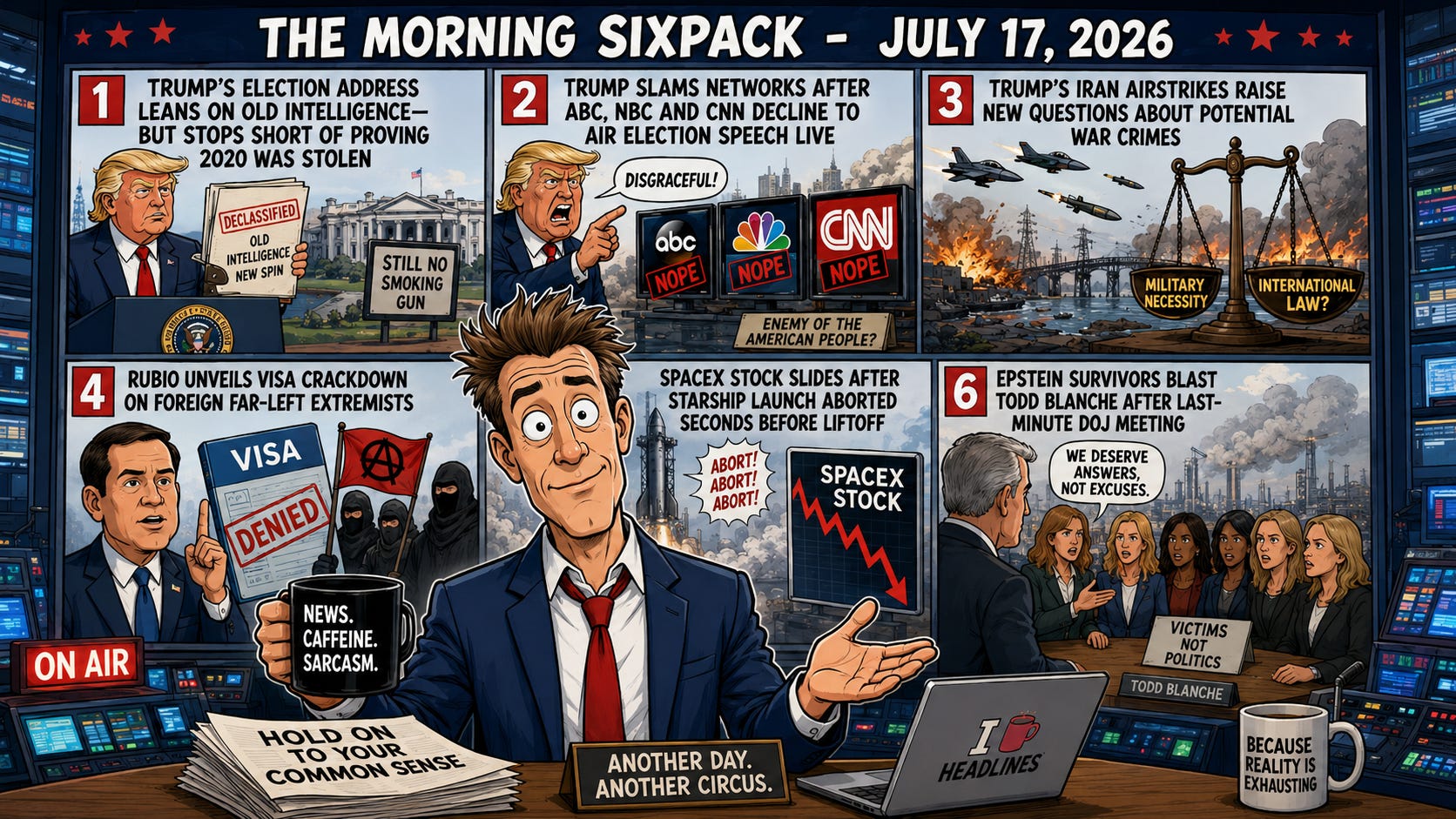
Trump used a prime-time address to revive 2020 election claims, but the declassified documents he highlighted stop well short of proving the outcome was changed—and in several places they undercut the broader narrative.
Trump’s Election Address Leans on Old Intelligence—But Stops Short of Proving 2020 Was Stolen
President Trump’s prime-time address promoted declassified intelligence as evidence of election vulnerabilities, but the documents themselves do not show that China—or any other foreign power—changed the outcome of the 2020 election.
The biggest headline wasn’t what the documents proved—it was what they didn’t.
The White House billed the speech as a major reveal, with Trump arguing that intelligence agencies sat on evidence showing China accessed voter data and exposed weaknesses in America’s election system. He directed the Justice Department to investigate and pursue criminal charges where warranted, while insisting the newly declassified material justified renewed scrutiny of the 2020 election.
“This evidence shows that the election system we have dangerously exposes—and really exposes like levels never thought possible—to hacking, exploitation, and foreign interference,” Trump said.
Dig into the documents, though, and the story gets more complicated. Intelligence assessments released by the administration acknowledge cyber activity and concerns about election espionage, but they also state that China was not assessed to have covertly interfered to sway the outcome of the 2020 election. Later dissenting views from a small number of intelligence officials questioned that conclusion, but even those stopped short of claiming the election result was altered.
Trump also revisited long-running concerns about voter rolls, election security, and voting technology while urging Congress to pass the SAVE Act. Election security experts continue to maintain that while vulnerabilities exist—as they do in any complex system—there remains no evidence that foreign actors changed vote totals in the 2020 presidential election. That distinction matters, even if it doesn’t make for the flashiest headline.
Source: NOTUS
Editor: If you’re going to promise a blockbuster reveal, the receipts should probably match the trailer. Otherwise, the debate just keeps replaying on an endless loop.
The bigger story wasn’t what Trump said—it was that major networks decided viewers shouldn’t see all of it on their biggest platforms.
Trump Slams Networks After ABC, NBC, And CNN Decline to Air Election Speech Live
President Trump blasted ABC, NBC, and CNN after they declined to carry his prime-time election security address on their primary broadcast platforms, accusing them of censorship and calling for their licenses to be revoked.
When major networks decide what’s too important—or too risky—for the public to watch live, they’re guaranteed to become part of the story themselves.
The speech, delivered four months before the midterm elections, centered on election security and declassified intelligence that Trump said pointed to Chinese interference efforts and vulnerabilities in the U.S. election system. ABC streamed the address on ABC News Live and aired it on radio, NBC carried it on NBC News NOW, and CNN offered it on its website and subscription streaming service instead of their primary television platforms. CBS and Fox News aired the speech live, although CBS interrupted its coverage to fact-check and challenge several of Trump’s claims.
“In a rare move NBC and ABC fake news have both said they would not cover this speech,” Trump said, adding, “Fraud like this should mean a revocation of their licenses.”
The decision came as broadcasters face increasing political pressure. FCC Chairman Brendan Carr has argued the public should have access to presidential addresses over the public airwaves, while ABC and NBC are already dealing with federal regulatory scrutiny on unrelated matters. Media organizations counter that the First Amendment gives broadcasters broad discretion over what they choose to air, even though presidents have traditionally received live network coverage during nationally televised addresses.
The controversy added another chapter to Trump’s long-running battle with legacy media. Democrats had urged networks not to air the speech, arguing it would repeat claims about the 2020 election that intelligence officials and election experts have disputed. By night’s end, the fight over whether Americans should see the speech live had nearly eclipsed the speech itself.
Source: Reuters
Editor: Networks have every right to choose their programming. Viewers have every right to notice when editorial decisions become the headline instead of the speech. Plus, there is no law that EVERY broadcast network carry presidential addresses.
Knocking out military targets is one thing; destroying civilian infrastructure that keeps millions alive is where the legal questions get much harder. #WarCrimes
Trump’s Iran Airstrikes Raise New Questions About War Crimes
The latest U.S. airstrikes on Iran are expanding beyond military sites to include bridges, power infrastructure, and a key port—moves that could trigger scrutiny under the laws of armed conflict.
Whether these attacks become known as military necessity or potential war crimes may ultimately depend on one question: Were civilians or civilian infrastructure deliberately targeted without a proportionate military justification? ANSWER: Yes, they were. Trump doesn’t care.
The overnight strikes reportedly hit bridges, energy infrastructure, and collapsed a tower at Iran’s Chabahar port as President Trump vowed to increase pressure on Tehran over its control of the Strait of Hormuz. Iran says dozens were killed and hundreds wounded in the latest attacks, while retaliatory missile strikes hit U.S. allies across the Middle East, including damage to a water desalination facility in Kuwait.
International humanitarian law does not automatically make attacks on infrastructure illegal. Bridges, ports and electrical facilities can become lawful military targets if they are being used to support military operations. However, the Geneva Conventions and customary laws of war require combatants to distinguish between military objectives and civilian objects, avoid indiscriminate attacks, and ensure civilian harm is not excessive compared with the anticipated military advantage. If investigators determine civilian infrastructure was intentionally targeted without sufficient military necessity—or that expected civilian harm was clearly disproportionate—the strikes could become the subject of allegations of war crimes.
Legal experts would also closely examine attacks on electrical systems if they leave large civilian populations without power, water, or medical care. Likewise, strikes on transportation networks and commercial ports would be evaluated based on whether they primarily served military purposes or whether the attacks unnecessarily disrupted civilian life. Those are fact-intensive determinations that typically require independent investigations rather than political statements from either side.
Source: Associated Press
Editor: Every government insists it’s hitting legitimate military targets. History has a way of asking tougher questions once the smoke clears. THIS is one of many reasons the Trump administration is attempting to dismantle the International Criminal Court (ICC). Look it up!
Visa bans for foreign extremists are one thing. Redefining what qualifies as terrorism is where the real fight begins.
Rubio Unveils Visa Crackdown on Foreign “Far-Left Extremists”
Secretary of State Marco Rubio announced a new visa restriction policy targeting foreign members and supporters of violent “far-left” extremist groups, arguing the United States has ignored left-wing political violence for too long.
The policy is aimed at foreign nationals tied to violent extremist organizations—not Americans—and signals the Trump administration’s broader effort to make “far-left” terrorism a top national security priority.
Rubio unveiled the policy while opening an international summit on political terrorism in Washington, saying the U.S. counterterrorism establishment has long had a “blind spot” when it comes to violence from the political left. The new restrictions apply to foreign individuals accused of supporting or inciting terrorism, participating in economic sabotage, or aiding violent criminal acts. Rubio also said additional terrorist designations are on the way as the administration expands its focus beyond Islamist and right-wing extremist threats.
“It is easy to destroy great things; it is far more difficult to make them,” Rubio said. “The enemies of civilization are only capable of the former.”
Editor: Like the J6ers and “DOGE.”
The announcement reflects a broader shift in the Trump administration’s counterterrorism strategy. Officials point to recent research showing an increase in left-wing extremist attacks from historically low levels, while critics note those incidents remain far below the historical levels of violence associated with right-wing extremists and jihadist groups. The debate is likely to center not only on the threat itself, but also on how broadly the administration defines “far-left extremist” and whether the policy is narrowly focused on violent actors or eventually expands beyond them.
Source: UPI
Editor: Every administration redraws its national security priorities. The challenge is making sure the definitions stay tied to violent conduct—not political labels.
Rocket science is hard. Public companies get reminded of that in real time.
SpaceX Stock Slides After Starship Launch Aborted Seconds Before Liftoff
SpaceX shares fell again after the company scrubbed its first Starship test flight since its record-breaking IPO when engine problems forced an automatic launch abort just before liftoff.
Wall Street is learning what space fans have always known: Every test flight is also a test of investor patience.
The Starship launch was called off Thursday during the final countdown after multiple Raptor engines failed to ignite properly, triggering the rocket’s automated safety system. Elon Musk said the vehicle was being safely defueled and blamed the scrub on engines that failed to start. He later announced two Raptors would be replaced and that another launch attempt is planned for early next week.
“Some of the engines didn’t start, triggering an automatic launch abort,” Musk posted on X. “Now offloading propellant. Next launch attempt hopefully in a few days.”
The setback comes at a time when investors are paying closer attention than ever. SpaceX went public in June in what was billed as the largest IPO in history, raising $85.7 billion. Shares have swung sharply since the debut, and this marked Starship’s first major test under the scrutiny of public shareholders. The previous flight in May also ended in disappointment after problems with both the upper stage and Super Heavy booster prompted an FAA investigation.
Source: CNBC
Editor: Test flights are supposed to find problems before astronauts—or paying customers—are onboard. Investors may not enjoy the ride, but this is exactly what a development program looks like. #Truth
Meeting with victims after senators demand it may satisfy a confirmation hearing, but it doesn’t necessarily rebuild trust.
Epstein Survivors Blast Todd Blanche After Last-Minute DOJ Meeting
Acting Attorney General Todd Blanche met with survivors of Jeffrey Epstein’s abuse only after Republican senators made it a condition for advancing his nomination—and at least one survivor left calling the meeting a political stunt.
The meeting may have checked a box for the Senate, but survivors say it did little to answer the questions they’ve been asking for months.
Blanche met with a group of Epstein survivors Thursday at the Justice Department after Sens. Thom Tillis and John Cornyn pressed him during his confirmation hearing to hear directly from victims before seeking their support. Tillis later praised Blanche for holding the meeting, but survivor Dani Bensky said the discussion was disappointing, accusing Blanche of repeatedly interrupting participants and failing to commit to investigating anyone beyond Jeffrey Epstein and Ghislaine Maxwell or adequately addressing the release of victims’ identifying information.
“He danced around his wording, repeatedly interrupted us, and could not commit to anything that would demonstrate good faith or begin to restore trust,” Bensky said.
The Justice Department described the meeting as “productive,” saying Blanche answered questions about ongoing investigations and encouraged survivors to meet directly with FBI investigators. But the encounter marked a sharp reversal after survivors said Blanche had ignored repeated requests to meet with them while overseeing the controversial release of Epstein case files. During his confirmation hearing, Bensky testified that Blanche “simply ignored us for the past eight months” and accused him of treating the Epstein files as a political problem rather than focusing on the victims.
Source: NOTUS
Editor: Confirmation hearings can force uncomfortable conversations. Whether those conversations lead to accountability—or just better optics—is a different question.
One thing is nearly FOR SURE: Blanche gets confirmed.
When thousands get sick, it’s no longer just a food recall—it’s a supply chain problem.
BONUS: Taco Bell Lettuce Linked to Massive Parasite Outbreak Across Multiple States
Federal investigators have traced a multistate cyclosporiasis outbreak that has sickened thousands of people to shredded iceberg lettuce served at Taco Bell restaurants in five states.
The investigation now reaches beyond Taco Bell, as officials work to determine whether contaminated lettuce from the same supplier was distributed elsewhere.
The Centers for Disease Control and Prevention and the Food and Drug Administration said traceback investigators linked the outbreak to shredded iceberg lettuce supplied to Taco Bell locations in Indiana, Kentucky, Michigan, Ohio and West Virginia. While federal officials have not publicly identified the supplier, multiple reports say investigators have traced the lettuce to Taylor Farms. More than 1,600 people sickened in the outbreak reported eating at Taco Bell, while Michigan alone has logged more than 4,300 cases and at least 100 hospitalizations.
“The investigation remains active, and additional states, restaurants, retailers, or products may be identified as more information becomes available,” Health and Human Services spokesperson Emily Hilliard said.
Taco Bell said it has voluntarily removed the potentially affected lettuce from the supplier in the impacted states and is replacing it throughout its supply chain. Federal investigators are now working to determine whether the contaminated lettuce was distributed to other restaurants or retailers. Cyclospora is a microscopic parasite that causes severe gastrointestinal illness and can linger for weeks if left untreated, making outbreaks especially difficult to contain and trace.
Source: The Washington Post
Editor: Salads are supposed to come with dressing—not a visit from the CDC. The next question is whether this lettuce stopped at Taco Bell or kept traveling through the food supply. ANSWER: Likely that this lettuce went everywhere. List.
You just knew Taco Bell had to be involved!