



The Morning Sixpack stays free because the news that shapes your life should not be hidden behind a paywall. Paid subscribers are not paying for access. They are helping fund the research, writing, and independent voice that goes into every issue. Become a paid subscriber and help keep smart, honest news analysis free for everyone.
Democrats didn’t just have a good election night. They flipped Republican strongholds, made history in multiple states, and handed Donald Trump and his party a sweeping defeat. Now the White House is preparing for a very different Washington.
Democrats Deliver a YUGE Midterm Victory, Seizing Control of Congress and Flipping Republican Strongholds
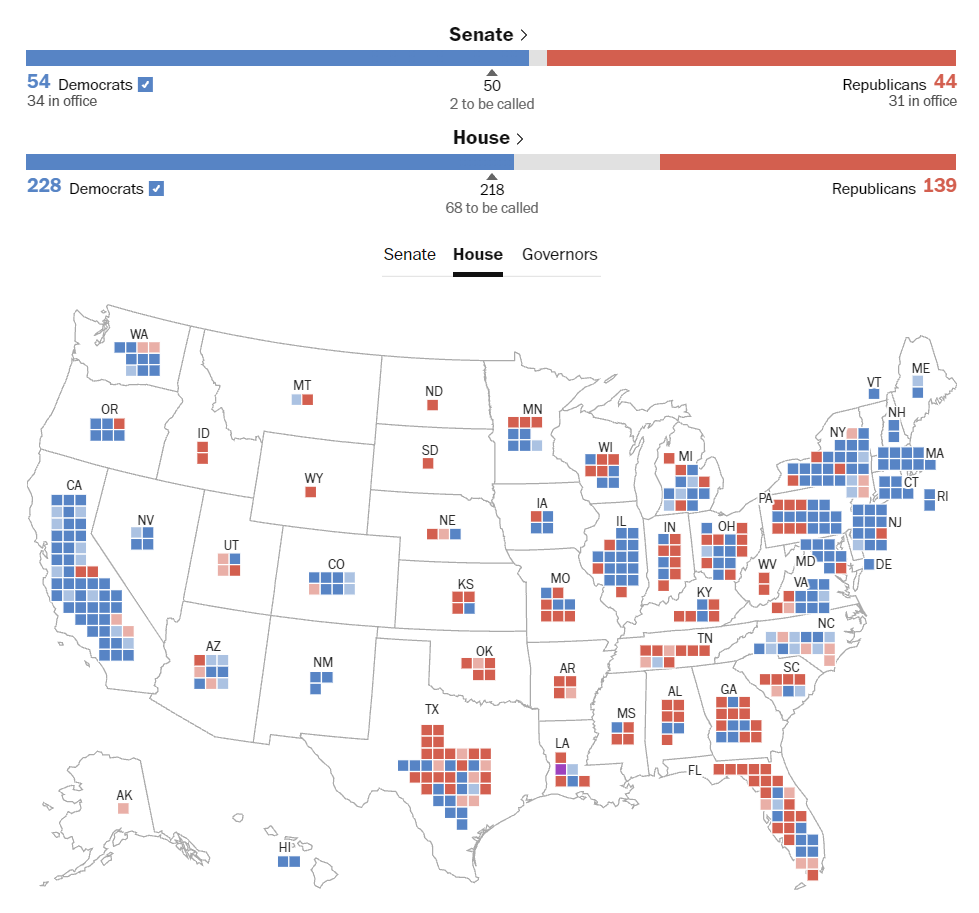
Democrats delivered a sweeping victory in the 2026 midterm elections, winning control of both the House of Representatives and the Senate while capturing major races in states long considered Republican territory. The results represented a dramatic rejection of the political direction of President Donald Trump and his Republican allies. Democratic candidates won competitive races across the country, including Senate contests in traditionally Republican states and gubernatorial elections that shifted state leadership. What began as an election focused on economic dissatisfaction, tariffs, and the increasingly unpopular war with Iran became a nationwide political reckoning for the party in power.
The scale of the Democratic victories extended far beyond the congressional battlegrounds that dominated pre-election coverage. Democrats flipped Senate seats in states including Texas, Ohio, North Carolina, Iowa, Kansas, Maine, and South Carolina, while defending important seats elsewhere. Democratic gubernatorial candidates also scored significant victories, including historic wins in Georgia and Texas. The breadth of the results showed Democratic candidates succeeding in places where Republicans had maintained substantial advantages for years. By the time the results became clear, Democrats had secured the congressional majorities needed to challenge the Trump administration’s legislative agenda and exercise greater oversight of the executive branch.
The elections were shaped by growing public frustration over economic conditions and the administration’s foreign policy decisions. The war with Iran became a major political liability for Republicans, particularly as voters expressed concerns about energy prices and the costs of military involvement overseas. Trump’s tariffs and their economic consequences also became prominent campaign issues. Democratic candidates emphasized affordability, government accountability, and opposition to administration policies, while Republicans struggled to defend their record. The results suggested that dissatisfaction with the administration extended well beyond reliably Democratic states and districts.
The new Democratic majorities will fundamentally change the balance of power in Washington. House Democrats will gain control of committees, investigations, and legislative priorities, while Senate Democrats will have the authority to shape the chamber’s agenda and oversee executive appointments. The administration will face substantially greater scrutiny from Congress during the final two years of Trump’s term. Republicans, meanwhile, must confront the political consequences of losing both chambers and determine how to respond before the 2028 presidential election.
For Democrats, the results offer both an opportunity and a significant governing challenge. Winning congressional majorities creates the ability to investigate administration actions, pursue legislative priorities, and challenge White House policies, but it does not eliminate the obstacles posed by presidential veto power or partisan divisions. The party must now translate electoral success into a coherent governing strategy while managing its own ideological differences. Nevertheless, the message from the 2026 midterms was unmistakable: voters delivered major victories to Democrats across Congress, state governments, and districts that Republicans had expected to hold.
Editor: Democrats didn’t merely squeak out a congressional majority. They won both chambers, flipped Republican seats across the country, and captured governorships that had been in GOP hands for decades. Trump spent months making the election a referendum on his presidency. Voters accepted the invitation. The results weren’t remotely close to what Republicans had hoped for.
One must wonder when the shenanigans and lawsuits begin… Trump and his MAGA troglodytes won’t take this beating well.
Source: The Washington Post — 2026 Midterm Election Coverage
Trump campaigned across the country urging voters to treat the midterms as a referendum on him. After Republicans lost, the White House began explaining why the results were everyone else’s responsibility.
Trump White House Deflects Blame After Democratic Sweep, Warns Political Fight Is Far From Over
President Donald Trump’s White House responded to the Democrats’ sweeping midterm victories by shifting responsibility for Republican losses onto candidates, turnout problems, and other political factors. Trump had spent the campaign season appearing at approximately 30 events across 20 states, repeatedly encouraging supporters to vote as though his own name were on the ballot. After the results went against Republicans, however, he emphasized that he had not personally been a candidate. The reversal came as Democrats captured both chambers of Congress and delivered a series of major defeats to Republican candidates nationwide.
Inside the administration, advisers offered competing explanations for the Republican collapse, with some blaming weak candidates and others acknowledging the political damage caused by administration policies. The war with Iran, rising gasoline prices, and Trump’s tariffs were among the issues identified as potential contributors to voter dissatisfaction. Some officials argued that Republican candidates had failed to attract enough of Trump’s supporters when he was not personally running. Others recognized that the administration’s decisions had become central campaign issues. The competing explanations revealed disagreements over whether the losses reflected candidate-specific problems or a broader rejection of the president’s agenda.
The political consequences are likely to extend well beyond election night. With Democrats preparing to take control of Congress, White House officials and administration staff have begun considering the possibility of extensive congressional investigations. According to reporting by Semafor, some administration personnel were already seeking legal representation in anticipation of increased scrutiny. Democratic control of House committees will provide new opportunities to examine executive branch decisions, spending, and conduct. The administration will face a Congress far less willing to defer to the president’s priorities.
Despite the losses, the White House signaled that it had no intention of retreating from political confrontation. One administration official warned Democrats to “Buckle up,” suggesting that the coming battles between Congress and the executive branch could be intense. Trump said he would accept the election results, even as his administration prepared for a more adversarial political environment. Republicans now face the challenge of defending the administration’s record while adjusting to minority status in both chambers of Congress.
The election also raises questions about Trump’s political influence when he is not personally on the ballot. His ability to mobilize supporters has long been central to Republican electoral strategy, but the midterm results demonstrated that his involvement did not guarantee success for candidates he supported. The administration must now contend with Democratic congressional majorities, growing oversight pressure, and internal disagreements over what went wrong. The next two years could feature sustained conflict over investigations, spending, legislation, and executive authority as both parties position themselves for 2028.
Editor: Trump wanted the midterms to be all about him—right up until the voters delivered their verdict. Now it’s the candidates’ fault, the party’s fault, and anyone else’s fault. Meanwhile, White House officials are already shopping for lawyers and telling Democrats to “buckle up.” Sounds like the next two years will be anything but boring.
Source: Semafor
A Navy admiral fired by Pete Hegseth just won a Republican-leaning South Carolina congressional seat, turning her former boss into a central issue in her successful campaign.
Fired by Hegseth, Navy Admiral Flips Deep-Red South Carolina House Seat for Democrats
Democrat Nancy Lacore, a former Navy admiral fired by Defense Secretary Pete Hegseth, has won a South Carolina congressional seat that Donald Trump carried by 13 percentage points in 2024. Lacore defeated Republican Jenny Costa Honeycutt in the state’s 1st Congressional District, according to a projection by Decision Desk HQ. With all votes tallied early Wednesday, Lacore received just under 50 percent of the vote, while Honeycutt finished above 48 percent. The victory adds another Republican-held seat to the Democratic column following Tuesday’s nationwide midterm elections.
Lacore made Hegseth’s leadership of the Pentagon and the increasingly unpopular war with Iran central issues in her campaign. The former admiral criticized the defense secretary who had fired her, drawing on more than three decades of military service to challenge the administration’s handling of national security. Her message resonated in a district that had been redrawn to favor Republicans and was widely expected to remain in GOP hands. The result represents a significant political reversal in a traditionally conservative South Carolina district.
Lacore brought extensive military experience to the race, beginning her Navy career as a helicopter pilot before rising to become chief of the Navy Reserve. In that position, she oversaw more than 60,000 sailors and had previously completed two deployments. Her defense credentials became a defining feature of her campaign, particularly among voters concerned about the Pentagon’s leadership and the ongoing conflict with Iran. Rather than avoiding national security issues, Lacore used her experience to make them a central part of her argument to voters.
The district had previously been represented by Republican Nancy Mace, who gave up her House seat to pursue an unsuccessful campaign for South Carolina governor. Lacore first had to defeat fellow Democrat Mac Deford, a Coast Guard veteran, in a competitive June primary runoff. She then faced Honeycutt, a Charleston County Council member, in the general election. As Lacore raised more campaign money than her Republican opponent, the nonpartisan Cook Political Report shifted its assessment of the contest from “lean Republican” to “toss-up.” That change reflected growing uncertainty about a seat Republicans had expected to retain.
Lacore’s victory illustrates how the political consequences of the Iran war extended into congressional races far beyond Washington. Her campaign linked criticism of Hegseth’s management of the Defense Department with concerns about the administration’s military decisions. The result also demonstrates the limits of Republican-friendly redistricting when voters move sharply against the party in power. For Democrats, the win adds to their expanded House majority and provides another example of a Republican-leaning district changing hands in the 2026 midterms.
Editor: Pete Hegseth fired Nancy Lacore from the Navy. She responded by running for Congress, criticizing his leadership, and winning a district Trump carried by 13 points. Hegseth may have ended her military career, but he certainly didn’t end her career in public service.
Source: The Hill
Trump called him a “jihadist,” Republicans poured money into attacking his religion, and even a fellow Democrat endorsed his opponent. Abdul El-Sayed won anyway—and made American history.
Abdul El-Sayed Defeats Republican Mike Rogers, Becomes First Muslim Elected to U.S. Senate
Democrat Abdul El-Sayed defeated Republican Mike Rogers in Michigan’s closely contested Senate race Tuesday, becoming the first Muslim ever elected to the United States Senate. The Michigan-born physician and epidemiologist overcame a well-funded Republican campaign that targeted his religion, political positions, and views on Israel. His victory kept the seat being vacated by retiring Democratic Sen. Gary Peters in Democratic hands and contributed to the party’s nationwide Senate gains. El-Sayed, the son of Egyptian immigrants, ran as an outspoken progressive promising to challenge Washington’s political establishment and reduce the influence of wealthy donors and corporations.
The campaign became one of the country’s most contentious Senate contests, with Donald Trump and Republican allies repeatedly attacking El-Sayed’s Muslim identity. Trump labeled him a “jihadist,” while Republican messaging questioned his loyalty and portrayed his political views as dangerous. Rogers, a former FBI agent, Army veteran, and seven-term congressman who once chaired the House Intelligence Committee, emphasized El-Sayed’s positions on Israel and progressive economic policies. El-Sayed countered with an economic populist message focused on taxing billionaires, breaking up monopolies, reforming campaign finance laws, and establishing Medicare for All. He carried that message into heavily Republican areas of Michigan that had helped elect Trump.
The race took an extraordinary turn just two days before Election Day when Democratic Rep. Haley Stevens, who had lost to El-Sayed in the party’s Senate primary, endorsed Republican Mike Rogers. Stevens cited disagreements over Israel and a personal conflict with El-Sayed as reasons for crossing party lines. Her decision outraged Democrats and triggered millions of dollars in additional donations to El-Sayed’s campaign. What Stevens intended as a rebuke of her former primary opponent may instead have strengthened his position during the campaign’s final hours. The endorsement added another layer of controversy to an already bitter contest.
Foreign policy and economic concerns also divided the candidates. El-Sayed called for ending American taxpayer support for Israel’s military, a position supported by some progressives but strongly criticized by Jewish Democrats. His decision to campaign alongside controversial Twitch streamer Hasan Piker also drew criticism because of Piker’s past comments about the September 11 attacks and Hamas. Rogers promoted working-family tax cuts, manufacturing jobs, and closer cooperation with Trump to address trade tensions with Canada. He also proposed a temporary gas tax holiday and expanded vocational education as ways to ease economic pressure on Michigan families.
El-Sayed’s victory carries significance beyond the outcome of a single Senate race. His election marks a historic first for Muslim representation in Congress’s upper chamber and demonstrates that a progressive candidate can compete statewide in a politically divided industrial state. His campaign combined economic arguments with an explicit challenge to corporate political influence, while confronting attacks on his religious identity. The result also highlights the political divisions within both parties over Israel, foreign policy, and the direction of American politics. As Democrats prepare to take control of the Senate, El-Sayed will arrive in Washington having defeated a prominent Republican opponent, survived a bitter intraparty dispute, and made electoral history.
Editor: Trump called El-Sayed a “jihadist.” Republicans attacked his religion. A fellow Democrat even endorsed the Republican. Michigan voters elected El-Sayed anyway, making him the first Muslim U.S. senator. That’s quite a collection of political attacks to overcome—and quite a historic result.
Source: The Washington Post
California voters chose a former Biden administration official over a former Fox News commentator, keeping the governor’s mansion in Democratic hands as Gavin Newsom prepares to leave office.
Xavier Becerra Defeats Steve Hilton to Become California’s Next Governor
Democrat Xavier Becerra is projected to become California’s next governor after defeating Republican Steve Hilton in Tuesday’s election. Becerra, who previously served as California attorney general and U.S. Health and Human Services secretary under President Joe Biden, entered Election Day with a substantial polling advantage. His victory will keep California’s governorship under Democratic control as Gov. Gavin Newsom prepares to leave office at the end of the year. Newsom, who has served two terms, was prohibited by state law from seeking another consecutive term.
Becerra’s victory came against a Republican opponent with experience in conservative media and British politics. Hilton, a former Fox News commentator, previously served as director of strategy for British Prime Minister David Cameron. The two candidates offered different political backgrounds and approaches to governing the nation’s most populous state. Becerra emphasized his experience in state and federal government, while Hilton entered the race with a background in political strategy and conservative commentary. Polling in the final days before the election showed Becerra holding a wide lead.
During the campaign, Becerra outlined several proposals that could shape California’s next administration. Among them was a possible new income tax on the state’s wealthiest residents, a healthcare-related fee on major corporations, and changes to California’s long-running high-speed rail project. Those proposals would place taxation, healthcare financing, and infrastructure among the major issues facing his administration. The article did not provide detailed implementation plans, leaving questions about how the proposals would move through the state legislature and what their financial impact might be.
Becerra celebrated his projected victory Tuesday night before an enthusiastic crowd chanting “Sí, se puede,” the Spanish-language slogan meaning “Yes, we can.” He spoke about his background as the son of immigrants who grew up in a union household and reflected on the difficulty of the campaign. Describing the previous two years as challenging, he told supporters that what had seemed like an impossible mission was actually a necessary one. He then joined the crowd in chants before declaring, “Yes, we can. Yes, we did.”
The election marks another chapter in Becerra’s lengthy career in Democratic politics, which has included leadership roles in both Sacramento and Washington. His experience as California attorney general and federal health secretary gives him a background in legal and healthcare policy as he prepares to assume the governorship. But winning the election is only the beginning: His administration will face questions about taxation, corporate healthcare costs, and the future of the state’s expensive high-speed rail project. With Newsom’s departure approaching, Becerra now has the opportunity to establish his own priorities while maintaining Democratic leadership of California’s executive branch.
Editor: California is trading one Democratic governor for another, but Becerra isn’t simply inheriting Newsom’s job. He’s proposing new taxes on wealthy residents, healthcare fees for major corporations, and changes to high-speed rail. Winning comfortably is one thing. Getting those proposals through Sacramento—and making them work—is the real test.
Source: KCRA 3
Georgia elected its first Black woman governor, ending more than two decades of Republican control of the governor’s office and marking a historic milestone in American politics.
Keisha Lance Bottoms Makes History as Georgia Elects Its First Black Woman Governor
Democrat Keisha Lance Bottoms defeated Republican billionaire Rick Jackson in Georgia’s gubernatorial election Tuesday, becoming the first Black woman ever elected governor of a U.S. state. The former Atlanta mayor also becomes Georgia’s first female governor, marking two historic firsts in a single election. Bottoms, 56, succeeds Republican Gov. Brian Kemp, who is leaving office after serving two consecutive terms. Her victory ends more than 20 years of Republican control of Georgia’s governorship and represents another major Democratic gain in the 2026 midterm elections.
Bottoms’ victory reflects the political transformation of Georgia, a state that was once reliably Republican but has become one of the nation’s most competitive electoral battlegrounds. Black voters have played a central role in building the Democratic coalition responsible for that shift. Bottoms previously served as Atlanta’s mayor before joining President Joe Biden’s administration as a senior adviser and director of the White House Office of Public Engagement. Her experience in municipal government and the White House provided a contrast with Jackson, a businessman who presented himself as a political outsider.
Jackson, the billionaire founder of healthcare staffing company Jackson Healthcare, campaigned on reducing taxes, strengthening public safety, and cutting government regulations. He sought to maintain Republican control of a governor’s office the party had held for more than two decades. Bottoms, meanwhile, benefited from the political organizing infrastructure that Democrats have developed across Georgia over successive election cycles. Her victory demonstrates how that coalition has expanded its influence beyond presidential and Senate elections to capture the state’s highest executive office.
The result also builds on the political groundwork established by Stacey Abrams, who became the first Black woman nominated for governor by a major U.S. political party in 2018. Although Abrams lost her gubernatorial campaigns in 2018 and 2022, her organizing efforts helped develop a multigenerational, multiracial Democratic coalition in Georgia. That coalition contributed to the election of two Democratic U.S. senators and helped deliver Georgia’s electoral votes to a Democratic presidential candidate for the first time in decades. Eight years after Abrams made history with her nomination, Bottoms has achieved the electoral breakthrough that had eluded her predecessor.
Bottoms’ election was part of a broader night of historic political milestones. Stacey Plaskett won the governorship of the U.S. Virgin Islands, becoming the first Black woman elected governor of a U.S. jurisdiction, although the Virgin Islands is a territory rather than a state. In Florida, Republican Rep. Byron Donalds won the governor’s race, becoming the first Black Republican elected governor in American history. Together, the results mark significant developments in representation across state and territorial executive offices. For Georgia, Bottoms’ victory also means a change in party leadership after more than two decades of Republican governors.
Editor: Eight years ago, Stacey Abrams became the first Black woman nominated for governor by a major party. She lost twice, but the organizing movement she helped build continued. Now Keisha Lance Bottoms has won the office, making history twice over and ending more than 20 years of Republican control. Georgia’s political transformation didn’t happen overnight, and this election shows just how far it has come.
Source: Reuters
Read The Morning Sixpack here: