


SPECIAL REPORT
The Math of Mass Deportation: Why Trump’s Plan Would Take Decades — or a Radical Expansion of State Power
When Donald Trump and his allies talk about mass deportation, they present it as an urgent, achievable project—a matter of will, toughness, and funding. The numbers tell a very different story.
At the center of the debate is a simple but unavoidable question: How long would it actually take to deport millions of people from the United States?
The Scale of the Target
The undocumented immigrant population in the United States is most commonly estimated at around 11 million people, though some political figures on the right claim the true number is far higher. Trump himself has repeatedly promised to deport “all” undocumented immigrants if returned to power. His top immigration adviser, Stephen Miller, has used rhetoric suggesting deportation on a scale never before attempted in modern U.S. history—with some statements and allied commentary inflating the target to a hundred million or more!
Even using the lowest credible estimate—11 million people—the logistics are staggering.
Current Reality: How Deportation Actually Works
Despite heated political rhetoric, deportation is not instantaneous. It is a labor-intensive, legally constrained process involving:
Identification and arrest
Detention or supervised release
Immigration court proceedings
Appeals and due process
Physical removal by air or land
Coordination with foreign governments
At present, Immigration and Customs Enforcement—U.S. Immigration and Customs Enforcement—removes roughly 300,000 to 600,000 people per year, depending on policy priorities, border activity, and court throughput.
This figure already includes:
Interior arrests
Border removals
Expedited removals
It is not a low-effort baseline. It reflects near-maximum operational capacity under recent administrations.
The Math No One Talks About
At the current pace, deportation timelines look like this:
300,000 removals per year → ~37 years to deport 11 million people
600,000 removals per year → ~18 years
1 million removals per year → ~11 years
3 million removals per year → ~4 years
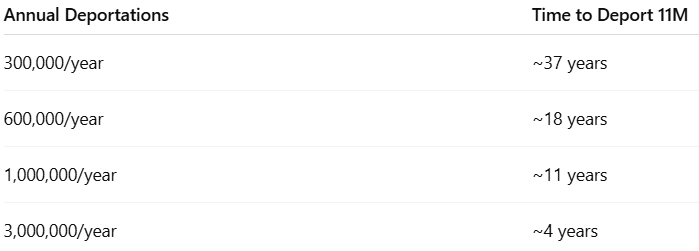
This math assumes:
No new undocumented immigration
No population growth
No successful legal challenges
No humanitarian or political slowdowns
In the real world, those assumptions do not hold.
Bottom line:
Without a massive escalation, deporting even 11 million people would take multiple decades—far longer than a single presidency, or even two.
The Gap Between Rhetoric and Capacity
To complete mass deportation within a single four-year term, ICE would need to increase removals by five to ten times current levels.
That would require an unprecedented transformation of the federal enforcement apparatus:
1. Explosive Growth in Enforcement Personnel
ICE would need tens of thousands of new agents, investigators, and support staff—trained, armed, and deployed nationwide for interior enforcement.
2. Detention Infrastructure on a Wartime Scale
Current detention capacity numbers in the tens of thousands of beds. Deporting millions would require:
Vast new detention facilities
Long-term contracts with private prison companies
Military-style logistics for housing, feeding, and transporting detainees
3. Immigration Court Overhaul or Bypass
The immigration court system already has millions of backlogged cases. Accelerating deportation would likely require:
Curtailing appeals
Expanding expedited removals
Reducing judicial discretion
Possibly bypassing courts altogether for large categories of people
Each of those steps would provoke constitutional and human-rights challenges.
Funding: Why $75 Billion Is Only a Down Payment
Trump and congressional Republicans have pointed to roughly $75 billion in recent enforcement funding—sometimes described as part of the “big beautiful bill”—as proof the machinery is already in place.
It isn’t.
Independent analyses suggest that full mass deportation could cost hundreds of billions to nearly $1 trillion over time, once detention, staffing, transportation, courts, surveillance, and state cooperation are factored in.
Crucially, deportation is not a one-time purchase. It is an ongoing operational burn rate, year after year.
Without sustained congressional funding at historically unprecedented levels, deportation rates would plateau far below stated goals.
What “100 Million” Actually Means
Claims about deporting 100 million people are not policy documents—they are political signals.
To reach numbers that high would require:
Sweeping removal of lawful permanent residents
Revocation of visas at scale
Denaturalization campaigns
Family-based removals extending to U.S. citizens by association
That would mark a radical departure from existing immigration law and constitutional norms—transforming deportation from enforcement policy into a mass population purge.
The Central Contradiction
Trump’s deportation agenda faces a fundamental contradiction:
If enforcement remains within legal and logistical constraints, deportation will take decades.
If deportation is accelerated to meet political promises, it requires further dismantling legal safeguards, expanding detention dramatically, and funding enforcement at levels comparable to major federal wars. (Do you now understand why we invaded Venezuela and have talked up invading Greenland, Iran, Canada, Cuba, and Mexico?)
There is no middle ground where millions are deported quickly, cheaply, and lawfully.
There is an alternative, of course: Mass murders. Ask the Nazis about this. They are experts.
Conclusion: What the Numbers Reveal
Mass deportation is not a switch that can be flipped. It is a long, grinding, resource-intensive process—one that exposes the gap between campaign slogans and governing reality.
At current rates, the promise to deport millions is arithmetically incompatible with a single presidency. To make it otherwise would require a scale of federal power, spending, and coercion that the United States has never deployed against a civilian population in peacetime. But we see the signs, don’t we?
The math is unforgiving—and it raises a final question voters must confront:
Is the country prepared to fundamentally remake its legal system and enforcement state to chase a promise the numbers say cannot be kept?
If you found this analysis useful, share it.
The debate over deportation is driven by rhetoric—but the math tells its own story.