



The Morning Sixpack stays free because the news that shapes your life should not be hidden behind a paywall. Paid subscribers are not paying for access. They are helping fund the research, writing, and independent voice that goes into every issue. Plus, snark is expensive!
Become a paid subscriber and help keep smart, honest news analysis free for everyone.
America heads to the polls with control of Congress on the line, voters furious about rising prices, and Donald Trump insisting everything is going great. It may or not be a great day for Democrats. Don’t get your hopes up or down… Nothing is going to change. Trump is still POTUS and will remain lawless.
Midterm Showdown: Voters Decide Whether Trump’s Power Survives Election Day
Americans are voting Tuesday in a midterm election that could dramatically reshape the final two years of President Donald Trump’s second term. Democrats need to flip just three seats to take control of the House of Representatives and four to capture the Senate. With voters frustrated by rising prices, the war in Iran, and Trump’s handling of the economy, Republicans face an increasingly difficult battle to maintain their congressional majorities. Democrats are cautiously optimistic, particularly as competitive races have emerged in states Trump comfortably carried in 2024.
The economy has become Republicans’ biggest political liability, despite Trump’s insistence that inflation is under control. Annual inflation stands at 3.7%, compared with 3% when Trump returned to office, while his tariffs and the war with Iran have contributed to higher consumer and fuel prices. An October AP-NORC poll found that only 35% of Americans approve of Trump’s overall job performance, and just one-quarter approve of his handling of the economy. Even Republican voters are souring on his economic record, with roughly six in ten disapproving of his handling of living costs. Nevertheless, Trump told Fox News on Election Day that “inflation is solved” and predicted Republican results would be better than expected.
The battle for the Senate has expanded into territory Democrats once considered virtually unwinnable. In Texas, Democrat James Talarico is challenging scandal-plagued Republican Attorney General Ken Paxton, hoping to deliver the state’s first Democratic Senate victory since 1988. Kansas Republican Roger Marshall faces an unusually competitive challenge from Democratic pastor Adam Hamilton, while Democrats are also targeting seats in Iowa, Maine, Ohio, Alaska, and North Carolina. Michigan’s open Senate seat pits Democrat Abdul El-Sayed against Republican Mike Rogers in another closely watched contest. Meanwhile, Republicans are largely defending House districts Trump won in 2024, suggesting the political landscape has shifted considerably since his reelection.
Election Day has also brought concerns about federal involvement in voting and the mechanics of conducting elections. The Justice Department dispatched approximately 1,000 election monitors across all 50 states, including Democratic strongholds such as Detroit, Philadelphia, and Georgia’s Fulton County, prompting concerns from voting rights advocates about possible intimidation. A federal judge separately blocked the Trump administration from distributing additional lists of alleged noncitizen voters to state election officials, citing the potential for confusion and disruption. In New York’s Westchester County, malfunctioning voting machines forced officials to secure paper ballots in emergency bags while voting continued. Millions of Americans are also casting ballots in newly drawn congressional districts following a contentious round of mid-decade redistricting.
The consequences of Tuesday’s election could extend well beyond which party controls congressional committees. A Democratic House majority would gain subpoena powers and the ability to launch investigations into Trump’s administration, policies, and potential conflicts of interest. Some Democrats could push for impeachment proceedings against Trump or Cabinet officials, although the prospects remain uncertain. Losing the Senate would also seriously complicate Trump’s ability to confirm judges and senior administration nominees. With Trump’s approval ratings underwater and voters increasingly focused on their household finances, Republicans are counting on their fundraising advantage and loyal supporters to prevent Democrats from reclaiming power in Washington.
Editor: Trump says inflation is solved, Republicans say everything is fine, and voters say their grocery bills disagree. By tonight, we’ll find out whose version of reality wins.
Source: Associated Press
Harvard’s election forecast gives Democrats a 96% chance of taking the House and a 71% chance of capturing both chambers of Congress. Republicans might want to start measuring the curtains in their minority offices.
Harvard Forecast Gives Democrats a 96% Chance to Win the House
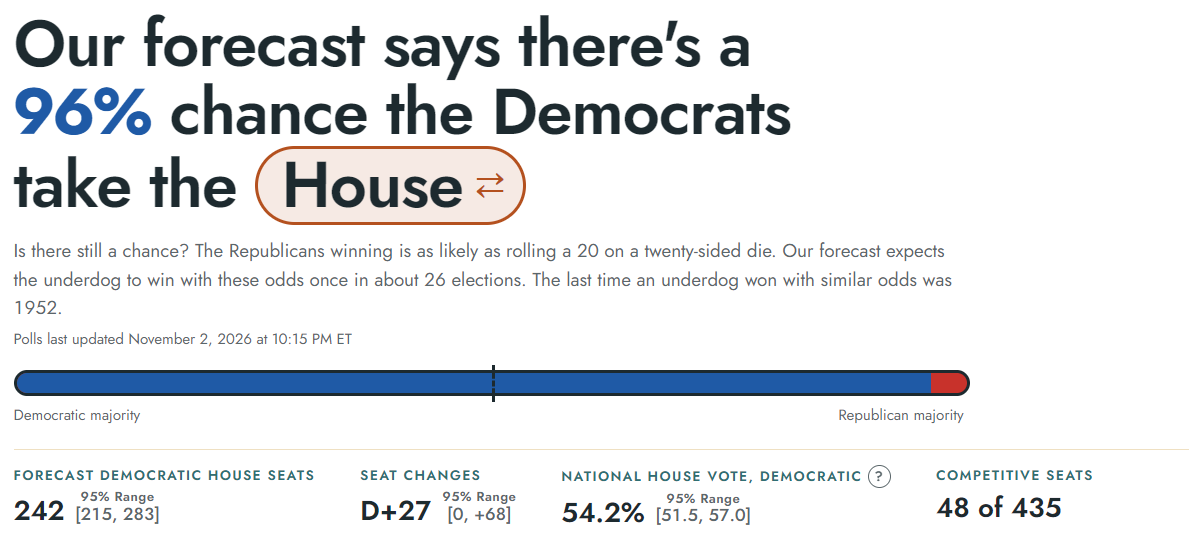
A Harvard-affiliated election forecasting project predicts Democrats are overwhelmingly favored to retake the House of Representatives and have a strong chance of winning the Senate in Tuesday’s midterm elections. ElectIt, a statistical forecasting project associated with Harvard political scientist Gary King, estimates a 96% probability that Democrats will capture the House and a 71% probability that they will control both chambers of Congress. Its central projection gives Democrats 242 House seats, a net gain of 27, with a 95% uncertainty range of 215 to 283 seats. The forecast suggests Republicans face a potentially devastating electoral setback that could fundamentally change the balance of power in Washington during President Donald Trump’s final two years.
The forecast points to a broad Democratic advantage that extends well beyond the handful of competitive districts needed to secure a House majority. ElectIt projects Democrats will receive approximately 54.2% of the average district-level two-party vote, with 48 House seats classified as competitive. The model identifies numerous Republican-held districts as likely Democratic pickups, including seats in California, Pennsylvania, Wisconsin, Arizona, Michigan, Virginia, and Iowa. Among its strongest predictions are Democratic victories in California’s 1st District and Pennsylvania’s 10th District, each assigned a 98% or greater probability of changing hands. The forecast also identifies several Republican incumbents facing serious trouble, including New York’s Mike Lawler and Pennsylvania’s Brian Fitzpatrick.
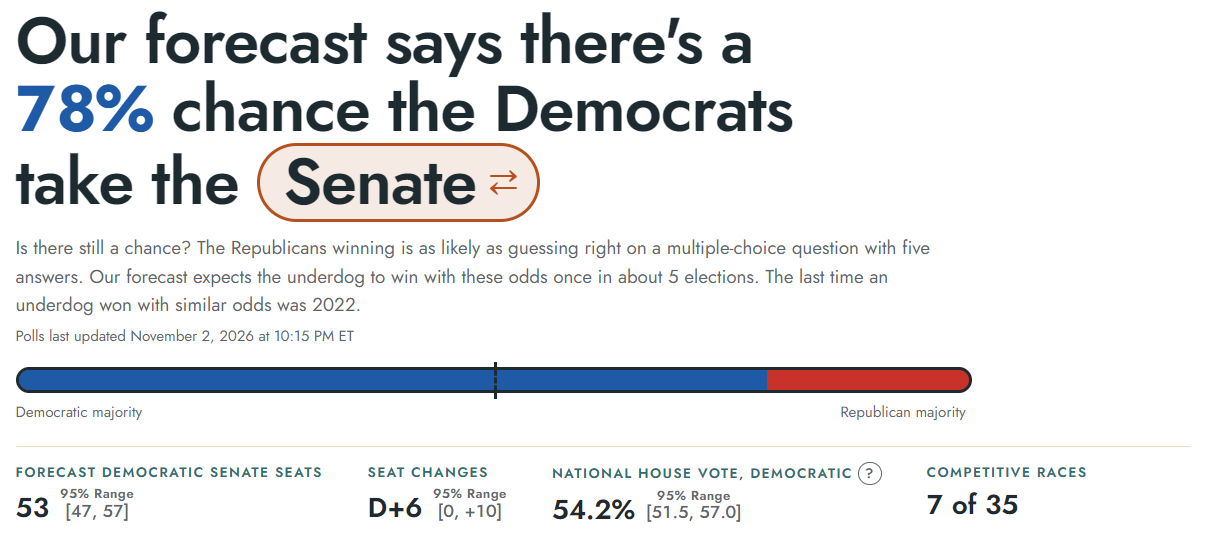
The Senate forecast is particularly consequential because Democrats began the election cycle facing a difficult electoral map dominated by Republican-leaning states. ElectIt’s analysis suggests Democrats could overcome those geographic disadvantages by winning competitive contests in states such as Alaska and Texas, with Iowa and Kansas also offering potential opportunities. Under a scenario in which national polling proves highly accurate, the model projects Democrats could finish with approximately 53 Senate seats alongside their 242-seat House majority. The project’s overall forecast assigns a 26% probability to Democrats winning the House while Republicans retain the Senate, and only about a 2% probability to Republicans maintaining control of both chambers. Those numbers suggest that divided government, rather than continued Republican dominance, is the more likely alternative to a complete Democratic takeover.
The forecast relies on a statistical model called LogisTiCC, developed using historical election results dating back to 1946, incumbency advantages, candidate characteristics, presidential midterm voting patterns, and contemporary polling. Researchers Danny Ebanks, Jonathan N. Katz, and Gary King designed the approach to account for uncertainty that traditional election forecasting models may underestimate. ElectIt offers three forecasting methods, including a model based on pre-campaign fundamentals, one incorporating national generic-ballot polling, and another incorporating district and state surveys. The researchers emphasize that their projections are probabilities rather than guarantees, and historical polling errors can still produce outcomes outside the most likely scenarios. They published their initial forecast October 15 and updated polling-based estimates through November 2.
ElectIt’s findings paint a difficult picture for Republicans, but the researchers caution against treating the projected results as inevitable. Their model still allows for a Republican House victory, while its 95% projected seat range includes outcomes in which Democrats narrowly miss a majority. The project also offers interactive scenarios allowing users to examine how individual congressional races could change the overall probability of Democratic control. In a notable demonstration of its methodology, the researchers compare the chance of a Republican House victory to rolling a particular number on a 20-sided die—unlikely, but certainly possible. As voters cast their ballots, the forecast provides a stark assessment of the political environment: Democrats are heavily favored to regain congressional power, but the final verdict belongs to the electorate.
Editor: Harvard’s computers are giving Democrats a 71% shot at running the whole congressional show. Republicans still have a path to victory, but it’s getting awfully narrow—and no amount of presidential ALL CAPS changes the math.
Source: Harvard University — ElectIt
Trump says America hasn’t been fighting Iran for months. Meanwhile, American fighter jets are exchanging missiles with Iranian forces. Apparently, somebody forgot to tell the Pentagon the war was over.
Trump Says the Iran War Is Over While U.S. Jets Trade Fire Near Hormuz
The U.S. military launched strikes against Iran’s strategically important Qeshm Island on Monday, even as President Donald Trump publicly downplayed the possibility of renewed warfare with Tehran. According to U.S. officials speaking to The Wall Street Journal, the attack was part of a series of limited military operations Washington has quietly conducted against Iran in recent weeks. The strikes have not been publicly announced, marking a departure from the administration’s earlier handling of the conflict. The contradiction became particularly glaring when Trump told reporters Monday that the United States had already won the war and hadn’t engaged in fighting for months.
American and Iranian forces exchanged fire Monday in separate incidents near the Strait of Hormuz, raising questions about just how peaceful the supposedly concluded conflict really is. U.S. officials said Iran’s Islamic Revolutionary Guard Corps fired a surface-to-air missile at an American fighter jet, which returned fire in self-defense. In another confrontation, American forces intercepted an Iranian missile launched from Qeshm Island that was reportedly targeting commercial shipping. Officials characterized the American operations as defensive measures intended to prevent Iran from threatening vessels traveling through the strategically vital waterway. One official said the administration has deliberately kept the strikes quiet to avoid signaling that Washington intends to resume large-scale combat operations.
Qeshm Island occupies a critical position at the entrance to the Strait of Hormuz, one of the world’s most important shipping routes for oil and other commodities. The island houses a substantial underground missile installation, a naval base, and a major desalination facility, making it a significant military and economic target. American forces previously struck the island during earlier phases of the conflict, and administration officials have even discussed the possibility of seizing it. Meanwhile, U.S. Central Command has reportedly been preparing for potentially broader operations by deploying additional missile defenses and munitions to the region. The United States has also warned Gulf nations to prepare for a possible short but intense military campaign following Tuesday’s midterm elections.
Despite those preparations, Trump has softened his public rhetoric as Americans head to the polls. Speaking to reporters Monday, he declared, “We had a war with Iran. We won,” adding that the United States hadn’t been fighting for months. Asked whether he was considering additional strikes after the election, Trump answered “no,” although administration officials acknowledged that military options remain under consideration. Trump and Vice President JD Vance have also expressed optimism that negotiations could produce an agreement dismantling Iran’s nuclear program. Trump further suggested on social media that oil prices were falling because markets believed another war with Iran was unlikely.
Iranian officials, however, have made clear that a diplomatic resolution remains uncertain and that renewed American attacks could trigger a broader confrontation. Foreign Ministry spokesperson Esmail Baghaei said Monday that “the ball is in the U.S. court,” insisting Tehran’s conditions for an agreement are reasonable and clearly established. Other Iranian leaders, including Supreme Leader Mojtaba Khamenei, have warned that Iran would retaliate both within and beyond the Middle East if Washington reignited the conflict. Senior Trump administration officials continue debating additional airstrikes, tougher economic sanctions, and expanded restrictions on Iranian trade. With American missiles already flying and military planners preparing for further operations, the administration’s public assurances of peace stand in sharp contrast to events unfolding in the Persian Gulf.
Editor: Trump says we won the war, stopped fighting, and aren’t planning another one. Meanwhile, we’re bombing Iranian territory, intercepting missiles, and preparing for more strikes. If this is what peace looks like…
Source: The Wall Street Journal
Saudi Aramco’s profits jumped 35% while Saudi Arabia’s economy shrank and Houthi attacks damaged critical infrastructure. Apparently, there’s still plenty of money to be made in an economy under siege.
Aramco Posts $36 Billion Quarterly Profit While Saudi Economy Contracts

Saudi Arabia’s state-owned oil giant Aramco reported a 35% surge in third-quarter profits, providing a financial lifeline to a kingdom struggling with the economic fallout of the Iran war and escalating attacks by Houthi militants. Net income climbed to $36.25 billion, up from $26.9 billion during the same period last year, the company announced Tuesday. Aramco attributed the increase to higher crude oil sales volumes, steady production, and stronger prices for refined petroleum and chemical products. The company also declared a $21.9 billion dividend, an increase of 3.5% from a year earlier, delivering much-needed revenue to the Saudi government.
The impressive corporate earnings stand in sharp contrast to Saudi Arabia’s broader economic troubles, which have intensified as regional warfare disrupts energy production and exports. The kingdom’s gross domestic product contracted 3.8% during the third quarter compared with the previous year, according to government statistics released Sunday. Oil-related economic activity plunged 20.4%, reflecting the severe consequences of the conflict between the United States and Iran. Meanwhile, Iran-aligned Houthi militants have stepped up attacks against Saudi airports and other critical infrastructure. Aramco said attacks through September 30 were not expected to materially affect its financial position, although several more serious incidents occurred after the quarter ended.
The Strait of Hormuz has become a major obstacle for Saudi Arabia’s energy industry since the U.S.-Iran war began February 28. Before the conflict, approximately one-fifth of the world’s oil and gas supplies traveled through the narrow waterway, making it one of the most strategically important shipping routes on the planet. Wartime restrictions have severely disrupted those exports, forcing Saudi Arabia to rely more heavily on alternative transportation routes. Aramco has continued shipping crude through its East-West pipeline, which connects oil-producing facilities in the Eastern Province to the Red Sea port of Yanbu. That route has provided a crucial alternative to the Persian Gulf, although it has also proved vulnerable to attacks.
The East-West pipeline was temporarily shut down for nearly two weeks in September following drone strikes originating from Iraq, highlighting the difficulty of maintaining reliable energy exports during the conflict. Nevertheless, analysts at investment bank Jefferies reported that Saudi oil shipments have been recovering, with Aramco recording its strongest monthly export volumes since February during September. The rebound suggests the company has managed to restore some shipments despite regional instability and damaged infrastructure. Aramco Chief Executive Amin H. Nasser said the company is exploring additional overseas storage facilities and alternative export routes to strengthen its global supply network. Those efforts are intended to reduce the company’s exposure to future disruptions in the Strait of Hormuz and other vulnerable transportation corridors.
For Saudi Arabia, Aramco’s financial performance offers a welcome cushion against an increasingly difficult economic environment. The company’s multibillion-dollar dividend provides substantial government revenue at a time when the broader economy is contracting and the kingdom faces growing security threats. Yet the contrast between rising corporate profits and declining national output illustrates how unevenly the war’s economic consequences are being distributed. Aramco has benefited from higher product prices and recovering export volumes, even as the country’s oil sector has suffered a steep overall decline. With Houthi attacks continuing and regional shipping routes remaining vulnerable, Saudi Arabia’s economic recovery will depend partly on whether its energy industry can keep oil flowing despite the fighting.
Editor: Saudi Arabia’s economy is shrinking, its infrastructure is getting bombed, and its biggest company just pocketed $36 billion in quarterly profits. War may be hell, but the oil business still knows how to make a buck.
Source: The Wall Street Journal
Trump says he’s cutting off nearly $4 billion in annual aid to Israel because the country doesn’t need it anymore—and because Democrats are using the payments against Republicans.
Trump Says U.S. Aid to Israel Ends in 2026, Citing a Deal With Netanyahu
President Donald Trump announced Tuesday that the United States will stop providing approximately $4 billion in annual financial assistance to Israel by the end of 2026, citing an agreement with Israeli Prime Minister Benjamin Netanyahu. Speaking on Fox News’ “Fox & Friends,” Trump said the two leaders reached the arrangement months ago because Israel no longer requires American financial support. The announcement comes on Election Day, as Republicans face mounting criticism over U.S. military assistance to Israel and the ongoing conflict with Iran. However, significant questions remain about how Trump intends to terminate the payments, particularly because the existing agreement providing $3.8 billion in annual military assistance runs through 2028.
Trump explicitly linked the decision to domestic political pressure, acknowledging that Democrats and progressive candidates have turned American financial support for Israel into a campaign issue. He singled out Michigan Democratic Senate candidate Abdul El-Sayed, who opposes unconditional military assistance to Israel and argues that American taxpayer money should prioritize domestic needs. Trump complained that continued payments were giving political opponents an opportunity to attack Republicans, calling the issue a “bad talking point.” He also described critics such as El-Sayed as lunatics, suggesting the administration’s decision was motivated partly by the desire to neutralize an increasingly uncomfortable political argument. Neither the White House nor Netanyahu’s office immediately responded to Reuters’ requests for clarification.
American public opinion toward Israel has shifted considerably since the Gaza war began in 2023, particularly among Democratic voters. A June Quinnipiac University poll found that 48% of American voters believe Washington provides too much support to Israel, compared with just 16% when the question was first asked in 2017. Among Democrats, that figure has climbed to 66%, up from 20% nine years earlier. Candidates critical of Israel have increasingly won Democratic primaries, while even moderate lawmakers have become more willing to challenge the longstanding bipartisan consensus supporting extensive American military assistance. Criticism has also emerged within Trump’s own MAGA movement, where some supporters accuse Israel of encouraging American involvement in the Iran war despite Trump’s campaign promises to avoid new foreign military interventions.
The proposed funding cutoff raises complicated legal and congressional questions that Trump has yet to address. The current U.S.-Israel military assistance memorandum provides $3.8 billion annually through 2028, and Congress passed legislation in 2020 authorizing the arrangement. Although lawmakers must approve annual appropriations to distribute the money, the president has not explained how the administration would end the payments two years before the agreement expires. Discussions were already underway about the future of American assistance after 2028, but Trump’s announcement would accelerate that timeline substantially. His statement also left open the possibility of renewed support if Israel encounters circumstances requiring additional American help.
Netanyahu appeared to anticipate a reduction in American assistance during an October television interview, warning Israelis that the country should not expect Washington’s financial support to continue indefinitely. He acknowledged that the United States had changed and suggested Israel would need to adjust to a future without the substantial military assistance packages he previously secured. Trump’s announcement now places that possibility on a much faster timetable, although the details remain unresolved. The decision reflects a changing political environment in which support for Israel has become increasingly contentious across both major American political parties. Whether the promised cutoff actually takes effect will depend on decisions by the administration and Congress, making Tuesday’s declaration a significant political statement rather than a completed change in U.S. policy.
Editor: Trump says Israel doesn’t need our $4 billion anymore, but his explanation sounds less like a budget decision and more like an attempt to take away a Democratic campaign issue. Funny how quickly decades of foreign policy can change when the polls start looking ugly.
Source: Reuters
A family vacation to the Bahamas ended in tragedy when a private jet plunged into a Florida neighborhood, killing nine people. Investigators are examining whether a rapidly intensifying thunderstorm turned an ordinary flight into a catastrophe.
Austin Family and Young Co-Pilot Among Nine Killed in Palm Beach County Crash
Federal investigators are examining whether severe weather caused a private Learjet to crash into a South Florida neighborhood Sunday, killing all nine people aboard, including two young children and a 20-year-old co-pilot. The Learjet 60 departed Austin, Texas, around 10:37 a.m., bound for North Eleuthera Airport in the Bahamas, before encountering dangerous weather over Palm Beach County. Shortly before the aircraft crashed around 12:50 p.m., a pilot reported rain, ice, and moderate turbulence before issuing a mayday call. The National Transportation Safety Board is investigating whether the jet began breaking apart before plunging nose-first into the entrance of a mobile home park. Officials emphasized that determining the cause will require a thorough investigation of the wreckage, weather conditions, and available flight data.
Among the victims were Austin technology entrepreneur Adam Robinson, his wife Helen Sharp, and their two children, 4-year-old Emma and 2-year-old Charlie. Robinson was the CEO and co-founder of Retention.com, a marketing technology company specializing in identifying website visitors and helping businesses reach them through email. Also killed were family friends Rachael Reed and Charmi Fehr, along with Anita Maria Cetina, the children’s nanny. Relatives described Robinson and Sharp as devoted parents whose children were the center of their lives, while remembering Reed and Fehr for their adventurous spirits and Cetina for her loving care of the children. The co-pilot, Nathalia Filgueiras of Boca Raton, Florida, was just 20 years old and had earned her pilot’s license in 2023 while still a high school senior.
Weather conditions surrounding the crash have become a central focus of the investigation. Thunderstorms were developing rapidly across South Florida as the aircraft traveled eastward, and air traffic controllers authorized the pilots to deviate from their route around 12:36 p.m. At that moment, a nearby thunderstorm had reached approximately 33,000 feet, but within 20 minutes it had grown to more than 48,000 feet as powerful updrafts pushed moisture and air higher into the atmosphere. The Learjet reportedly entered the storm around 12:47 p.m. while flying at approximately 35,000 feet. Investigators are examining whether severe turbulence, rapid ice accumulation, or a combination of weather-related hazards caused the aircraft to lose control.
Former FAA and NTSB accident investigator Jeff Guzzetti suggested that powerful turbulence may have played a greater role than icing in destabilizing the aircraft. Rapidly developing thunderstorms can produce violent updrafts and downdrafts capable of pushing an aircraft outside its normal flight path, potentially triggering an uncontrolled descent. Although icing is also possible when supercooled water droplets accumulate on an aircraft, Guzzetti said the available circumstances appeared consistent with a weather-related loss of control. NTSB investigators have not reached that conclusion and are still examining the evidence. They are also trying to determine whether a previously installed recording device remained aboard the jet and can be recovered to help reconstruct its final moments.
The crash also created chaos on the ground, where approximately 600 residents of a nearby mobile home park were evacuated to emergency shelters. Although initial reports indicated no injuries outside the aircraft, investigators later confirmed that a man driving nearby suffered a leg injury. The jet left a crater in the roadway, complicating efforts to recover wreckage and determine whether pieces of the aircraft separated before impact. Investigators have asked residents to leave debris undisturbed and provide any photographs or videos that might help establish what happened. NTSB member Tom Chapman cautioned against drawing premature conclusions, explaining that the agency’s responsibility is to identify the cause and recommend safety improvements that could prevent similar tragedies.
Editor: Nine people, including two toddlers and a young pilot just beginning her career, lost their lives on what should have been a routine trip to paradise. This is just a reminder that severe weather deserves absolute respect, especially at 35,000 feet in a very small airplane.
Source: The Washington Post
Read The Morning Sixpack here: