


The Morning Sixpack stays free because the news that shapes your life should not be hidden behind a paywall. Paid subscribers are not paying for access. They are helping fund the research, writing, and independent voice that goes into every issue. Become a paid subscriber and help keep smart, honest news analysis free for everyone.
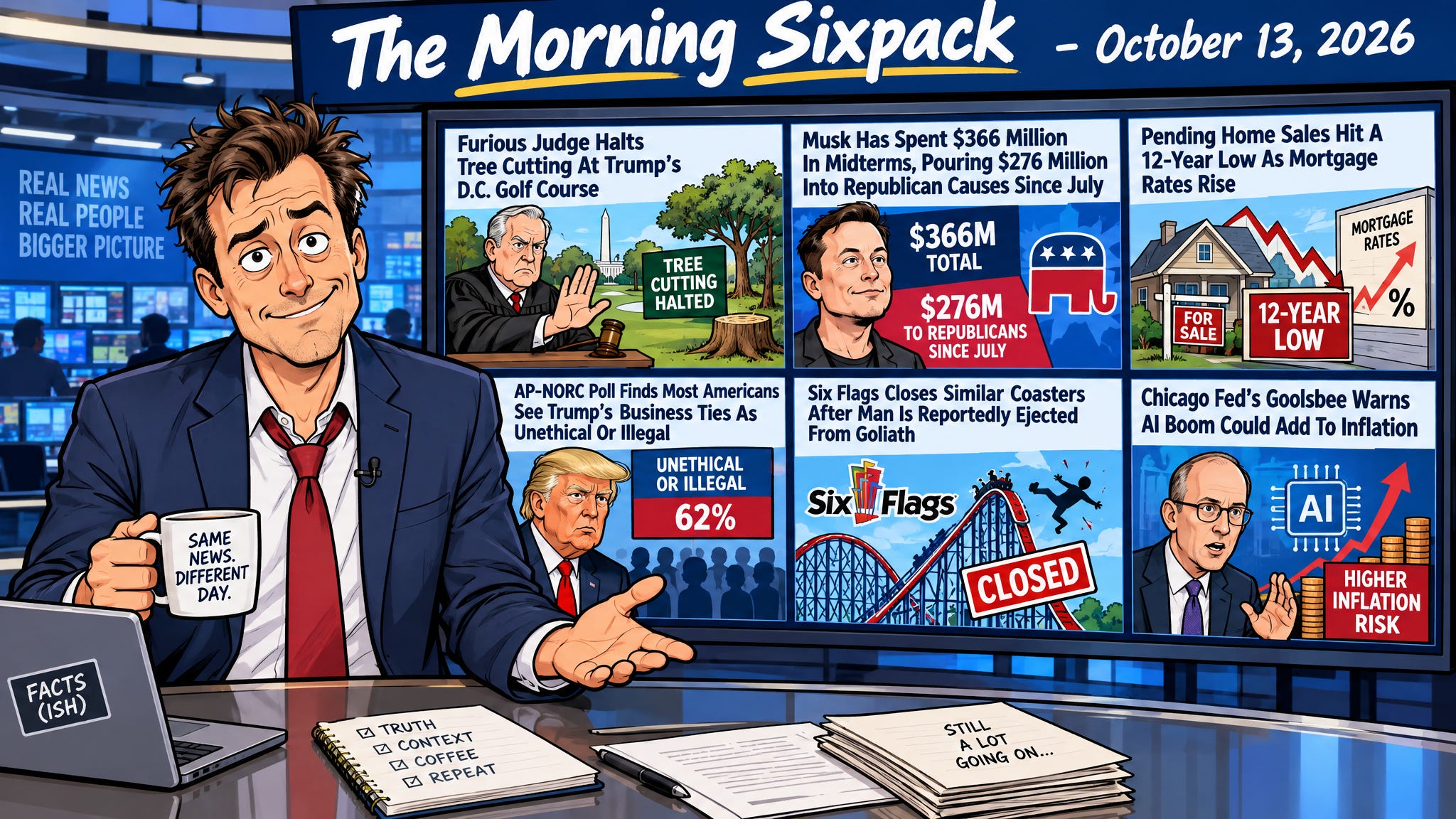
A federal judge halted tree cutting at East Potomac after crews removed hundreds of trees despite repeated warnings—turns out “we’ll let you know” means before the chainsaws start.
Furious Judge Halts Tree Cutting At Trump’s D.C. Golf Course
A federal judge ordered the Trump administration to stop cutting trees at East Potomac Golf Links after crews removed about 430 trees over the weekend. U.S. District Judge Ana C. Reyes also said the government must give 72 hours’ notice before any future work that would permanently alter the historic course. Another 299 trees remain targeted for removal. Reyes said she no longer trusted the government to stop without a formal order.
Reyes sharply rebuked government lawyers for failing to give timely notice, saying they had done their “absolute worst.” The government filed notice at 4:55 p.m. Friday, roughly 12 hours before crews began cutting Saturday. A Justice Department lawyer said officials had learned the work could begin as early as Wednesday, but were still gathering details and had made no conscious decision to withhold notice. “Ignorance is not an excuse here,” Reyes said.
The emergency hearing followed a request from preservationists seeking to block more tree removal. The D.C. Preservation League and two golfers argue the administration is advancing irreversible work without required environmental and historic preservation reviews for President Donald Trump’s proposed championship-level redesign. The administration says the tree cutting is unrelated to that potential overhaul and is part of park maintenance.
National Mall and Memorial Parks Superintendent Kevin Griess testified that the Park Service recently got the money and staff to carry out a tree-management program outlined in a 2019 report. He said none of the trees cut Saturday had been identified as hazardous and described the plan as restoring the park to its original links course state. The initial plan called for removing 169 trees, with 90 more expected; field inspections could have raised the total to 529.
Reyes ordered Interior Department deputy chief of staff Gregory Wischer and National Park Service Director Jessica Bowron to testify when the hearing resumes Oct. 19 about when the plan was conceived and why the work began Saturday. She said she was examining whether the government had made “multiple misrepresentations” about the project and its timing. The plaintiffs plan to seek a preliminary injunction, arguing that federal law requires environmental review before agencies commit to major or irreversible actions.
Editor: The judge said she wasn’t trying to be the Lorax. The administration still managed to make her ask where the trees—and the advance notice—went.
Source: The Washington Post
Musk has put $366 million into the midterms so far, including a $276 million burst for Republican causes since July—apparently democracy’s fundraising thermometer needed a very large red line.
Musk Has Spent $366 Million In Midterms, Pouring $276 Million Into Republican Causes Since July
Elon Musk has spent roughly $366 million in the 2026 election cycle, including $276 million since July to help Republicans hold Congress. That spending makes the world’s richest person likely the biggest political donor in this year’s races, according to campaign finance records. The figures were confirmed by a spokesman for Musk’s America PAC.
The latest donations sent $158 million to the Senate Leadership Fund and $20 million to the Congressional Leadership Fund. Both groups support Republicans in Congress. Musk also gave $76 million to America PAC, $10 million to the Lone Star Liberty PAC backing Texas Attorney General Ken Paxton’s Senate campaign, and $10 million to the Republican Governors Association. Another $2 million went to the Republican Attorneys General Association.
America PAC is supporting Republican candidates in seven battleground states and nearly three dozen House races. Much of the new spending is expected to become public when super PACs disclose their third-quarter activity on Thursday. The New York Times reported that Musk has also contributed through groups that do not disclose their donors.
The America PAC spokesman said roughly $90 million spent this cycle paid for work from the previous election or backed other issues. Those efforts included an unsuccessful Wisconsin Supreme Court candidate and a program offering $1 million to registered voters who signed a petition supporting free speech and gun rights. Musk spent roughly $290 million during the last election cycle, when Donald Trump won the presidency.
Musk’s political spending comes as House Democrats call for investigations into his government contracts as SpaceX CEO and his leadership of the Department of Government Efficiency under Trump. The new donations arrive while Democrats’ chances of retaking the House and Senate have improved. The money is a substantial bet on the party that could shape oversight of Musk’s government work.
Editor: A few hundred million dollars can buy a lot of political influence—and still doesn’t come with a receipt voters can easily read.
Source: Reuters
Pending home sales fell in every state as mortgage rates climbed above 7%—a nationwide market slowdown is about as subtle as a “For Sale” sign nobody calls about.
Pending Home Sales Hit A 12-Year Low As Mortgage Rates Rise
U.S. pending home sales fell 4 percent in September, reaching their lowest level in 12 years, according to housing data platform Redfin. Pending sales track homes where sellers have accepted a buyer’s offer. Redfin said the monthly drop was the largest in more than three years. Sales under contract declined in all 50 states for the first time in three years.
Rising mortgage rates are weighing on buyers, with rates reaching 7.4 percent last week—the highest level since November 2023. Redfin said rates rose steadily through September and passed 7 percent by month’s end. Pending sales were lower in April 2020, at the start of the pandemic, but Redfin excluded that period from its analysis as an outlier.
Homes are also taking longer to sell, spending a median 51 days on the market before a seller accepts an offer. Mortgage rates may not fall soon: The Federal Reserve raised its benchmark rate by a quarter point in September, and home-loan rates have climbed from 6.95 percent on September 17 to 7.4 percent. The report says higher rates can add to the cost of buying while cooling demand.
That slowdown can hurt sellers, but it may give some buyers more room to negotiate. LendFriend Mortgage President Eric Bernstein told the National Association of Realtors that higher rates can reduce buyer demand and increase negotiating leverage, depending on local conditions. He said buyers may have more leverage in softer markets, while limited inventory and stronger demand can constrain it.
The National Association of Realtors recommends getting quotes from multiple lenders when shopping for a mortgage. It says rates can vary widely, so comparing several loan offers may help buyers find a lower rate. In a market where both prices and borrowing costs matter, accepting the first quote is an unnecessarily expensive way to save time.
Editor: The market has cooled enough to give buyers a little leverage. Sellers, meanwhile, may want to make sure that “dream home” price is still tethered to Earth.
Source: The Independent
Six in 10 Americans say Trump is either illegally profiting from the presidency or behaving unethically—apparently “nobody cared” didn’t settle the question for the public.
AP-NORC Poll Finds Most Americans See Trump’s Business Ties As Unethical Or Illegal
About six in 10 U.S. adults believe President Donald Trump is illegally profiting from the presidency or doing something unethical, though not illegal, according to a new AP-NORC poll. Roughly two in 10 say he is doing nothing wrong, and a similar share say they don’t know enough to judge. The poll comes as Trump’s family business expands into new ventures, including cryptocurrency and overseas real estate deals.
More than half of Americans say Trump has put “a lot” of emphasis on his personal financial interests since returning to office. By comparison, about one-quarter say he has focused “a lot” on the country as a whole, and only about one in 10 say he has strongly prioritized people like them. The White House rejects claims that Trump or his family benefit financially from his office, saying he has no conflicts and acts in the country’s interest.
The poll found partisan differences: about eight in 10 Democrats believe Trump is doing something illegal, compared with about three in 10 independents and one in 10 Republicans. About two in 10 independents and a similar share of Republicans say his conduct is unethical but not illegal. Most Republicans either say he is doing nothing wrong or don’t know enough to decide.
Trump has lifted a self-imposed restriction on overseas private-sector deals by his family and launched several crypto businesses. A federal financial disclosure filed in June reported more than $1 billion in income from new crypto ventures, while the Trump Organization struck eight foreign real estate deals in the first year of his presidency. The AP report also describes major investments in a Trump-linked crypto venture from a UAE business tied to the royal family and a cryptocurrency company founded by a Chinese billionaire facing legal trouble in the United States.
Even among Americans who don’t believe Trump broke the law, many say he has prioritized his own business interests and those of friends and family over the country or ordinary people. The AP-NORC poll surveyed 2,140 adults from Sept. 24–28 and has a margin of sampling error of plus or minus 2.9 percentage points. It was conducted through NORC’s probability-based AmeriSpeak Panel.
Editor: “Nobody cared,” Trump reportedly said about conflicts of interest. The poll suggests plenty of people have noticed—and have opinions.
Source: AP News
A man was reportedly ejected from Six Flags’ Goliath coaster, and the park has temporarily closed similar rides while authorities investigate—“out of an abundance of caution” is doing some heavy lifting here.
Six Flags Closes Similar Coasters After Man Is Reportedly Ejected From Goliath
A man was reportedly ejected from the Goliath roller coaster at Six Flags Over Georgia, according to witnesses quoted by 11 Alive. A husband and wife said he struck the coaster after being thrown from it. The incident was captured in souvenir photos automatically taken during the ride, another witness said. The supplied report excerpt does not identify the man or describe his condition.
Six Flags temporarily closed similar attractions across its parks while the incident is investigated. The company said park staff and local authorities responded immediately and are cooperating with the investigation. Mableton Mayor Michael Owens said the city’s public safety director was coordinating with local police and park security.
Goliath opened in 2006 and reaches a height of 200 feet, with a 170-foot drop and a 540-degree spiral. The ride can reach speeds of up to 70 mph, and Six Flags rates it four out of five on its thrill scale. The couple who spoke to 11 Alive said workers checked their safety harnesses before the ride began.
Six Flags is North America’s largest amusement park operator, with 20 amusement parks, 14 water parks, and nine resorts in Canada, the United States, and Mexico. The company’s temporary closures apply to similar attractions across its parks. The supplied excerpt does not specify how many rides were closed or how long the closures will last.
Editor: A roller coaster’s souvenir photos are meant to capture the fun. This is a grim reminder that safety checks have to work before the ride leaves the station.
Source: BBC News
AI data centers were supposed to bring efficiencies someday; right now, they’re bidding up the cost of power, construction and electrical parts—and the Fed is watching to see how far the bill spreads.
Chicago Fed’s Goolsbee Warns AI Boom Could Add To Inflation
Chicago Fed President Austan Goolsbee says inflation tied to the AI buildout is beginning to spread beyond data centers and related industries. Land, electricity, water, construction, and electrical components have all become more expensive. Goolsbee said he is increasingly concerned the boom could turn into “straight, old-fashioned overheating demand.” He has not seen clear evidence that those higher costs have yet reached everyday purchases such as groceries or haircuts.
The key question for the Federal Reserve is whether AI investment is driving broad demand or simply shifting activity into a few hot sectors. Fed Governor Lisa Cook recently warned that rate hikes aimed at sector-specific price increases could be a mistake. But Goolsbee said he is hearing businesses complain about shortages of electricians and long waits for electrical components, with data center construction competing for the same resources. If those price pressures spread into general services, he said, they could be harder to reverse than a temporary supply shock.
Inflation stood at 3.4 percent in August, with September’s report due later this week. Goolsbee said economists are trying to separate the effects of higher oil prices linked to the Middle East war from stronger demand across the economy. If inflation remains persistent, he said, “it’s clear what the Fed has to do.” Goolsbee does not vote on rates this year; he is scheduled to rejoin the rate-setting committee in 2027.
Goolsbee also questioned whether higher interest rates will slow the biggest AI investors, which have continued spending despite higher borrowing costs. He said AI companies are becoming more reliant on debt, which could make rate increases matter more over time, but cautioned that the Fed has limited tools and any action can cause collateral damage. He argued that the central bank’s job is to control inflation and support employment—not to keep stock or bond markets happy.
On AI’s long-term impact on jobs, Goolsbee said he expects technology to change many occupations but doubts unemployment will reach extreme levels. He pointed to the “lump of labor fallacy,” the idea that there is a fixed amount of work machines will simply take away, and noted that workers have historically moved between jobs as technology changes. He said transitions can be traumatic for affected workers, but past technological shifts have not caused the labor market to disappear.
Editor: The AI boom may eventually make things cheaper. For now, data centers are helping make some very ordinary inputs more expensive—and that’s the kind of “future” the Fed has to price in today.
Source: Semafor
Check the Archives here: