


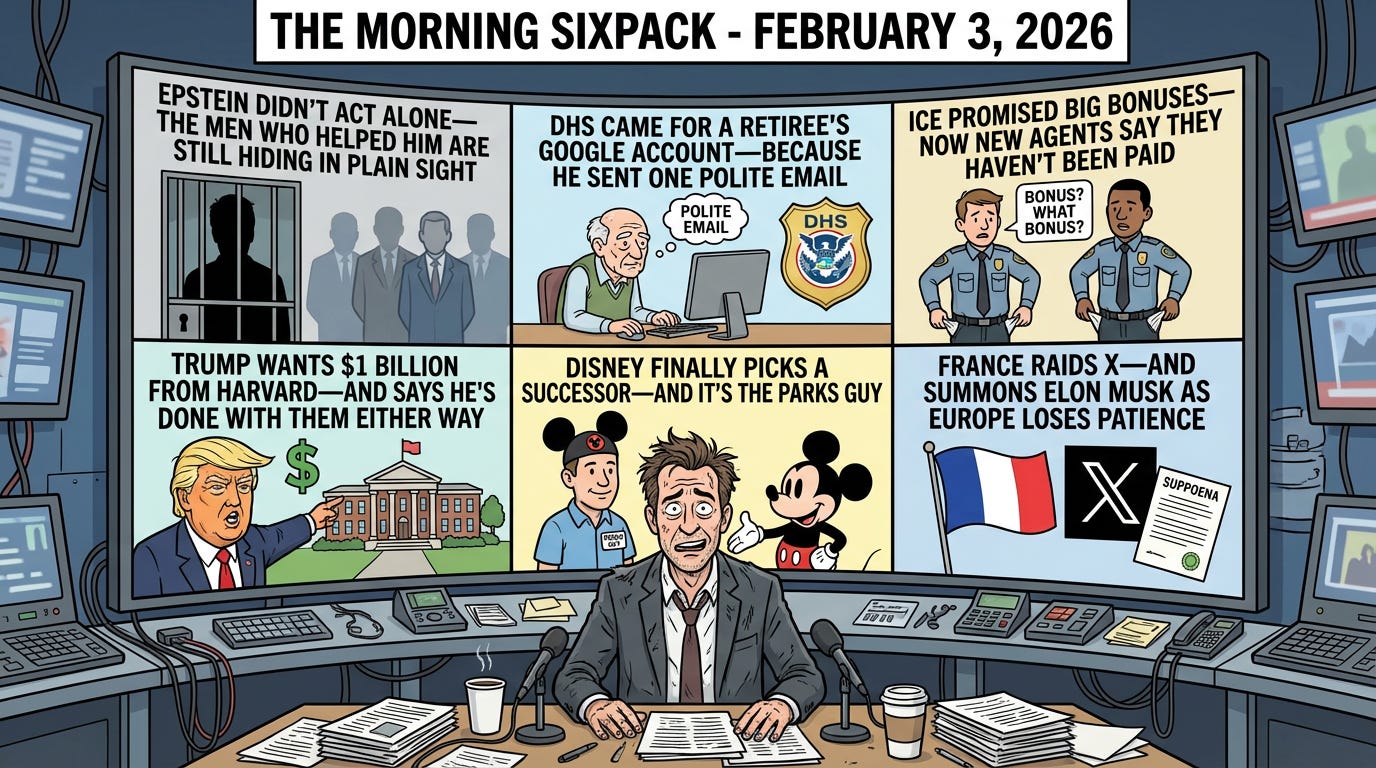
Epstein Didn’t Act Alone—The Men Who Helped Him Are Still Hiding in Plain Sight
This was never just about Jeffrey Epstein—it was about the powerful men (and a few women) who knew exactly what he was and chose to help him anyway.
The latest Epstein file dump isn’t a political parlor game or a gossip scavenger hunt—it’s a grim reminder that a network of rich, famous men worked to soften, excuse, and strategically rebrand a convicted sex offender after he’d already gone to prison. The obsession shouldn’t be with whose career gets dented, but with how casually women and girls were discarded to protect male power.
Emails show figures like Richard Branson, Noam Chomsky, Steve Bannon, Peter Mandelson, and Prince Andrew offering advice, access, or credibility to Epstein long after his 2009 conviction. This wasn’t ignorance. This was effort. As one message attributed to Chomsky put it, dismissing outrage over Epstein’s victims as “the hysteria that has developed about abuse of women.” That line alone should end any debate about whether these men understood the stakes.
Branson’s contributions read like a masterclass in billionaire moral relativism—minimizing Epstein’s crimes, reframing them as a youthful “slip,” and suggesting endorsements from other powerful men as reputational Febreze. All of this while Epstein had already served time and settled multiple civil suits brought by underage victims. Googling was apparently too much to ask.
The common defense now is silence—or the claim that no one really knew. That’s insulting. These are men who understand exactly how the justice system bends for wealth. They knew why Epstein went to prison. They just didn’t care enough to walk away. As long as association was useful, the exploitation of girls was background noise.
And while attention keeps drifting to political fallout, survivors are once again pushed to the margins. Twenty Epstein victims recently said their information was released while “the men who abused us remain hidden and protected.” That’s the story. Not Mandelson’s peerage. Not Westminster gossip. The real scandal is that women can see—clearly—that for many of the world’s most powerful men, their suffering simply wasn’t a dealbreaker.
Source: The Guardian
Editor: The richest men on Earth keep insisting they had no idea—while simultaneously proving they understood the system well enough to game it. Funny how “I didn’t know” always shows up right on time, but basic decency never does.
DHS Came for a Retiree’s Google Account—Because He Sent One Polite Email
A 67-year-old American learned how fragile free speech can be when Homeland Security subpoenaed his Google account for emailing a prosecutor and urging mercy.
Jon, a retired insurance worker in the Philadelphia suburbs, sent a four-sentence email to a federal attorney asking the government not to deport an Afghan asylum seeker who feared being killed by the Taliban. Five hours later, Google notified him that Department of Homeland Security had subpoenaed his account. No judge. No grand jury. Just a secretive administrative subpoena—and soon, agents at his front door.
That subpoena demanded sweeping data: IP addresses, locations, account history, even Social Security and credit card numbers. The legal tool DHS used requires no prior judicial approval, operates largely in the dark, and is increasingly criticized by civil liberties groups as a shortcut around the First Amendment. Under President Donald Trump’s second term, advocates say the practice has expanded sharply, targeting protesters, students, and now private citizens who speak up.
Jon had never been arrested, never threatened violence, and signed his real name. Agents eventually told him his email broke no law—but still suggested the prosecutor might have “felt threatened.” The message? Even mild dissent can trigger surveillance. As one ACLU attorney put it, you don’t need to jail people to silence them—just make them afraid. The American Civil Liberties Union (link) is now representing Jon to block any release of his data.
Adding insult, Jon wasn’t even given the subpoena itself—just seven days to challenge it without knowing what it said. Only after a Washington Post reporter contacted Google did the company finally hand over a redacted copy, weeks late. Google says it reviews and sometimes resists overbroad requests, but the episode underscores how much power the government can quietly wield through private tech platforms.
Jon’s takeaway is blunt: if a respectful email can put you under a federal microscope, then everyone is a potential target. That chilling effect isn’t collateral damage—it’s the point. Democracy doesn’t usually die with a bang. Sometimes it starts with a polite message, a secret subpoena, and a knock on the door.
Source: The Washington Post
Editor: When the government treats conscience like probable cause, it’s not enforcing the law—it’s training the public to keep quiet. And judging by this playbook, silence is exactly what they’re after.
ICE Promised Big Bonuses—Now New Agents Say They Haven’t Been Paid
The Trump administration rushed to hire thousands of immigration agents, but some recruits now say the paychecks and benefits never showed up.

According to social media posts reviewed by international reporters, newly hired agents at Immigration and Customs Enforcement say they’re missing everything from health insurance to actual wages. “Monday is four weeks since I started and I haven’t been paid yet,” one apparent recruit wrote on Reddit. Another said they’d been on the job for two months with no health coverage—while caring for a sick child.
The complaints cut directly against the recruitment pitch pushed by the administration of Donald Trump, which promised high salaries, generous benefits, and signing bonuses to rapidly expand immigration enforcement. The White House aimed to add 10,000 agents in a year, ultimately hiring more than 12,000 after drawing over 220,000 applications.
But the rush appears to have come with consequences. Posts cited by the International Business Times UK say five-figure signing bonuses haven’t materialized, and basic onboarding systems—like payroll and insurance—are lagging badly. For a workforce tasked with carrying out mass deportations, the logistical chaos is starting at home.
The problems don’t stop at paperwork. Independent journalist Ken Klippenstein reports that the hiring blitz has produced what one senior ICE agent called “sketchy” recruits. A new agent told Klippenstein that some colleagues openly passed around a flask while surveilling suspects—hardly the image of a disciplined federal force.
ICE was built to project authority and control. Instead, new hires are learning the same lesson as everyone else in Trump’s second-term government: promises are easy, execution is optional, and if you’re waiting on the system to take care of you—don’t hold your breath.
Source: Raw Story
Editor: It’s almost poetic—an agency famous for telling people “just follow the rules” can’t manage payroll, benefits, or sobriety checks. Turns out chaos at the border starts with chaos in HR.
But is it any real surprise that Trump is stiffing his workers? He’s done it for DECADES.
Trump Wants $1 Billion From Harvard—and Says He’s Done with Them Either Way
Donald Trump just put a nine-figure price tag on his grievance politics—and Harvard is the latest target.

Late Monday, Donald Trump said his administration is now demanding $1 billion from Harvard University to settle ongoing federal probes into the school’s policies, while also declaring he wants “nothing further to do” with the university. Trump offered no explanation for how he calculated the number or what specific “damages” Harvard allegedly caused—just a Truth Social post and a whole lot of menace.
The threat is part of a broader pressure campaign against elite universities over pro-Palestinian protests, diversity initiatives, and transgender policies. Trump claims Harvard and others allowed antisemitism during demonstrations tied to Israel’s war in Gaza, a framing protesters—including some Jewish groups—strongly dispute. Rights advocates warn the probes blur criticism of Israel with extremism and trample free speech and academic freedom.
Trump’s comments directly contradicted a New York Times report saying his administration had dropped its demand for cash in negotiations. In fact, talks have dragged on for months, with Trump previously floating a $500 million settlement. Harvard has already sued the administration, and a judge ruled last year that the government unlawfully terminated some of its federal grants.
Other Ivy League schools have chosen a different path. Columbia University agreed to pay more than $220 million to resolve its dispute, while Brown University committed $50 million toward local workforce development. Harvard, so far, appears unwilling to write a check just to make the problem go away.
At bottom, this isn’t really about antisemitism policy or campus governance—it’s about leverage. Threaten funding, float a massive number, dare institutions to fight back, and see who blinks. Whether Harvard pays or resists, Trump has made clear the spectacle is the point.
Source: NBC News
Editor: When a president starts naming settlement figures like he’s pricing Manhattan real estate, it’s less law enforcement than a shakedown—complete with a social media receipt.
Trump is a mob boss.
Disney Picks Josh D’Amaro as CEO—Ending the Iger Era (Again)

Disney has finally chosen its next boss, and it’s a parks insider betting that operational calm beats boardroom drama.
The Walt Disney Company announced Tuesday that Josh D’Amaro will replace Bob Iger as chief executive, formally ending Iger’s second, stabilizer-in-chief stint atop the 102-year-old entertainment giant. D’Amaro, a 28-year Disney veteran, becomes just the ninth CEO in company history and takes over on March 18.
Iger praised D’Amaro’s “instinctive appreciation of the Disney brand” and his ability to marry creativity with operational discipline—code for someone who knows how to actually run things. As chairman of Disney Experiences, D’Amaro has overseen a $60 billion investment spree aimed at turbocharging theme parks, cruise ships, and resorts, the company’s most reliable cash machines.
His rise caps a closely watched internal contest with Dana Walden, Disney’s co-chair of entertainment, who will now step into the role of president and chief creative officer. The choice signals that Disney’s board wants steadiness, not another executive culture war, after years of turbulence and whiplash leadership changes.
That turbulence traces back to Iger’s original departure in 2020, the brief and bruising tenure of Bob Chapek—later described as “three years of hell”—and Iger’s 2022 return to clean up the mess. Acquisitions, streaming bets, political blowback, and stock-price slides all piled up along the way.
D’Amaro is a known quantity to Disney fans, often popping up in park promos and Instagram selfies with celebrities and cast members alike. Now the challenge is bigger than nostalgia: restore confidence, keep parks printing money, and prove Disney can finally move forward without dragging Bob Iger back in like a corporate security blanket.
Source: The Independent
Editor: When Disney picks a parks guy to fix a corporate soap opera, it’s basically admitting the magic only works when someone remembers where the turnstiles—and the profits—actually are.
France Raids X—and Summons Elon Musk as Europe Loses Patience
French police didn’t just knock—they searched X’s offices and formally summoned Elon Musk, sharply escalating Europe’s standoff with Big Tech.
Authorities in France searched the local premises of X on Tuesday as prosecutors moved forward with a yearlong investigation into the platform, dramatically raising pressure on its owner, Elon Musk. The probe, led by Paris cybercrime prosecutors, centers on seven allegations ranging from the distribution of child sexual abuse material to Holocaust denial and fraudulent data extraction.
The investigation began after concerns raised by a French lawmaker about X’s algorithm and later widened to include accusations that Grok, the platform’s AI chatbot, spread sexual deepfakes and Holocaust denial. Prosecutors said people associated with X—including Musk and former CEO Linda Yaccarino—have been summoned to explain what compliance measures, if any, the company plans to implement.
X has denied the allegations and previously dismissed the case as politically motivated, accusing France of twisting the law to restrict free speech. But Tuesday’s search signals that European authorities are done arguing in press releases. They’re enforcing the rules—and daring Musk to ignore them.
This all plays out against a broader trans-Atlantic clash over tech regulation, sharpened under Donald Trump’s second term. While the U.S. government frames European fines as attacks on American free speech, countries like France enforce strict laws against hate speech and Holocaust denial—and expect Silicon Valley to comply. The European Union already fined X $140 million under the Digital Services Act, with more scrutiny piling on.
French prosecutors were blunt about the principle at stake. In France, they said, “no one is above the law.” That includes the world’s loudest free-speech absolutist—especially when his platform operates inside European borders.
Source: The New York Times
Editor: Musk keeps telling Europe to pound sand—but when the police are searching your offices, the free-speech cosplay starts to look a lot like regulatory reality. Turns out “move fast and break things” hits different when the thing being broken is the law.