


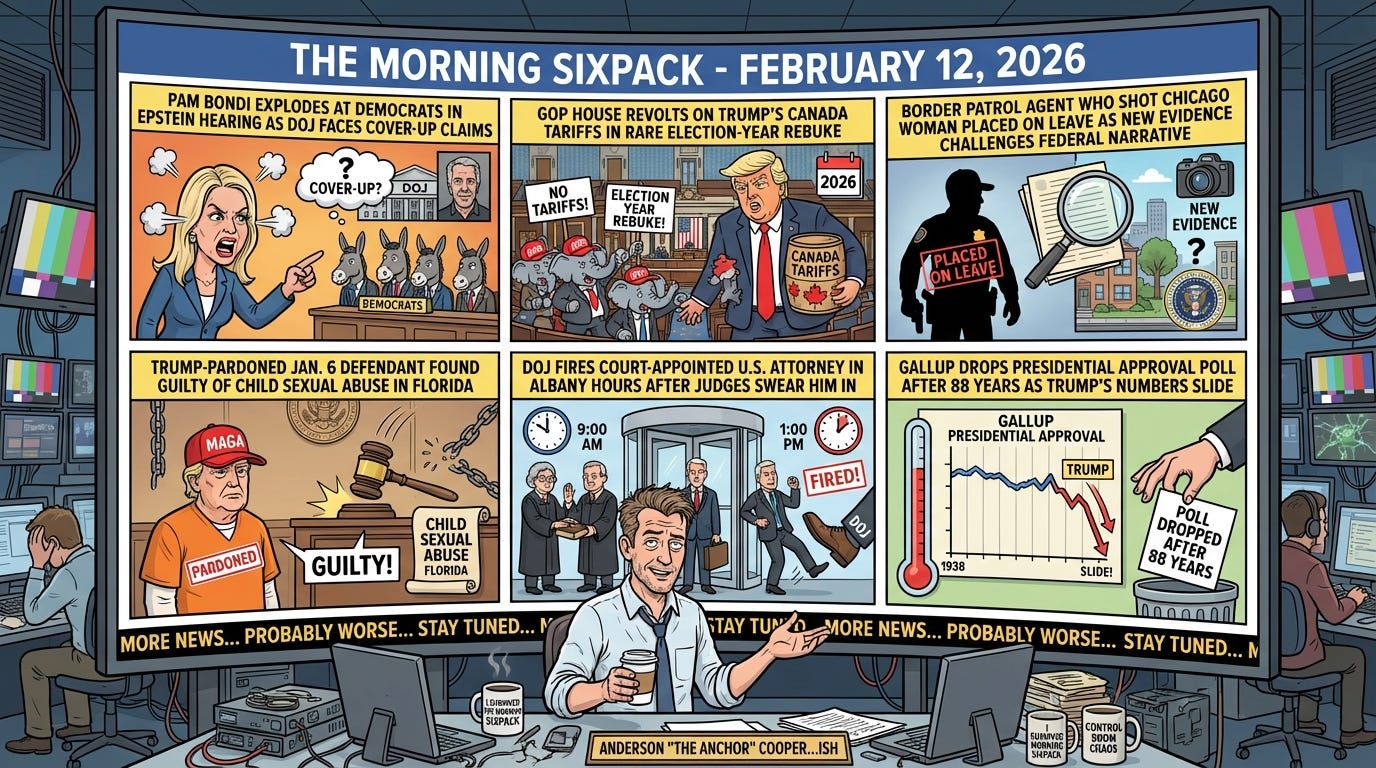
Pam Bondi Explodes at Democrats in Epstein Hearing as DOJ Faces Cover-Up Claims
Pam Bondi turned a routine oversight hearing into a political cage match—shouting down Democrats and casting herself as Donald Trump’s chief defender amid intensifying scrutiny over the Jeffrey Epstein files.
At a combustible House Judiciary Committee hearing, the attorney general repeatedly clashed with Democrats pressing her over the Justice Department’s handling of Epstein records. Rather than directly answering questions, Bondi pivoted to defending Donald Trump, blasting critics and insisting she would not tolerate attacks on the president. “You sit here and you attack the president and I’m not going to have it,” Bondi declared. “I am not going to put up with it.”
The fireworks escalated when Rep. Jamie Raskin accused her of dodging questions. Bondi fired back, calling him a “washed-up loser lawyer — not even a lawyer.” Democrats, including Rep. Becca Balint, grew visibly frustrated. “This is pathetic. This is pathetic,” Balint said, accusing Bondi of refusing to provide straight answers about Trump officials’ alleged ties to Epstein.
At the heart of the fight: the long-promised Epstein files. Bondi’s rollout last year—complete with binders handed to conservative influencers—generated major expectations but little new substance. The Justice Department later concluded there was no Epstein “client list,” igniting backlash from Trump’s own base and fueling bipartisan demands for full disclosure. A review by the Associated Press and other outlets found sloppy redactions in the released documents, exposing private information and even nude photographs of victims. Rep. Thomas Massie told Bondi bluntly: “Literally the worst thing you could do to survivors, you did.”
Bondi insisted DOJ staff worked under tight legislative deadlines and removed documents once errors were flagged. She also urged Epstein survivors to come forward, saying she was “deeply sorry” for their suffering and that “any accusation of criminal wrongdoing will be taken seriously and investigated.” But she refused a request from Rep. Pramila Jayapal to turn and face victims seated behind her, dismissing the suggestion as “theatrics.”
The hearing underscored a larger question hanging over Bondi’s tenure: Is the Justice Department under her leadership an independent law enforcement agency—or a political shield for Trump? Republicans, led by Chairman Jim Jordan, praised Bondi for restoring the department’s “core missions” after what they call years of politicization under President Joe Biden. Democrats countered that Bondi’s combative posture and refusal to directly engage only deepen concerns of a DOJ bent on protecting one man above all.
The spectacle may have energized partisan loyalists on both sides. But for Epstein’s victims—and for Americans looking for clarity—the shouting match offered little in the way of real answers.
Source: AP News
Editor: When your strategy is to yell louder than the questions, it’s usually because you don’t like the answers. The DOJ isn’t a campaign rally, and “I’m not going to have it” isn’t a legal argument. If transparency was the goal, this was an odd way to show it. #FAIL
GOP House Revolts on Trump’s Canada Tariffs in Rare Election-Year Rebuke
In a sharp break from party orthodoxy, six Republicans joined Democrats to slap down Donald Trump’s Canada tariffs—handing the president a public election-year embarrassment.
The Republican-led House voted 219-211 to invalidate the emergency declaration underpinning Trump’s tariffs on Canada, a cornerstone of his second-term trade agenda. The resolution now heads to the Senate and, if it passes there, to Donald Trump—who has already signaled he would veto it. “Any Republican, in the House or the Senate, that votes against TARIFFS will seriously suffer the consequences come Election time, and that includes Primaries!” Trump posted on Truth Social.
The revolt exposed cracks inside the GOP conference and delivered a second straight setback to House Speaker Mike Johnson. Reps. Don Bacon, Kevin Kiley, Thomas Massie, Dan Newhouse, Brian Fitzpatrick and Jeff Hurd broke ranks. One Democrat, Jared Golden, sided with most Republicans.
Johnson downplayed the fallout, saying Trump “understands what is going on” and can veto the measure. But the vote was made possible by a rarely used fast-track provision in the International Emergency Economic Powers Act, which allows Congress to challenge emergency declarations used to justify tariffs. Democrats targeted the Canada levies in part because Trump tied them to fentanyl smuggling—even though little of the drug enters the U.S. from Canada.
The internal GOP dissent is notable as lawmakers stare down an election year and mounting concerns over the economic impact of tariffs. After duties rose to levels not seen in centuries, the U.S. shed tens of thousands of manufacturing jobs in 2025. House Minority Leader Hakeem Jeffries said the vote shows Republicans’ “mandate has evaporated because their policies are so unpopular,” and promised more tariff challenges targeting Brazil and other nations.
Overriding a veto would require two-thirds majorities in both chambers—an unlikely math problem. Still, the symbolism matters. A GOP House publicly rebuking a Republican president on his signature economic policy is not nothing. It’s a warning flare from within the ranks that even loyalty has limits when the politics—and the economics—get tough.
Source: The Wall Street Journal (free)
Editor: Tariffs were billed as economic muscle. Now they’re political quicksand. When members of your own party start choosing principle—or survival—over party unity, that’s not a messaging glitch. That’s a crack in the foundation.
Border Patrol Agent Who Shot Chicago Woman Placed on Leave as New Evidence Challenges Federal Narrative
The Border Patrol agent who shot Marimar Martinez five times is now on administrative leave—after newly released evidence cast doubt on the federal government’s version of events.
According to a spokesperson for U.S. Customs and Border Protection, agent Charles Exum has been placed on administrative leave following the Oct. 4 shooting of Martinez on Chicago’s Southwest Side. The agency declined to say when the leave began or whether it remains in effect. The move comes as Martinez’s attorneys argue fresh disclosures show Exum misled investigators to justify opening fire.
In emails sent hours after the shooting, U.S. Border Patrol Cmdr. Gregory Bovino praised Exum’s “excellent service in Chicago” and even floated extending his retirement “beyond age 57.” Exum later wrote that support stretched up the chain of command—from Homeland Security Secretary Kristi Noem to “El Jefe himself,” a reference that may have meant Donald Trump. In one congratulatory text, another agent told Exum, “You are a legend among agents you better f---in know that.”
Martinez’s legal team says the paper trail—and video—tell a different story. Attorney Christopher Parente pointed to a federal diagram showing three vehicles ahead of Exum’s Chevrolet Tahoe at the scene. “Video shows the three cars depicted ahead of Exum’s Tahoe don’t exist,” Parente said. He also disputes Exum’s claim to the FBI that all five shots were fired through Martinez’s windshield, arguing ballistics show multiple rounds entered from the passenger side and rear of her Nissan Rogue.
Body-camera footage captures agents saying “it’s time to get aggressive” and “we’re going to make contact, we’re boxed in,” before the collision. Homeland Security initially claimed Martinez “rammed” the Tahoe. But footage appears to show Exum turning his wheel left toward her vehicle. Federal assault charges filed against Martinez were dropped in November, though officials have not rescinded prior claims labeling her a “domestic terrorist.”
U.S. District Judge Georgia Alexakis allowed Martinez to release key evidence, though prosecutors with the Chicago U.S. Attorney’s office disclosed it first. Martinez’s attorneys say they plan to pursue a Federal Tort Claim Act complaint against Homeland Security and Exum. As Parente put it: “This is a time where you just cannot trust the words of our federal officials.”
Administrative leave isn’t accountability—but it’s movement. And for a case that began with a one-sided narrative and a hail of gunfire, the facts now look far more complicated than the government first suggested.
Source: Chicago Sun-Times
Editor: When agents are texting each other about being “legends” hours after someone gets shot five times, that’s not optics—that’s culture. Administrative leave is the bare minimum. If the evidence doesn’t match the official story, the public deserves more than a shrug and a press release.
Trump-Pardoned Jan6 Defendant Found Guilty of Child Sexual Abuse in Florida
A man pardoned by Donald Trump for his role in the January 6 Capitol attack now faces the possibility of life in prison after a Florida jury convicted him on multiple child sexual abuse charges.
Andrew Paul Johnson—one of roughly 1,500 defendants granted clemency for the 2021 Capitol riot—was found guilty this week on five counts, including molesting a child under 12, molesting a child under 16 and lewd and lascivious exhibition. A jury acquitted him on one charge related to transmitting harmful material to a minor electronically. He had pleaded not guilty.
Walter Forgie, chief assistant state attorney for Florida’s fifth judicial circuit, said Johnson “is exposed to the possibility of life in prison,” with sentencing to come later. The Hernando County Sheriff’s Office began investigating last July after a report that two juveniles had been subjected to “lewd and lascivious acts over a many-month span.”
According to a probable cause affidavit, one child told authorities Johnson—who had lived with the family—molested him three times between April and October 2024, beginning when the boy was 11. The affidavit also alleged Johnson claimed he had been pardoned for storming the Capitol and was set to receive $10 million as a result of being a “jan 6er,” promising to leave money to the child in his will. Investigators said the tactic appeared aimed at preventing the boy from exposing the abuse.
Johnson previously pleaded guilty in April 2024 to charges tied to the January 6 attack, in which supporters of Donald Trump stormed the U.S. Capitol. Prosecutors alleged he unlawfully entered through a window and encouraged others to follow, later describing himself online as an “American Terrorist” and “Proud j6er.” He later attempted, unsuccessfully, to withdraw his plea before receiving clemency.
Trump has publicly floated compensating January 6 defendants, though none have been paid. His administration did agree to pay nearly $5 million to the family of a woman shot by police during the siege, according to prior reporting.
The case is a grim reminder that a presidential pardon wipes away federal convictions—it doesn’t rewrite character, and it doesn’t shield anyone from state prosecution.
Source: The Guardian
Editor: A pardon isn’t a halo. When political theater collides with real-world crimes, the consequences don’t vanish—they just move jurisdictions. Clemency may win applause at rallies, but it doesn’t age well when the headlines change.
DOJ Fires Court-Appointed U.S. Attorney in Albany Hours After Judges Swear Him In
In a constitutional tug-of-war that escalated in real time, the Justice Department fired a federal prosecutor just hours after judges in New York appointed him to the job.
A panel of judges in the Northern District of New York appointed former prosecutor Donald T. Kinsella on Wednesday to lead the Albany-based U.S. attorney’s office, citing a federal law that allows courts to name a temporary replacement when an interim U.S. attorney’s term expires. The move followed a ruling that acting U.S. Attorney John Sarcone was serving unlawfully.
By Wednesday night, Deputy Attorney General Todd Blanche responded bluntly on X: “You are fired, Donald Kinsella.” Blanche added, “Judges don’t pick U.S. Attorneys, [the president] does. See Article II of our Constitution,” invoking the section that outlines presidential appointment powers. The clash adds to months of friction between the Trump administration and federal courts over who controls U.S. attorney appointments.
The dispute traces back to Sarcone, a former campaign attorney for Donald Trump. After his 120-day interim term expired, judges declined to extend it. Attorney General Pam Bondi then named Sarcone first assistant U.S. attorney and a “special attorney,” allowing him to continue leading the office in an acting capacity. Last month, U.S. District Judge Lorna Schofield ruled that maneuver violated federal vacancy laws, declaring Sarcone “is not lawfully serving as Acting U.S. Attorney.”
Schofield also barred Sarcone from overseeing an investigation into New York Attorney General Letitia James and quashed subpoenas tied to that probe. The Justice Department has appealed her ruling. Similar legal battles have flared in New Jersey, California, Virginia and Nevada, as the administration seeks to keep interim picks in place without Senate confirmation.
The broader fight boils down to separation of powers. The administration argues the president and attorney general have the authority to select prosecutors. Critics say the White House is sidestepping the Senate’s advice-and-consent role. In at least one other case, a federal judge tossed indictments after determining an interim U.S. attorney was unlawfully serving—proof that this bureaucratic chess match has real consequences in courtrooms.
In Albany, the message was unmistakable: judges made an appointment, the Justice Department erased it, and the constitutional debate just got louder.
Source: CBS News
Editor: When a U.S. attorney can be sworn in at lunch and fired by dinner on X, it’s not just awkward—it’s unstable. If this is about Article II authority, fine. But the optics look less like constitutional clarity and more like institutional chaos.
Gallup Drops Presidential Approval Poll After 88 Years as Trump’s Numbers Slide
After nearly nine decades of tracking presidential approval, Gallup is pulling the plug—just as Donald Trump’s approval rating sinks to 38%.
Editor: How on God’s green earth can it be this high?
The polling giant confirmed it will no longer conduct its long-running presidential approval survey, telling The Hill the move “reflects an evolution in how Gallup focuses its public research and thought leadership.” A spokesperson added, “This is a strategic shift solely based on Gallup’s research goals and priorities.”
For context, Gallup has measured presidential approval since the days of Franklin D. Roosevelt. The poll became a staple of modern politics, a barometer cited by campaigns, cable news, and history books alike. Now it’s gone—at a moment when Donald Trump is facing some of the weakest approval numbers of any president in recent decades.
Trump’s current approval rating stands at 38 percent. He has not publicly targeted Gallup over its polling. But he has shown little patience for surveys he dislikes. In December 2024, he sued the Des Moines Register, its parent company Gannett, and pollster Anne Seltzer over a pre-election poll. In January, he blasted the The New York Times after one of its surveys showed independent voters souring on him.
Gallup insists the decision is strategic, not political. And to be fair, polling as an industry has been under pressure—shrinking response rates, rising costs, and a public increasingly skeptical of institutions. Still, when the gold standard of presidential approval tracking exits the stage while the sitting president’s numbers are underwater, people are going to notice.
Correlation isn’t causation. But optics matter in politics—and this one raises eyebrows.
Source: The New Republic
Editor: When the scoreboard operator walks off the field mid-game, fans are going to wonder about the score. Maybe it’s just a business decision. Or maybe the approval numbers weren’t the only thing heading south. Either way, losing an 88-year benchmark isn’t exactly a vote of confidence in where things stand.