


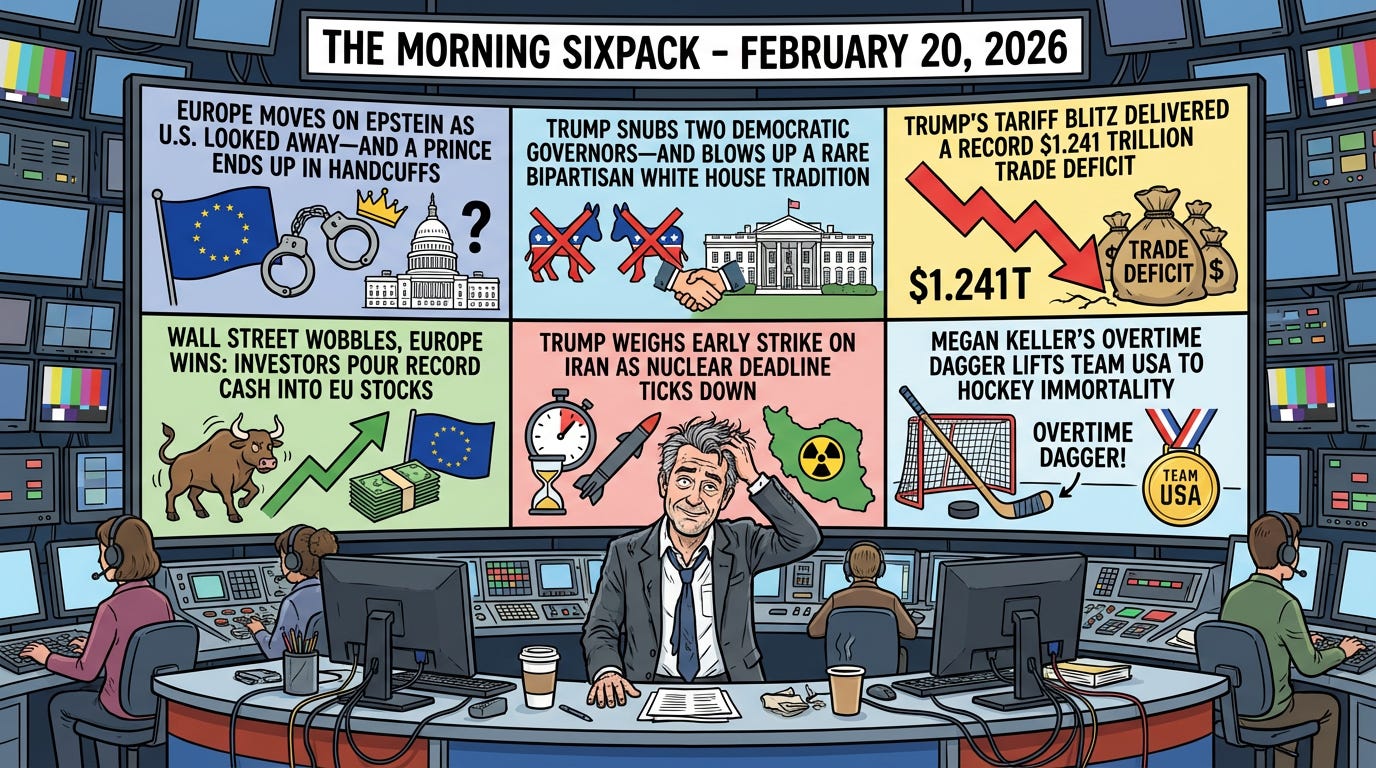
Europe Moves on Epstein as U.S. Looked Away—and a Prince Ends Up in Handcuffs
While Washington said there was nothing to see in the Epstein files, Europe just started making arrests.
After Congress forced the release of millions of additional Jeffrey Epstein documents, prosecutors overseas began digging—and quickly found enough to act. The headline moment: Prince Andrew was arrested in the U.K. on suspicion of misconduct in public office. Authorities are also investigating Peter Mandelson, charging Norway’s former prime minister Thorbjørn Jagland with aggravated corruption, and opening French probes that now touch former culture minister Jack Lang.
This comes after Trump-era Justice Department officials declared—following what they called an “exhaustive review”—that there was no incriminating client list and no evidence “that could predicate an investigation against uncharged third parties.” Deputy Attorney General Todd Blanche doubled down: “We said in July and it remains as true today, if we had info about men who abused women we would prosecute them.”
Europe clearly read the same files and came to a different conclusion. French prosecutors are examining possible sex trafficking and financial crimes. Norway is scrutinizing gifts, travel and loans tied to Jagland’s time leading the Council of Europe. British authorities are looking at whether confidential government reports were shared with Epstein while Andrew served as a trade envoy.
The legal standards differ, of course. So does political insulation. As former White House ethics lawyer Richard Painter put it, U.S. presidents are “politically insulated much more so than the prime minister in most European countries.” Translation: accountability can look very different depending on which side of the Atlantic you’re standing.
And here’s the part that should make Washington uncomfortable: Rep. Thomas Massie, who pushed for the files’ release, said Andrew’s arrest was “the metric I established for success of the Epstein Files Transparency Act,” adding, “Now we need JUSTICE in the United States.” Europe is combing through the wreckage. The U.S. insists it already did.
Source: WSJ (free)
Editor: So let me get this straight—millions of pages drop, Europe starts filing charges, and we’re told everything here was thoroughly handled years ago? Either European prosecutors are reckless… or they’re reading more carefully. Pick your poison. I think you know the answer.
Trump Snubs Two Democratic Governors—And Blows Up a Rare Bipartisan White House Tradition
One of Washington’s last bipartisan rituals just got torched—because the president didn’t like the guest list.
The National Governors Association is pulling out of its annual White House meeting after Donald Trump declined to invite Democratic Govs. Jared Polis and Wes Moore—calling them “not worthy of being there.” The dinner may still happen. The bipartisan tradition that framed it? Not so much.
Polis took the high road, saying he doesn’t have “any ability to get in (Trump’s) head,” and focused instead on swapping best practices with colleagues from both parties. Moore, the NGA’s vice chair, was more pointed: “I didn’t run for governor like, man, I can’t wait so me and the president can go toe to toe,” he said, before adding, “I pray for him and I just feel bad for him because that has just got to be a really, really hard existence.”
Even Republicans seemed uneasy. Spencer Cox acknowledged Trump isn’t trying to unify the country: “He’s said very clearly that that’s not who he is.” Kevin Stitt, who chairs the NGA and tried to defuse the standoff, was blasted by Trump as a “RINO.” He responded diplomatically: “Politics has a way of just beating you down over time so I can’t imagine being president of the United States.”
Former Maryland Gov. Larry Hogan called it a “mistake” not to include all governors. “It can’t hurt to be in the same room together,” he said. That used to be the point of the event—a ceremonial reminder that states still have to work with Washington whether they like it or not.
Hovering over the conference was 2028. Moore, Josh Shapiro, Andy Beshear, and others fielded the inevitable presidential buzz. But the immediate takeaway is simpler:
When even a White House dinner turns into a loyalty test, the temperature in Washington isn’t cooling anytime soon.
Source: AP News
Editor: When the annual governors’ dinner can’t survive the guest list, maybe the problem isn’t seating arrangements. If “not worthy” is the new bipartisan standard, buckle up for the next three years.
Trump’s Tariff Blitz Delivered a Record $1.241 Trillion Trade Deficit #TrumpTariffs
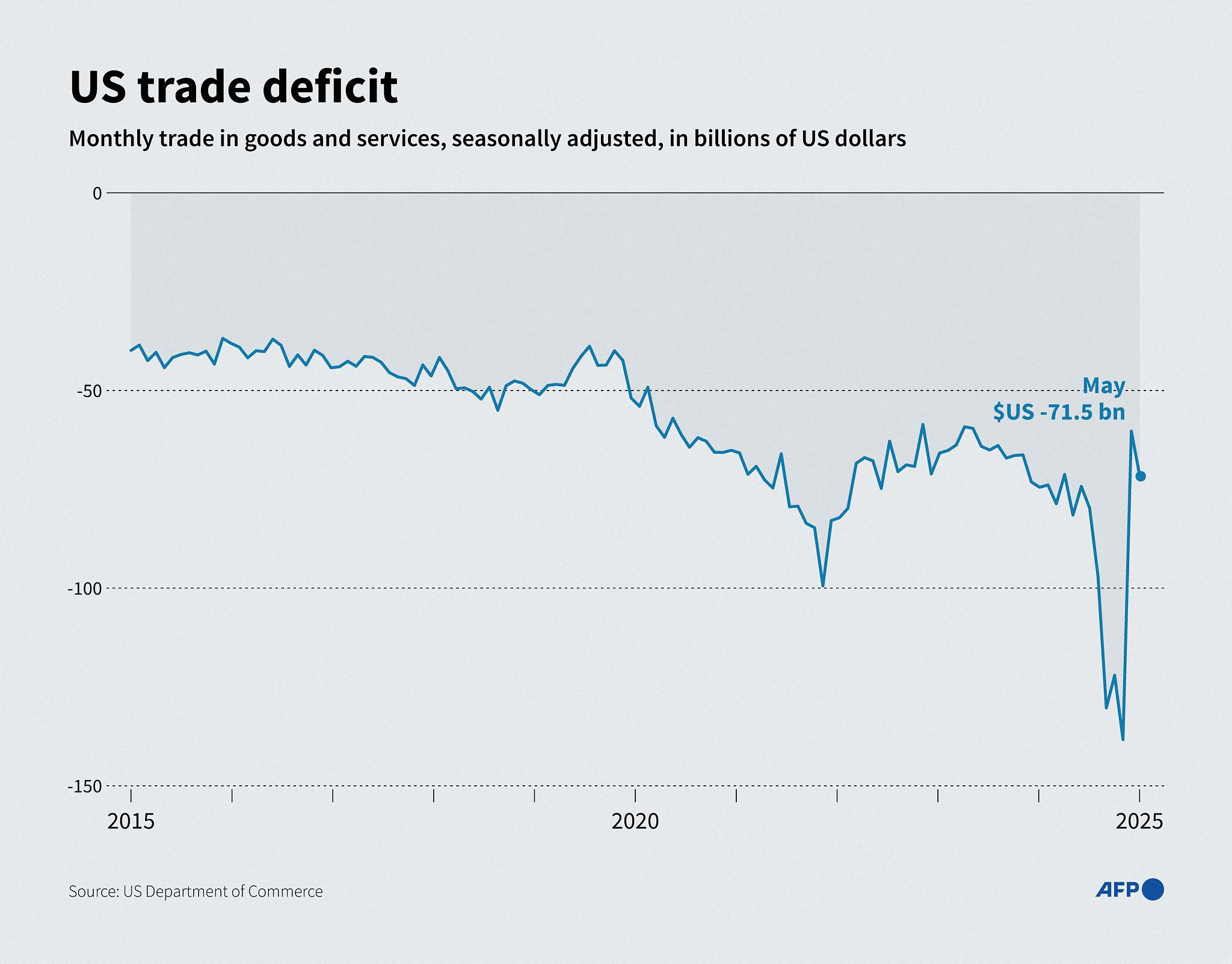
After a year of tariff threats, “Liberation Day” duties, and supply-chain gymnastics, America’s trade deficit didn’t shrink—it hit a record $1.241 trillion.
That’s the headline from year one of Donald Trump’s return to tariff warfare. The administration can point to a narrower deficit with China after slapping tariffs as high as 145%—later reduced to 20% after a deal. But companies simply rerouted supply chains. Deficits with Mexico, Vietnam, and India climbed to record highs as imports shifted rather than shrank.
There was also a lot of “frontloading.” Businesses rushed to import goods ahead of April’s so-called Liberation Day tariff rollout, ballooning the deficit early in 2025. Once duties kicked in, imports slowed and monthly numbers swung wildly—at one point producing the smallest monthly goods gap since 2016, before widening again by year’s end. Think turbulence, not transformation.
Then came the iPhone shuffle. Apple accelerated its move to India, slashing U.S. smartphone imports from China while boosting shipments from Indian factories. Gold dealers flew bars from Europe to New York amid tariff confusion, only for Trump to later declare on social media that gold wouldn’t be tariffed—reversing the trade. Pharmaceutical firms also rushed to stockpile drugs from Ireland, Switzerland, and Germany ahead of expected levies.
One quiet bright spot: services. Even as goods deficits ballooned, U.S. services exports—financial advice, intellectual property, tourism, streaming—hit a record $1.235 trillion. Fewer Canadians in Las Vegas hurt, but Wall Street and Big Tech helped offset the sting.
The bottom line? Tariffs reshuffled global trade lanes and jolted monthly data. What they didn’t do—at least not yet—is erase the gap between what America buys and what it sells.
Source: WSJ (free)
Editor: A trillion-dollar+ deficit after a year of tariff brinkmanship isn’t exactly the “mission accomplished” banner moment. Companies adapted. Consumers paid. The deficit? Still here—just with a new passport stamp.
Wall Street Wobbles, Europe Wins: Investors Pour Record Cash Into EU Stocks
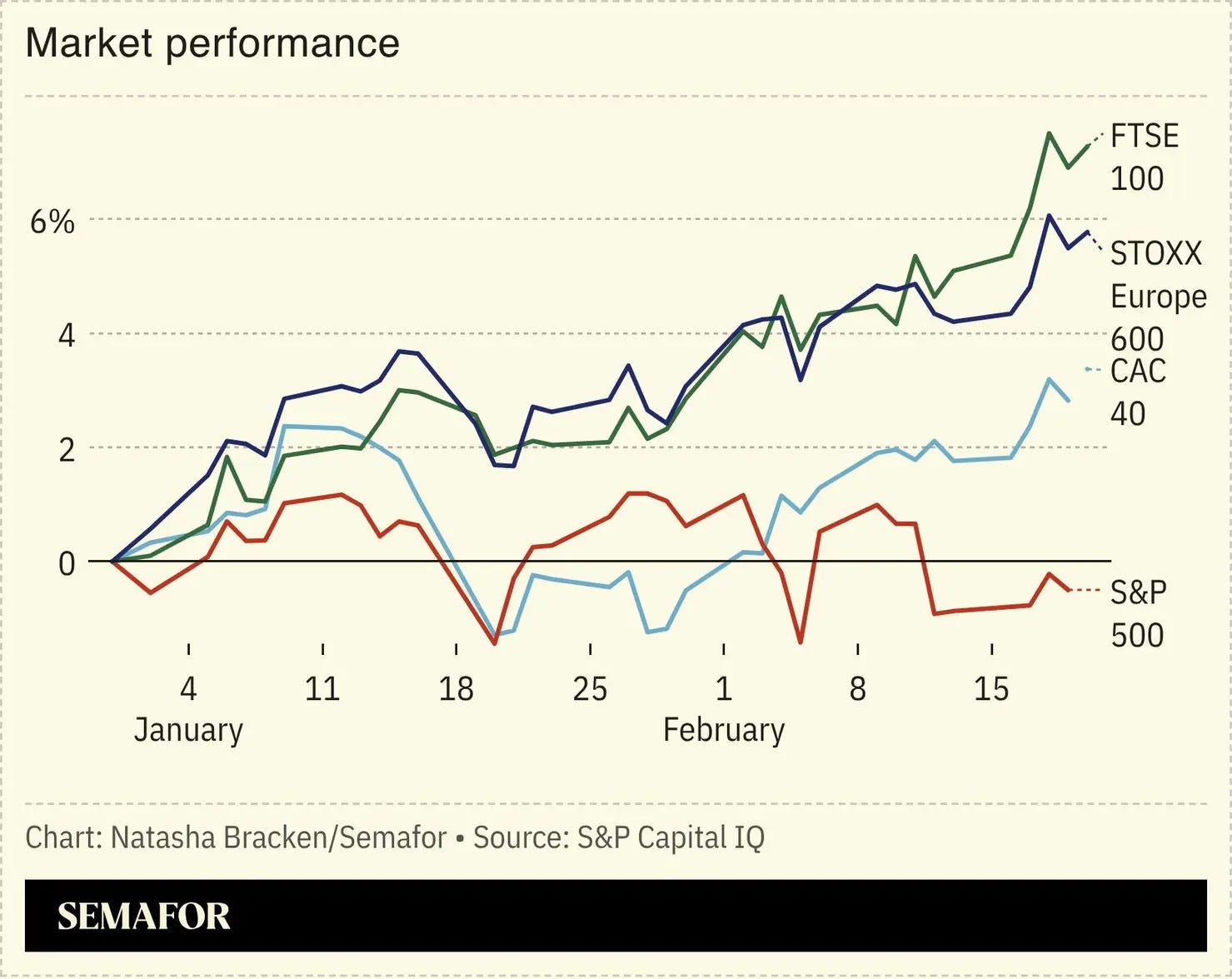
As uncertainty clouds the U.S. outlook, global investors are quietly shifting billions into Europe.
European equities have attracted record inflows in recent weeks as money managers look to diversify away from Wall Street’s tech-heavy surge. After years of outflows and hand-wringing over sluggish growth, the continent’s funds have now logged steady investment over the past year—an abrupt change in sentiment.
Part of the shift is about risk. With geopolitical tensions simmering and U.S. tech giants spending aggressively on AI, some investors worry about bubble dynamics forming stateside. Rather than betting against America outright, many are hedging it—rotating into European industrials, financials and even physical assets while keeping a toe in U.S. markets.
It’s not exactly “Sell America.” It’s more like “Don’t marry it.” Investors want less concentration risk tied to a handful of mega-cap tech names, but they also don’t want to miss out if U.S. markets continue climbing. Europe, long viewed as the laggard, suddenly looks like a diversification play with room to run.
For a continent that spent years being dismissed as slow-growth and overregulated, this reversal is notable. Capital flows don’t move on vibes alone—they move when the risk-reward math changes.
Source: Semafor
Editor: For years the trade was “buy America, ignore Europe.” Now it’s “maybe spread it around.” Funny how diversification sounds wise only after everyone crowds into the same seven stocks.
Trump Weighs Early Strike on Iran as Nuclear Deadline Ticks Down

With a self-imposed 10-to-15-day deadline looming, President Trump is reportedly considering an early, limited military strike on Iran.
According to reporting cited by The Wall Street Journal and covered by The Guardian, aides have discussed targeting specific Iranian government buildings or military sites—an operation designed to be forceful but contained enough to avoid triggering full-scale retaliation. Other options on the table reportedly include broader strikes aimed at crippling Tehran’s nuclear program or even destabilizing the regime.
Donald Trump has publicly warned Iran it has “10 to 15 days” to cut a deal over its nuclear ambitions. “We’re either going to get a deal, or it’s going to be unfortunate for them,” he said aboard Air Force One, calling that timeline “pretty much” the maximum. The Pentagon, meanwhile, has moved two aircraft carriers, fighter jets, and refueling tankers into the region—reportedly the largest buildup since the Iraq invasion 23 years ago.
The pressure campaign comes as Trump juggles other political firestorms. The newly released Epstein files continue to reverberate, with Virginia Giuffre’s brother telling CNN the president “is potentially implicated”—a claim Trump rejects, insisting he was “exonerated.” FBI Director Kash Patel is facing scrutiny over overseas travel expenses, and the husband of Labor Secretary Lori Chavez-DeRemer has reportedly been barred from her department’s headquarters amid sexual assault allegations.
And in case geopolitics wasn’t enough, Trump also announced he’s directing agencies to release files related to the search for alien life—apparently unwilling to let Barack Obama have the last word on extraterrestrials.
But the immediate stakes are far more terrestrial. A limited strike might be calibrated to force negotiations. It might also spiral. Deadlines in the Middle East have a way of becoming something else entirely.
Source: The Guardian
Editor: Setting a two-week clock on Iran while parking aircraft carriers offshore is one way to negotiate. The question isn’t whether the clock runs out—it’s what happens the morning after it does.
Megan Keller’s Overtime Dagger Lifts Team USA to Hockey Immortality

One move, one backhand, one flash of red light—and Team USA had its forever moment.
In sudden-death overtime against Canada, Megan Keller took a long pass, deked a defender, and slipped a backhand through the goalie’s pads to seal a 2-1 Olympic gold for the United States. “I thought, ‘Why not?’” Keller said. “Let’s take a chance.” That chance is now etched into hockey lore.
The goal instantly became driveway legend stuff—the kind kids mimic on frozen ponds for the next decade. Keller, 29, a Boston College alum and Boston Fleet pro, now owns the defining highlight of her third Winter Games. Gloves flew. Canada froze. Gold.
Lost in the euphoria was the equalizer that made it possible. Down 1-0 late, Team USA pulled its goalie and captain Hilary Knight deflected a laser from Laila Edwards to tie it. “We’re gonna win the game,” Knight said afterward. That belief carried them into overtime.
And none of it happens without Aerin Frankel, who turned away 30 shots and absorbed everything Canada threw at her. The U.S. was dominant all tournament, but in the final they needed their goalie to be granite. She was.
Olympic hockey thrives on chaos and nerve. One second you’re bracing for heartbreak. The next you’re watching history skate away in celebration. This was the kind of game that lives on long after the medals tarnish.
Source: WSJ (free)
Editor: Canada had it. Then they didn’t. That’s hockey at its cruelest and most glorious—and if you didn’t yell at your TV on that backhand, check your pulse.