


The Morning Sixpack stays free because the news that shapes your life should not be hidden behind a paywall. Paid subscribers are not paying for access. They are helping fund the research, writing, and independent voice that goes into every issue. Become a paid subscriber and help keep smart, honest news analysis free for everyone.
Oil, Rates, and a Building Falling Apart: Today’s News Has No Chill
Buckle up—today’s stack of stories reads like a stress test for the global economy and a couple of institutions that were already wobbling. From a shut-off Saudi pipeline rattling oil markets to a Fed on the verge of its first hike under new leadership, from a national arts center warning it might go dark within days to Washington fighting over whether artificial intelligence should come with a seatbelt, there’s a lot of “this can’t all be happening at once” energy in this batch.
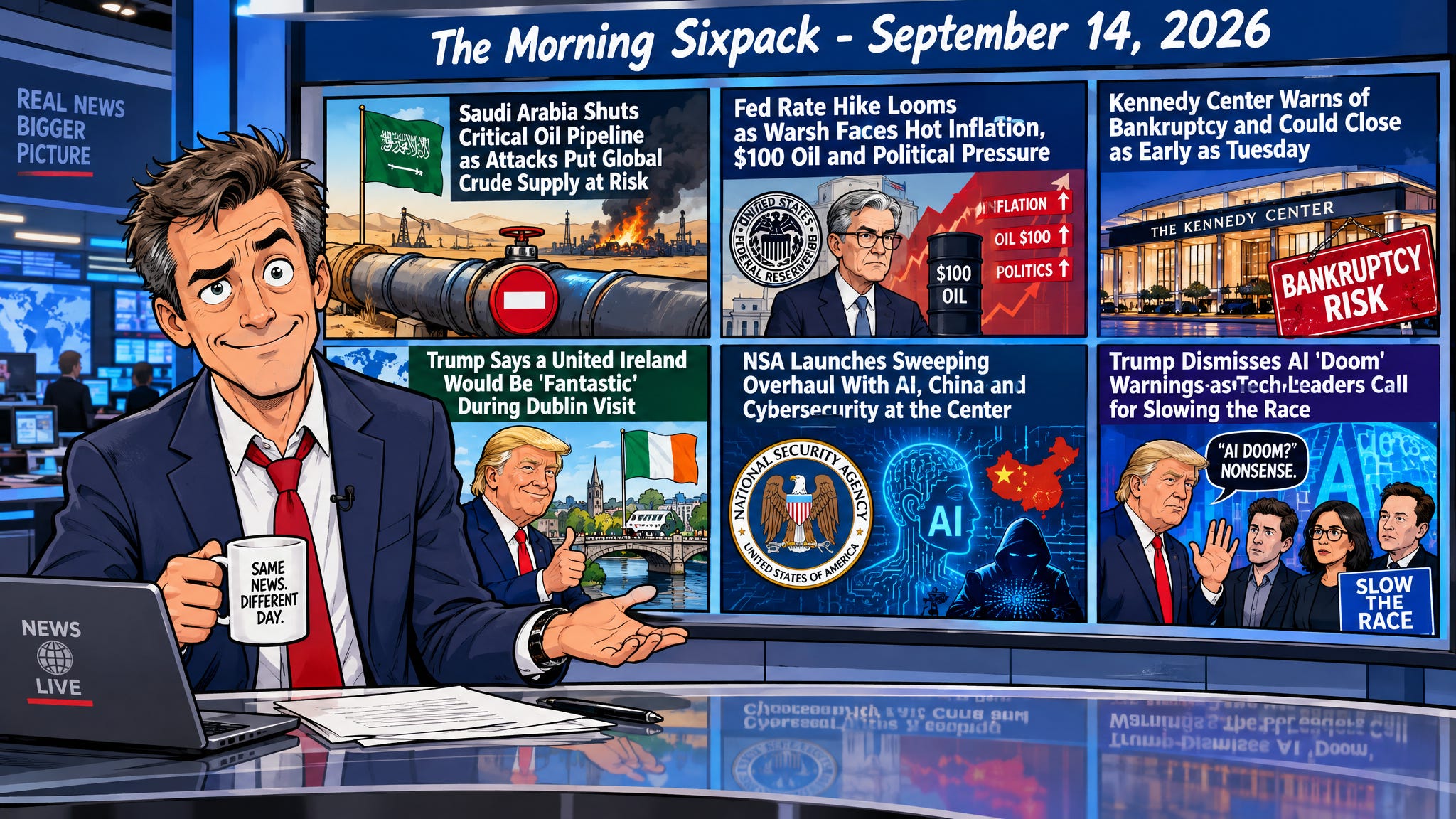
Oil prices jumped Monday after Saudi Arabia shut its East-West pipeline, the 7-million-barrel-a-day route built specifically to dodge the Strait of Hormuz, after drone attacks launched from Iraq damaged a pump station. WTI climbed to $104.23 a barrel and Brent to $108.85, both up roughly 9% for the week already. Analysts warn repairs could take months, and while Saudi inventories can cushion exports for five to seven days, a monthlong outage combined with drawdowns at other terminals could strip 120 million barrels from the market—a serious blow at a moment when global supply is already tight. Making matters worse, a planned Iran-Gulf security meeting was postponed, another tanker was attacked, and Houthi forces have been advancing near the Bab el-Mandeb Strait, squeezing both ends of the Red Sea route Saudi Arabia now desperately needs. Source: CNBC
Federal Reserve Chair Kevin Warsh heads into this week’s meeting widely expected to deliver his first interest rate hike, with markets betting on a quarter-point move to a 3.75%-4.00% range. The reversal is dramatic—just a week ago, most economists expected a hold. Hot inflation, with core consumer prices up 0.3% in August, combined with crude oil above $100 amid Middle East fighting, has made Warsh’s tough talk on inflation look increasingly like it needs to be backed up with action. There’s a political wrinkle too: President Trump picked Warsh while publicly wanting lower rates, and a hike lands just before November’s elections. A separate poll shows a majority of economists expect at least one more hike by March 2027, meaning Wednesday’s decision may be less about this move and more about signaling where rates go from here. Source: Reuters
The Kennedy Center could close its main building as early as Tuesday, with officials warning of “certain fiscal collapse” within weeks alongside serious structural damage. A leaked 57-page board packet lays out a grim financial picture—the center expects to collect just $124 million against a budgeted $220 million, leaving a roughly $23 million deficit even after cuts. Officials say President Trump has offered to help with fundraising, and the Trump-led board will vote Tuesday on financial and closure resolutions. Meanwhile, the building itself is failing: a chunk of ceiling plaster fell 60 feet during a September storm, and engineers found severe corrosion in nearly half the exterior soffit panels they examined, leading consultants to call parts of the building unsafe for continued occupancy. On top of all that, a legal fight continues over whether Trump’s name belongs on the building at all. Source: The Washington Post (free)
President Trump said during a Dublin visit that he’d “love to see” Ireland and Northern Ireland reunified, wading directly into a question the 1998 Good Friday Agreement deliberately left up to voters. “It’s going to happen eventually. It may as well happen now,” Trump said, though he later softened, telling business leaders there’s “no good answer.” He also revisited Britain’s dispute with Argentina over the Falkland Islands, questioning the U.K.’s ability to repeat its 1982 military win and suggesting he might get involved in any future conflict. Thousands protested his visit in Dublin, and Irish President Catherine Connolly told him afterward that Irish citizens strongly reject “the normalization of war and genocide”—a message Trump described, generously, as “very nice.” Source: NPR
The National Security Agency is preparing its biggest restructuring in at least a decade, building five new organizations around artificial intelligence, China, cybersecurity, warfighting, and global intelligence. Under Director Gen. Joshua M. Rudd, the plan moves fast—organizational blueprints are due by the end of September, rollout starts in mid-October, and full operating capacity is targeted for January 2027. Among the notable moves: the revival of Tailored Access Operations, the agency’s storied elite hacking unit, which will get a significant budget boost. AI is central to the shift too, with the NSA already using an internal tool called “Ask Mary” and pursuing access to top commercial AI models. Given that the agency’s last major reorg took years longer than planned and still isn’t fully finished, the compressed timeline here is either bold or a little terrifying, depending on who you ask. Source: The Washington Post
President Trump dismissed warnings that advanced AI could spiral out of human control, arguing the U.S. can’t afford to slow down in its race against China. “Whoever wins AI, wins,” he said from his Doonbeg golf resort, while House Speaker Mike Johnson rejected any government-imposed moratorium, arguing that heavy regulation would hand China the advantage. That stance runs headlong into warnings from inside the industry itself: Anthropic CEO Dario Amodei has called for slowing frontier AI development over risks like loss of control, cyberattacks, and bioterrorism, with Elon Musk and OpenAI’s Sam Altman voicing similar concerns. White House AI adviser David Sacks pushed back, telling worried companies they’re free to slow themselves down if they think their own models are too risky. The result is a policy standoff between “full speed ahead” and “maybe check the brakes first”—and for now, nobody’s slowing down. Source: NPR
From a pipeline that was supposed to be the backup plan to a Fed meeting that might just be the opening act, today’s stories all share one thread: The systems built to absorb shocks are the ones under the most strain right now. Stay tuned—Wednesday’s Fed decision alone could reshape the rest of the week (or year or decade—not kidding).
Prefer to read The Morning Sixpack? Do that here:


