


A federal judge just told Uncle Sam to cough up $130 billion in Trump tariffs—and the bill is finally coming due.
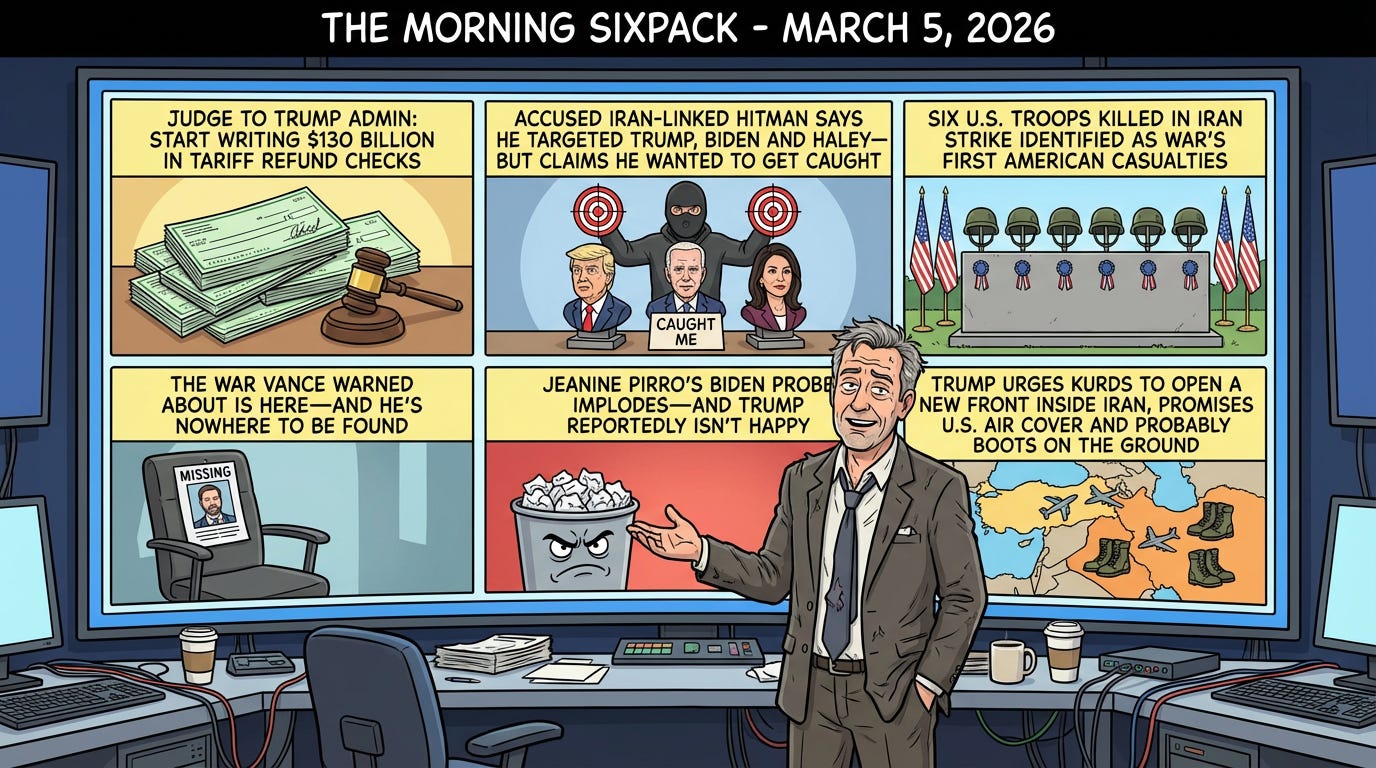
Judge to Trump Admin: Start Writing $130 Billion in Tariff Refund Checks
A federal trade judge has ordered the Trump administration to begin refunding more than $130 billion in tariffs the Supreme Court invalidated last month.
In a Manhattan courtroom at the U.S. Court of International Trade, Judge Richard Eaton told the administration to get moving. After the Supreme Court struck down a swath of Trump-era global tariffs, Eaton ordered U.S. Customs and Border Protection to recalculate duties—this time without the voided levies—and start issuing refunds. More than 2,000 companies, including Costco, FedEx and Pandora Jewelry, have lined up to get their money back.
The government tried to slow-walk it. A Justice Department lawyer asked the judge to pause the order pending appeal. Eaton wasn’t having it. When the administration claimed it hadn’t formalized its refund position, the judge cut through the fog: “Your position is clear,” he said. “The Supreme Court told you what your position is.” When officials warned the process would be manual and time-consuming, Eaton shot back, “We live in the age of computers. It must be possible for Customs Service to program its computers so it doesn’t need a manual review.”
Trade lawyers didn’t expect this to move so fast. One attorney admitted, “This is the order I hoped for, but never expected to see.” Still, some caution that refunds aren’t automatic checks in the mail. “The courts still need to figure out the mechanics of how this actually gets unwound,” said customs broker Nunzio De Filippis. “My message to the trade community is to chill out. There’s still a whole process to figure out.”
President Trump had openly groused after the Supreme Court ruling, noting the justices didn’t spell out whether the government should keep the cash. “Wouldn’t you think they would have put one sentence in there, saying: ‘Keep the money,’ or ‘Don’t keep the money’, right?” he said. Turns out, the lower court is more than happy to fill in that blank—and it’s leaning heavily toward “Don’t keep the money.”
Appeals are coming. But for now, the meter is running in reverse.
Source: The Wall Street Journal (free)
Editor: If you collect $130 billion you weren’t allowed to collect, it’s not called strategy—it’s called owing everybody a refund. Better start warming up those Treasury printers.
A Pakistani businessman admits he tried to hire hit men to kill Trump, Biden, and Haley—but says Iran forced his hand and he expected to get caught anyway.
Accused Iran-Linked Hitman Says He Targeted Trump, Biden, and Haley—But Claims He Wanted to Get Caught
A Pakistani businessman on trial in New York admitted he tried to hire hit men to assassinate Donald Trump, Joe Biden and Nikki Haley—but told jurors he only did it because Iran’s Revolutionary Guard threatened his family.
He says he expected the FBI to arrest him before anyone was hurt—and hoped it might even score him a green card.
The defendant, 47-year-old Asif Merchant, testified through an Urdu interpreter that he traveled to the U.S. in 2024 to recruit killers for what prosecutors describe as an Iran-backed plot. “My family was under threat, and I had to do this,” Merchant said. “I was not wanting to do this so willingly.” Assistant U.S. Attorney Nina Gupta cut to the chase: “You traveled to the United States for the purpose of hiring Mafia members to kill a politician, correct?” Merchant replied flatly, “That’s right.”
The supposed hit men he handed $5,000 in cash to were actually undercover FBI agents. He was arrested July 12, 2024—just one day before a separate attempt on Trump’s life in Butler, Pennsylvania. Prosecutors say investigators found handwritten codewords outlining aspects of the alleged plot. Merchant testified he believed he was under U.S. surveillance and still moved forward, researching Trump rally locations and sketching out a shooting scenario despite claiming he thought he’d be caught first.
Merchant told jurors he had been recruited by an operative from Iran’s Islamic Revolutionary Guard Corps, which the U.S. designates a foreign terrorist organization. He said the handler named three targets: Trump, Biden and Haley. Merchant claims he “had no other option” because the operative knew where his relatives in Iran lived. Yet prosecutors note he never alerted U.S. authorities before his arrest and failed to mention key duress claims in early FBI interviews. When his defense lawyer asked, “And are you a super-spy?” Merchant answered, “No. Absolutely not.”
The trial unfolds against the backdrop of escalating U.S.-Iran tensions and fresh conflict overseas, though jurors have been instructed to ignore outside news. Iran has denied plotting to kill Trump or other U.S. officials.
The government says this was a real assassination conspiracy backed by Tehran. Merchant says it was a desperate bluff by a businessman who thought he could outmaneuver both Iran and the FBI.
That’s a risky bet in Brooklyn federal court.
Source: CBS News
Editor: If your master plan is to hire undercover agents to stage a fake assassination so you can negotiate immigration benefits, that’s not espionage—that’s fantasy football for felonies.
Six Army Reserve soldiers died in a drone strike on a fortified trailer in Kuwait—proof that even the “safe” posts aren’t safe anymore.
Six U.S. Troops Killed in Iran Strike Identified as War’s First American Casualties
The Pentagon has identified six Army Reserve service members killed when an Iranian projectile pierced air defenses and slammed into a makeshift tactical operations center in Kuwait.
They weren’t on the front lines—they were in what was supposed to be a fortified rear-area post.
The strike hit a triple-wide trailer at Shuaiba port on just the second day of U.S. and Israeli military operations against Iran. Concrete barriers surrounded the structure, but there was nothing overhead to stop a drone or missile. All six were assigned to the 103rd Sustainment Command out of Iowa, supporting logistics operations in the region. Defense Secretary Pete Hegseth said the attack came without warning.
Among the dead: 20-year-old Sgt. Declan Coady of Des Moines, an IT specialist studying cybersecurity at Drake University who hoped to become a commissioned officer. Capt. Cody Khork, 35, of Lakeland, Florida, described by family as “the life of the party” and a decorated military police officer. Sgt. 1st Class Nicole Amor, 39, a Minnesota mother of two who was days away from returning home—“She was almost home,” her husband said. Sgt. 1st Class Noah Tietjens, 42, of Nebraska, remembered as the mentor who “made you feel important.” Maj. Jeffrey O’Brien, 45, an Iowa State computer engineering graduate and 17-year reservist. And Chief Warrant Officer 3 Robert Marzan, 54, of California, a husband and father praised as a steady leader. Final identification for Marzan is pending, but officials say he was present at the scene.
Several of the fallen had deployed together before, including in Kuwait in 2019—a rare reunion of reservists who returned years later to serve side by side again. A retired colonel who knew them said that kind of unit loyalty “is not common.” Their decorations span Meritorious Service Medals, Army Commendation Medals, National Defense Service Medals and more—but those ribbons don’t soften the knock at the door for families in Iowa, Florida, Minnesota, Nebraska and California.
“You don’t go to Kuwait thinking something’s going to happen,” said Joey Amor. That assumption ended Sunday. Sustainment troops—the logisticians, mechanics and signal officers who keep wars running—are now among the first American names etched into this one.
The war with Iran has already redrawn the map of “safe” assignments. And for six families, it has redrawn everything.
Source: CNN
Editor: When a fortified trailer becomes a coffin, it’s time to admit the battlefield has no rear anymore. The enemy doesn’t care about your job title—only your coordinates.
J.D. Vance warned against war with Iran—now he’s the quiet guy in the Situation Room photo while Trump lights the fuse anyway.
The War Vance Warned About Is Here—and He’s Nowhere to Be Found
J.D. Vance built his brand opposing a war with Iran, but as Trump plunges the U.S. into one, the vice president’s influence appears to be evaporating.
The loudest critic of “forever wars” is suddenly whisper-quiet while the bombs fall.
During the 2024 campaign, Vance was crystal clear: America should not “constantly police every region of the world.” A war with Iran, he warned, would be “massively expensive” and a dangerous distraction from China. He even called an Israel–Iran war “the most likely and most dangerous scenario” for triggering World War III. Fast-forward to today—President Trump has joined Israel in a widening war against Tehran, promising to do “whatever it takes” and declaring wars can be fought “forever.” Vance? Silent on X. Not at Mar-a-Lago. Not front and center.
Instead, the administration released a photo of him running a secondary White House meeting—Diet Mountain Dew on the table, Tulsi Gabbard at his side—while the real decisions appeared elsewhere. For a man once touted as the intellectual future of Trumpism, it’s a telling frame.
On foreign policy, Vance was the isolationist counterweight inside a coalition that includes interventionists like Marco Rubio. He argued America couldn’t afford to burn through munitions in regional conflicts while preparing for a showdown with China. Yet now, missile interceptors are being expended at a furious pace in the Middle East—not Ukraine, the fight Vance derided, but Iran. When Trump reversed course and resumed robust support for Kyiv, Vance didn’t win that argument either.
It’s not just foreign policy. Vance once pitched a worker-first GOP—higher child tax credits, more aggressive antitrust enforcement, even flirtations with European-style labor representation. Aside from tariffs—which Trump loved long before Vance—little of that vision has materialized. The administration’s big legislative win nudged child tax credits upward but stopped well short of the sweeping pronatalist overhaul Vance championed. On labor and corporate power, the swamp looks remarkably undrained.
To be fair, vice presidents rarely run the show. But Vance wasn’t supposed to be just another ceremonial understudy. His 2024 nomination signaled Trumpism after Trump—a bridge to the party’s future. Instead, on immigration Stephen Miller seems more influential. On economics, Treasury Secretary Scott Bessent. On foreign affairs, Rubio and special envoy Steve Witkoff. When policy clashes, Vance doesn’t appear to be winning many rounds.
The irony is thick. The man who rose to prominence decrying George W. Bush’s wars and promising restraint may now be tied to a conflict he explicitly warned against. Reinvention worked for him before. It may have to again—especially if 2028 ambitions collide with 2026 realities.
Because the record is stacking up. And it doesn’t read like the speeches.
Source: The Atlantic
Editor: When your signature issue is “don’t start another war” and the war starts anyway, you’re not shaping history—you’re posing for the group photo.
Jeanine Pirro can’t conjure indictments out of thin air—and Trump reportedly isn’t thrilled about it.
Jeanine Pirro’s Biden Probe Implodes—And Trump Reportedly Isn’t Happy
U.S. Attorney Jeanine Pirro’s attempt to build a criminal case over Joe Biden’s use of an autopen has collapsed—and it’s the latest setback in Donald Trump’s push for legal retribution.
When prosecutors can’t find a law to charge, even Trump’s loyalists run out of road.
According to a New York Times report, the failed Biden probe underscores what’s becoming a pattern inside Trump’s Justice Department: big demands for indictments, thin legal footing. Investigators couldn’t identify a statute to support charges over Biden’s use of the autopen—a signing device presidents of both parties have used for years. As Times reporter Michael Schmidt put it bluntly, “They couldn’t find a law, you know, to hang this thing on.”
Schmidt, speaking on MSNBC, said the problem runs deeper than one fizzled case. Trump, he noted, has pressed for prosecutions against political adversaries ranging from Democratic lawmakers to former FBI Director James Comey and New York Attorney General Letitia James. “He wanted the Justice Department to seek retribution and vengeance against those people who he didn’t like,” Schmidt said. So far, those efforts have hit “roadblock after roadblock.”
Pirro, a former Fox News host now serving in a key federal prosecutor role, appears to be walking a tightrope—trying to satisfy a president eager for payback while avoiding cases that would implode before a grand jury. Schmidt suggested she understands the legal limits but is operating in a difficult political environment. “I’ve watched people try and do that now for, you know, two different terms,” he warned, “and usually it doesn’t end well.”
That’s the bind. Prosecutors can chase headlines, or they can win cases. Doing both requires facts and statutes—not just presidential frustration. And if history is any guide, Trump’s patience with underperforming loyalists has a short shelf life.
Source: Raw Story
Editor: You can demand indictments all day long—but if there’s no crime, even the loudest gavel won’t make it appear. Law school tends to frown on “because the president said so.”
One thing we can be sure of: Trump will abuse the autopen now and forever.
Trump is urging Kurdish groups to rise up inside Iran—with promises of U.S. air cover and (perhaps!) “boots on the ground”—reviving a risky playbook that rarely ends cleanly.
Trump Urges Kurds to Open a New Front Inside Iran, Promises U.S. Air Cover
President Trump has reached out to Kurdish leaders in Iran and Iraq, offering U.S. air support and backing if they move against Tehran’s regime in western Iran.
It’s a high-stakes gamble that could widen the war—and once again test whether Washington stands by the Kurds or leaves them exposed.
According to multiple officials, Trump personally called leaders of Iraq’s two dominant Kurdish parties, pressing them not to block Iranian Kurdish militias from mobilizing across the border. The message, as described by a senior Kurdish official, was blunt: choose a side—America and Israel, or Iran. The outreach comes as the administration weighs deeper involvement in the conflict, even as U.S. casualties mount.
Iranian Kurdish opposition groups—long fragmented—recently formed a coalition in Iraq. One faction publicly urged Iranian soldiers to abandon the regime. But Iraqi Kurdish leaders have been careful, reiterating they won’t allow their territory to be used as a launchpad for aggression. They sit in a precarious position: too much cooperation risks Iranian retaliation; too little risks alienating Washington.
History hangs heavy here. The Kurds have often aligned with U.S. objectives—from Iraq to Syria—only to feel abandoned when American priorities shift. A U.S. official acknowledged the ambiguity, noting cooperation “is not totally cut and dry.” Kurdish leaders are reportedly watching to see “which way the wind is blowing” before committing to any ground offensive.
Complicating matters further: Turkey’s sensitivities about Kurdish militancy, Iran’s powerful Islamic Revolutionary Guard Corps presence in the region, and internal rivalries among Kurdish factions themselves. Analysts warn that even the perception of U.S. backing could make Iranian Kurdish areas immediate targets for regime retaliation. Meanwhile, Israeli strikes have already focused heavily on military infrastructure in Iran’s western Kurdish regions—fueling speculation about a coordinated strategy.
The risk calculus is brutal. If a Kurdish uprising succeeds, it could fracture Tehran’s grip on its western provinces. If it fails, Iraqi Kurdistan could absorb the blowback. As one Kurdish official put it, “We are in a very delicate position.” Reject Trump outright? Risk Washington’s wrath. Embrace him? Risk Iran’s.
This is how regional wars metastasize—one phone call at a time.
Source: The Washington Post (free)
Editor: The Kurds have heard promises of American “support” before. They also remember how often that support comes with an expiration date. And don’t be alarmed when this shifts—again—to more talk of “American boots on the ground.”