


Yes, five people helped move a bill touching billions in taxpayer dollars while most of the Senate was nowhere to be found.
Five Senators, $50 Billion, 3 A.M.: The DHS Vote That Slipped Through a Near-Empty Senate
At 3 a.m., just five U.S. senators sat in a near-empty chamber and advanced a spending bill steering tens of billions to the Department of Homeland Security.
The legislation funds most of DHS—excluding Immigration and Customs Enforcement and Customs and Border Protection—and nudges lawmakers closer to resolving airport disruptions tied to the funding lapse. But the optics were brutal: a cavernous chamber, a handful of lawmakers, and a vote that technically counts.
As Punchbowl News reporter Andrew Desiderio noted, only five senators were present. On social media, disbelief spread quickly. “I don’t understand. Five people is a quorum in the Senate?” asked one user. Another fumed, “And they call us a democracy.” A third declared Congress “a not-funny joke.”
Here’s the catch: Senate rules require a majority of its 100 members for a quorum—but only if someone demands it. Without a quorum call, a quorum is simply assumed. No one objected. No one called it out. So the vote rolled on, courtesy of procedure and indifference.
Senate Majority Leader John Thune wasn’t the story here—the rulebook was. In the Senate, silence equals consent. And at 3 a.m., silence was apparently in abundant supply.
Source: Raw Story
Editor: If you ever wondered how billions move through Washington while you’re asleep, now you know. Bring coffee—or at least a quorum call.
When nearly 18 million barrels a day run through one chokepoint, even a single maritime standoff can jolt markets worldwide.
Oil Jumps Above $111 After Iran Turns Back Chinese Ships in Strait of Hormuz Standoff
Oil prices climbed sharply after two Chinese container ships were blocked from transiting the Strait of Hormuz, underscoring how fragile global energy flows have become.
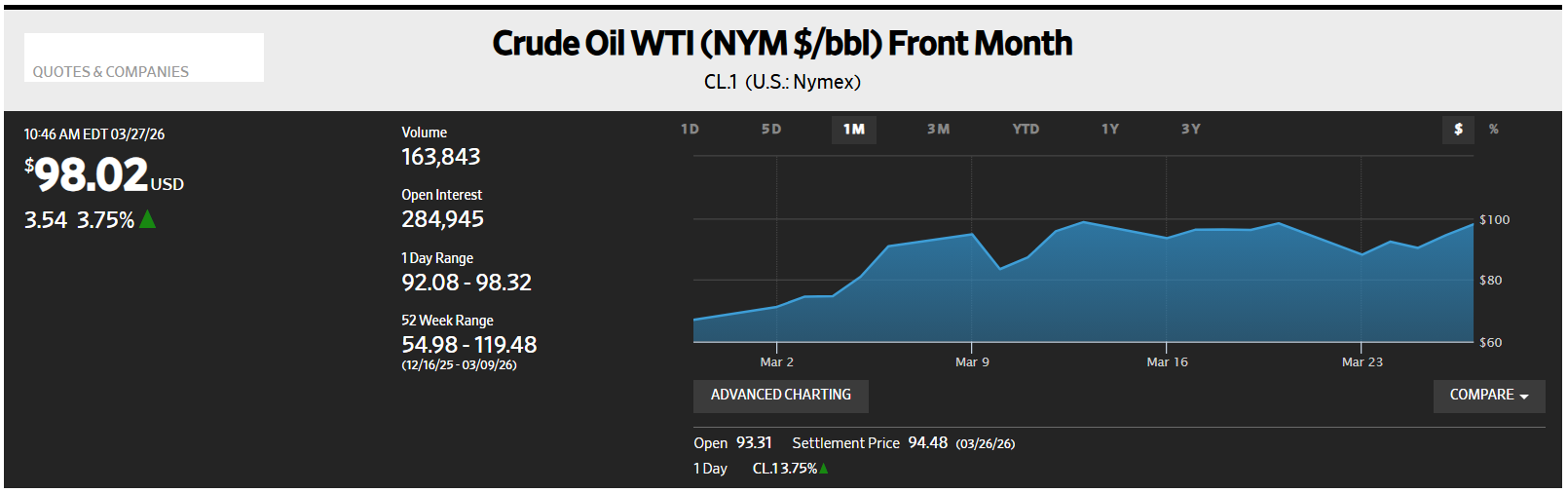
Brent crude surged 2.82% to $111.06 a barrel, while West Texas Intermediate rose 2.68% to $97.01. The move followed reports that two ultra large container vessels owned by China Ocean Shipping Company—better known as COSCO—were turned back while attempting to pass through the strait. According to MarineTraffic, it marked the first attempt by a major carrier to cross since the war began. COSCO ranks as the world’s fourth-largest shipping line by capacity.
The Strait of Hormuz handles roughly 17.8 million barrels per day of oil and fuel. Rystad Energy estimates nearly 500 million barrels of total liquids have already been lost amid weeks of disruption. Chief oil analyst Paola Rodriguez-Masiu put it bluntly: “The oil market did not underreact to the disruption in the Strait of Hormuz; it absorbed it.” She added that the system has shifted from “buffered to fragile” after inventories were drawn down.
Meanwhile, President Donald Trump said talks with Iran were “going very well” and announced a 10-day extension for Tehran to reopen the strait. (Editor: Trump TACO’d AGAIN.) He also claimed Iran allowed 10 oil tankers to pass this week as a “present” to the U.S., saying, “They then apologized for something they said, and they said, ‘We’re going to send two more boats.’ And [it] ended up being 10 boats.” Iran has yet to comment publicly on those remarks.
The market isn’t waiting for diplomatic clarity. Even if a handful of tankers squeeze through, traders see a system running with little cushion. Hormuz isn’t just another shipping lane—it’s the world’s most sensitive energy pressure point, and right now, the dial is edging higher.
Source: CNBC
Editor: Energy markets can handle drama. What they can’t handle is uncertainty at a chokepoint that powers half the planet. Buckle up.
In plain English: the court just told the “Department of War” it overreached.
Judge Slaps Down Pentagon’s ‘Supply Chain Risk’ Label on Anthropic
A federal judge has temporarily blocked the Pentagon from calling Anthropic a “supply chain risk,” giving the AI company a crucial lifeline in its fight to protect federal contracts.
U.S. District Judge Rita Lin ruled that the government’s designation was likely “contrary to law and arbitrary and capricious,” writing, “The Department of War provides no legitimate basis to infer from Anthropic’s forthright insistence on usage restrictions that it might become a saboteur.” That’s not subtle. That’s a judicial eyebrow raised at full height.
The Department of Defense—rebranded the Department of War under President Donald Trump (curiously, the “non-war President”)—had relied on Anthropic’s Claude AI tools to draft sensitive documents and analyze classified material. But earlier this month, officials began cutting ties, arguing Anthropic imposed usage limits the administration didn’t like. The “supply chain risk” label effectively froze adoption across agencies and dented the company’s reputation.
Lin’s order restores the status quo to late February, before the directives were issued. It doesn’t force the Pentagon to use Claude, and it doesn’t stop the government from switching vendors. What it does do is strip away the scarlet letter—at least for now. A separate lawsuit is still pending in a Washington appeals court, and the injunction won’t take effect for a week.
For Anthropic, this is more than symbolic. In the AI arms race, perception is currency. Being tagged as a national security liability is the kind of thing that scares off customers fast. Now, the company can point to a federal judge and say the government may have been the one playing fast and loose.
Source: Wired
Editor: When the government calls you a saboteur and a judge responds with “show me the evidence,” that’s not just a legal win—it’s a reputation rescue.
For the first time ever, a sitting president will have his signature printed on U.S. paper currency—and yes, it’s Donald Trump.
Trump to Put His Signature on U.S. Dollar Bills for 250th Anniversary
President Donald Trump’s signature will soon appear on U.S. paper currency, marking the first time a sitting president’s name is printed on American dollar bills.
It’s not just policy—now it’s literally pocket change.
The Treasury Department announced Thursday that Trump’s signature will be added to bills in honor of the nation’s 250th anniversary. Traditionally, U.S. currency carries only the signatures of the treasury secretary and the treasurer. Treasury Secretary Scott Bessent framed the move as tribute, saying, “The President’s mark on history as the architect of America’s Golden Age economic revival is undeniable. Printing his signature on the American currency is not only appropriate, but also well deserved.”
Paper money has featured the treasurer’s and treasury secretary’s signatures since 1861. This breaks that precedent. It also lands at a time when polls show voters sour on the economy, frustrated by inflation, rising living costs, and climbing oil prices tied to the Iran conflict.
And the branding doesn’t stop there. A federal commission has already approved a design for a 24-karat commemorative gold coin bearing Trump’s image, pending Treasury approval. Americans may recall that in 2020, Trump’s name appeared on Covid stimulus checks as well—another presidential first.
From affixing his name to the John F. Kennedy Center for the Performing Arts to attaching it to federal programs and proposed warships, Donald Trump has made clear he intends to leave a visible imprint on government. Now that imprint may be sitting in your wallet.
Source: NBC News
Editor: Most presidents settle for a portrait decades later. This one skipped the waiting period and went straight for the signature line. NO BETTER TIME TO GO “CASHLESS”.
Suburban “soccer moms” who once leaned moderate are organizing mass “No Kings” protests against Trump, with millions expected to turn out.
‘Our Hair Is on Fire’: Suburban Voters Lead Expanding ‘No Kings’ Revolt Against Trump
Affluent suburban communities once known for moderation are now fueling a nationwide wave of anti-Trump activism, with millions expected to rally in “No Kings” protests far beyond America’s big cities.
The political middle of the cul-de-sac is picking a side—and it’s not the White House.
In Montclair, New Jersey, Allison Posner went from politically disengaged mom to full-time activist—organizing protests, handing out supplies to immigrant families and leading a march through her town this weekend. “The people in the suburbs are definitely radicalizing,” she said. “This is not some other people’s fight. This is our fight.”
The activist group Indivisible says roughly two-thirds of more than 3,000 planned demonstrations will unfold outside urban centers, with over 9 million people expected nationwide. Co-founder Ezra Levin put it simply: “We’re going to be everywhere.” Organizers report especially strong sign-ups in competitive districts like Scottsdale, Langhorne, East Cobb, and northern New Jersey’s 11th.
That district is now a test case. Democrat Analilia Mejia, a progressive backed by Sen. Bernie Sanders and Rep. Alexandria Ocasio-Cortez, is running in an April 16 special election. She calls out what she describes as Trump’s “violent authoritarianism” and rejects accusations of antisemitism over her criticism of Israel’s war in Gaza, saying, “When I say Palestinians have rights, like Jewish people and Israelis have rights, that is not antisemitism, that is humanism.”
Republican nominee Joe Hathaway is trying to thread a needle—supporting parts of President Donald Trump’s agenda while arguing Congress must reassert itself as the “first branch of government.” But the broader trend may be bigger than any one race. College-educated and increasingly diverse suburban voters have been drifting left for years, accelerating during the Trump era.
Once the backbone of pragmatic Republicanism, the suburbs now look like the front line of organized resistance. If turnout matches the projections, this isn’t just a protest weekend—it’s a warning shot aimed squarely at November.
Source: Associated Press
Editor: When the PTA starts quoting the Constitution and planning marches between soccer practice and lacrosse, politicians should probably start sweating.
U.S. intelligence can confirm only about one-third of Iran’s missile arsenal is destroyed, despite public claims that Tehran has “very few rockets left.”
U.S. Has Only Verified Destruction of One-Third of Iran’s Missiles—Despite Trump’s Claims
U.S. intelligence officials can only confirm that roughly one-third of Iran’s missile arsenal has been destroyed nearly a month into the war, contradicting President Donald Trump’s claim that Tehran has “very few rockets left.”
Behind the confident podium talk, the battlefield math is far murkier.
According to five people familiar with U.S. intelligence, another third of Iran’s missiles may be damaged, buried, or inaccessible in underground bunkers—but that’s far from certain. The remaining stockpile? Still very real. One source said the assessment is similar for Iran’s drone capability, with only about a third verifiably destroyed.
That stands in sharp contrast to President Donald Trump’s public remarks Thursday. “The problem with the straits is this: let’s say we do a great job. We say we got 99% (of their missiles). 1% is unacceptable, because 1% is a missile going into the hull of a ship that cost a billion dollars,” Trump said at a Cabinet meeting—while also asserting Iran has “very few rockets left.”
Operation “Epic Fury,” led by U.S. Central Command, has struck more than 10,000 Iranian military targets and reportedly sunk 92% of Iran’s large naval vessels. But officials have declined to provide precise figures on missile and drone destruction. Estimates of Iran’s pre-war missile stockpile range from 2,500 to 6,000.
Meanwhile, Iran continues to fire back. Just Thursday, it launched 15 ballistic missiles and 11 drones at the United Arab Emirates. Last week, it even targeted the U.S.-UK base at Diego Garcia in the Indian Ocean with long-range missiles—hardly the move of a regime scraping the bottom of the barrel.
Nicole Grajewski, a missile expert at Sciences Po, said Iran may still retain roughly 30% of its missile capability and noted the country operates more than a dozen large underground facilities. “The big question is: have these facilities collapsed?” she asked.
One senior U.S. official was blunt: “I don’t know if we’ll ever have an accurate number.”
Translation: This war may be degrading Iran’s arsenal—but the fog is thick, the tunnels are deep, and the certainty being projected publicly doesn’t quite match the classified briefings.
Source: Reuters
Editor: If you’re claiming 99% success while admitting 1% could sink a billion-dollar ship, maybe pump the brakes on the victory lap.