


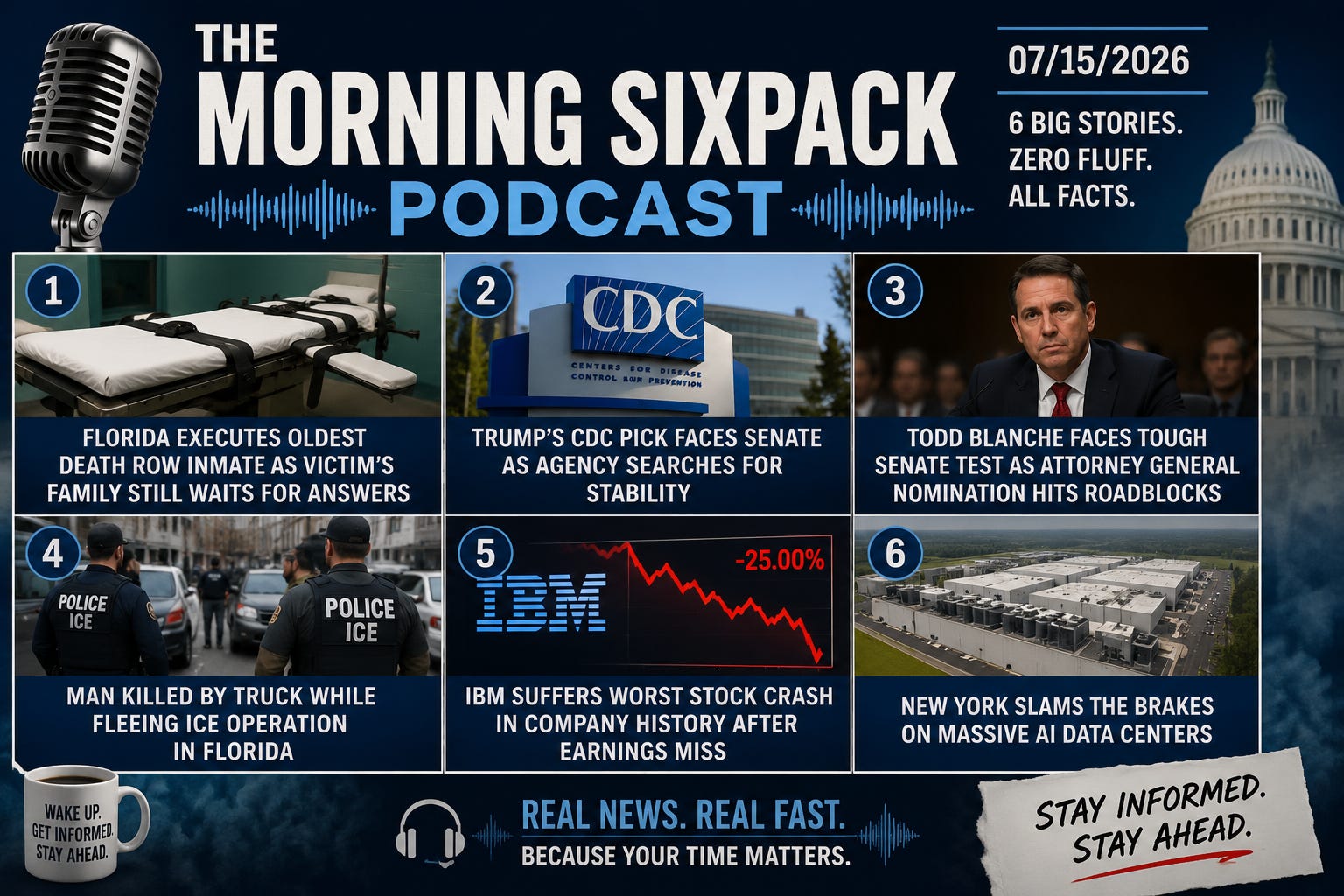
Forty-four years after Patty Gifford vanished, Florida executed her killer—but her family still doesn’t know where he left her.
Florida Executes Oldest Death Row Inmate as Victim’s Family Still Waits for Answers
Florida executed 74-year-old Dennis Sochor Tuesday evening, closing one of the state’s oldest death penalty cases while leaving its biggest question unanswered.
Patty Gifford’s body has never been found—and that means the people who loved her are still waiting for the one answer Sochor took to his grave.
Sochor was pronounced dead at 6:19 p.m. after receiving a lethal injection, becoming the oldest inmate ever executed in Florida. Convicted of sexually assaulting and strangling 18-year-old Patty Gifford after a 1982 New Year’s Eve party, he never revealed where he disposed of her remains. Earlier in the day, the U.S. Supreme Court rejected his final request to halt the execution over concerns about Florida’s lethal injection protocol.
“It’s unfinished. Where is she? What did he do to her? Where did he leave her? It just matters. It matters so much,” Patty Gifford’s sister, Marilyn Gifford, told CBS News.
She added that Sochor’s execution would finally bring her family some measure of peace, saying, “I expect to sleep like a baby tomorrow night for the first time in decades.”
The execution also reignited the debate over capital punishment. Opponents argued Florida was putting to death a man who had grown old in prison and no longer posed a threat, while supporters pointed to the decades-long wait for justice in Gifford’s murder. Meanwhile, Gov. Ron DeSantis has already scheduled two more executions for July 28, which would mark Florida’s first double execution day since the death penalty resumed in 1977.
Source: UPI
Editor: Justice may have reached the end of this case, but the truth never did. That’s a brutal reminder that some families never get the closure they’re promised.
The CDC has gone through enough leadership drama to make a reality TV producer jealous—now President Trump’s latest nominee gets her turn.
Trump’s CDC Pick Faces Senate as Agency Searches for Stability
President Trump’s nominee to lead the CDC heads to Capitol Hill Wednesday as the agency looks for steady leadership after months of turmoil.
Whoever gets the job won’t just inherit a public health agency—they’ll inherit the political and bureaucratic mess that’s been building for more than a year.
Dr. Erica Schwartz, a retired U.S. Public Health Service rear admiral and former Coast Guard chief medical officer, will appear before the Senate Health, Education, Labor and Pensions Committee for her confirmation hearing. If confirmed, she’ll become the permanent director of the Centers for Disease Control and Prevention after two previous Trump nominees failed to establish lasting leadership. Schwartz previously served as deputy surgeon general during Trump’s first administration and has publicly supported vaccines, particularly for military readiness.
Public health officials from across the spectrum say Schwartz has the experience to lead the agency, but the job comes with significant challenges. Internal CDC emails released by Sen. Bernie Sanders revealed extensive political oversight of policy decisions, confusion over leadership, staffing cuts, and declining employee morale. One former Health and Human Services official instructed CDC leadership to submit major policy decisions for political review and signed off with “Make America Great!”
Schwartz would also report to Health and Human Services Secretary Robert F. Kennedy Jr., whose efforts to reshape vaccine policy have sparked legal challenges and criticism from public health experts. At the same hearing, the Senate will also consider Sean Kaufman to lead HHS’s preparedness office, a position responsible for overseeing the nation’s response to pandemics and other health emergencies.
Source: NPR
Editor: Running the CDC is hard enough without turning every scientific decision into a political tug-of-war. The next director will need more than medical credentials—they’ll need plenty of patience.
Even with a Republican Senate, President Trump’s attorney general pick is finding out confirmation hearings aren’t just a formality.
Todd Blanche Faces Tough Senate Test as Attorney General Nomination Hits Roadblocks
Acting Attorney General Todd Blanche heads into a high-stakes Senate hearing Wednesday with Republicans demanding answers about two of the Justice Department’s biggest controversies. #EpsteinFiles
The biggest questions aren’t coming from Democrats—they’re coming from members of Trump’s own party.
Blanche, who previously served as President Trump’s personal defense attorney before becoming the Justice Department’s second-in-command and later acting attorney general, is seeking Senate confirmation to permanently lead the department. Republican senators including Thom Tillis, John Cornyn, and John Kennedy have raised concerns about Blanche’s role in a controversial settlement involving Trump’s lawsuit against the IRS, including a now-abandoned $1.8 billion compensation fund and tax provisions that drew criticism from a federal judge.
The hearing is also expected to focus on the Justice Department’s handling of the Jeffrey Epstein files, where lawmakers from both parties criticized the public release over inconsistent redactions and other missteps. Blanche also faces scrutiny over allegations that political considerations influenced Justice Department decisions under his leadership. According to the Washington Post, Senate Democrats also plan to question Blanche about investigations targeting Trump’s political critics.
President Trump has publicly urged Senate Republicans to confirm Blanche, calling him “tough, brilliant, and 100% LOYAL to our Constitution, and the American people.” But with a closely divided Judiciary Committee and several Republicans still undecided, Blanche’s testimony could determine whether his nomination advances to a full Senate vote before the August recess.
Source: The Washington Post
Editor: Confirmation hearings are usually about qualifications. This one looks like it’ll be about explaining a lot of headlines Republicans would rather not be answering questions about.
Immigration enforcement is supposed to end with arrests—not another death making national headlines.
Man Killed by Truck While Fleeing ICE Operation in Florida
A Mexican national was killed after running into traffic while fleeing a federal immigration operation in Florida, marking the third death linked to ICE actions in the past week.
Three immigration-related deaths in seven days have now forced the Trump administration to rethink at least part of its enforcement strategy.
Federal immigration agents encountered a vehicle at a gas station in St. Augustine Tuesday morning when four people fled on foot, according to the Florida Highway Patrol. One man ran into the roadway and was struck by a tractor-trailer, dying at the scene. Authorities said the Florida Highway Patrol and Homeland Security Investigations are investigating the incident.
The fatality came just hours before ICE reportedly ordered agents to temporarily suspend most vehicle stops following two earlier fatal shootings involving immigration agents in Texas and Maine. In both of those cases, the Department of Homeland Security said the men who were killed were not the intended targets of the operations. The string of deaths has drawn criticism from lawmakers in both parties, with some questioning ICE’s tactics while others argued fleeing law enforcement carries serious risks.
“It’s perfectly understandable that someone has that reaction after being chased by agents who, in the last seven days, have killed two innocent men,” said Adriana Rivera of the Florida Immigrant Coalition.
Republican Rep. Byron Donalds took a different view, saying, “We don’t want to see anybody pass away, but you fled federal law enforcement. You’re not supposed to do that.” Counterpoint: When you KNOW ICE is likely to murder you, what would YOU do?
Source: NOTUS
Editor: Whatever your position on immigration enforcement, three deaths tied to operations in a single week should raise hard questions about tactics, training, and how these encounters are unfolding.
Wall Street loves AI winners—until one of the biggest names in tech reminds everyone the transition won’t be painless.
IBM Suffers Worst Stock Crash in Company History After Earnings Miss
IBM shares plunged 25% Tuesday after the company warned second-quarter results missed expectations, marking the worst single-day drop in the stock’s history.
The selloff erased years of market confidence and underscored just how unforgiving investors have become when Big Tech stumbles.
IBM reported adjusted earnings of $2.93 per share on $17.2 billion in revenue, missing Wall Street forecasts on both measures. CEO Arvind Krishna blamed the disappointing quarter on customers shifting spending away from software and infrastructure projects and toward hardware purchases such as servers, storage, and memory chips as companies rushed to lock in supplies before expected price increases.
“We did not adapt and move quickly enough, and numerous large deals failed to close on the timelines we expected, driving the majority of our shortfall,” Krishna told investors.
He also dismissed concerns that artificial intelligence is disrupting IBM’s software business, arguing customers are simply delaying some purchases while prioritizing AI-related infrastructure investments.
The 25% collapse surpassed IBM’s previous worst trading day during the 1987 stock market crash and highlighted growing investor anxiety over how the AI boom is reshaping the technology sector. While chipmakers and memory manufacturers continue benefiting from soaring AI demand, software companies are facing tougher questions about when customers will resume broader technology spending.
Source: CNBC
Editor: One bad quarter doesn’t erase more than a century of history, but on Wall Street patience is measured in milliseconds, not decades.
Sounds like a buying opportunity to me.
New York just became the first state to tell Big Tech to hit pause until someone figures out who’s paying the electric bill.
New York Slams the Brakes on Massive AI Data Centers
Gov. Kathy Hochul has imposed a one-year ban on new large-scale AI data centers, arguing the facilities are putting too much strain on the state’s power grid and driving up utility costs.
It’s the first statewide moratorium of its kind—and it throws New York squarely into the growing fight over balancing AI expansion with energy reality.
The executive order blocks construction of new data centers requiring 50 megawatts or more of electricity while the state develops new standards for future projects. Hochul said hyperscale AI facilities consume enormous amounts of power, threatening grid reliability and increasing costs for everyday New Yorkers. State officials noted residential electricity prices have climbed nearly 68% since 2019, fueling public opposition to additional power-hungry developments.
Environmental groups and many Democratic lawmakers applauded the move, arguing communities deserve stronger protections for electric rates, water supplies, and air quality before more massive facilities are approved.
This one-year moratorium is fundamentally about trust,” Sen. Kirsten Gillibrand said. “Right now, New Yorkers aren’t convinced these massive facilities benefit them.”
The tech industry and many Republicans blasted the decision, warning it could discourage investment and weaken America’s position in the global AI race.
Pennsylvania Sen. John Fetterman summed up that concern in three words: “China wins.”
Let’s not forget that John Fetterman is an idiot.
Hochul said the pause is temporary and will end once New York establishes a comprehensive framework for future AI data center development.
Source: CNBC
Editor: AI may be the future, but somebody still has to keep the lights on. Turns out electricity isn’t an unlimited resource, even in the age of artificial intelligence.