


The Pentagon says it wasn’t enemy fire—it was a deadly accident in one of the most dangerous jobs in modern warfare.
Four Airmen Dead After Midair KC-135 Crash in Iraq During Iran Combat Mission
Four U.S. service members were killed when two KC-135 refueling tankers collided midair over Iraq during a combat mission tied to the escalating war with Iran.
The crash happened Thursday in western Iraq as U.S. forces ramped up strikes on Iran’s missile and drone infrastructure. U.S. Central Command confirmed four fatalities and said rescue efforts were ongoing for two additional crew members. The second aircraft landed safely. “The circumstances of the incident are under investigation,” the command said, withholding the names of the fallen for 24 hours while families are notified.
Speaking at the Pentagon alongside Defense Secretary Pete Hegseth, Joint Chiefs Chairman Dan Caine made clear the KC-135 crash “was not the result of hostile or friendly fire.” He added, “Please keep these brave airmen, their families, friends and units in your thoughts in the coming hours and days…Those are very, very, very tough days when that knock comes on the door.” Hegseth later called the crew “American heroes” and summed up the reality in blunt terms: “War is hell. War is chaos.”
The KC-135 Stratotanker is a flying gas station—crewed by at least a pilot, co-pilot and boom operator—and aerial refueling is among the most complex maneuvers in military aviation. Tanker crews must hold steady while another jet closes in at high speed to connect to a refueling boom controlled by joystick from the rear of the aircraft. One mistake. One miscalculation. Catastrophe.
Open-source flight data reviewed by The Washington Post showed KC-135s departing from Israel’s Ben Gurion Airport on Thursday, with one failing to return. Another tanker reportedly squawked an emergency code and later landed safely, with online photos appearing to show tail damage—though that image has not been independently verified. The crash comes as more than 50,000 U.S. troops support operations against Iran and after thousands of airstrikes on over 6,000 targets since late February.
Source: The Washington Post
Editor: A midair collision during a combat mission isn’t “fog of war”—it’s a brutal reminder that even without enemy fire, this fight is extracting a price. And it’s being paid in American lives.
The longer that waterway stays clogged, the louder the talk of $200 oil gets.
Oil Flirts With $100 as Strait of Hormuz Chokehold Fuels $200 Warnings
Brent crude is hovering near $100 a barrel as the U.S.-Iran war drags into week three and traders brace for what comes next in the Strait of Hormuz.
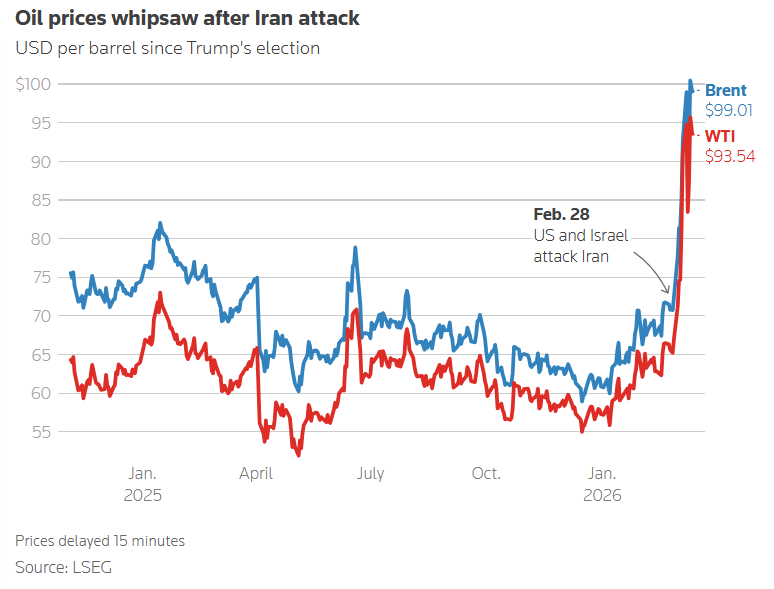
Global benchmark Brent was trading at $99.32 early Friday after briefly topping $100, while West Texas Intermediate sat near $93.75. It caps back-to-back monster weeks—Brent up more than 9% after a nearly 28% surge the week before, its biggest jump since the 2020 pandemic chaos. WTI is pacing for another weekly gain after its best run since 1983.
Tensions are radiating from the Strait of Hormuz, the artery for a fifth of the world’s oil. Several foreign vessels have reportedly been hit by ammunition this week, and traffic has slowed to a crawl. The tanker Callisto now sits anchored in Port Sultan Qaboos in Oman as the standoff grinds on. Traders who once priced in a quick flare-up are recalculating.
President Donald Trump signaled overnight that this isn’t ending tomorrow: “We have unparalleled firepower, unlimited ammunition, and plenty of time,” he said, urging followers to “watch what happens.” Meanwhile, Iran’s new supreme leader Mojtaba Khamenei vowed on state TV to keep fighting. Axios reported Trump told G7 leaders Iran was “about to surrender.” Tehran’s answer suggests otherwise.
Iranian military spokesperson Ebrahim Zolfaqari delivered the blunt market thesis: “Get ready for oil to be $200 a barrel, because the oil price depends on regional security, which you have destabilised.” Even a record 400 million–barrel release from the International Energy Agency’s emergency reserves—and temporary U.S. sanctions waivers on some Russian exports—hasn’t knocked prices back to earth.
Amjad Bseisu, CEO of EnQuest, told CNBC the oil market has “never seen something of this magnitude before,” adding, “Every day we see a delay, there’s another 20 million barrels [wiped off the market].” He compared the supply hit to the 1970s Arab embargo, when prices quadrupled. Investors may still believe in the so-called “Trump put,” but as Barclays warned, the longer Hormuz stays shut, the more stagflation risk creeps into global markets.
Source: CNBC
Editor: If your summer road trip budget just doubled, blame geopolitics—and the world’s most important 21-mile-wide bottleneck. Oil traders don’t do optimism when tankers stop moving.
When your favorite shoe brand wants a refund from your trade policy, that’s not exactly a ringing endorsement.
Even Trump’s Go-To Shoe Brand Is Suing Him Over Tariffs
The company behind the Florsheim shoes President Trump reportedly wears and gifts is suing his own administration to claw back millions paid in tariffs.
Weyco Group—the parent company of Florsheim Shoe Company—filed suit in the U.S. Court of International Trade in December, challenging tariffs imposed under the International Emergency Economic Powers Act. The company is betting that the Supreme Court of the United States could ultimately invalidate the duties and open the door to refunds.
Florsheim’s leather Oxfords—priced around $145—are reportedly a staple in President Donald Trump’s wardrobe. According to The Wall Street Journal, he’s even handed out pairs to cabinet members and White House visitors. Meanwhile, Weyco says it has spent “millions” on tariffs, with CEO Thomas Florsheim Jr. noting that the company paid rates as high as 145% on shoes imported from China before shifting production to India—only to face tariffs there, too.
“The idea behind the tariffs originally was pro-business, and it feels like somehow the pro-business part of this has gotten lost,” Florsheim said in a recent interview. Weyco’s lawsuit seeks reimbursement of its tariff costs—with interest.
Earlier this month, a trade court judge indicated companies are “entitled to benefit” from a recent Supreme Court ruling that could pave the way for refunds. The timing and mechanics of any repayment remain murky. But one thing is clear: even brands closely associated with Trump’s image are feeling the squeeze of his trade agenda.
Source: Business Insider
Editor: It’s one thing when political opponents complain about tariffs. It’s another when the guys making your Oxfords start lawyer-shopping. That’s when you know the bill finally came due.
If they’re called into combat, it will be their first real test—under fire, in one of the world’s most dangerous waterways.
The Navy Retired Its Gulf Minesweepers—Now Iran Is Mining the Strait
Just months after decommissioning half its Avenger-class minesweepers in Bahrain, the U.S. Navy is betting brand-new littoral combat ships can handle Iran’s mine threat in the Strait of Hormuz.
U.S. Navy retired the USS Devastator, USS Dextrous, USS Gladiator and USS Sentry in 2025 after more than three decades of service in the Middle East. Those Avenger-class ships had hunted mines during the Iran-Iraq war, Operation Desert Storm and post-Gulf War clearance missions off Kuwait. Now, only four Avengers remain—and they’re forward deployed to Japan with the 7th Fleet.
Their replacements? Independence-class littoral combat ships equipped with a mine countermeasures package. The U.S. Central Command said this week it struck 16 Iranian mine-laying vessels as Tehran reportedly began seeding the Strait of Hormuz. The LCS USS Canberra arrived in the region last May, followed by USS Santa Barbara and USS Tulsa, all assigned to the 5th Fleet.
Unlike the Avengers—wooden-hulled, low-magnetic-signature ships built to creep directly into minefields—the LCS concept keeps sailors farther from danger. It deploys manned and unmanned systems to locate, identify and neutralize mines from outside the threat zone. A Navy official described it as “a sophisticated suite of manned and unmanned systems designed to locate, identify, and neutralize sea mines, at a safer distance from minefields than the Avenger-class MCMs.”
That sounds great on paper. But the LCS mine package has never been used in combat. The Avengers, by contrast, were battle-tested. They used sonar, cable cutters, helicopters like the MH-53 Sea Dragon and even magnetic sleds to trigger or sever mines—sometimes working directly inside mined waters. If Operation Epic Fury forces the LCS into action, it won’t be a training exercise. It will be a debut performance in a live minefield.
The Navy says it has “no plans” to recommission the retired Avengers. Translation: this modernization gamble is locked in. Whether it proves visionary or premature may depend on how many mines Iran manages to drop—and how quickly the new fleet can clear them.
Source: Navy Times
Editor: Retire the old warhorses, roll out the sleek replacements, and hope the first real test isn’t a mine detonating under the hull. Modernization always sounds smarter before the shooting starts.
In the middle of an energy crunch fueled by Tehran, Washington is quietly cracking the door for Moscow.
Trump Waives Sanctions on Russian Oil as Iran War Squeezes Global Supply
The Trump administration just issued a 30-day waiver allowing countries to buy stranded Russian oil—an attempt to cool markets rattled by the Iran war.
The temporary license covers Russian crude loaded onto vessels as of March 12 and runs through April 11. According to the administration, the move is meant to ease pressure as oil supply disruptions tied to the Iran conflict ripple through global markets. Asian oil prices reportedly softened following the announcement.
Treasury Secretary Scott Bessent described the waiver as “narrowly tailored” and “short-term,” insisting it won’t materially benefit the Russian government. That may be technically true. But it’s also a reminder that energy policy tends to bend when prices spike.
The International Energy Agency has warned the Iran war is causing the largest oil supply disruption in history. Meanwhile, European Commission President Ursula von der Leyen has urged against easing sanctions pressure on Russia—underscoring just how politically fraught this workaround is.
With the Strait of Hormuz still closed and tankers stalled, the White House is trying to thread the needle: contain inflation without looking soft on Moscow. Whether 30 days buys enough breathing room—or simply signals that energy realities trump geopolitics—remains to be seen.
Source: The Independent
Editor: Sanction Russia, fight Iran, then waive the sanctions when gas hits triple digits. Energy policy in wartime is less a straight line and more a frantic game of whack-a-mole.
The country some U.S. lawmakers call the big loser in an Iran oil crisis may actually be the one best positioned to endure it.
While Oil Spikes, China Looks Built for This Energy War
As tankers idle in the Persian Gulf and oil prices surge, China may be better prepared than the West to ride out a prolonged energy shock.
“This is China’s nightmare,” Sen. Lindsey Graham said this week. But Beijing has spent years preparing for exactly this scenario. Massive crude stockpiles—estimated at 1.3 billion barrels—could cover more than six months of disruption through the Strait of Hormuz. That’s the same waterway now paralyzed by Iranian attacks as the U.S.-Iran war drags on.
China’s strategy goes beyond stockpiling. Energy analysts increasingly describe it as an “electrostate”—a country shifting away from imported fossil fuels toward domestically generated electricity. Roughly one-third of China’s total energy consumption now comes from electricity, far above the global average, with more than a third of that power sourced from solar, wind and hydropower. It’s also building coal plants at a pace that ensures spare capacity during crunch time.
China is also dominating electric vehicles—more than half of cars sold there are EVs—and exporting batteries, solar panels and grid storage systems worldwide. According to the International Energy Agency, that pivot has helped China avoid what would have been 1.2 million barrels of additional daily oil demand since 2019.
Energy experts caution that China isn’t immune. Its factories still depend on imported oil and gas for certain industrial processes. But compared with the United States and Europe—where political whiplash has slowed renewable expansion and strategic reserves have been drawn down—China appears more insulated. As one analyst put it, “This is a shock China can absorb. It will end up in a stronger position on the other side.”
The longer the Strait remains closed, the more this becomes a stress test—not just of oil markets, but of national energy strategies. And in that contest, Beijing may be getting something close to a rehearsal for bigger ambitions.
Source: The Washington Post
Editor: Washington talks about “all of the above.” Beijing actually built it. If this is supposed to be China’s nightmare, they’ve done a remarkable job sleepwalking through it.