


The Morning Sixpack stays free because the news that shapes your life should not be hidden behind a paywall. Paid subscribers are not paying for access. They are helping fund the research, writing, and independent voice that goes into every issue. Become a paid subscriber and help keep smart, honest news analysis free for everyone.
France is burning, protesters are furious, and Macron’s response is to condemn the chaos while leaving the grievances that sparked it largely unresolved.
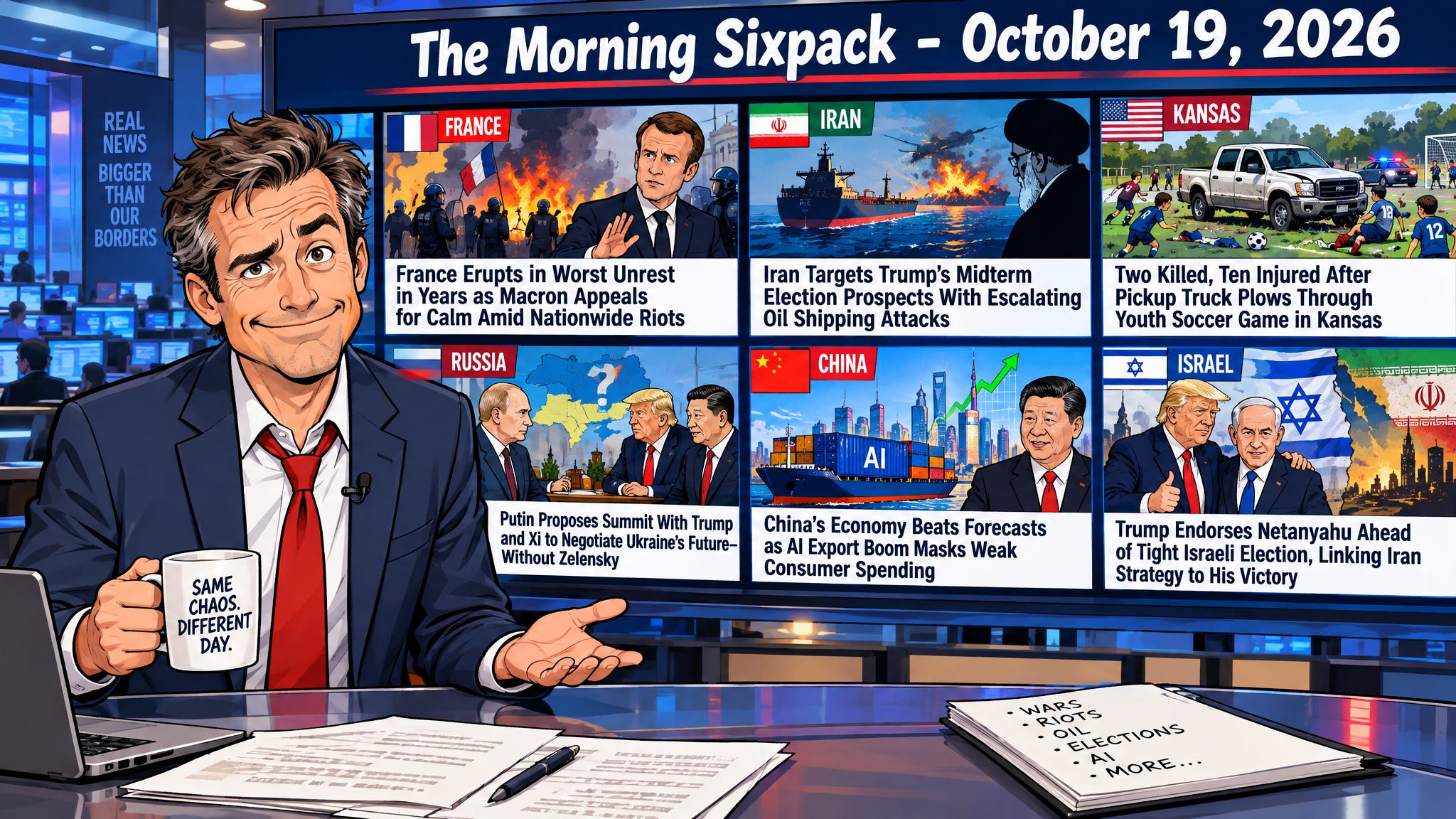
France Erupts in Worst Unrest in Years as Macron Appeals for Calm Amid Nationwide Riots
French President Emmanuel Macron appealed for calm Sunday after nationwide protests over soaring living costs and deteriorating public services erupted into some of the country’s worst violence in years. More than half a million people marched Saturday, but demonstrations descended into riots in several cities, leaving businesses looted, public buildings damaged, and streets littered with burned vehicles. Authorities arrested 2,400 people, while nearly 1,000 police officers were injured, according to Interior Minister Laurent Nunez. One protester died after suffering cardiac arrest during demonstrations in Paris.
Violence continued Sunday despite Macron’s televised appeal, with riot police firing tear gas at protesters in Paris and intervening to prevent looting in Marseille. At Place de la Republique, several hundred demonstrators gathered as fires burned in piles of bicycles. Cleanup crews worked across the country, from Lille and Strasbourg to Bordeaux and Marseille, confronting widespread destruction. In Limoges, rioters torched the historic town hall, causing its clock tower to collapse in flames reminiscent of the 2019 Notre Dame cathedral fire. Mayor Guillaume Guerin accused authorities of failing to deploy enough police and threatened to resign unless the city received adequate rebuilding funds.
Macron condemned the destruction while acknowledging that peaceful protesters had legitimate grievances.
“Nothing justifies it, nothing explains it, nothing excuses it. Tonight, we all feel anger and shame,” he declared in his national address.
Although he rejected calls from some right-wing politicians to declare a state of emergency, Macron said regional authorities would receive powers to prohibit demonstrations when necessary to protect public buildings and businesses. His government blamed ultra-left groups and criminals for much of the violence, distinguishing them from the hundreds of thousands who demonstrated peacefully.
The unrest reflects mounting frustration with Macron’s presidency, which ends in 2027 after a decade increasingly overshadowed by economic weakness, growing government debt, and public dissatisfaction. Saturday’s demonstrations brought together a month-long student protest movement and broader opposition to rising prices and declining public services.
Far-right presidential frontrunner Marine Le Pen urged calm, declaring, “Violence is not an opinion. Destruction is not a form of expression. And chaos cannot serve as a project for France.”
Meanwhile, hard-left presidential candidate Jean-Luc Melenchon argued that Macron must address the demands of protesting high-school students rather than simply focus on restoring order.
Businesses are facing substantial losses, with Carrefour CEO Alexandre Bompard reporting that 50 company stores were damaged, including 20 that were looted, resulting in tens of millions of euros in losses. Economy Minister Roland Lescure promised government support for affected businesses and vowed that those responsible for the destruction would be held accountable. In Bordeaux, masked rioters invaded the residence of the regional prefect, while in Paris, tourists found themselves caught in the turmoil. Dutch entrepreneur Tije De Boer, visiting with his children, described the capital as a war zone after being forced to evacuate his hotel. With another presidential election approaching, France faces a deepening political crisis that police crackdowns alone are unlikely to resolve.
Editor: Macron has a little over a year left in office, and France is giving him quite the farewell tour. The riots deserve condemnation, but condemning broken windows won’t fix the economic frustrations that brought half a million people into the streets.
Source: Reuters
Iran has apparently decided that the quickest route to Trump’s negotiating table runs through American gas pumps—and possibly the Republican Party’s midterm election prospects.
Iran Targets Trump’s Midterm Election Prospects with Escalating Oil Shipping Attacks
Iranian leaders are intensifying attacks on shipping in the Strait of Hormuz, hoping rising energy prices will damage President Donald Trump and his Republican allies ahead of the November 3 midterm elections. Iranian officials and regional diplomats say Tehran views the remaining weeks before the vote as a critical opportunity to pressure Washington into negotiating an end to the war. Some officials reportedly believe they can punish Trump politically, drawing comparisons to the Iran hostage crisis that damaged President Jimmy Carter’s 1980 reelection campaign. One Arab diplomat described Iranian leaders as obsessed with the American elections, saying they believe they can bring down a presidency.
The pressure campaign has triggered a dangerous escalation in one of the world’s most important oil shipping corridors, even as American forces work to keep tankers moving. Iran launched roughly 30 attacks per week in September and has struck more than 20 vessels so far in October, sinking at least one, according to maritime monitoring authorities. U.S. forces are conducting extensive daily operations involving fighter jets, drones, and Special Operations personnel to escort and protect commercial shipping. Those efforts have helped restore oil exports through Hormuz to near prewar levels on several recent days, according to energy analytics firm Kpler. Nevertheless, persistent security threats continue to inflate global energy prices, with Kpler estimating that geopolitical risks alone add approximately $30 to every barrel of oil.
Iranian officials openly acknowledge their attacks while accusing the United States of illegally moving oil through the strait. National security adviser Mohsen Rezaei claimed Iranian forces were targeting five or six vessels nightly and threatened to expand strikes against regional infrastructure if full-scale warfare resumes. Potential targets include undersea cables, data centers, and expensive artificial intelligence facilities. Meanwhile, Iranian state television closely monitors American energy prices, Trump’s approval ratings, and Republican election prospects. Iranian commentators argue that Democratic gains in Congress could constrain Trump’s military options and potentially expose him to impeachment proceedings.
Beyond influencing the elections, Tehran is trying to strengthen its negotiating position as Iran’s own economy deteriorates under the strain of war and international isolation. A Western diplomat warned that Iranian leaders increasingly fear their government could struggle to pay security forces and maintain essential operations within months. American and Iranian negotiators last met directly at a senior level in September during the United Nations gathering, exchanging proposals without reaching an agreement. Iranian officials reportedly pushed for a deal before the midterms but rejected Washington’s demand for an upfront nuclear concession. Neither government currently appears willing to make the compromises necessary to end the conflict.
Iran’s strategy also extends beyond Trump’s presidency, with leaders hoping to establish a lasting political deterrent against future American military intervention. Iranian researcher Negar Mortazavi of the Center for International Policy said Tehran wants future U.S. presidents to associate attacking Iran with serious domestic political consequences, including electoral defeat. Former Iranian foreign minister Manouchehr Mottaki has publicly suggested that Republican losses could make Trump’s remaining two years in office a nightmare. The gamble carries considerable risks for Tehran, whose economy is already under severe pressure, but Iranian leaders apparently believe their leverage will diminish once American voters cast their ballots. For now, the Strait of Hormuz has become both a military battleground and an unlikely front in America’s midterm election campaign.
Editor: Iran is betting that American voters will blame Trump for expensive gasoline before they blame Tehran for attacking oil tankers. It’s a risky strategy for a government that may soon have trouble paying its own security forces, but apparently election interference doesn’t always require hacking a voting machine.
Source: The Washington Post
A Saturday afternoon youth soccer game in Kansas turned into a nightmare when a pickup truck plowed through players and spectators, leaving two dead and witnesses struggling to comprehend what they had seen.
Two Killed, Ten Injured after Pickup Truck Plows through Youth Soccer Game in Kansas
A 6-year-old boy and a 35-year-old man were killed Saturday when a pickup truck drove onto a youth soccer field in Wichita, Kansas, striking children and adults during an afternoon game. Police identified the victims as Cole Adrian, 6, and Nicholas Schafer, 35, both from McPherson, Kansas, though they were not related. Ten additional victims, ranging in age from 5 to 68, were hospitalized with injuries authorities described as non-life-threatening. The collision occurred shortly before 3:30 p.m. at the city-owned Stryker Sports Complex, where families had gathered for youth soccer matches.
Witnesses described terrifying scenes as the dark Chevrolet pickup accelerated across the field, striking people and sending debris flying through the air. Erica Case, whose 9-year-old son was playing on an adjacent field, initially heard an engine revving followed by repeated booming sounds that she struggled to identify. Another witness, David Griekspoor, said the impacts sounded like small bursts of gunfire until he looked up and saw the truck driving through a line of people. Parents scrambled to locate their children while others rushed toward the injured. Case said the realization that the sounds were coming from people being struck by the truck left her overwhelmed.
As chaos spread across the complex, spectators immediately began helping victims before emergency responders arrived. Case recalled a mother identifying herself as a nurse and rushing toward the injured while Case took responsibility for keeping the woman’s child safe. According to Case, emergency services arrived approximately 10 minutes after the collision, but bystanders had already begun administering CPR and other lifesaving assistance. She praised those who stepped forward, particularly people who performed mouth-to-mouth resuscitation on victims struck by the vehicle. Griekspoor said he grabbed his nephew and moved away from the scene while other family members checked on nearby children.
Police identified the driver as a 34-year-old woman from Garden City, Kansas, who had two children riding in the pickup at the time of the collision. Authorities said one of her children had been scheduled to play soccer on a different field at the complex. The woman was initially taken into custody but subsequently released following consultation with the Sedgwick County District Attorney’s Office. She has not been publicly identified or charged with a crime, and investigators said she has been cooperating with police. Officers have interviewed more than 30 witnesses while working to reconstruct what happened.
Investigators have not determined why the pickup entered the soccer field, and authorities are awaiting results from a mechanical examination of the vehicle and toxicology testing of the driver. Police have not announced whether mechanical failure, driver error, or another factor contributed to the collision. The investigation continues as families and witnesses confront the aftermath of an ordinary Saturday sporting event that ended in tragedy. For those who watched the truck cross the field, the sights and sounds remain difficult to forget. What began as an afternoon of children’s soccer left two families mourning and an entire community searching for answers.
Editor: Two people went to a youth soccer game and never came home. Those families will never be the same.
Source: NBC News
Putin wants to sit down with Trump and Xi to decide Ukraine’s future. There’s just one small detail: Ukraine’s president isn’t invited to the table.
Putin Proposes Summit with Trump and Xi to Negotiate Ukraine’s Future—Without Zelensky
Russian President Vladimir Putin has proposed a three-way summit with President Donald Trump and Chinese President Xi Jinping to negotiate an end to the war in Ukraine, with Ukrainian President Volodymyr Zelensky excluded from the discussions. According to people familiar with the proposal, Putin raised the idea during an October 9 phone call with Trump, hoping to secure a settlement favorable to Moscow. The Kremlin has suggested holding the meeting during the Asia-Pacific Economic Cooperation summit in Shenzhen, China, on November 18 and 19. Kremlin spokesman Dmitry Peskov confirmed discussions about a possible meeting, although a senior U.S. official said Trump has not agreed to participate.
The proposal comes as relations between Washington and Moscow improve, raising concerns that Ukraine’s future could be negotiated without its participation or the involvement of European allies. Trump recently reached an agreement to purchase Russian diesel fuel and facilitate its sale internationally, hoping to ease energy prices that have damaged the American economy and Republican election prospects. He also suspended implementation of sanctions against Russia, drawing criticism from lawmakers, including members of his own party. Energy experts say the Iran war remains the primary driver of high diesel prices and that Russian fuel shipments are unlikely to make much difference. Meanwhile, Trump has criticized Zelensky for attacking Russian oil facilities and suggested Ukraine needs a new president.
Ukraine has firmly rejected the prospect of a peace agreement negotiated without its participation. Foreign Minister Andrii Sybiha warned that excluding Kyiv would encourage Putin to continue the war rather than negotiate seriously. Trump, who promised during his presidential campaign to end the conflict on his first day back in office, is approaching two years into his second term without a settlement. Secretary of State Marco Rubio acknowledged Monday that discussions about a potential summit were underway but said nothing had been finalized. The White House declined to comment on the proposal, while Chinese officials have reportedly indicated they would not object to a meeting if Trump agrees.
For Putin, the summit represents an opportunity to elevate Russia’s standing as one of three dominant global powers while sidelining European governments that have strongly supported Ukraine. A former Russian intelligence officer familiar with the discussions said Putin envisions something resembling a second Yalta Conference, the historic 1945 gathering where Allied leaders negotiated arrangements for postwar Europe. Such a meeting could also raise concerns in Taiwan, whose leaders might fear that major powers could someday negotiate the island’s future without its consent. China, meanwhile, sees potential diplomatic benefits from hosting the talks, although Xi must balance his support for Moscow against the risk of damaging Beijing’s economic relationships with Europe.
The proposed meeting would come amid continuing battlefield violence and stalled diplomatic efforts to end the four-year war. Trump recently accused Zelensky of obstructing peace negotiations following a Ukrainian drone strike on an oil terminal in St. Petersburg, while defending his decision to delay sanctions against Moscow. Putin appears to believe that improved relations with Trump and China’s willingness to host discussions could strengthen Russia’s negotiating position. Yet Beijing remains cautious about allowing the Ukraine conflict to overshadow its planned APEC gathering or provoke additional tensions with European governments. Whether the summit happens remains uncertain, but the proposal alone highlights Moscow’s ambition to shape Ukraine’s future through negotiations among the world’s largest powers rather than directly with Kyiv.
Editor: Putin wants a modern-day Yalta, with Trump and Xi dividing up the geopolitical pie while Ukraine waits outside. Nothing says “peace negotiations” quite like deciding a country’s future without inviting the country.
Source: The Wall Street Journal
China’s economy is beating expectations thanks to booming AI-related exports, but its consumers apparently didn’t get the memo. The factories are humming while the shopping malls struggle.
China’s Economy Beats Forecasts as AI Export Boom Masks Weak Consumer Spending
China’s economy grew faster than expected in the third quarter of 2026, expanding 4.5 percent from a year earlier as booming technology exports helped offset weak domestic demand. The latest figures from China’s National Bureau of Statistics showed growth accelerating from 4.3 percent in the second quarter, exceeding most economists’ forecasts. During the first nine months of the year, the world’s second-largest economy expanded 4.6 percent, putting Beijing on track to meet its official annual growth target of 4.5 to 5 percent. The results suggest China’s export industries remain resilient even as its property market and household spending continue to struggle.
Artificial intelligence and semiconductor demand have become major engines of Chinese economic growth, driving a surge in technology-related exports. Official figures showed exports rising more than 16 percent during the first three quarters of 2026, reaching a reported 23.19 billion yuan, or $3.47 billion. Strong international demand for semiconductors and other technology products helped support manufacturing activity despite sluggish conditions elsewhere in the economy. Industrial production increased 5.5 percent in September, bringing growth for the first nine months to 5.3 percent. The figures highlight China’s continued dependence on overseas buyers to sustain economic momentum.
Domestic consumption, however, remains a persistent weakness, raising questions about the sustainability of export-driven growth. Retail sales increased just 1.1 percent in September compared with a year earlier, while growth for the first nine months reached only 2.6 percent. China’s troubled real estate sector continues to weigh on household confidence and broader investment activity. Fixed-asset investment, which includes spending on property, factories, and machinery, increased slightly in September but contracted 7.2 percent during the January-September period. The combination of sluggish consumer spending and declining investment underscores the uneven nature of China’s economic recovery.
Beijing’s leadership has established a relatively modest growth target of 4.5 to 5 percent for 2026, reflecting expectations of a slower economic expansion than China experienced during previous decades. Outside the COVID-19 pandemic, growth at that pace would rank among the country’s weakest performances in decades. Stanford University finance professor Zhiguo He said the economy appears positioned to achieve Beijing’s objectives, although policymakers remain concerned about excessive reliance on exports. He described a controlled slowdown as the most favorable realistic outcome for Chinese authorities. The challenge is maintaining economic stability while allowing the property sector to contract and households to adjust their financial expectations.
China’s latest economic performance presents a complicated picture for policymakers and international investors. Technology manufacturers are benefiting from the global AI boom, providing a valuable source of growth while traditional economic drivers remain subdued. Yet stronger exports cannot fully disguise weak domestic spending, falling property investment, and the difficulties facing Chinese households. Beijing must balance its ambitions to dominate emerging technologies with the need to strengthen consumer confidence and reduce dependence on foreign markets. For now, China’s economy is meeting its official targets, but the growth is coming disproportionately from industries selling products abroad rather than consumers spending money at home.
Editor: China’s AI factories are booming, its exports are surging, and its consumers are apparently still checking their wallets. Beijing may hit its growth target, but an economy that depends on the rest of the world buying its products while its own citizens hold back has some serious balancing to do.
Source: Al Jazeera
After months of keeping Netanyahu waiting, Trump finally delivered his endorsement just nine days before Israel’s election—complete with a warning that American support against Iran could depend on who wins.
Trump Endorses Netanyahu Ahead of Tight Israeli Election, Linking Iran Strategy to His Victory
President Donald Trump endorsed Israeli Prime Minister Benjamin Netanyahu on Sunday, delivering a politically valuable boost just nine days before Israel’s October 27 national elections. Trump praised Netanyahu as a strong wartime leader and partner in confronting Iran, ending months of uncertainty over whether he would support his longtime ally’s reelection bid. The endorsement comes as Netanyahu faces a closely contested race amid public dissatisfaction with the nearly eight-month war against Iran. The vote will be Israel’s first national election since Hamas attacked the country on October 7, 2023.
Trump’s endorsement went beyond political praise, suggesting that continued American military action against Iran could depend on Netanyahu remaining in power. In his social media statement, Trump threatened to resume major action against Tehran unless Iranian leaders quickly changed course. However, he indicated that a Netanyahu defeat might reduce his willingness to intervene, saying the United States could be left to handle the confrontation without Israel’s preferred leadership. Netanyahu promptly thanked Trump for his support, while his Likud Party released a 35-second campaign video featuring the two leaders together. The video highlighted their relationship, which Netanyahu has repeatedly presented as an important reason for Israeli voters to keep him in office.
The endorsement follows months of increasingly visible disagreements between Trump and Netanyahu over military operations and diplomatic strategy in the Middle East. Although the two leaders appeared closely aligned following joint American-Israeli strikes on Iranian nuclear facilities in 2025, tensions emerged during this year’s broader war. Trump criticized Israel’s attack on a major Iranian gas field and expressed frustration that continued fighting against Hezbollah in Lebanon was complicating negotiations with Tehran. In June, Trump even described Netanyahu as “crazy,” reflecting the strain in their relationship. Their differences extended to Gaza, where Netanyahu rejected an American ceasefire proposal that would have required Israeli territorial withdrawals before Hamas was disarmed.
Despite those disagreements, Trump remains popular among Israeli voters, making his endorsement potentially influential in a tight election. However, some Israelis have expressed disappointment with the inconclusive outcome of the Iran war and the terms of Trump’s proposed ceasefire, which failed to achieve several objectives the allies initially pursued. Netanyahu’s campaign has emphasized his access to the American president, portraying their personal relationship as a strategic advantage for Israel. Trump previously supported Netanyahu in Israeli elections and even urged President Isaac Herzog to pardon the prime minister over corruption charges. Until Sunday’s announcement, however, Trump had repeatedly avoided committing to another endorsement.
Trump’s intervention also reflects his broader willingness to influence elections beyond American borders. During his second term, he has endorsed political leaders in Hungary, Japan, Poland, and Latin America, sometimes claiming credit for their electoral successes. His support for Hungarian Prime Minister Viktor Orbán did not prevent Orbán’s unsuccessful bid for another term, demonstrating that presidential endorsements do not guarantee victory. Whether Trump’s backing will meaningfully influence Israeli voters remains uncertain, particularly given disagreements over Iran and Gaza. With election day approaching, Netanyahu now has the endorsement he wanted, but Israeli voters must decide whether his relationship with Washington outweighs their concerns about the country’s ongoing conflicts.
Editor: Trump spent months keeping Netanyahu guessing, then endorsed him nine days before the election while suggesting America’s willingness to confront Iran might depend on the outcome. Apparently, even foreign policy comes with campaign-season terms and conditions.
Source: NPR
Read The Morning Sixpack Archives here: