


Today, it was reported that both Nvidia and AMD “agreed” to give Washington 15% of every dollar they make selling advanced chips to China.
Call it a fee, a surcharge, or whatever. The label is window dressing.
The precedent is the point: Once the executive branch can skim your foreign sales by decree, the percentage becomes a dial—15 today, 30 tomorrow, and 50 when “circumstances change.”
And yes, that’s exactly how market economies get domesticated.
(Side note: the U.S. Constitution bans direct taxes on exports; clever governments often route around that with licensing, “security reviews,” and surcharges. Function over form. But who cares, right? The U.S. Constitution is nearly dead.)
Let’s run it back about 100 years and take a trip down memory lane.
20th Century Fascism
Benito Mussolini took power in Italy after the March on Rome (Oct 22–29, 1922)1 and moved fast: The Acerbo Law (Nov 1923)2 rigged parliamentary majorities; the Matteotti crisis (June 1924)3 gutted opposition; and the exception laws of 1925–264 turned a fragile democracy into a dictatorship.
Once the politics were locked, the economics followed: The Charter of Labour (Apr 1927)5 dressed up state direction as “corporatism,” and the regime built institutions like IRI (Istituto per la Ricostruzione Industriale, 1933) to buy, steer, and “stabilize” key industries. After the invasion of Ethiopia (1935–36) and League sanctions, Italy lurched into autarky6: quotas, licenses, currency controls, and “strategic” diktats. By the late 1930s, most firms were still privately owned on paper—but pricing, inputs, markets, even salaries orbited Rome’s priorities. Ownership in form; obedience in fact.
Germany ran a faster version. Hitler became Chancellor Jan 30, 1933; the Enabling Act (Mar 23, 1933) wipes out checks; Schacht’s “New Plan” (1934) and the Mefo bills (1934–38) funnel secret credit into rearmament; and the Four-Year Plan (announced Sept 9, 1936) puts Göring over the economy. Export licenses, raw-material rationing, and price/wage controls—again, business keeps its nameplate, but production serves the state.
Spain under Franco (Civil War 1936–39; dictatorship from 1939) and Portugal under Salazar (Estado Novo, 1933) built their own flavors of corporatist control.
Japan’s militarists did it through zaibatsu discipline and resource commands across the 1930s.
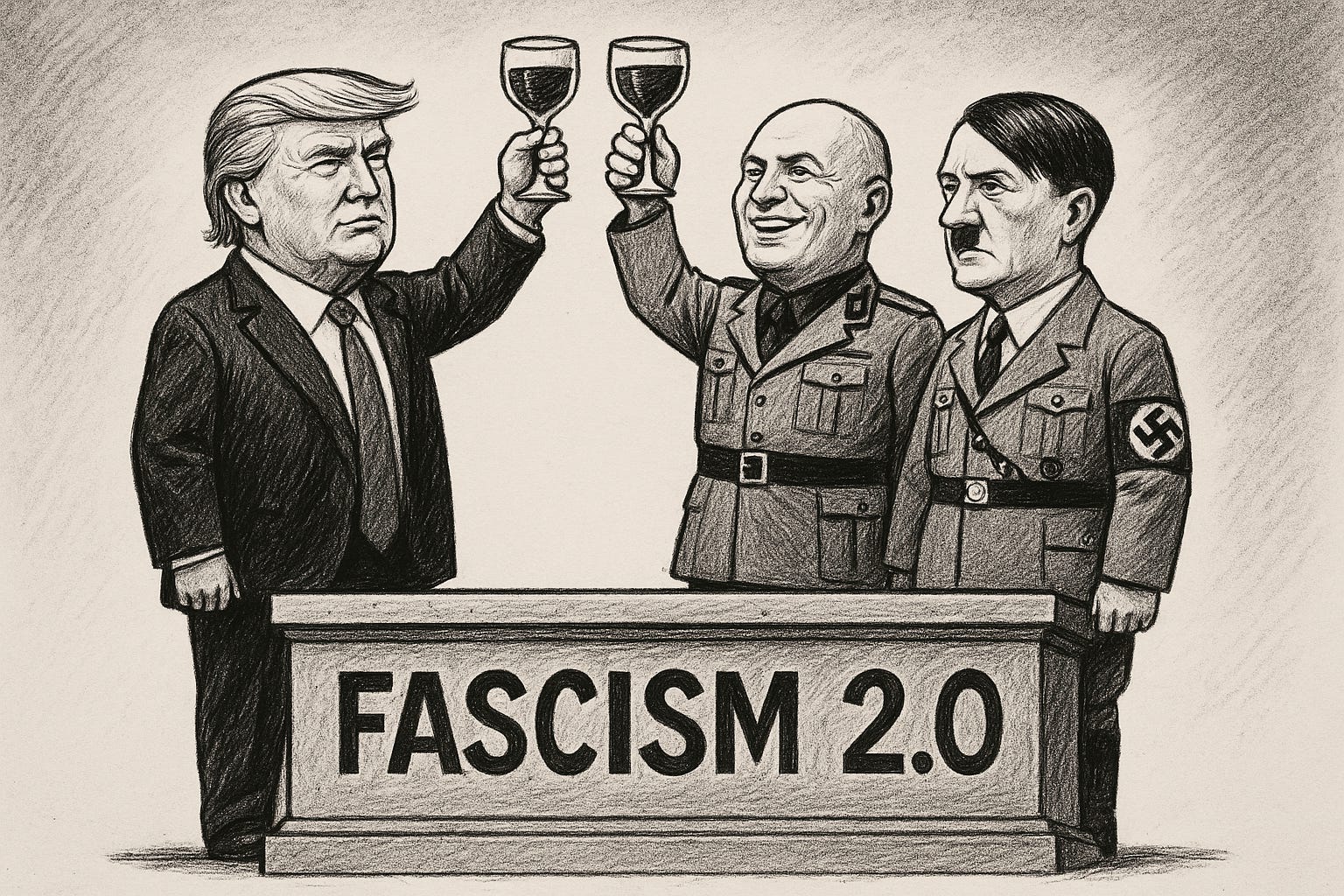
Different logos, same playbook: “National interest” becomes the pretext for permanent economic commandeering. “America First,” anybody?
The fall? Italy toppled first: Mussolini was deposed July 25, 1943, then propped up in the German-controlled Italian Social Republic (1943–45) until he was captured and executed Apr 28, 1945. Germany surrendered May 8, 1945.
Oh, there was a bigass war, too.
The economic verdict was brutal: Shortages, black markets, shattered industry—and a long, expensive climb back to normalcy. Fascism didn’t just lose the war; it lost the Board Room. It could coerce production, but it couldn’t produce prosperity.
And yet the ideas never fully died. Postwar Europe saw tidy rebrands: Italy’s MSI (founded 1946) nursed the flame; later “post-fascist” parties learned to talk softer while keeping the same bones—statist leverage, political loyalty as economic currency, and “temporary” emergencies that never end.
Elsewhere, the toolkit showed up under new marketing—illiberal “national champions,” security-framed export controls, and compliance-for-access finance rules.
No jackboots required.
Back to today. If Washington can skim 15% off advanced-chip sales to China, it can do it to any export-reliant sector—agriculture, aerospace, energy, you name it.
Once CEOs accept that their margin depends on a government dial, a few things follow.
First, foreign buyers shift to Brazil, Vietnam, and the EU—some never come back.
Second, smaller U.S. exporters get squeezed, then acquired, and then we’re down to a handful of “national champions” who live on waivers, subsidies, and special lanes.
Free market, be damned. Oligarchies abound.
Third, with foreign outlets throttled, production is “encouraged” to serve domestic priorities—at approved prices, with approved inputs, from approved suppliers. That’s corporatism with cloud dashboards.
This is how Fascism 2.0 would look here if it came: Not brownshirts, but a compliance stack. Not overt nationalization, but permanent “temporary measures.” Not a party emblem over your door, but a letter from an office you can’t appeal informing you your export clearance is on hold unless you adjust “risk factors.”
We’ve already begun to see it: Apple’s Tim Cook giving Trump a gold-plated trinket and $100 billion investment in the U.S.
Apple’s $100 Billion Bribe to Trump

If you thought Apple was about to toss China’s factories out like last year’s iPhone case, think again. On August 6th, Apple CEO Tim Cook and President Donald Trump strutted into the White House with a headline-grabbing $100 billion investment pledge to boost Apple’s American supply chain. This move, part of a broader $500 billion plan announced earlier…
Different century, same hammer.
Why it matters: Fascism failed because it could mobilize but not innovate, command but not compound. It crushed dissent, then competition, then—inevitably—growth. If we normalize a state claim on private foreign sales by decree, we’re volunteering for the same trap, this time with better branding.
Do something. If this 15% story is real, demand the legal basis, the sunset, and the guardrails—in writing. Push Congress to legislate limits on executive trade levers; insist on judicial review of export-control “fees”; force transparency on exemptions so economic favor isn’t a political IOU.
Today’s percentage is tomorrow’s precedent. Pull the plug now, while it’s still a policy fight—not a survival test.
Footnotes
The March on Rome (Italian: Marcia su Roma) was an organized mass demonstration in October 1922 which resulted in Benito Mussolini's National Fascist Party (Partito Nazionale Fascista, PNF) ascending to power in the Kingdom of Italy.
The Acerbo Law was an Italian electoral law proposed by Baron Giacomo Acerbo and passed by the Italian Parliament in November 1923. The purpose of it was to give Mussolini's fascist party a majority of deputies. The law was used only in the 1924 general election, which was the last competitive election held in Italy until 1946.
In June 1924, Socialist deputy Giacomo Matteotti was assassinated by Fascist thugs after publicly condemning Fascist violence in elections.
The exception laws (leggi eccezionali) of 1925–1926 were the legal turning point where Mussolini’s government shifted from an authoritarian-leaning parliamentary system to an outright fascist dictatorship.
I’m not going to footnote and explain everything. Too much shit went down to explain it all. Suffice it to say that it’s not a difficult leap to conclude that the United States is forging a similar path. Are you scared yet? You should be.
Autarky is the economic policy of trying to make a nation completely self-sufficient — producing all the goods and services it needs domestically while minimizing or outright banning imports and exports.
It’s not just “buy local” on steroids; it’s state-directed economic isolation, often tied to nationalist or militarist goals. The idea is that by cutting reliance on foreign trade, a country becomes immune to external economic pressure (sanctions, supply disruptions, foreign competition).
Autarky in practice
Mussolini’s Italy (1930s): After sanctions from the League of Nations over the 1935–36 invasion of Ethiopia, Italy pushed autarchia. The regime ramped up domestic substitutes for imports — synthetic rubber, “Italian” coal from lignite, artificial fibers — and tightened trade controls. It was wildly inefficient but politically sold as patriotic.
Nazi Germany: Under the Four-Year Plan (1936), Germany aimed for war readiness and reduced dependence on imports, especially in oil, rubber, and certain metals. Synthetic fuel and ersatz products became a hallmark of German autarky.
Other examples: Franco’s Spain (1939–1959) pursued autarky with disastrous economic stagnation; North Korea today is a modern extreme, though it secretly trades where it can.
Why regimes like it
Military readiness: No reliance on foreign powers for strategic goods.
Political leverage: No foreign trade partners to use economic influence against you.
Propaganda value: “We produce everything ourselves” makes for great speeches, even if the reality is shortages and lower living standards.
Why it fails
Inefficiency: Self-sufficiency ignores comparative advantage; producing everything domestically is expensive and low-quality.
Innovation lag: Without foreign competition or exchange, industries stagnate.
Shortages: Cutting imports often means going without key goods entirely.
Retaliation: Other nations stop buying your exports in return, shrinking your economy.