


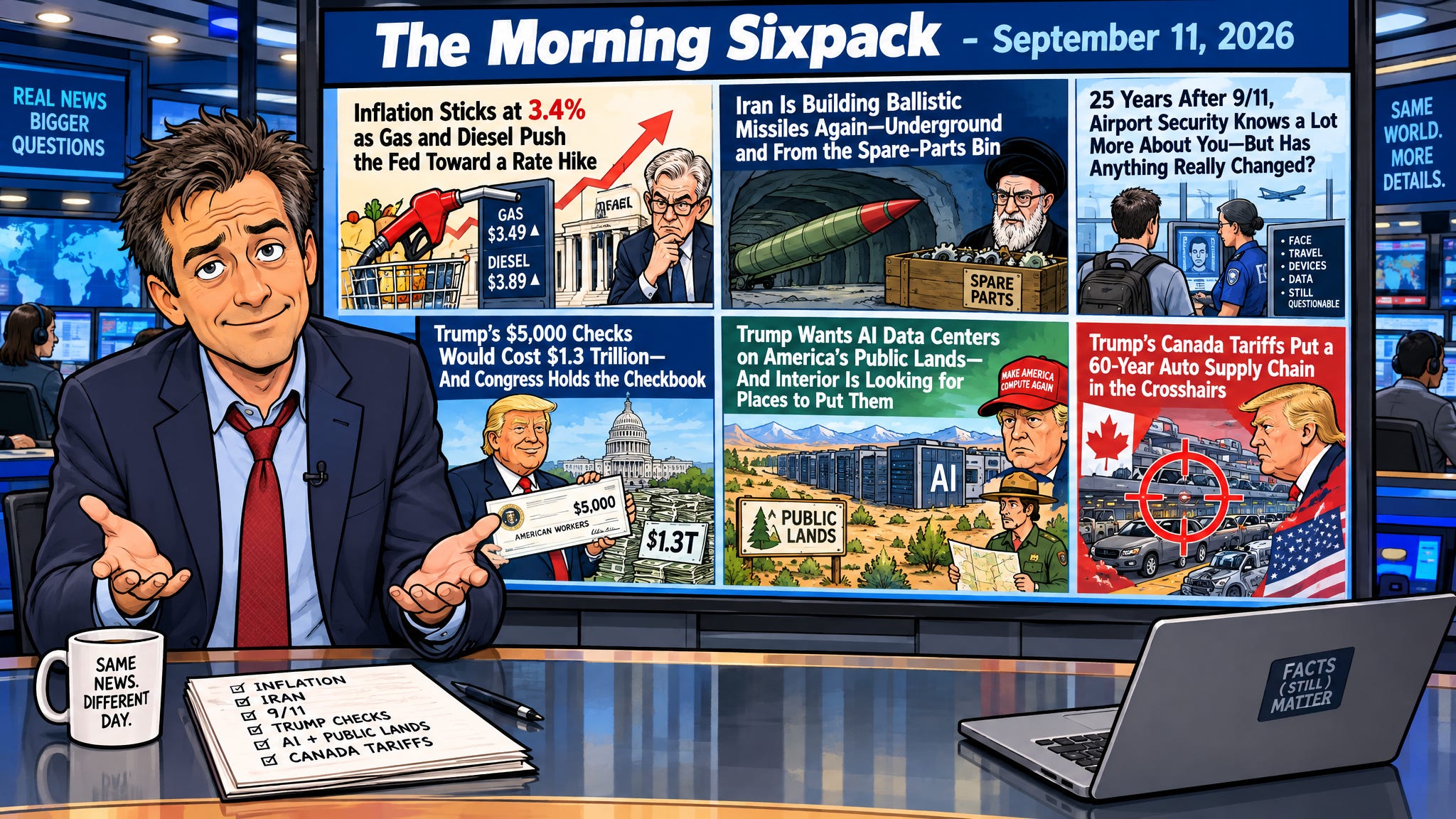
The Morning Sixpack stays free because the news that shapes your life should not be hidden behind a paywall. Paid subscribers are not paying for access. They are helping fund the research, writing, and independent voice that goes into every issue. Become a paid subscriber and help keep smart, honest news analysis free for everyone.
August inflation stayed at 3.4%, gasoline jumped 3.9% for the month and diesel hit record highs—apparently the inflation dragon has discovered an oil-powered second wind.
Inflation Sticks at 3.4% as Gas and Diesel Push the Fed Toward a Rate Hike
U.S. inflation refused to budge in August, holding at 3.4% year over year while consumer prices jumped 0.4% from July, driven heavily by gasoline and other fuels. Gasoline alone rose 3.9% for the month and accounted for more than a third of the overall CPI increase, while diesel and other motor fuels surged 9.6%.
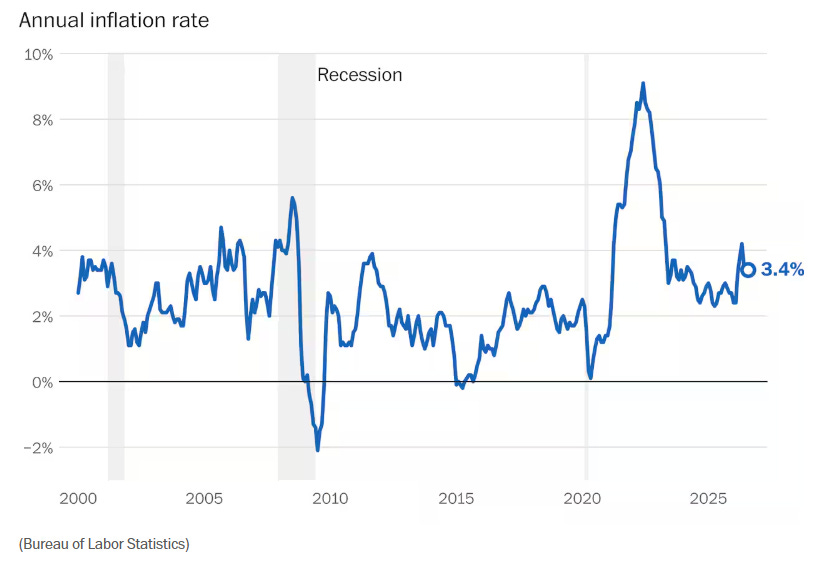
The inflation problem isn’t disappearing—it’s moving from the gas pump into everything the gas pump helps deliver.
There was at least some relief in the grocery aisle. Food prices rose just 0.1% for the second consecutive month, grocery prices overall were unchanged, and fruits and vegetables fell 0.4%. But record diesel prices threaten to work their way through transportation costs and eventually onto store shelves. Housing inflation, meanwhile, has been slowing, providing an important counterweight to the energy spike.
The Fed’s headache is underneath the headline number. Core CPI, which strips out food and energy, increased 0.3% in August—above economists’ expectations for 0.2% and the largest monthly increase since April. Reuters reported that markets subsequently priced in roughly a 91% chance of a rate increase next week, up from about 72% a day earlier. Ellen Zentner of Morgan Stanley Wealth Management summed up the predicament: “It wasn’t as hot as yesterday’s PPI, but today’s CPI left the Fed with less room to maneuver as it tries to maintain its inflation-fighting credentials.”
The political stakes are considerable heading into the November midterms, with gasoline and food prices remaining highly visible household expenses. Sen. John Kennedy put the cost-of-living problem rather succinctly on NBC’s “Meet the Press”: “The economy is solid, but inflation sucks.” Whatever happens at the Fed next week, 3.4% inflation remains well above its 2% target—and expensive energy is making the road back considerably harder.
Editor: Inflation was supposed to be heading politely toward the exit. Instead, $6 diesel just pulled up to the curb, left the engine running and handed the Fed another rate-hike headache.
Source: Washington Post | Reuters via Investing.com
Iran is rebuilding ballistic missiles underground from stockpiled parts after months of U.S. and Israeli strikes—turns out “destroyed” and “needs some reassembly” aren’t quite the same thing.
Iran Is Building Ballistic Missiles Again—Underground and From the Spare-Parts Bin
Iran has resumed assembling ballistic missiles in underground facilities, using components stockpiled before the war despite extensive U.S. and Israeli attacks on its missile infrastructure. Production remains below prewar levels, but U.S. and Middle Eastern officials say Tehran is assembling both liquid- and solid-propellant missiles while attempting to establish additional underground production sites.
That’s a pretty significant comeback for a missile program that Defense Secretary Pete Hegseth declared “functionally destroyed” in April.
Intelligence reportedly shows activity at several underground locations, including the Khojir missile complex southeast of Tehran. Iran’s biggest advantage may be the warehouse inventory it accumulated before the war: finished warheads, airframes, guidance systems and other components that can now be assembled into weapons. A U.S. official told the Journal that Tehran could have enough components to assemble at least a couple hundred missiles, while former CIA analyst Jim Lamson said the ultimate number could reach much higher depending on the size of Iran’s stockpiles and how many underground facilities remain operational.
The rebuilding has limits. U.S. and Israeli strikes damaged industrial facilities needed to manufacture missiles and their components, while the naval blockade has complicated Iran’s ability to import materials needed for solid fuel. The Pentagon says the U.S. destroyed up to 90% of Iran’s drone, ballistic-missile and naval industrial base. But Tehran has also repaired roads, reopened tunnel entrances and used the relative calm of the summer to restore military capabilities.
And that’s the larger problem: destroying missiles is apparently easier than destroying the system designed to keep making them. Nicole Grajewski of Sciences Po told the Journal that Iran’s missile infrastructure has “quicker regenerative capacity than the nuclear program” and is widely dispersed. Iran continues firing missiles at U.S. positions in the region even as it rebuilds, meaning the contest is increasingly about endurance—how quickly Tehran can replenish missiles versus how quickly the U.S. and its allies can replenish the interceptors used to shoot them down.
Editor: The Pentagon says it wrecked Iran’s missile industry. Iran appears to have responded by moving the assembly line downstairs. That’s not exactly the victory-lap ending anyone had in mind.
Source: Wall Street Journal (free)
Twenty-five years after 9/11, airport security has evolved from checking your bags to increasingly verifying your identity with databases and biometrics—the checkpoint got faster, but the government’s information window got considerably bigger.
25 Years After 9/11, Airport Security Knows a Lot More About You—But Has Anything Really Changed?
Twenty-five years after 9/11 transformed American air travel, the obvious question isn’t whether airport security has changed—it plainly has—but whether we’ve traded one kind of vulnerability for a system in which surveillance has become an ordinary part of getting from Point A to Point B. TSA checkpoints, intelligence sharing, REAL ID, passenger vetting, advanced scanners and facial-recognition systems have all become part of the post-9/11 security architecture. Government auditors have also documented privacy concerns surrounding facial recognition, including how travelers are notified and how personal information is handled.
Has anything really changed? Yes. We used to worry about Big Brother watching us; now we’re debating whether his camera makes the airport line move faster.
Before 9/11, private contractors generally handled passenger screening, non-ticketed family members could walk to the gate and travelers faced far fewer restrictions on what they carried aboard. Today, security begins well before you reach the metal detector. Airlines and government agencies exchange passenger information, TSA conducts identity and security vetting, and biometric systems can compare a traveler’s face against an existing image. TSA itself describes biometrics as a way to increase assurance of traveler identity and automate parts of checkpoint processing.
That doesn’t mean every traveler is secretly being followed everywhere, and calling the United States a literal “surveillance state” goes beyond what the evidence here establishes. But the concern isn’t imaginary, either. GAO has documented expanding federal use of facial recognition and previously identified shortcomings in privacy notices, oversight and monitoring of how facial-recognition systems were being used. Meanwhile, a DHS rule that took effect in December 2025 broadened biometric collection authority for noncitizens entering and leaving the United States. The government’s position is that these systems improve identity verification and security; the civil-liberties question is how much information should be collected, how long it should be retained, who gets access and how meaningful opting out actually is.
And that’s the strange legacy of 25 years of airport security: some of the most intrusive-looking technology can simultaneously make travel less intrusive. Shoes can stay on, trusted travelers can move faster, digital identification can replace repeated document checks, and future AI-assisted scanners could reduce the need to rummage through bags. Security has unquestionably changed. So has our definition of normal. The unresolved question isn’t whether technology can make us safer—it’s how much personal information Americans are willing to exchange for that safety, and whether safeguards will keep pace when yesterday’s extraordinary security measure becomes tomorrow’s invisible infrastructure.
Editor: Orwell had telescreens bolted to the wall. We voluntarily walk up to ours, stare into the camera and hope it gets us to Starbucks before boarding starts.
Source: UPI
Trump’s proposed $5,000 payment to every American adult would cost roughly $1.3 trillion, require a source of financing and, under the normal constitutional spending process, congressional authorization—there’s a rather large difference between promising a check and having permission to write one.
Trump’s $5,000 Checks Would Cost $1.3 Trillion—And Congress Holds the Checkbook
President Donald Trump’s proposal to send $5,000 to roughly 270 million American adults would cost about $1.35 trillion, potentially adding enormously to a federal deficit already approaching $1.8 trillion annually unless Congress paired the payments with equivalent spending cuts or new revenue. The national debt has already passed $40 trillion, according to the figures cited by AP, and the proposed checks would cost roughly as much as the federal government’s projected interest expense for fiscal 2026. In other words, this isn’t finding five grand underneath the Treasury’s couch cushions.
Where does the $1.35 trillion come from? That’s the trillion-dollar question—and so far there isn’t a funded answer.
Trump has previously suggested tariff revenue could finance payments, but AP reports that available tariff revenue wouldn’t cover a program of this magnitude. Borrowing the money would increase the deficit by roughly $1.35 trillion if there were no offsets, meaning a $1.8 trillion annual deficit could mathematically become roughly $3.15 trillion if the entire program landed in one fiscal year and nothing else changed. Borrowing would also add approximately the same amount to federal debt. Alternatively, Congress could raise taxes, dedicate other revenue or cut spending elsewhere. Those choices would produce very different fiscal outcomes, but somebody ultimately has to finance the checks.
Then there’s inflation. Dumping more than $1 trillion of purchasing power into an economy already experiencing above-target inflation would increase consumer demand, although the size and timing of the inflation effect would depend on how much recipients spent, saved or used to repay debt—and whether the payments were deficit-financed or offset elsewhere. Federal Reserve research identifies pandemic stimulus payments and the accompanying surge in goods demand among contributors to the post-COVID inflation episode. That doesn’t establish that $5,000 checks would mechanically recreate 2021, but it explains why economists quoted by AP are worried about adding a giant fiscal stimulus while inflation is already elevated.
Could Trump simply order Treasury to start printing checks? Under the ordinary constitutional framework, no. Article I’s Appropriations Clause says money cannot be drawn from the Treasury except pursuant to appropriations made by law, and Congressional Research Service analysis describes that framework as a restraint on executive spending authority. Congress could enact legislation authorizing the payments—Sen. Bernie Moreno has said he would prepare such legislation—but a presidential announcement by itself isn’t an appropriation. As for whether the promise constitutes a criminal “bribe,” that’s a different question. AP reports legal experts don’t regard the proposal as straightforward vote buying because the proposed payments aren’t conditioned on an individual casting a vote for a particular candidate or party. The election-linked framing may invite political criticism, but that isn’t the same thing as satisfying the elements of a criminal bribery or vote-buying offense.
So will those $5,000 checks actually arrive? Right now they’re a proposal, not enacted spending. Trump has previously proposed payments funded by DOGE savings and tariffs that were not ultimately distributed, and this version would require overcoming the basic question of congressional authorization plus finding roughly $1.3 trillion. Until legislation appropriating the money is enacted—or some other valid statutory authority is identified—Americans shouldn’t mistake a campaign-stage promise for a Treasury payment schedule.
Editor: Five thousand dollars sounds terrific right up until you notice Washington is already borrowing heavily, paying enormous interest on the debt and fighting inflation. The government can absolutely mail everybody money. The fascinating part always comes later, when we discover who actually paid for it.
Source: Associated Press
The Trump administration is searching federal public lands for sites that could host massive AI data centers while simultaneously trying to accelerate the environmental reviews required to build them—Silicon Valley apparently looked at the American West and saw server racks.
Trump Wants AI Data Centers on America’s Public Lands—and Interior Is Looking for Places to Put Them
The Bureau of Land Management has reportedly ordered state directors to identify federal land suitable for AI data centers, part of President Trump’s broader effort to accelerate America’s AI infrastructure buildout using public property. The Washington Sun reports that state officials were given just three days to compile potential sites, even as BLM contends with significant staffing vacancies and questions about whether remote federal lands have enough electricity, water and infrastructure to support enormous computing facilities. The administration says the effort serves economic prosperity, technological leadership and national security.
The government manages 245 million acres of public land, and some of the world’s richest technology companies would very much like somewhere to park their electricity-guzzling computers.
Trump’s July 2025 executive order explicitly directs Interior and Energy to make appropriate federal sites available for qualifying data-center projects and calls for faster environmental permitting. The order covers projects exceeding 100 megawatts of new AI-related electrical load and also opens the door to federal financial support including loans, loan guarantees, grants and tax incentives. The White House argues that faster construction is necessary for U.S. technological and national-security competitiveness.
The controversy is over what happens when that national AI push meets land that belongs to the public. Interior Secretary Doug Burgum has met with executives from Amazon, energy companies and other businesses involved in the AI infrastructure boom, according to calendars reviewed by the Washington Sun. Critics fear development is being prioritized too aggressively, particularly when BLM employees must evaluate environmental effects involving water, power, wildlife and other land uses. That’s not a trivial responsibility: BLM’s statutory mission requires managing its lands for multiple uses while conserving natural, historical and cultural resources. The agency itself says “multiple use” does not mean every use belongs on every acre.
And the legal machinery is already being tested. BLM approved an 88.5-acre Townsite Data Center project near Boulder City, Nevada, in June, explicitly connecting the project to Trump’s data-center executive order. The Washington Sun reports that project was subsequently halted by a judge amid a dispute over its environmental review. Other projects are being explored in Nevada, while the National Park Service is considering a land swap involving 36 federally owned acres at Virginia’s Prince William Forest Park. The larger fight is therefore about more than AI: it’s about what qualifies as an appropriate private use of federally managed land, what environmental scrutiny applies, and whether the government’s push for AI infrastructure can coexist with BLM’s obligation to balance competing public uses.
Editor: America spent decades arguing over drilling, mining, grazing and conservation on public lands. Now we’ve added “Should we put a hyperscale AI server farm there?” to the agenda. Apparently even the sagebrush needs a cloud strategy.
Source: The Washington Sun
The U.S.-Canada auto industry spent six decades turning the border into little more than a line on a supply-chain map—tariffs are now making every trip across that line potentially more expensive.
Trump’s Canada Tariffs Put a 60-Year Auto Supply Chain in the Crosshairs
The escalating U.S.-Canada trade fight is colliding with an auto industry built around parts crossing the border repeatedly before a finished vehicle ever reaches a dealership. Canada imposed new counter-tariffs of 15%, 25% and 50% on $27.6 billion worth of U.S. imports beginning Sept. 8, while existing Canadian auto tariffs remain in effect. Against that backdrop, President Trump has threatened additional tariffs on Canadian vehicles, auto parts and steel beginning Jan. 1.
You can put a tariff on the border overnight. You cannot rebuild a continental automobile supply chain by Tuesday.
That’s because there really isn’t a neatly divided “American” and “Canadian” auto industry anymore. Integration dates to the 1965 Auto Pact, deepened under NAFTA and continued under the USMCA, which requires qualifying vehicles to meet North American content rules. A component can begin in Mexico, get machined in the United States, receive additional work in Canada and return to an American assembly plant. Jim Jarrell, CEO of Canadian supplier Linamar, gave NPR the appropriate culinary description: “I’ve often described it like an omelet.” Once you’ve scrambled the eggs, separating them again gets expensive.
And tariffs can hit long before the finished car reaches the lot. Automobiles contain thousands of components and huge quantities of steel and aluminum. A supplier may buy tariff-affected metal, turn it into a component and send that component across the border for another stage of production. Smaller Tier 2 and Tier 3 suppliers can be especially exposed because they have less ability to absorb sudden cost increases or relocate production. Canada has now raised counter-tariffs on numerous U.S. steel products to 50%, while its existing 25% auto countermeasures continue to apply to specified U.S.-origin vehicles and content.
The alternative—moving factories and rebuilding supply chains—is neither quick nor cheap. Auto plants, tooling, supplier contracts and logistics networks represent years of investment. Companies therefore face an uncomfortable choice: absorb tariff costs, pass some of them to customers, shift sourcing, postpone investments or spend heavily reorganizing production without knowing how long the tariff regime will last. “The challenge is that the automotive industry does not move at the speed of politics,” Cox Automotive’s Sean Tucker told NPR. Canada’s response illustrates how quickly the cycle can escalate: Ottawa says its latest tariffs match U.S. measures dollar for dollar and has simultaneously announced $7.5 billion in additional support for Canadian workers and businesses affected by the dispute.
That’s what makes this bigger than another tariff argument. For more than 60 years, automakers deliberately constructed North America as one manufacturing platform. Disentangling it could shift jobs and investment among the U.S., Canada and Mexico, but it also risks raising production costs while North American manufacturers face increasingly intense global competition. Tariffs may change where companies eventually build things. Until factories and supply chains catch up, however, they can also make the things already being built more expensive.
Editor: Detroit spent generations perfecting just-in-time manufacturing. Now the supply chain has to master just-in-case-the-tariff-changes-again manufacturing. Catchy name. Terrible business model.
Source: NPR