


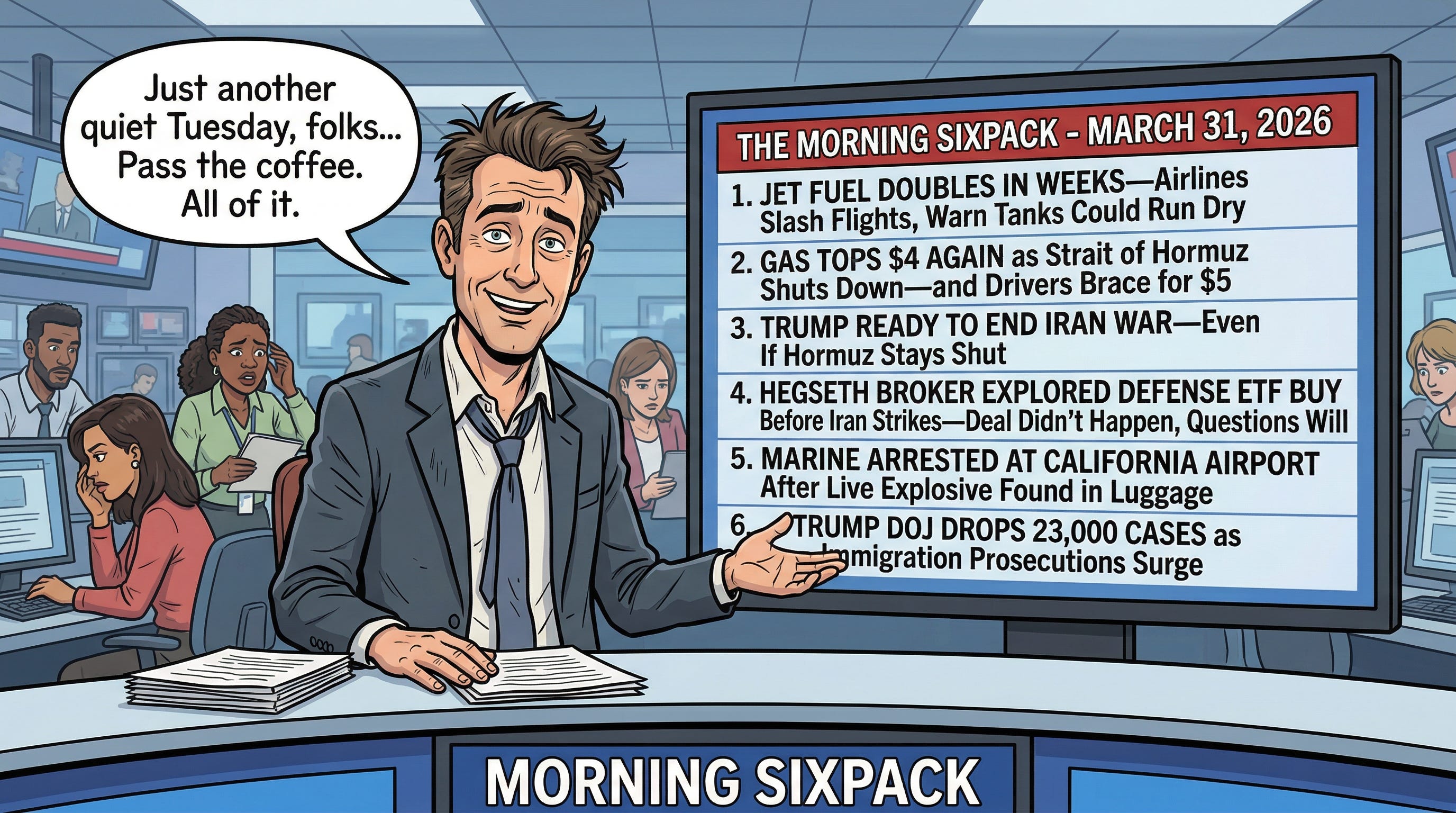
Jet fuel prices have doubled to $4.57 a gallon as Middle East tensions choke supply, and airlines are already cutting flights and raising fares—because nothing says “vacation season” like a fuel squeeze.
Jet Fuel Doubles in Weeks—Airlines Slash Flights and Warn Tanks Could Run Dry
Jet fuel in the U.S. has rocketed from $2.17 to $4.57 a gallon in a matter of weeks, and airlines say the squeeze could leave them scraping the bottom of the tank.
If this sticks, your summer trip just got a lot more expensive—and a lot less certain.
According to the Argus U.S. Jet Fuel Index, prices more than doubled by March 27 as Middle East tensions throttled supply. United Airlines CEO Scott Kirby says the carrier will trim about 5% of planned flights in the near term, warning that if prices persist, jet fuel alone could tack on $11 billion in annual costs. United is already cutting off-peak service and suspending select international routes, including Israel and Dubai.
Delta Air Lines CEO Ed Bastian says the spike added as much as $400 million in costs in March alone, and he’s moving quickly to pass that along through fare hikes. American Airlines expects fuel to pile roughly $400 million onto its first-quarter expenses. Translation: the meter is running, and passengers are picking it up.
The pain isn’t just American. European carriers like Lufthansa and Air France-KLM warn a prolonged Middle East conflict will strain already thin fuel inventories and push fares higher. Air France-KLM plans to raise long-haul prices. Cathay Pacific and other Asian carriers are boosting fuel surcharges. SAS will cancel about 1,000 April flights. Qantas and Thai Airways are adjusting schedules and fares.
Here’s the choke point: the Middle East exports about 1.1 million barrels per day of jet fuel—roughly 15–17% of global consumption—and much of it moves through the Strait of Hormuz, just 21 miles wide at its narrowest. The waterway carries roughly 20 million barrels of oil per day and about one-fifth of global liquefied natural gas, along with significant jet fuel volumes. When tanker traffic slows there, the ripple hits your boarding pass fast.
Source: Fox News
Editor: Airlines spent years blaming weather for delays. Now it’s geopolitics. Either way, pack snacks and patience. And get a third job if you can find one.
Gas just cracked $4 a gallon again as the Strait of Hormuz effectively shuts down, and the White House is telling the world to “TAKE IT.”
Gas Tops $4 Again as Strait of Hormuz Shuts Down—and Drivers Brace for $5
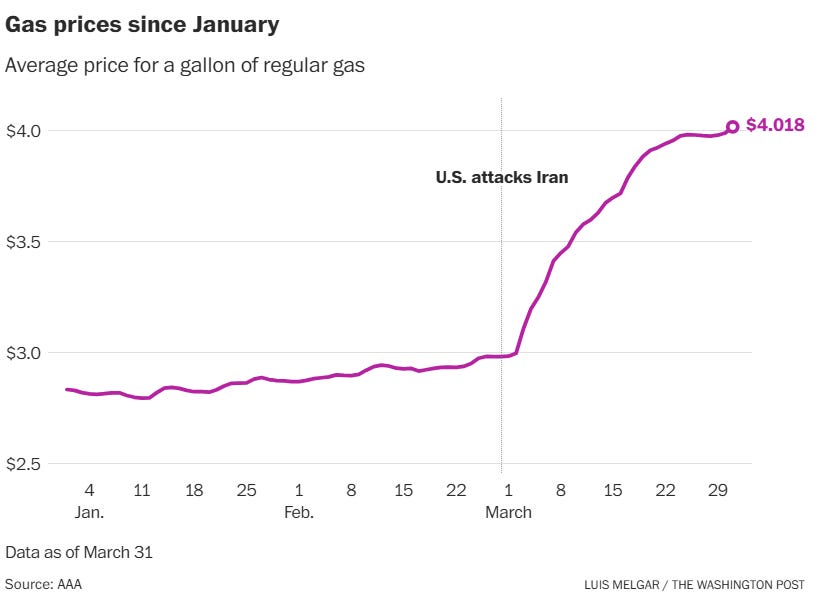
The national average for a gallon of gas just hit $4.01—the first time since 2022—and this time it’s war, not a pandemic hangover, pushing prices higher.
And if the Strait of Hormuz stays blocked, $5 gas is back on the table.
According to AAA, the national average crossed $4 Tuesday as oil surged following fresh attacks in the Gulf. A Kuwaiti-flagged tanker was struck in Dubai’s waters, blamed on Iran, underscoring just how exposed global energy supplies are right now. Brent crude was trading around $106 a barrel, and markets are bracing for more volatility.
The bigger problem? The Strait of Hormuz—through which roughly one-fifth of the world’s oil and natural gas flows—is effectively closed to maritime traffic. Countries are tapping reserves and rationing energy. As one maritime historian put it, “If you sever one of the legs of the web, the other ones assume the weight.” Translation: The global oil market doesn’t snap—it strains. And consumers feel it.
President Donald Trump urged countries facing shortages to buy American fuel because “we have plenty,” and told other nations to “build up some delayed courage, go to the Strait, and just TAKE IT.” Meanwhile, economists warn that even if shipping resumes tomorrow, it could take months for supply chains to normalize. Recovery, experts say, could take roughly a week for every day the strait has been blocked—and it’s already been about a month.
Gas prices are highest on the West Coast, but no region is immune. And it won’t stop at the pump. Higher fuel costs mean higher shipping costs, which means grocery bills and consumer goods won’t be far behind. One economist summed it up plainly: “This is only the beginning.”
Source: The Washington Post (free)
Editor: If you needed another reminder that global chokepoints matter, try filling up your tank this week. The receipt will do the explaining.
Trump is ready to end the Iran war even if the Strait of Hormuz stays closed, gambling that reopening a global energy chokepoint isn’t America’s problem.
Trump Ready to End Iran War—Even If Hormuz Stays Shut
President Trump has told aides he’s willing to wind down the U.S. military campaign against Iran even if the Strait of Hormuz remains largely closed.
That means the world’s most critical oil chokepoint could stay squeezed—while Washington moves on.
According to The Wall Street Journal, Trump and his team believe forcing the strait fully open would extend the conflict beyond his preferred four-to-six-week timeline. Instead, the administration wants to focus on degrading Iran’s navy and missile stockpiles, then pivot to diplomacy—while nudging Europe and Gulf allies to take the lead on reopening the waterway if needed.
Trump didn’t mince words. Posting on Truth Social, he urged other nations to step up: “Build up some delayed courage, go to the Strait, and just TAKE IT. You’ll have to start learning how to fight for yourself, the U.S.A. won’t be there to help you anymore, just like you weren’t there for us.” He’s argued the strait matters more to Europe and Asia than to the U.S., since much of the oil and liquefied natural gas flowing through it is bound for Asian markets.
Here’s the catch: Roughly 20% of the world’s oil supply moves through Hormuz. U.S. crude just closed above $100 a barrel for the first time since 2022, and some analysts warn prices could spike far higher if disruptions drag on. One Iran expert called ending military operations before reopening the strait “unbelievably irresponsible,” warning that energy markets are global and economic damage won’t respect borders.
The administration insists options remain—from multinational naval escorts to renewed pressure on Tehran—but reopening the strait isn’t currently listed among core military objectives. Translation: winning the war may not mean reopening the tap.
Source: The Wall Street Journal (free)
Editor: If 20% of the world’s oil is stuck behind a geopolitical toll booth and we’re calling that “mission accomplished,” buckle up. The gas pump has opinions. Tired of winning yet?
Defense Secretary Pete Hegseth’s broker explored a multimillion-dollar defense ETF investment weeks before the Iran strikes—an awkward look even if no trade happened.
Hegseth Broker Explored Defense ETF Buy Before Iran Strikes—Deal Didn’t Happen, Questions Will
A broker for Defense Secretary Pete Hegseth looked into buying a defense-focused ETF just weeks before the U.S.-Israeli military campaign against Iran.
The investment never went through—but the timing is going to raise eyebrows. And hey, remember that attempting a crime is a crime. Remember attempted murder? You failed, but you tried anyway.
According to a Financial Times report cited by InvestingLive, a Morgan Stanley broker acting for Hegseth approached BlackRock in February about allocating millions into its Defense Industrials Active ETF. The fund targets companies positioned to benefit from rising military spending—names like RTX, Lockheed Martin and Northrop Grumman, along with defense-tech player Palantir.
The inquiry was reportedly flagged internally at BlackRock, though the purchase ultimately didn’t proceed because the ETF wasn’t yet available on Morgan Stanley’s platform. There’s no indication of wrongdoing. Still, when the sitting Defense Secretary—deeply involved in shaping Iran policy—has a broker sniffing around defense plays ahead of military action, the optics aren’t exactly subtle.
Hegseth has been a prominent voice backing the Iran campaign. Defense stocks have been among the clear beneficiaries of escalating geopolitical tensions. That’s what makes this less about market mechanics and more about perception. Even unrealized trades can become political liabilities.
This story also lands amid heightened scrutiny of trading activity ahead of major policy decisions, especially in sectors directly influenced by government action. Markets move fast. So do headlines.
Source: InvestingLive
Editor: In Washington, timing is everything. Even when a trade doesn’t clear, the paper trail still does.
A U.S. Marine was arrested at a California airport after TSA found a live 25mm explosive round in his checked bag—he says he thought it was inert.
Marine Arrested at California Airport After Live Explosive Found in Luggage
A U.S. Marine was detained at Palm Springs International Airport after TSA officers discovered a live 25mm explosive round in his checked baggage.
It wasn’t a souvenir—it was a live round, and authorities blew it up in the desert.
According to police, TSA screeners flagged the item around 12:05 p.m. Monday. Extensive rust and corrosion—and missing identifying markings—initially made it unclear whether the munition was inert or active. The Riverside County Explosive Ordnance Disposal Unit X-rayed the device and determined it was live.
Authorities transported the round to a remote desert area off Gene Autry Trail, where it was safely detonated. Video released by the Palm Springs Police Department captured the controlled blast, preceded by a clear warning: “Fire in the hole,” followed by a countdown and a small explosion kicking up dust and smoke.
Police say the Marine told investigators he found the round in a field about a year ago and kept it, believing it was a harmless training munition. That belief didn’t survive an X-ray.
The case will be submitted to the Riverside County District Attorney’s Office for possible charges. The Marine could also face administrative action from the Corps and civil penalties from TSA. Souvenirs are one thing. Explosive ordnance is another category entirely.
Source: UPI
Editor: Pro tip—if you “find” military-grade hardware in a field, maybe don’t pack it next to your toiletries. TSA has trust issues for a reason. And let’s not forget, this dummy got in before the DoD relaxed its requirements. We don’t enlist the sharpest tools in the shed. And it’s going to get MUCH WORSE.
Trump DOJ Drops 23,000 Cases as Immigration Prosecutions Surge
In the first six months of President Trump’s second term, the Justice Department declined more than 23,000 criminal investigations—a record-setting pivot toward immigration enforcement.
Nearly 11,000 cases were declined in February 2025 alone—the highest monthly total in at least two decades.
According to ProPublica’s analysis of DOJ data, the department abandoned investigations spanning terrorism, drug trafficking, labor racketeering, white-collar fraud and environmental crimes. At the same time, it prosecuted 32,000 new immigration cases—nearly triple the number under the Biden administration and 15% higher than Trump’s first term.
The shift followed a directive ordering prosecutors to review and close out older cases within 10 days—an unusually compressed timeline, according to former DOJ officials. The department says the spike reflects efforts to “clean, remediate, and validate data” and prioritize resources.
Here are the key numbers:
Key DOJ Declination & Prosecution Stats (First 6 Months of Trump’s 2nd Term)
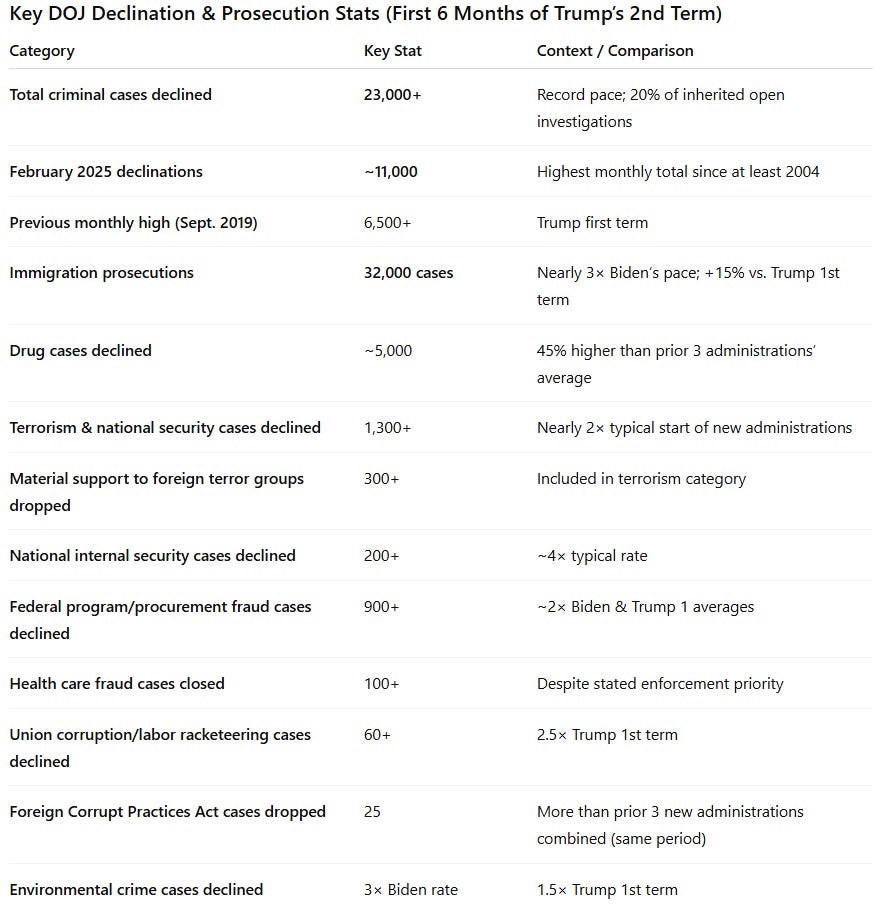
ProPublica reports that the DOJ declined about 20% of inherited open investigations, compared with 11% under Biden during a comparable period. Critics argue the department is retreating from core enforcement areas. Supporters say it’s a strategic reallocation toward border security and cartel-related threats.
Either way, this isn’t a minor policy tweak. It’s a wholesale reshuffling of federal prosecutorial muscle.
Source: ProPublica
Editor: When you close 23,000 cases in six months, that’s not trimming fat—that’s rewriting the menu. The question is what—and who—gets left off the plate.