


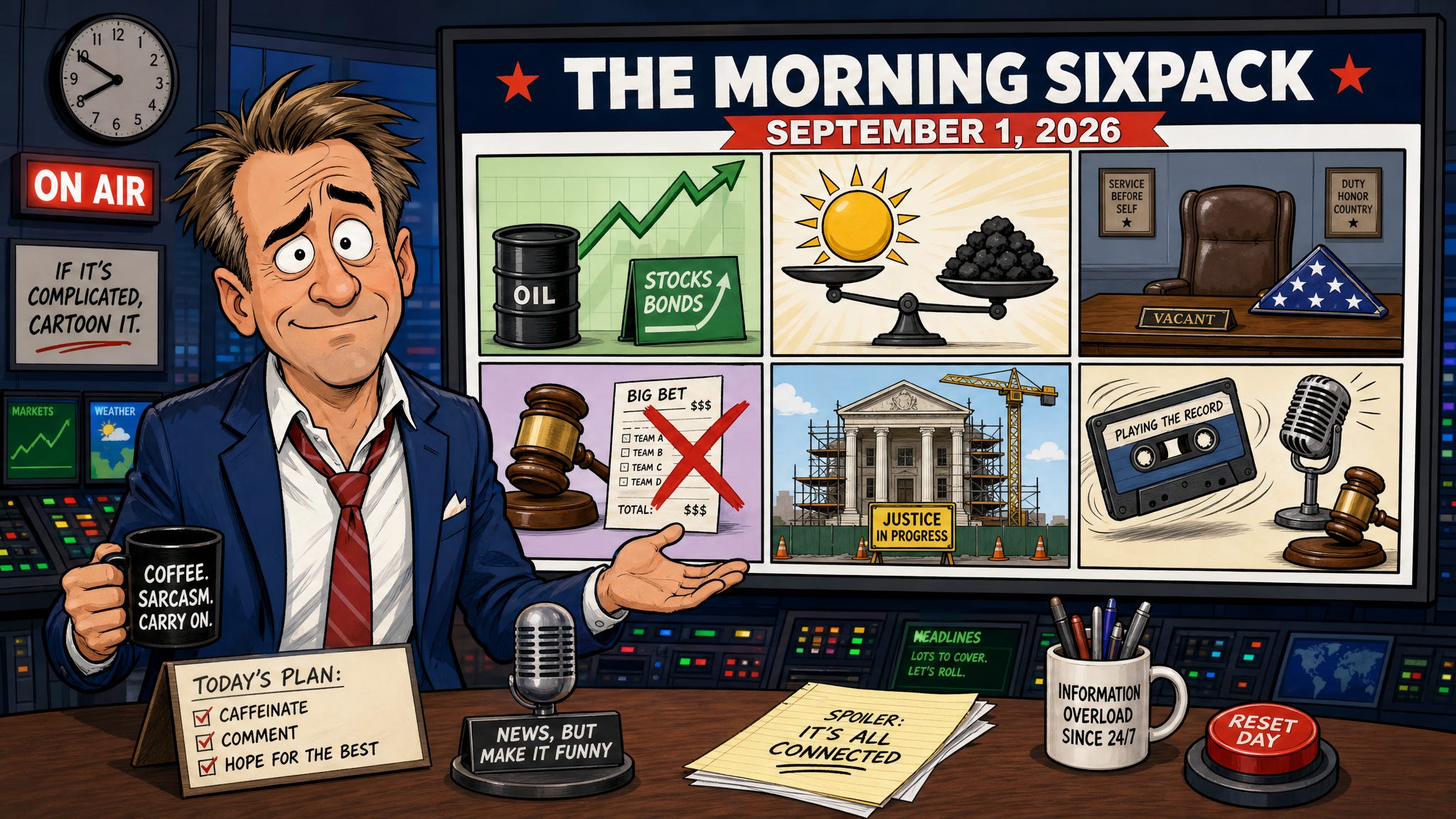
The Morning Sixpack stays free because the news that shapes your life should not be hidden behind a paywall. Paid subscribers are not paying for access. They are helping fund the research, writing, and independent voice that goes into every issue. Become a paid subscriber and help keep smart, honest news analysis free for everyone.
The bond market just sent central bankers a memo: Inflation isn’t dead, oil isn’t helping, and cheap money may remain an exhibit at the economic history museum.
Global Bond Yields Hit 20-Year High as Oil Fuels Inflation Fears
Global bond yields have climbed to their highest level in almost two decades as rising oil prices revive inflation fears and investors brace for higher interest rates. Treasuries are leading the retreat, with the 10-year U.S. yield reaching its highest level since January 2025 and a Bloomberg gauge of global government debt yields hitting 3.72%—the highest since mid-2008.
The “rates are coming down” party suddenly has a very expensive bar tab.
Fed Chairman Kevin Warsh added fuel Friday at Jackson Hole, reiterating his determination to tame inflation after five straight years above the central bank’s target. Meanwhile, renewed U.S.-Iran hostilities are threatening prolonged disruptions to energy flows through the Strait of Hormuz, pushing oil prices higher and giving inflation another potential source of oxygen. “Markets are pricing in a higher path for short rates in the US, but also globally,” First Eagle Investments’ Idanna Appio told Bloomberg TV.
Those “long rates” aren’t doing so well, either.
The pressure isn’t confined to America. Investors are demanding more compensation to hold longer-term government debt amid concerns about heavy government spending in the U.S., Japan, and the UK. Japan’s 10-year government bond yield reached 3% for the first time since 1996, while comparable Australian yields climbed to levels last seen in 2011.
TD Securities strategist Prashant Newnaha put it neatly: “The bond market is not imploding, but it’s sending a very clear memo that stickier inflation means higher for longer policy rates as the absolute minimum.”
That memo matters far beyond Wall Street. Higher government bond yields will filter into mortgages, corporate borrowing, and government financing costs—and markets that had been counting on easier monetary policy may have to rethink the calendar.
Editor: Inflation keeps getting declared mostly defeated, then wanders back into the room carrying an oil barrel and a higher mortgage quote.
Source: Yahoo Finance/Bloomberg
China now has more solar capacity than coal capacity, which is a hell of a milestone—even if the coal plants are still doing most of the actual work.
Solar Overtakes Coal as China’s Largest Source of Installed Power Capacity
Solar farms overtook coal plants in July to become China’s largest source of installed power capacity, with 1,288 gigawatts of solar edging past coal’s 1,285 GW. It’s a landmark moment for the world’s largest energy consumer and a striking measure of just how aggressively Beijing has built out renewable power.
China has officially installed more power from sunshine than from coal.
There is, however, a rather large asterisk attached to that achievement: Installed capacity isn’t the same thing as electricity actually generated. Solar panels don’t produce power when the sun isn’t shining, and wind and solar combined supplied 24.6% of China’s electricity during the first half of the year. Coal still supplied 49.7%—nearly twice as much—although that marked the first time coal’s share had fallen below 50%.
The crossover didn’t arrive out of nowhere. China’s combined installed wind and solar capacity surpassed its coal fleet in March 2025, and the country’s enormous renewable buildout has continued since then. New solar installations have slowed this year following China’s shift from fixed feed-in tariffs toward market-based pricing, but the country’s total solar fleet is still expanding.
So coal isn’t packing its bags just yet, but the direction of travel is getting difficult to ignore. China now has more installed solar than coal while renewables continue taking a larger bite out of electricity generation—a transition happening at a scale that can reshape global energy markets.
Editor: China just put solar ahead of coal on the capacity scoreboard. Now comes the slightly harder part: Keeping the lights on when the scoreboard is dark.
But China does have a lock on the heavy metals needed for battery production to store that energy when the sun is down. They are winning.
Source: Reuters
Army Secretary Dan Driscoll is heading for the Pentagon exit after months of friction with Pete Hegseth, leaving the Army with another leadership vacancy at a particularly inconvenient moment.
Army Secretary Dan Driscoll Resigns After Months of Tension with Pete Hegseth
Army Secretary Dan Driscoll submitted his resignation to President Donald Trump after months of tension with Defense Secretary Pete Hegseth over the direction of the Army and the removal of senior military officers. Driscoll is expected to leave the Pentagon within days, creating another leadership gap while the U.S. remains embroiled in the conflict with Iran.
Nothing screams organizational harmony quite like the Army secretary deciding it’s time to hand in his keys.
The relationship between Driscoll and Hegseth appeared to deteriorate significantly after Hegseth forced Army Chief of Staff Gen. Randy George to retire in April. Driscoll later told lawmakers he was on vacation when he learned George had been told to leave and drove directly to the general’s home after returning.
His praise for George wasn’t exactly subtle: “There is no person who has more respect for Gen. George,” Driscoll said, calling him an “amazing, transformational leader” and adding, “I, too, loved Gen. George.”
Hegseth never publicly explained George’s removal, while reports indicated Driscoll and George had also clashed with the defense secretary over his decision to block four Army officers from being promoted to one-star general. Driscoll nevertheless avoided publicly attacking Hegseth, telling lawmakers that civilian leaders “get to pick the leaders that they want, and we execute on those orders.” The White House, meanwhile, praised Driscoll’s tenure, pointing to military operations, readiness efforts, and his work involving Russia-Ukraine negotiations.
Driscoll’s exit would leave the Army without either a Senate-confirmed civilian secretary or a Senate-confirmed uniformed chief during the Iran conflict. Gen. Christopher LaNeve has been serving as acting Army chief of staff, while NOTUS reports Hegseth favors Pentagon spokesperson Sean Parnell to replace Driscoll—a potential nomination that could face complications in the Senate.
Editor: When both of the Army’s top confirmed jobs are empty during a war, “personnel reshuffling” starts sounding like one hell of an understatement.
Source: NOTUS
George Santos apparently found a new frontier in personal branding: Betting on whether George Santos would show up somewhere, then publicly talking about whether George Santos would show up somewhere.
George Santos Gets Lifetime Kalshi Ban and $71,356 Fine Over Prediction-Market Trades
Former Republican congressman George Santos has been permanently banned from prediction market Kalshi and fined $71,356 after the company found he violated its insider-trading and market-manipulation rules. The case centered on an unusually self-referential wager: Santos traded contracts tied to whether he himself would attend President Trump’s February 2026 State of the Union address.
When you possess inside information about George Santos because you are George Santos, perhaps sit this market out.
According to Kalshi’s disciplinary notice, Santos traded the attendance markets and then made public statements attempting to influence contract prices, including statements Kalshi described as “false or misleading.” The day before Trump’s address, Santos posted on X: “I’m going to be there for the State of Union in the gallery, guys.” During the speech, however, Santos posted that he was actually watching from an airport. “FML,” he wrote.
Kalshi froze Santos’ account and referred the trades to the Commodity Futures Trading Commission. Santos later settled with the CFTC for $35,000 without admitting its allegations, findings, or conclusions, including returning roughly $17,500 in profits and paying another $17,500 as a penalty. Santos isn’t exactly taking his Kalshi ban quietly, either.
He sarcastically thanked the company “for the lifetime ban from your gambling platform,” before adding, “Let’s see how much longer you guys are around for 💋.” Kalshi says Santos successfully influenced prices in several markets and is threatening legal action if he doesn’t pay the company’s penalty.
And Santos has company, although nobody else earned the lifetime treatment. Kalshi also penalized political candidates Laurie Buckhout, Stephen Cloobeck, and Ben Midgley for attempting to trade contracts involving their own races, temporarily suspending them. Santos, meanwhile, brings considerably more baggage: Congress expelled him in 2023, he later pleaded guilty to federal crimes, and served prison time before Trump commuted his sentence in 2025.
Editor: There are conflicts of interest, and then there’s literally betting on your own whereabouts while telling the public where you’re supposedly going to be. Even Vegas would admire the efficiency.
Source: WIRED
The Supreme Court says Trump can keep building his White House ballroom even as the chief justice says the project is “likely unlawful”—apparently construction law now comes with a finish-first, litigate-later option.
Supreme Court Lets Trump Keep Building White House Ballroom Despite Roberts Calling It ‘Likely Unlawful’
The Supreme Court ruled 5-4 that President Donald Trump can continue construction of his massive White House ballroom, even though Chief Justice John Roberts joined the dissent and said the project is “likely unlawful” because Congress never approved it. The ruling keeps construction moving while the underlying lawsuit continues—a significant victory for Trump, but decidedly not a declaration that the ballroom itself is legal.
Trump can keep building a project the chief justice of the United States says he probably doesn’t have the legal authority to build.
The majority focused on who has the right to sue rather than whether Trump has the right to build. Five Republican-appointed justices concluded that the National Trust for Historic Preservation likely lacks legal standing because the asserted harm to one of its members’ “aesthetic, cultural, and historical interests” wasn’t sufficient.
The unsigned majority emphasized the narrowness of its decision: “We do not pass upon the legality” of the project. Roberts, joined by Justices Sonia Sotomayor, Elena Kagan, and Ketanji Brown Jackson, saw things differently.
Roberts said the construction is “likely unlawful,” pointing to the administration’s “apparent absence of statutory authority” and a federal law requiring Congress to expressly approve construction of a “building or structure” on federal parkland in Washington, including the White House grounds. Congress hasn’t approved the ballroom.
Meanwhile, this isn’t exactly a gazebo going up behind the Rose Garden. The ballroom complex has grown to a planned 90,000 square feet with room for 1,000 guests, while its original $200 million price tag has doubled. The administration says the project also includes major military and security features, including an underground hospital and rooftop drone port. Solicitor General John Sauer told the court that a 250-person crew has been working 20 hours a day, seven days a week, and that the structure is already roughly two-thirds complete. Two lower courts had declared the project illegal and ordered construction stopped, but that order was put on hold during the administration’s appeals.
Trump celebrated the ruling, declaring that the ballroom would be “one of the Greatest ever constructed in Washington, D.C.” But the legal fight isn’t over. The decision is technically an interim ruling, and opponents could potentially find plaintiffs with a stronger claim to standing. For now, though, the concrete keeps pouring while the courts continue debating whether anyone can legally stop it.
Editor: When the chief justice says your construction project is “likely unlawful” but the bulldozers keep moving anyway, you’ve discovered the ultimate Washington permitting loophole: build faster than the lawyers can sue.
I am not a lawyer but can’t a) Congress stop this and/or b) can’t a member of the public say you’re spending taxpayer dollars that haven’t been approved by me through my representatives?
Source: The Wall Street Journal (free)
Nearly 30 years after Tupac Shakur was murdered, Duane “Keffe D” Davis was convicted after prosecutors used decades of his own interviews and storytelling to help put him away—apparently some cold cases just need the suspect to keep talking.
Tupac Shakur Murder Case Finally Gets a Conviction Nearly 30 Years Later
A Las Vegas jury convicted Duane “Keffe D” Davis of first-degree murder in the 1996 killing of Tupac Shakur, delivering the first conviction in one of the most infamous murders in music history. Jurors deliberated for less than three hours before finding the 63-year-old Davis guilty of murder with use of a deadly weapon, and he could now spend the rest of his life in prison.
After three decades of mystery, the evidence that finally helped crack the Tupac case came largely from the defendant’s own mouth.
Prosecutors never claimed Davis fired the shots that killed the 25-year-old rapper. Instead, they argued he organized the group, obtained the gun, and passed it into the backseat of the white Cadillac that pulled alongside Shakur and Death Row Records co-founder Marion “Suge” Knight on Sept. 7, 1996. Under Nevada law, someone who assists in a murder can be held criminally responsible for it. And Davis had spent years describing his involvement to investigators, filmmakers, interviewers, and readers of his memoir. In one particularly damaging statement to investigators, Davis said: “If we would have been on my side, I would have blasted.”
Davis’ defense argued those stories were exaggerations and fabrications designed to make money and generate notoriety. Attorney Michael Sanft emphasized the lack of surveillance footage, phone records, or other physical evidence proving Davis was even in Las Vegas that night.
“They have nothing in this case that says that man was here in Las Vegas on Sept. 7, 1996,” Sanft told jurors.
Prosecutors acknowledged that some details in Davis’ accounts changed over time, but argued the essentials remained consistent: He repeatedly put himself in the Cadillac, described obtaining the weapon, and explained his role in the retaliatory attack following an earlier fight involving Shakur, Knight’s entourage, and Davis’ nephew. “The core facts remain. The material facts remain,” prosecutor Binu Palal told the jury.
Davis was ordered held without bail and is scheduled for sentencing Oct. 13. He immediately told the judge he wants to appeal. Whatever happens next, the verdict closes an extraordinary chapter in a case that seemed destined to remain unsolved after witnesses refused to cooperate and other suspected participants “died.”
Editor: There are plenty of lessons here, but “don’t spend years publicly describing your alleged role in an unsolved murder” probably didn’t need to be one of them.
Source: Associated Press