


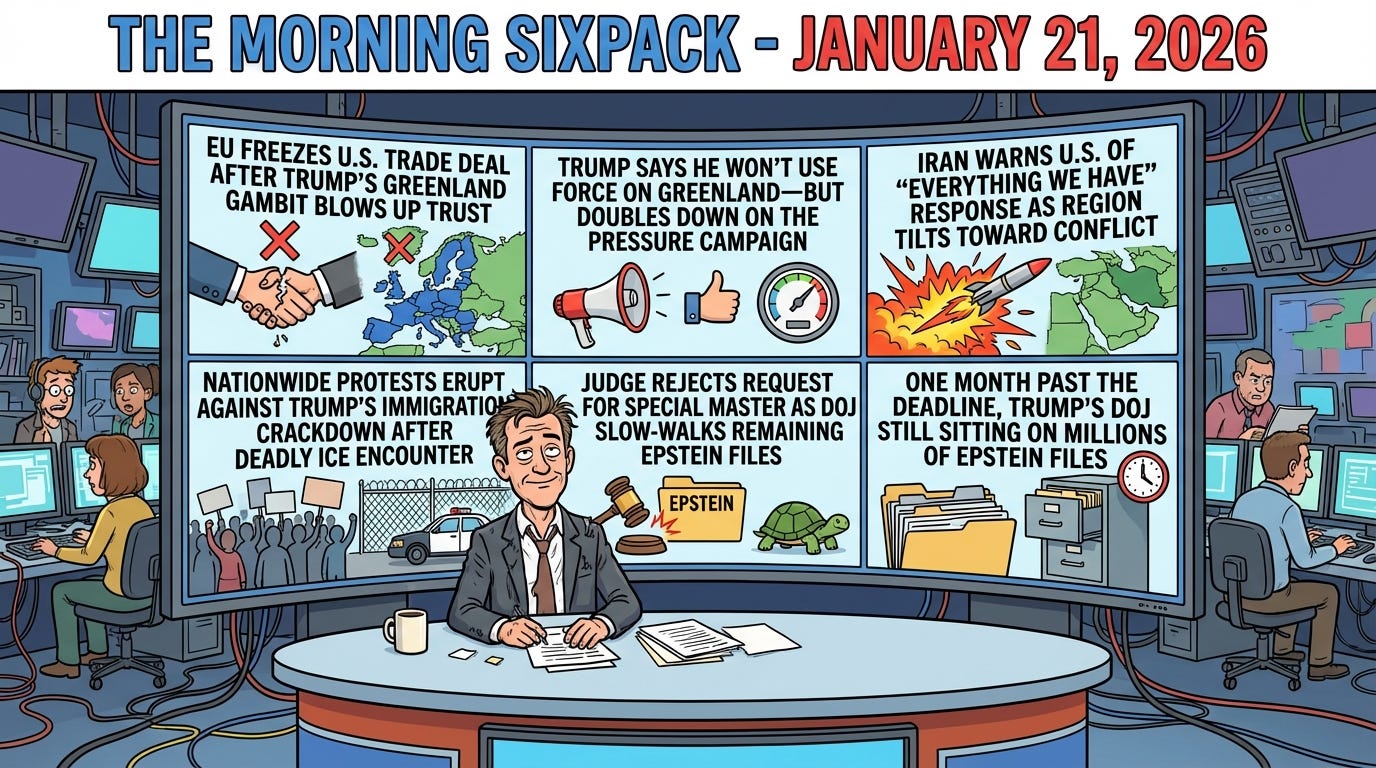
EU Freezes U.S. Trade Deal After Trump’s Greenland Gambit Blows Up Trust
EU lawmakers have slammed the brakes on a major trade deal with the U.S. over Donald Trump’s renewed crusade to buy Greenland.
In a move that should surprise exactly no one who has watched this geopolitical theater unfold, the European Parliament has put its legislative work on the EU-U.S. trade agreement on ice. The trigger: Trump’s insistence on pressing Denmark—yes, Denmark—to hand over Greenland like it’s a beachfront condo he’s been eyeing.
Lawmakers made it clear the issue isn’t just the land grab—it’s the tariffs being waved around as leverage. As Bernd Lange, chair of the Parliament’s international trade committee put it, “By threatening the territorial integrity and sovereignty of an EU member state and by using tariffs as a coercive instrument, the U.S. is undermining the stability and predictability of EU-U.S. trade relations.”
That’s diplomatic language for: We’re not playing this game. And honestly, who can blame them? Some MPs had already hinted they were ready to shut the whole thing down after Trump’s threat of new tariffs on eight European countries brave enough to roll their eyes at the Greenland fantasy.
Lange went further, saying lawmakers were left with “no alternative but to suspend work on the two Turnberry legislative proposals until the U.S. decides to re-engage on a path of cooperation rather than confrontation.” Which, given recent history, might be a long wait.
Source: WSJ (free)
Editor: Love that Europe finally said the quiet part out loud: if you threaten to buy someone’s territory (or take it by force) and then slap them with tariffs for saying no, don’t expect a trade deal wrapped in a bow. At this rate, Greenland will file a restraining order before Congress even weighs in.
Trump Says He Won’t Use Force on Greenland—but Doubles Down on the Pressure Campaign
President Trump ruled out using military force to acquire Greenland, but everything else in his Davos speech pointed straight toward coercion by another name.
In a rare moment of restraint, Trump told world leaders at the World Economic Forum that he “won’t use force” to secure Greenland from Denmark. Markets, battered the day before by his escalating rhetoric, immediately breathed a sigh of relief. For a president who’d been dangling tariffs like party favors, simply not threatening war apparently counts as stabilizing.
But the calm didn’t last. Trump pivoted right back to his all-too-familiar pressure tactics, urging “immediate negotiations” with Denmark over what he kept calling the U.S. “acquisition” of Greenland. At one point he framed it with the subtlety of a mob movie: “You can say yes, and we will be very appreciative. Or you can say no, and we will remember.”
He bounced between hyping Greenland as a strategic Arctic linchpin and brushing it off as just a “piece of ice,” even confusing it with Iceland more than once—a geographic hiccup that didn’t exactly instill confidence. But he did deliver one refrain with absolute clarity: only the U.S., he insisted, can defend Greenland. Denmark and NATO, he argued, are simply outmatched.
This came just days after he threatened tariffs on eight NATO allies who weren’t lining up behind the Greenland fantasy. So yes, no force—but plenty of leverage.
And for anyone still keeping score: we have a U.S. president openly musing about buying an autonomous territory from a NATO ally while simultaneously menacing that same alliance with tariffs. Just another Wednesday.
Source: CNBC
Editor: Apparently we’re supposed to throw a parade because he promised not to invade an ally over an island he keeps calling a “piece of ice.” The bar is subterranean at this point, and he’s still tripping over it.
Iran Warns U.S. of “Everything We Have” Response as Region Tilts Toward Conflict
Iran’s foreign minister just issued his bluntest warning yet: if the U.S. strikes again, Tehran will answer with full force.
Abbas Araghchi, already disinvited from Davos over Iran’s bloody suppression of protesters, used a Wall Street Journal op-ed (link) to lay down a threat that was anything but subtle. He insisted the unrest lasted “less than 72 hours” and blamed armed demonstrators—conveniently ignoring the videos showing security forces firing on unarmed crowds. But the centerpiece of his message was unmistakable: “our powerful armed forces have no qualms about firing back with everything we have if we come under renewed attack.”
Editor: Sounds a lot like what’s happening with ICE in Minneapolis…
And tensions are hardly abstract. A U.S. carrier strike group is steaming westward, fighter jets and HIMARS systems are landing in the region, and Iran has closed its airspace like a country bracing for impact. Gulf nations are begging Washington not to launch a strike, which is usually a sign that everyone expects someone to do something reckless anyway.
Tehran is also escalating beyond rhetoric. A Kurdish separatist group in Iraq says Iran hit one of its bases with drones and missiles, killing a fighter—potentially Iran’s first cross-border operation since protests erupted. Iran isn’t acknowledging it, but then again, Iran isn’t acknowledging much these days aside from its own indignation.
Meanwhile, the human cost inside Iran keeps climbing. At least 4,519 people have been killed—an astonishing toll that evokes the chaos of 1979. Over 26,300 have been arrested, internet access remains shut down, and even Iran’s Supreme Leader admitted “several thousand” are dead. Araghchi warns that a regional war would be “ferocious” and drag on “far, far longer than the fantasy timelines” floating around Washington. He’s right about one thing: when you kill thousands at home and threaten everyone abroad, the fantasy is pretending this fire stays contained.
Source: AP News
Editor: Nothing says “we abhor war” quite like promising to unleash the full arsenal while the bodies from your own crackdown aren’t even counted yet. Tehran keeps lecturing the world about reality while refusing to look in the mirror. Ditto Trump.
Nationwide Protests Erupt Against Trump’s Immigration Crackdown After Deadly ICE Encounter
Thousands of Americans took to the streets and campuses nationwide to denounce President Trump’s immigration policies after a U.S. citizen was shot and killed by federal agents.
On the anniversary of Trump’s second term, protests ignited across major cities and college campuses, fueled by the death of 37-year-old Renee Good—an American mother dragged from her car and fatally shot by ICE agents in Minneapolis. The administration keeps insisting it has a voter mandate to deport millions, but polls show most Americans aren’t buying the idea that “mandate” means license to use lethal force.
From Washington to Asheville, demonstrators marched with chants like “No ICE, no KKK, no fascist USA,” underscoring just how much Trump’s hardline tactics have alienated younger voters and moderates alike. University students in Cleveland joined high schoolers in Santa Fe who walked out of class for a “Stop ICE Terror” rally—because nothing says civic engagement like deciding class can wait when democracy might not.
The movement wasn’t fringe. Labor unions, left-leaning groups such as Indivisible and 50501, and grassroots anti-detention organizations helped organize the actions, pointing especially to the detention camp in El Paso where three detainees have died in six weeks. That’s not a policy debate—that’s a moral indictment.
And the wave was far from over. Demonstrations were expected to surge westward into San Francisco and Seattle, carrying the message that Americans aren’t willing to tolerate an immigration policy that leaves citizens and refugees alike in the crosshairs.
Source: Reuters
Editor: When high school kids have to walk out to remind the government not to kill people during traffic stops, it’s safe to say the system has drifted off course. ICE insists it’s enforcing the law—everyone else is wondering when enforcing the law started looking like open season.
Judge Rejects Request for Special Master as DOJ Slow-Walks Remaining Epstein Files
A federal judge acknowledged serious doubts about the Justice Department’s handling of the Epstein files—but said he has no power to do anything about it.
U.S. District Judge Paul Engelmayer didn’t sugarcoat it. In his ruling, he said the concerns raised by lawmakers and victims about DOJ foot-dragging are “undeniably important and timely,” and that they raise “legitimate concerns about whether DOJ is faithfully complying with federal law.” That’s about as close as a federal judge comes to saying: Yeah, something smells off.
But then came the catch—he said he lacks jurisdiction to appoint a special master to oversee compliance with the Epstein Files Transparency Act. In other words, the court sees the problem but can’t touch it. Congress may have demanded the files by Dec. 19, but the DOJ is still sifting through an estimated two million documents, redacting material from the Epstein and Ghislaine Maxwell cases to satisfy victim-protection orders. “Substantial progress” is the DOJ’s phrase of choice, which is government-speak for: we’ll get there when we get there.
Representatives Thomas Massie and Ro Khanna had pushed hard for a neutral monitor, backed by several Epstein victims. But Engelmayer noted Congress has “no role” in the matter and that seeking oversight this way is “far afield” from anything the court can entertain. Translation: if you want enforcement power, write the law differently next time.
So far, released materials have revealed early FBI warnings and details about Epstein’s 2019 arrest—but not the explosive evidence against powerful men that many expected or, depending on the cynic, were certain must exist. The longer DOJ drags this out, the more conspiracy oxygen they pump into the room.
Source: ABC News
Editor: Only in Washington can a judge say “these concerns are legit” and “my hands are tied” in the same breath. Meanwhile, DOJ is sitting on two million documents like a dragon on a hoard, insisting they’ll release everything—eventually. Great way to build public trust in, oh, literally anything.
Impeach Pam Bondi and Kash Patel. They are criminals.
One Month Past the Deadline, Trump’s DOJ Still Sitting on Millions of Epstein Files
The Justice Department blew past Congress’s hard deadline to release all Epstein files—and survivors say the delay isn’t procedural, it’s betrayal.
Under the Epstein Files Transparency Act, DOJ was legally required to disclose all investigative records by 19 December 2025. Not “some,” not “whatever they got to,” but all. Instead, Trump’s Justice Department has coughed up roughly 125,575 pages—just 12,285 files—while admitting it is still sitting on more than two million potentially responsive documents. That’s not compliance; that’s stalling dressed up as paperwork.
Survivors’ attorney Spencer Kuvin didn’t mince words: “Congress did not create a discretionary timeline—it created a legal obligation… Continued secrecy retraumatises victims and undermines public confidence in the justice system.” And he’s right. These aren’t dusty archives; they’re evidence of institutional failure and the people who enabled Epstein to operate in plain sight for years.
So lawmakers Ro Khanna and Thomas Massie—the bipartisan duo behind the act—asked Judge Paul Engelmayer to appoint a special master to force DOJ to comply. They accused DOJ of missing the deadline, inventing privileges the law doesn’t allow, and redacting material that the act explicitly says cannot be withheld to protect “politically exposed persons.” They also noted DOJ ignored another statutory requirement: providing a report summarizing what’s being released, withheld and why. Without it, there’s no audit trail—just trust us, bro.
Advocates argue a special master could bring structure and accountability to a process that appears to have crashed into a wall. Even Radar Online—locked in its own eight-year legal battle with DOJ over Epstein files—called the move essential. Legal experts agree the tool is appropriate for massive, complex disclosures. But even if appointed, a special master wouldn’t magically open the vault; multiple courts and layers of review could still slow the process.
Still, the alternative is worse: letting the DOJ self-police disclosures it’s already delayed, resisted, and redacted into near meaninglessness. As Kuvin put it, “Transparency doesn’t fail because statutes are unclear—it fails when institutions choose protection over accountability.” And at the moment, accountability is nowhere in sight.
Source: The Guardian
Editor: Whenever a federal agency insists it’s ‘reviewing’ two million documents months after a mandatory deadline, you know the priority isn’t transparency—it’s triage for whoever might look bad (Trump). Congress wrote the law. DOJ shrugged. Victims wait. Same old story, just with a bigger file cabinet.
And a burn box, no doubt.