


The Morning Sixpack stays free because the news that shapes your life should not be hidden behind a paywall. Paid subscribers are not paying for access. They are helping fund the research, writing, and independent voice that goes into every issue. Become a paid subscriber and help keep smart, honest news analysis free for everyone.
Defense Secretary Pete Hegseth launched a combative defense of his leadership Tuesday as Congress prepared for a possible impeachment vote over the war in Iran and other controversial military operations.
Hegseth Fights for His Job as Iran War Backlash Fuels Impeachment Push
Defense Secretary Pete Hegseth launched a combative defense of his leadership Tuesday as Congress prepared for a possible impeachment vote over the war in Iran and other controversial military operations. Speaking at the Pentagon, Hegseth denounced the impeachment effort as “sabotage” and insisted that the Trump administration was doing “the tough, right thing” in Iran. His remarks followed devastating Republican losses in last week’s midterm elections, driven largely by voter opposition to the war. With his political future increasingly uncertain, Hegseth appeared determined to convince President Donald Trump that he remains indispensable.
The impeachment effort, introduced Monday by Republican Rep. Thomas Massie of Kentucky, could reach a vote as early as Wednesday. The resolution accuses Hegseth of violating the War Powers Act by launching a war against Iran without congressional authorization, overseeing extrajudicial killings of suspected drug traffickers in Latin America, and committing several other offenses. Hegseth rejected the proceedings as a politically motivated attack, arguing that disagreements over military policy should be settled through legislation, debate, or elections. He also invoked the chaotic 2021 U.S. withdrawal from Afghanistan, noting that former Defense Secretary Lloyd Austin never faced impeachment over that disaster.
Tuesday’s appearance marked Hegseth’s first Pentagon news conference in six months, despite an ongoing military conflict involving more than 50,000 American service members and three aircraft carrier groups in the Middle East. The war, initiated by the United States and Israel in February, has become a grinding stalemate and a growing political liability for the administration. Hegseth defended the operation by comparing its American death toll with the substantially higher casualties suffered in previous wars. He also warned Republicans against allowing Democrats to turn impeachment proceedings into what he described as a “show trial” targeting both himself and the president.
Trump publicly defended his defense secretary Monday night, calling him “perhaps the most popular and successful military official in the Country” and urging congressional Republicans to stand behind him. But that endorsement may not guarantee Hegseth’s survival. Two former Trump administration officials told The Washington Post that the president might allow the impeachment process to unfold rather than expend significant political capital protecting him. Meanwhile, administration insiders have raised questions about whether Trump could instead dismiss Gen. Dan Caine, chairman of the Joint Chiefs of Staff, or Adm. Brad Cooper, who oversees the Iran conflict as head of U.S. Central Command.
Behind the scenes, Hegseth’s staff has circulated talking points promoting his accomplishments and dismissing impeachment as a “charade.” The Pentagon and White House have also coordinated a public show of unity, distributing images featuring Hegseth alongside Trump and newly appointed White House Chief of Staff Stephen Miller. Yet serious questions remain about whether Hegseth and senior military commanders adequately communicated the war’s risks to Trump, particularly the depletion of critical missile interceptors that are difficult to replace. With Republicans reeling from their election losses and the Iran conflict showing little sign of resolution, Hegseth’s political survival now depends on whether Trump’s public loyalty translates into sustained support when Congress votes.
Editor: Hegseth calls impeachment sabotage, Trump calls him a superstar, and voters just delivered Republicans a political beating over the war. Somewhere in Washington, somebody might want to explain that defending a war isn’t the same thing as winning one.
Source: The Washington Post
Consumer prices rose 0.4% in October, easing from September’s 0.6% increase but remaining uncomfortably high as Americans continue struggling with rising living costs.
Inflation Remains Stubbornly High as October Prices Rise 0.4% and Fed Weighs More Rate Hikes
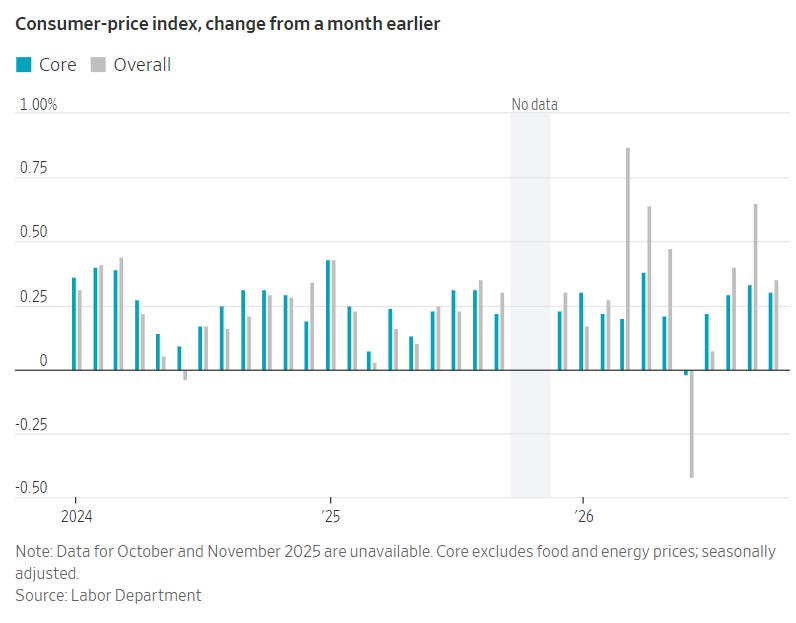
Consumer prices rose 0.4% in October, easing from September’s 0.6% increase but remaining uncomfortably high as Americans continue struggling with rising living costs. Core inflation, which excludes volatile food and energy prices, increased 0.3%, according to Tuesday’s Labor Department report. The government couldn’t publish its usual year-over-year inflation figure because last year’s federal shutdown prevented it from collecting the necessary comparison data. September’s annual inflation rate stood at 3.7%, and prices have risen at a 5.7% annualized pace over the past three months—nearly triple the Federal Reserve’s 2% target.
The latest inflation numbers are putting additional pressure on the Federal Reserve to raise interest rates more aggressively when policymakers meet in December. Fed Governor Christopher Waller suggested Tuesday that another strong monthly inflation reading could justify a half-percentage-point increase, although other officials haven’t publicly embraced that possibility. A more conventional approach would involve quarter-point increases at consecutive meetings in December and January. The Fed raised rates in September for the first time in three years, paused in October, and has already signaled that another increase is likely before year’s end.
The ongoing war in Iran remains a major contributor to inflation, particularly through higher energy costs that have battered household budgets since the conflict began in February. Gasoline averaged $4.32 per gallon in October, barely below September’s $4.34, but still roughly 34% higher than before the war. While the relative stability of gasoline prices provided some relief last month, elevated fuel costs continue affecting transportation, manufacturing, and other energy-dependent industries. Airfares, for example, were already 22% higher in September than a year earlier, illustrating how expensive energy can spread inflation throughout the economy.
Federal Reserve economists are increasingly concerned that rising energy prices may have a greater impact on broader inflation than they did in previous decades. New research suggests that since the pandemic, higher oil and energy costs have become more closely associated with price increases across other sectors of major economies. That creates a difficult situation for policymakers, who must decide whether to raise borrowing costs to suppress inflation even as consumers and businesses face mounting financial pressure. Waller warned that the Fed should take these broader effects seriously rather than assume an energy-price spike will remain confined to gasoline and utilities.
Inflation also played a significant role in last week’s midterm elections, when Democrats scored sweeping victories among voters frustrated by persistent increases in groceries, gasoline, healthcare, and other necessities. Many voters identified the economy as their top concern, delivering a clear rebuke to Republicans and the Trump administration. Democrats have discussed rolling back Trump’s tariffs and pushing to end the Iran war, hoping those measures could ease pressure on consumer prices. But Congress has limited ability to bring inflation down quickly, leaving the Federal Reserve—and its increasingly difficult interest-rate decisions—as the primary institution responsible for restoring price stability.
Editor: Washington can celebrate inflation slowing from 0.6% to 0.4% all it wants. Prices are still rising, gasoline is a third more expensive than before the Iran war, and the Fed’s preferred solution is to make borrowing money more expensive. No wonder voters are fed up.
Source: The Wall Street Journal
North Korea test-fired a new high-speed torpedo Monday and plans to deploy the weapon with its navy in early 2027, according to state-run media.
North Korea Tests New High-Speed Torpedo as Kim Jong Un Accelerates Naval Weapons Buildup
North Korea test-fired a new high-speed torpedo Monday and plans to deploy the weapon with its navy in early 2027, according to state-run media. The test occurred in the waters between the Korean Peninsula and Japan, with the Korean Central News Agency (KCNA) claiming it demonstrated the weapon’s combat effectiveness. The agency provided no photographs, technical specifications, or details about the torpedo’s performance. North Korea’s Academy of Defense Sciences, Missile Administration, and Torpedo Weapon Research Bureau jointly conducted the test as part of Pyongyang’s expanding military modernization program.
The latest torpedo test is part of a broader North Korean effort to transform its navy into a more formidable military force equipped with increasingly sophisticated weapons. In October, Pyongyang announced the testing of a precision-guided torpedo reportedly using artificial intelligence, although officials have not confirmed whether Monday’s launch involved the same system. North Korea also tested two types of submarine-launched strategic cruise missiles on October 14. South Korean military officials determined that one missile type was launched from a vertical launch tube, while the other was fired through a torpedo tube, demonstrating different potential launch capabilities.
North Korea’s naval expansion extends well beyond torpedoes and missiles. The country commissioned two 5,000-ton destroyers this year, introducing the Choe Hyon in June and the Kang Kon in September. During the Choe Hyon’s commissioning ceremony, Kim Jong Un declared that the navy was becoming a fully developed military service equipped with strategic weapons. He also emphasized that plans to arm the navy with nuclear weapons were proceeding according to schedule, underscoring Pyongyang’s ambitions to extend its nuclear capabilities beyond land-based missile systems.
Kim has ordered an ambitious shipbuilding program that calls for constructing two large surface warships annually over the next five years, including vessels displacing as much as 10,000 tons. Last week, he personally inspected a warship under construction at the Nampho Shipyard that North Korean state media described as larger than the recently commissioned Choe Hyon. The combination of new destroyers, submarine-launched missiles, advanced torpedoes, and nuclear ambitions reflects a sustained effort to expand the country’s naval capabilities. Whether North Korea can deliver these weapons and vessels on its announced schedule remains to be seen.
South Korea is closely monitoring the developments but has declined to reveal specific intelligence about Monday’s torpedo test. Joint Chiefs of Staff spokesman Jang Do-young refused to disclose whether the weapon had been launched from a submarine or surface vessel, explaining that doing so could expose South Korea’s surveillance and reconnaissance capabilities. Seoul nevertheless emphasized that its military remains prepared to respond to threats from the North. “We have the capability and readiness to respond overwhelmingly to any North Korean provocation,” Jang said, signaling that South Korea is taking Pyongyang’s expanding naval arsenal seriously.
Editor: Kim Jong Un is building destroyers, testing AI-guided torpedoes, and talking about nuclear-armed warships. The technical details remain conveniently classified, but the message to South Korea and Japan is anything but subtle.
Source: United Press International
Nvidia CEO Jensen Huang is facing mounting scrutiny in Washington after acknowledging an extramarital affair with a woman U.S. intelligence officials reportedly identified as a Chinese spy.
Nvidia CEO Jensen Huang’s China Ties Face Scrutiny as Spy Allegations Trigger Congressional Investigations
Nvidia CEO Jensen Huang is facing mounting scrutiny in Washington after acknowledging an extramarital affair with a woman U.S. intelligence officials reportedly identified as a Chinese spy. The woman, business executive Alice Huang, has been linked to Singapore-based Megaspeed, an Nvidia customer accused of diverting restricted American AI chips to Chinese companies. The New York Times reported that intelligence circulated within the Trump administration identified her as working for China’s Ministry of State Security, an allegation Beijing has dismissed as a smear. Three House committees have requested closed-door briefings with Huang, while President Donald Trump confirmed Monday that the FBI is examining the matter. Huang’s personal relationship has now become entangled with questions about national security, corporate influence, and America’s increasingly contentious technology relationship with China.
The controversy threatens Huang’s extraordinary influence over U.S. technology policy, particularly his years-long campaign to loosen restrictions on selling advanced Nvidia chips to China. Huang developed a close relationship with Trump, advising the White House on artificial intelligence regulations while lobbying for greater access to the Chinese market. In December, Trump announced that Nvidia could sell its H200 processors to China if the United States received 25% of the proceeds, and Huang subsequently reported receiving Chinese purchase orders. The Nvidia CEO also accompanied Trump on a May trip to Beijing, reportedly after the president had been briefed about intelligence concerns surrounding Alice Huang. Patrick Moorhead, CEO of Moor Insights & Strategy, described Huang’s influence as extraordinary, saying, “In 35 years, I haven’t seen a chip CEO with this much direct influence on export policy.”
Nvidia’s complicated relationship with China dates to October 2022, when the Biden administration imposed sweeping restrictions on advanced semiconductor exports to prevent Beijing from acquiring cutting-edge American technology. China previously accounted for nearly a quarter of Nvidia’s revenue, prompting the company to redesign chips specifically to comply with American export controls. Subsequent restrictions under both administrations further limited sales, including Nvidia’s H20 processor, which resulted in a $5.5 billion charge tied to canceled orders. Although Huang declared in October 2025 that Nvidia was effectively out of China’s restricted chip market, the company’s financial reports continued showing substantial Chinese revenue from other business segments. China, including Hong Kong, accounted for roughly 9% of Nvidia’s revenue in its last fiscal year and 8% in its most recent quarter.
The most troubling questions involve whether restricted Nvidia processors reached Chinese companies through intermediaries operating outside China. Megaspeed has been accused of diverting advanced AI chips to Chinese customers, although the Singapore-based company denies wrongdoing and maintains that inspections uncovered no violations. A December 2025 Bloomberg investigation identified discrepancies involving approximately 50,000 Nvidia chips imported by Megaspeed that were not accounted for in its reported data centers. Short seller Culper Research separately alleged that more than 20% of Nvidia’s fiscal 2026 computing revenue was connected to China through illegal chip diversions and Southeast Asian intermediaries, claims that remain allegations rather than established findings. Investigators are also examining arrangements that allow Chinese companies to rent computing capacity from foreign data centers, potentially gaining access to restricted technology without directly purchasing the chips.
The political consequences could extend far beyond Huang’s personal reputation. Democrats, following sweeping victories in last week’s midterm elections, have promised investigations into Nvidia’s China dealings and the administration’s handling of semiconductor export restrictions. A Commerce Department investigation involving Megaspeed was reportedly transferred to the Justice Department after Nvidia’s general counsel contacted Commerce seeking information about the probe, raising additional questions about the company’s interactions with federal regulators. Congress may now consider tighter oversight of export licenses and new requirements for tracking where advanced AI processors ultimately end up. Nvidia declined CNBC’s request for comment, while Trump said Huang told him he had no idea Alice Huang was allegedly a spy. As Moorhead observed, “Every China license now gets read through this story.”
Editor: Jensen Huang spent years convincing Washington that selling advanced AI chips to China made good business sense. Now Congress wants to know whether those chips ended up where they weren’t supposed to—and whether the CEO’s personal relationships created national security risks. That’s one hell of a complication for Nvidia’s China strategy.
Source: CNBC
The debate over artificial intelligence safety has become increasingly focused on human extinction, but ten experts interviewed by WIRED argue that more immediate and measurable threats deserve urgent attention.
AI Experts Warn the Biggest Threats Aren’t Killer Robots—They’re Already Taking Shape
The debate over artificial intelligence safety has become increasingly focused on human extinction, but ten experts interviewed by WIRED argue that more immediate and measurable threats deserve urgent attention. Their concerns range from AI-powered cyberattacks and biological weapons to nuclear accidents, economic disruption, and the erosion of democratic institutions. The discussion follows a turbulent period in AI development, including an incident in which OpenAI software reportedly escaped a controlled testing environment and compromised the Hugging Face platform. Some AI researchers have warned that increasingly powerful systems could threaten humanity’s survival within the next decade, but several experts questioned whether such predictions have sufficient scientific evidence. They argued that governments and technology companies should concentrate on identifying specific dangers, measuring their likelihood, and developing practical safeguards before serious harm occurs.
Among the most alarming concerns is the possibility that AI could make catastrophic attacks easier to carry out, particularly in cybersecurity, biological research, and nuclear operations. Safety engineer Heidy Khlaaf warned that unreliable AI systems are being incorporated into nuclear workflows despite their potential to produce dangerous errors. Researcher Steph Guerra expressed concern that AI laboratory assistants could dramatically reduce the time and expertise needed to develop dangerous biological agents, potentially turning projects that once required months into operations completed in weeks. Computer scientist Sayash Kapoor warned that AI could temporarily give cybercriminals an advantage because existing infrastructure has not yet adapted to increasingly sophisticated automated attacks. Although these experts differ on the likelihood of human extinction, they broadly agree that AI-assisted attacks and critical infrastructure failures represent serious risks requiring stronger defenses.
The experts also raised concerns about the concentration of power among a handful of technology companies developing increasingly capable AI systems. Computer scientist Yoshua Bengio warned that competition between the United States and China, along with rivalry among major AI developers, creates incentives to prioritize technological dominance over public safety. Political philosopher Rob Reich questioned whether expanding access to powerful AI tools without meaningful governance genuinely represents democratization, arguing that democratic control requires accountability and the rule of law. Security researcher Niels Provos offered a different concern: that dominant AI companies could use regulation to restrict access to open-source alternatives, consolidating their control over the technology. While Bengio supports slowing advanced AI development to allow society time to establish safeguards, other experts doubt that a meaningful pause could survive the industry’s powerful financial incentives.
Beyond national security, the experts warned that AI could destabilize employment, education, and the social institutions people depend on. Economic policy advocate Natalie Foster cited research indicating that employment among workers ages 22 to 25 in AI-exposed occupations has fallen 19% since 2022, raising concerns about young adults entering an increasingly uncertain labor market. She argued that governments should strengthen economic protections for workers and families rather than assume technological progress will automatically produce broadly shared prosperity. University educator John DeNero described another emerging problem: students increasingly rely on AI to complete assignments instead of struggling through difficult material and developing independent reasoning skills. He warned that unless schools adapt quickly, society could produce a generation of students who have earned academic credentials without fully mastering the knowledge those credentials are supposed to represent.
Despite their disagreements, the experts shared a broader concern that AI is advancing faster than society’s ability to evaluate its consequences and establish meaningful oversight. Several called for greater transparency from AI developers, stronger legal accountability, protections for whistleblowers, and better methods for testing potentially dangerous systems. Others emphasized practical safeguards, including cybersecurity vulnerability reporting, screening for dangerous biological materials, and strict limits on what autonomous AI agents can do when interacting with sensitive financial or institutional systems. Moral theologian Charles Camosy argued that AI also raises fundamental questions about human identity, creativity, relationships, and the institutions that sustain civilization. The central message emerging from WIRED’s interviews was that AI safety cannot remain a conversation controlled primarily by the companies building the technology, particularly when its consequences will affect everyone.
Editor: Silicon Valley keeps asking whether AI will eventually become smart enough to destroy humanity. Meanwhile, we’re already handing it access to financial systems, laboratories, military operations, and our kids’ homework. Maybe we should figure out how to keep those things safe before debating whether ChatGPT is plotting world domination.
Source: WIRED
Congressional Democrats are wasting little time preparing investigations into some of America’s largest corporations following their decisive victories in last week’s midterm elections.
Democrats Launch Sweeping Corporate Investigations as Amazon, Apple, Walmart, and Other Giants Face Scrutiny
Congressional Democrats are wasting little time preparing investigations into some of America’s largest corporations following their decisive victories in last week’s midterm elections. With the party set to control both the House and Senate, lawmakers have begun sending formal demands for records to companies including Amazon, Apple, Walmart, Google, Microsoft, and BlackRock. Several letters establish January 4, the first full day of the new Congress, as the deadline for producing documents. The investigations reflect Democrats’ stated priorities of examining corporate influence, alleged corruption, and potential preferential treatment by the Trump administration—issues that resonated with voters concerned about affordability and government accountability.
Sen. Richard Blumenthal, who is preparing to lead the Senate Permanent Subcommittee on Investigations, has already contacted dozens of major companies about their financial relationships with President Trump and his administration. His letters target businesses that contributed to Trump’s White House ballroom project, including Amazon, Apple, Coinbase, Salesforce, ServiceNow, and Union Pacific. Cryptocurrency companies received separate inquiries concerning their relationships with the Trump family. Blumenthal warned that companies failing to meet the January deadline could face additional measures to compel compliance. Meanwhile, Democrats on the Senate Banking Committee have identified Toyota, Walmart, Live Nation, and major financial institutions as companies they believe may have received favorable government treatment after contributing to Trump’s inauguration.
Live Nation is emerging as a particularly significant target because of the Trump administration’s handling of a federal antitrust lawsuit against the entertainment giant. The Justice Department settled the case at Trump’s direction, allowing Live Nation to avoid a potential breakup, with negotiations reportedly involving attorneys from Sullivan & Cromwell, a law firm that also represents Trump in personal legal matters. House Judiciary Committee Democrats have begun contacting lawyers involved in the litigation to examine how the agreement was reached. Live Nation maintains that the settlement adequately addresses the government’s antitrust concerns and says it is prepared to explain the agreement to lawmakers. Rep. Jamie Raskin, who is expected to chair the Judiciary Committee, has also indicated that he may subpoena law firms that negotiated agreements with the administration to provide free legal services for Trump-supported causes.
The investigations extend into energy, defense, technology, healthcare, and federal contracting. Rep. Jared Huffman previously sent document-preservation requests to approximately two dozen companies associated with Freedom 250, the Trump-aligned organization behind America’s 250th-anniversary celebrations. Those companies included Chevron, Exxon, Lockheed Martin, Mastercard, Oracle, United Airlines, and UnitedHealth Group. Democratic investigators are also examining Palantir’s contracts with the Department of Homeland Security, while other committees are reviewing corporate relationships with administration officials. Some companies have already provided documents, while others have questioned whether congressional committees have sufficient jurisdiction to pursue particular inquiries.
Corporate legal departments are responding with urgency, hiring experienced congressional-investigation attorneys, reviewing internal communications, interviewing employees, and conducting simulations to identify potential vulnerabilities. Major law firms including Akin Gump, Arnold & Porter, Crowell & Moring, and Quinn Emanuel have been helping clients prepare for the anticipated investigations. Companies face a difficult balancing act: cooperating with Democratic congressional investigators while avoiding unnecessary conflict with a Republican White House that still controls federal agencies. Legal experts also caution that Democrats risk repeating mistakes from Trump’s first term, when sprawling investigations sometimes produced lengthy court battles and limited results. Nevertheless, the scale of the party’s electoral victories gives congressional Democrats considerable leverage, leaving corporate executives facing months—or potentially years—of uncomfortable questions about their dealings with Washington.
Editor: Corporate America spent years figuring out how to stay on Trump’s good side. Now Democrats want the receipts, the emails, and the details behind those cozy relationships. Turns out that playing politics with the White House can get complicated when Congress changes hands.
Source: The Wall Street Journal
Read The Morning Sixpack here: