


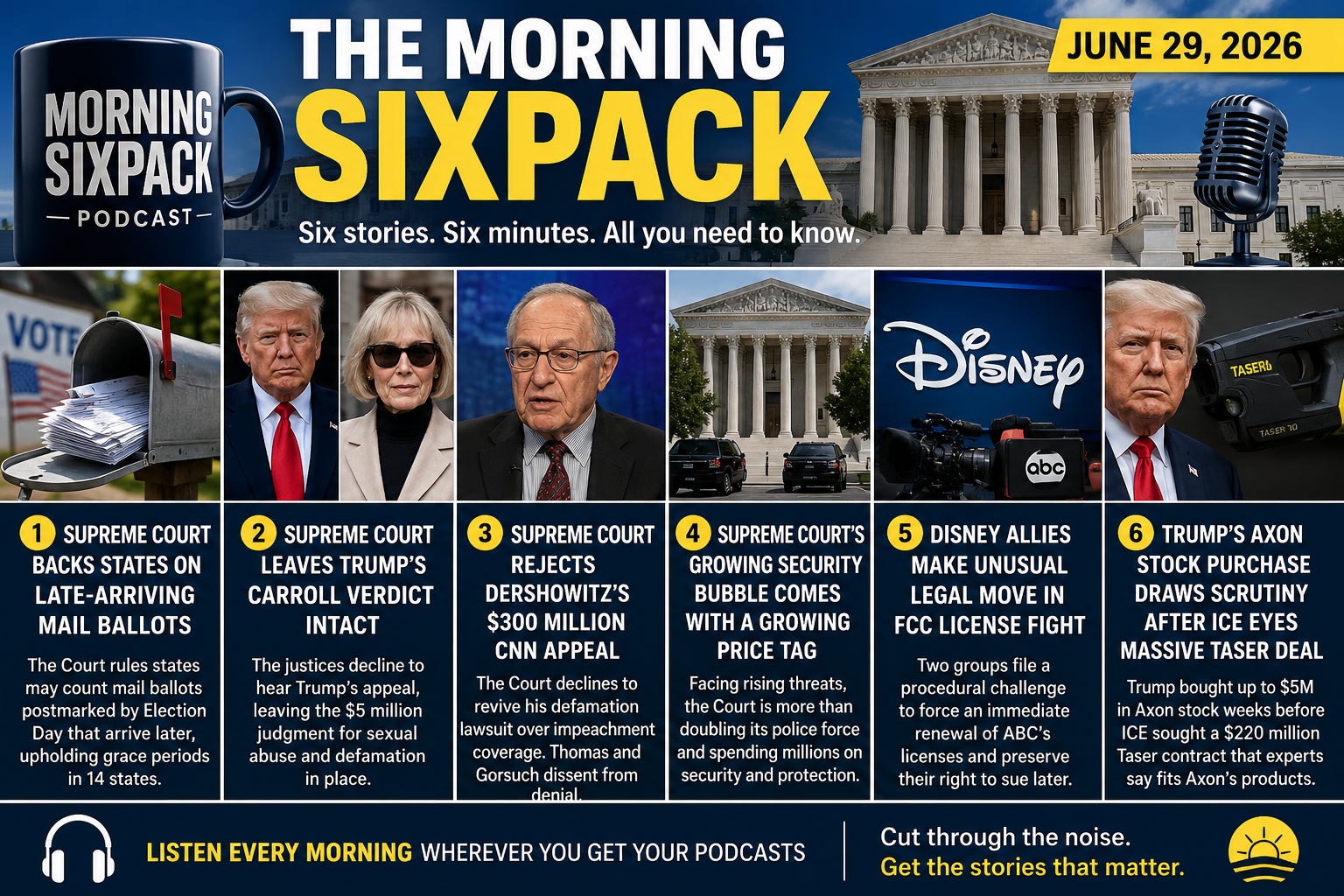
The Supreme Court says states can keep counting mail ballots that were postmarked by Election Day—even if they arrive a few days later. One less election fight settled, which probably means three new ones are already on the calendar.
Supreme Court Backs States on Late-Arriving Mail Ballots
The Supreme Court ruled that states may continue counting mailed ballots that are postmarked by Election Day but arrive days later, rejecting a Republican challenge to state grace periods.
The 5-4 decision keeps election rules in 14 states intact and preserves a system that counted more than 750,000 on-time mailed ballots after Election Day in the 2024 election.
The case centered on Mississippi’s five-business-day grace period for mailed ballots. The Republican National Committee argued federal law requires ballots to be in election officials’ hands by Election Day, but the Court disagreed and upheld state laws allowing ballots mailed on time to be counted after they arrive.
No state permits ballots postmarked after Election Day to be counted. The ruling only applies to ballots that were mailed by Election Day and arrived within state-established grace periods. Around a dozen additional states have similar extensions for military and overseas voters.
The decision is a significant setback for Republican efforts to eliminate post-Election Day ballot counting and leaves existing state grace periods in place unless Congress changes federal law.
Source: The Wall Street Journal article (free)
Editor: Election Day may end on the calendar, but in plenty of states the paperwork gets a few extra business days. Expect this debate to keep showing up every election season. Especially since Trump has instructed the Postmaster to delay mail as long as possible.
The Supreme Court isn’t coming to Donald Trump’s rescue in the E. Jean Carroll case, leaving one of the biggest civil judgments against him firmly in place. Not every appeal gets a second act—especially after two juries have already had their say.
Supreme Court Leaves Trump’s Carroll Verdict Intact
The Supreme Court refused to hear President Donald Trump’s appeal of the $5 million civil judgment stemming from E. Jean Carroll’s sexual abuse and defamation lawsuit, leaving the verdict untouched.
Without a single noted dissent, the justices closed the door on Trump’s latest attempt to erase one of his most high-profile courtroom defeats.
The case stems from Carroll’s allegations that Trump sexually assaulted her in a Bergdorf Goodman dressing room in the mid-1990s. A New York jury found Trump liable for sexual abuse and defamation, awarding Carroll $5 million. While jurors rejected a rape finding, they concluded Trump committed a lesser form of sexual battery and then defamed Carroll by publicly denying her account.1
Trump argued the trial was unfair because jurors heard testimony from two other women who accused him of sexual misconduct and were shown the infamous “Access Hollywood” recording. His attorneys told the Supreme Court, “It is deeply damaging to the fabric of our Republic for President Trump, in the midst of a historic presidency, to have to take his focus away from his singular and unique duties as Chief Executive to continue fighting against decades-old, false allegations and the myriad wrongs throughout this baseless case.”
The ruling affects only the first Carroll case. Trump is separately appealing the $83.3 million judgment from Carroll’s second defamation trial, where the judge ruled the earlier verdict established his liability.
Source: The Hill
Editor: The Supreme Court takes only a tiny fraction of the cases it’s asked to review. This one joins the much larger pile labeled, “The lower court’s decision stands.”
The Supreme Court passed on Alan Dershowitz’s bid to revive his $300 million lawsuit against CNN, leaving one of the toughest standards in American defamation law firmly in place. Some legal battles don’t get a sequel.
Supreme Court Rejects Dershowitz’s $300 Million CNN Defamation Appeal
The Supreme Court declined to revive Alan Dershowitz’s $300 million defamation lawsuit against CNN, leaving lower court rulings in the network’s favor intact.
The Court also declined another opportunity to revisit the landmark legal standard that makes it difficult for public figures to win libel lawsuits against the press.
Dershowitz claimed CNN selectively edited his remarks during President Donald Trump’s first impeachment trial, making it appear he believed a president could justify illegal acts if they helped win reelection. He argued the edited clip made him look like he’d “lost his mind” and sought $300 million in damages.
Lower courts dismissed the lawsuit after finding Dershowitz failed to show CNN acted with “actual malice,” the constitutional standard established by New York Times Co. v. Sullivan. CNN maintained it aired his full comments during its live coverage and later invited him back twice to further explain his position.
Justices Clarence Thomas and Neil Gorsuch dissented from the Court’s decision not to hear the case, arguing the justices should reconsider the decades-old precedent governing defamation claims brought by public figures.
Source: Associated Press
Editor: The “actual malice” standard has survived another challenge. Critics want it reexamined, supporters say it remains one of the strongest safeguards for a free press. For now, the Court isn’t interested in reopening that debate.
The Supreme Court is quietly building a much larger police force as threats against the justices continue to climb. When nine people need an army, maybe it’s worth asking how we got here.
Supreme Court’s Growing Security Bubble Comes with a Growing Price Tag
The Supreme Court is more than doubling its police force and spending tens of millions of taxpayer dollars to protect the justices as threats against the nation’s highest court continue to escalate.
The expanded security is changing not only the Court’s budget—but the everyday lives of the justices themselves, who increasingly live behind armored SUVs, security details, and round-the-clock protection.
The security buildup accelerated after the 2022 attempted assassination of Justice Brett Kavanaugh and years of escalating threats tied to high-profile rulings. Congress has approved tens of millions in additional funding, while the Court plans to expand its police force, add intelligence analysts, cyber specialists, and specialized security units, and establish an off-site command center. The Court’s operating budget has jumped from roughly $98 million in 2022 to a requested $210 million for fiscal year 2027.
The added protection has dramatically changed life for the justices. Justice Clarence Thomas says he no longer attends Nebraska sporting events or takes annual trips with law clerks because of security concerns (which means it’s harder for him to take bribes). Justice Amy Coney Barrett has described adjusting to constant protection after once being sent home wearing a bulletproof vest. Even routine trips to the grocery store now require security escorts.
The growing security apparatus has also drawn criticism from lawmakers, who want greater transparency about the rapidly increasing costs. Some worry the justices are becoming increasingly isolated from the public, interacting mostly with friendly audiences while living what one attorney described as “cloistered lives.”
Source: POLITICO Magazine
Editor: No one should shrug off threats against judges. But when the institution charged with interpreting the Constitution starts looking more like a VIP protection operation, taxpayers are justified in asking how much security is enough—and whether greater isolation comes with its own cost.
Disney’s allies are using an unusual legal strategy to stop the FCC from turning a broadcast license review into a political weapon. Sometimes the best way to oppose a petition is to file one yourself.
Disney Allies Make Unusual Legal Move in FCC License Fight
Two media advocacy groups have filed an unusual petition asking the FCC to immediately renew Disney’s ABC broadcast licenses, positioning themselves to challenge any effort to revoke the licenses or force a political settlement.
The legal maneuver gives Disney’s supporters standing to sue later if they believe the FCC turns a routine license renewal into a political pressure campaign.
The groups, Frequency Forward and the Media Action Center, filed what’s known as a “petition to deny”—normally used to block license renewals—but instead asked the Federal Communications Commission to approve Disney’s applications without conditions. The filing is designed to preserve their ability to challenge the FCC in court if the agency later revokes ABC’s licenses or negotiates what they describe as a backroom deal.
The dispute began after FCC Chairman Brendan Carr ordered an early review of Disney-owned ABC stations, citing concerns about the company’s diversity, equity and inclusion policies. Conservative organizations are expected to argue that alleged political bias on programs such as “The View” and Jimmy Kimmel’s late-night show should also factor into the license review. Disney has called the process politically motivated and says it serves “no legitimate purpose.”
Democratic FCC Commissioner Anna Gomez has also criticized the review, arguing it appears intended to pressure Disney rather than enforce established broadcast regulations.
Source: Raw Story
Editor: Broadcast licenses are supposed to be about whether stations serve the public interest—not whether Washington likes what’s on television. Once regulators start weighing political viewpoints, every network has reason to watch its back.
President Trump bought up to $5 million in Axon stock just weeks before ICE sought a massive new Taser contract that appears tailored to the company. The Trump Regime is the most corrupt presidential apparatus in history.
Trump’s Axon Stock Purchase Draws Scrutiny After ICE Eyes Massive Taser Deal
President Donald Trump’s purchase of up to $5 million in Axon Enterprise stock came just two weeks before Immigration and Customs Enforcement sought a potential $220 million Taser contract that experts say appears designed for Axon’s products.
There is no evidence Trump influenced the procurement or knew about it in advance, but ethics experts say the timing creates the appearance of a conflict that presidents typically try to avoid. And note: The appearance of a conflict is enough when it comes to regular folks; this should be more strongly applied to people in positions of power.
Trump disclosed buying between $1 million and $5 million in Axon shares on Feb. 10. Two weeks later, ICE issued a request seeking roughly 17,800 new Tasers, unlimited cartridges, and training. The request never names Axon, but procurement specialists told CNBC the specifications closely match the company’s Taser 10 system. The contract has not yet been awarded.
The White House says Trump’s assets are held in a trust managed by his children and that investment decisions are made by independent third-party firms. “There are no conflicts of interest,” a White House spokesperson said. Federal law also exempts presidents from the criminal conflict-of-interest rules that apply to most executive branch officials.
Even so, government ethics experts argue the optics are problematic because Axon’s business could benefit from the administration’s expanded immigration enforcement agenda. Beyond Tasers, the company also sells body cameras, cloud storage, evidence management software, and AI-powered policing tools that could see increased federal demand.
Source: CNBC
Editor: The key distinction here is between proof and perception. CNBC found no evidence of wrongdoing, but when government policy and personal investments intersect this closely, the appearance alone is enough to keep ethics watchdogs busy.
Make no mistake: Trump and his goons are cashing in at your expense.
The first E. Jean Carroll trial (yes, there were two, and the story here is about the first one) against Donald Trump was a civil trial in federal court in Manhattan in 2023. Carroll alleged that Trump assaulted her in a Bergdorf Goodman dressing room in the mid-1990s, and that he later defamed her by denying it and saying she fabricated the story.
The jury reached its verdict on May 9, 2023. It found Trump liable for sexual abuse and liable for defamation, but it did not find him liable for “rape” under the then-applicable, narrow New York Penal Law definition. The jury awarded Carroll $5 million total: about $2 million for the sexual-abuse/battery claim and about $3 million for defamation-related damages.
The important distinction is legal wording. Judge Lewis A. Kaplan, who presided over the case, later rejected Trump’s argument that the jury had “cleared” him of rape. Kaplan wrote that the jury only declined to find rape under New York’s narrow technical definition, which required penile vaginal penetration at the time. He said that, in ordinary modern usage, the jury’s finding amounted to rape: the verdict did not mean Carroll failed to prove Trump “raped” her as many people commonly understand the word; rather, Kaplan said, the jury found that Trump “in fact did exactly that.”
In a later ruling dismissing Trump’s counterclaim against Carroll, Kaplan put it even more directly, saying the jury had established that Trump “raped her,” albeit digitally rather than with his penis, and that both acts can constitute rape in common usage and in some legal definitions.
So the clean summary is: the civil jury found Trump liable for sexually abusing and defaming Carroll, not legally liable for rape under New York’s then-narrow statutory definition; Judge Kaplan later said the conduct the jury found was “rape” in the ordinary sense of the word. The verdict was upheld on appeal, and the U.S. Supreme Court declined to hear Trump’s challenge on June 29, 2026, leaving the $5 million judgment in place.