


The Morning Sixpack stays free because the news that shapes your life should not be hidden behind a paywall. Paid subscribers are not paying for access. They are helping fund the research, writing, and independent voice that goes into every issue. Become a paid subscriber and help keep smart, honest news analysis free for everyone.
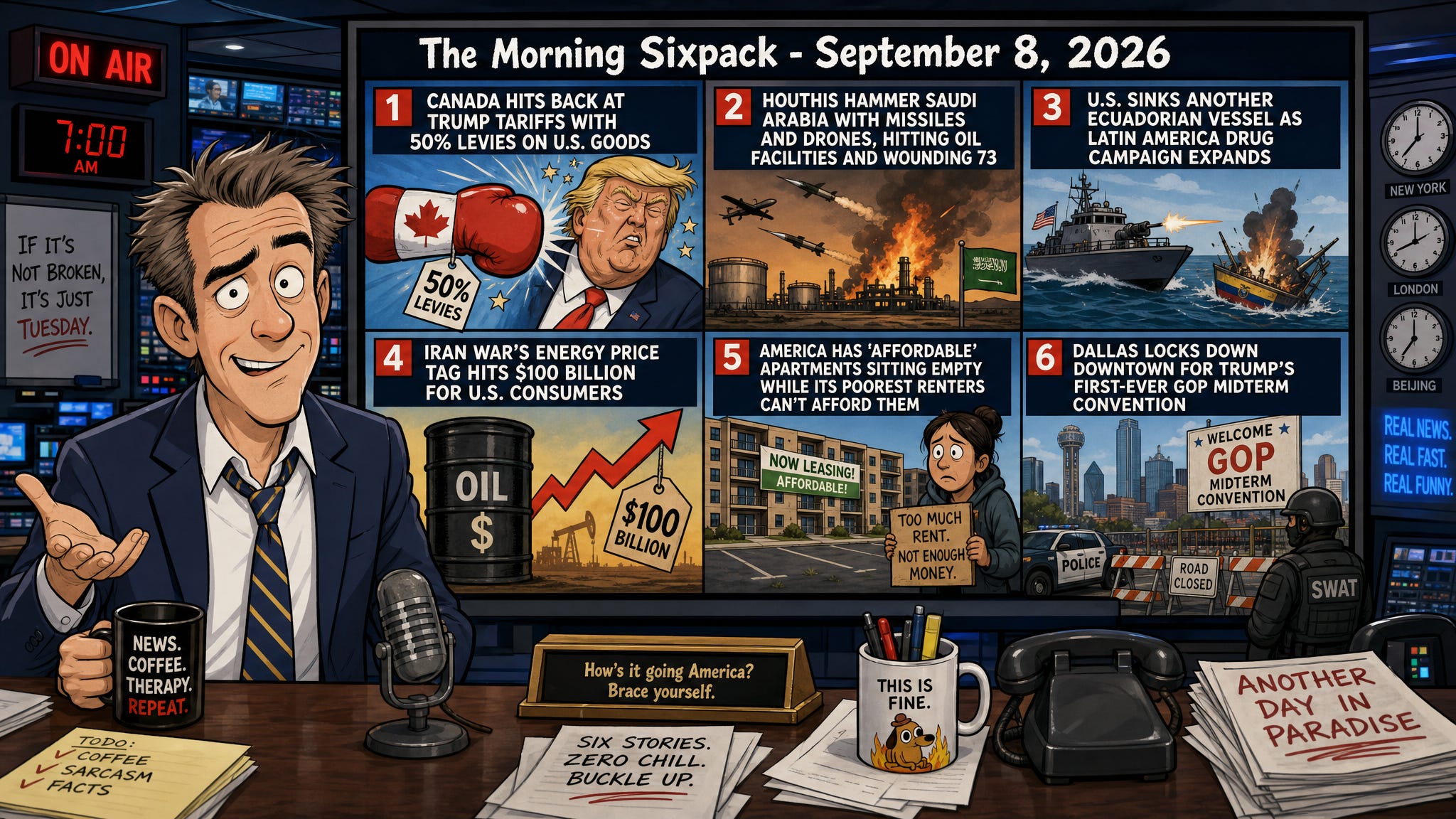
Canada’s answer to another round of U.S. tariffs is tariffs of its own—because apparently North American trade policy now comes with a receipt marked “return to sender.”
Canada is imposing new retaliatory tariffs of 15%, 25%, and 50% on $27.6 billion worth of U.S. imports beginning September 8, matching the latest American tariffs rate-for-rate. The targets range from steel and dairy products to appliances, clothing, and sporting goods, escalating a trade fight that is reaching deeper into everyday commerce.
The tariff war is no longer hovering over factories and trade negotiations—it’s landing directly on products consumers buy.
American milk, certain steel and aluminum products, clothing, and sporting goods including golf equipment face tariffs as high as 50%. Cheese and some appliances are among products facing 25% levies, while other goods will be taxed at 15%. Existing Canadian counter-tariffs on U.S. automobiles will remain in effect.
The Canadian government says the measures are designed to match U.S. tariffs “dollar for dollar, rate for rate.” They follow Washington’s decision to impose a 50% tariff on $27.6 billion of Canadian goods effective August 22. Ottawa says its retaliation is concentrated in sectors particularly affected by U.S. tariffs, including steel and aluminum, dairy, appliances, agricultural equipment, pulp and paper, plastics, and electronics.
The political logic of retaliation may be straightforward, but the economic bill can be considerably messier: Tariffs collected at the border can translate into higher costs for importers and, of course, consumers. Canada does maintain a remission process for exceptional circumstances, including cases where necessary goods cannot reasonably be sourced domestically or outside the United States.
Editor: Washington raises tariffs, Ottawa raises tariffs, and suddenly milk, cheese, golf clubs, and air conditioners have been drafted into international diplomacy. Somewhere, a customs broker is ordering a bigger coffee.
Source: BBC News
The Houthis just reminded the world that the Middle East has another war capable of setting oil facilities—and potentially markets—on fire.
Iran-backed Houthi rebels launched a wave of missile and drone attacks across southern Saudi Arabia Tuesday, wounding 73 people and setting fires at oil facilities and utilities. The strikes mark a major escalation between the Houthis and Saudi Arabia, threatening to reignite a conflict in Yemen that had largely cooled since a 2022 truce.
And this time, the battlefield sits uncomfortably close to an increasingly important route for getting oil to the rest of the world.
Saudi officials said the attacks struck civilian and economic facilities in Abha, Jazan, Najran, and Khamis Mushait. Saudi Arabia’s Energy Ministry said fires broke out at several oil facilities and utilities, forcing temporary shutdowns. The region includes the 400,000-barrel-per-day Jazan refinery, one of the kingdom’s largest. The Houthis claimed they fired dozens of ballistic missiles and drones at oil and economic targets as well as King Khalid Air Base.
The escalation comes as pressure is already mounting on global oil supplies and shipping routes. The Houthis have targeted shipping in and around the Red Sea, while Saudi Arabia has relied on routes connected to the Bab el-Mandeb as an alternative avenue for moving oil while traffic through the Strait of Hormuz has been constrained. Saudi coalition spokesman Maj. Gen. Turki al-Malki called Tuesday’s attacks a “serious escalation” and vowed retaliation. Houthi military spokesman Brig. Gen. Yahya Saree offered his own warning: “Every aggression against our country and people will be met with a firm response.”
The renewed fighting is also reopening wounds from Yemen’s devastating civil war, which has killed at least 150,000 people according to U.N. estimates. Recent clashes have already displaced about 18,500 people in Taiz and Hodeida. International Organization for Migration official Abdusattor Esoev described the human cost plainly: “Families are arriving with nothing: no shelter, no food, no way to know if it’s safe to go back.”
Editor: Missiles hitting oil infrastructure near a critical shipping corridor is the kind of sentence commodities traders read before canceling lunch. Yemen’s war never really disappeared—it just stopped commanding the world’s attention.
Source: Associated Press
The U.S. military sank another Ecuadorian vessel it says supported drug trafficking, making it five targeted in less than two weeks as Washington’s maritime campaign keeps getting bigger.
U.S. Southern Command says it intercepted and sank an Ecuadorian vessel allegedly serving as a floating refueling station for drug trafficking operations in the eastern Pacific. The people aboard were removed before the vessel was destroyed and are expected to be transferred to Ecuadorian authorities.
Five vessels targeted in less than two weeks makes this considerably more than an occasional interdiction.
Southern Command says the vessels were linked to Los Choneros, an Ecuadorian criminal organization the U.S. has designated a foreign terrorist organization. Video released with the latest announcement showed military personnel boarding the vessel, a helicopter overhead, and then a projectile striking and sinking the boat. Ecuadorian authorities had not immediately commented on the latest operation.
The broader campaign has drawn scrutiny over its legality and effectiveness. According to AP, at least 227 people have been killed in 68 U.S. government strikes against boats in the Caribbean and Pacific since the operations began more than a year ago. In at least one previous case, Ecuadorian authorities said they had no evidence that a survivor had participated in criminal activity.
The operations are also moving beyond the water. The Trump administration has pursued agreements with Latin American governments for joint operations against criminal groups on land. AP reports that Defense Secretary Pete Hegseth said Colombia, Guatemala, and Honduras had agreed to such operations, although Guatemala denied reaching such an agreement; Ecuador began similar missions with the U.S. in March.
Editor: When five boats get targeted in less than two weeks and military operations start migrating from sea toward land, the important question isn’t whether the campaign is expanding. It’s how far Washington intends to take it.
Source: Associated Press
The Iran war has now added an estimated $100 billion to Americans’ gasoline and diesel bills, according to Brown University’s tracker—because apparently the gas pump needed its own war correspondent.
U.S. consumers have paid an estimated $100 billion (and counting, by the millisecond) in additional energy costs since the Iran war began February 28, according to Brown University’s real-time energy cost tracker. Axios reports that the meter was adding roughly another $1 million every two minutes as of Monday morning, with the average American household paying more than $760 in additional fuel costs.
That’s $100 billion disappearing through gas pumps and diesel tanks—and the tab is still running.
Brown University’s Climate Solutions Lab calculates the burden by comparing actual gasoline and diesel prices with an estimate of what prices would have been without the war. Back in May, the tracker had already crossed $40 billion, or more than $300 per household. Less than four months later, according to Axios, that figure had climbed to $100 billion.
Diesel may be the bigger economic headache from here. Higher diesel prices don’t stay neatly parked at truck stops—they can feed into freight and transportation costs, which can then affect prices across the economy. Axios reports Texas alone has absorbed about $11 billion of the estimated additional energy costs.
Diesel Breaks 2022's Record as Wars Squeeze Global Fuel Supply

The Morning Sixpack stays free because the news that shapes your life should not be hidden behind a paywall. Paid subscribers are not paying for access. They are helping fund the research, writing, and independent voice that goes into every issue. Become a paid subscriber and help keep smart, honest news analysis free for everyone.
Brown’s researchers have emphasized from the beginning that higher fuel prices represent an economic cost separate from direct military spending. Their May report estimated Pentagon expenditures on the conflict at roughly $29 billion at that point, while fuel costs borne by consumers had already exceeded $40 billion. Now the consumer energy bill has blown through $100 billion, turning the economic consequences of the war into something Americans can watch climb every time they fill the tank.
This is so important to understand: Direct war costs, while high, are nothing like the “tax” Trump has stupidly foisted on the American consumer, dwarfing was costs by 3 to 1.
Editor: Wars come with Pentagon budgets everyone argues about. This one also comes with a rolling surcharge at the gas station—and $100 billion buys one hell of a lot of “I did that” stickers.
Source: Axios
America has millions of people desperate for affordable housing while thousands of apartments officially labeled “affordable” sit vacant—a housing-policy math problem worthy of its own remedial class.
The U.S. has only about 4 million affordable rentals available for 11 million extremely low-income renter households, yet cities including Austin, Denver, and Portland have significant numbers of vacant affordable units aimed at people higher up the income ladder. The disconnect is painfully simple: Much of the housing being subsidized as “affordable” still isn’t affordable to the people who need help most.
We have an affordable-housing shortage and empty affordable apartments at the same time. That takes some doing.
About three-quarters of extremely low-income renter households spend more than half their income on rent and utilities. Yet only about 12% of affordable units financed in 2024 through the federal Low-Income Housing Tax Credit were reserved for these renters. Most were aimed at households earning at least 50% of their area’s median income. As developer Carmen Romero put it: “The math does not lie.” Without substantially more subsidies, she said, developers often can’t make apartments for the lowest-income renters financially workable.
Then there’s the other end of this housing pretzel. Austin has more than 4,500 vacant affordable units, for a vacancy rate approaching 16%. Denver reports a 13% vacancy rate among tax-credit units targeting renters at 60% of area median income and 21% for those at 80%. Portland has more than 1,700 vacant affordable units. In some cases, subsidized rents are getting close enough to market rents that prospective tenants would rather pay a little more and skip the paperwork Olympics required to qualify.
Austin provides perhaps the clearest illustration. The city set a goal of producing 20,000 units for extremely low-income households between 2018 and 2027. As of 2024, it had built just 543. Meanwhile, all 15,000 planned units for households earning 60% to 80% of area median income had been built. For Mathew Davis, who lives in an Austin homeless shelter and previously spent a year living in his car, the objective is considerably less complicated than the financing formulas: “I want to shut the door at night and be able to sleep. I really just want to find the right place.”
Editor: When the country has empty “affordable” apartments and homeless people who can’t afford them, maybe the quotation marks are doing more work than the housing policy.
Source: Associated Press
Dallas is preparing for 20,000 visitors, President Trump, Vice President JD Vance and enough security to make a trip through Victory Park considerably more complicated than grabbing lunch downtown.
Republicans are gathering at Dallas’ American Airlines Center Wednesday and Thursday for the party’s first national midterm convention, bringing an estimated 20,000 attendees and extensive security restrictions to the surrounding downtown area. Checkpoints have been established around Victory Park and the arena, where people entering designated areas by foot or vehicle may be required to show identification or documentation establishing why they are there.
This isn’t a presidential nominating convention—it’s essentially a two-day, arena-sized midterm campaign event.
Trump is scheduled to appear both nights, with Vice President Vance also among the headline speakers. More than 100 Republican House members and candidates are expected to attend, and the program will promote GOP candidates and highlight issues including taxes, health care, immigration, trade, and manufacturing ahead of the November elections. Unlike a traditional presidential convention, there are no delegates selecting a nominee because candidates have already been chosen through the primaries.
The security footprint may be the part Dallas residents notice first. Barricades and checkpoints were already being installed Monday around the American Airlines Center, with screening areas positioned on multiple sides of the venue. Those restrictions are expected to remain through Friday, meaning people who live, work, or travel through the area should expect delays and controlled access.
The Republican National Committee is treating the gathering as a national showcase before the midterms. RNC Chairman Joe Gruters called it a “Trumpapalooza” when announcing the event, while the Texas GOP offered $10,000 packages that included tickets and “honorary delegate” credentials; a free ticket lottery was also offered. Whatever you call it, Dallas is about to find out what happens when the spectacle of a presidential convention gets dropped into the middle of midterm season.
Editor: Twenty thousand visitors, security checkpoints, $10,000 honorary-delegate packages, and two nights at an NBA arena. Apparently midterm campaigning has discovered the stadium tour.
Source: Chron