


The Morning Sixpack stays free because the news that shapes your life should not be hidden behind a paywall. Paid subscribers are not paying for access. They are helping fund the research, writing, and independent voice that goes into every issue. Become a paid subscriber and help keep smart, honest news analysis free for everyone.
The Supreme Court told Trump his midterm mail-ballot overhaul can wait—apparently “weeks before Election Day” is not ideal timing for rebuilding the machinery of democracy.
Supreme Court Blocks Trump’s Mail-Voting Restrictions Ahead of 2026 Midterms
The Supreme Court rejected President Donald Trump’s attempt to impose new restrictions on mail ballots before the November midterms, leaving states free to continue using their existing vote-by-mail systems. The ruling is a significant defeat for Trump on an election issue he has pushed for years, and it comes after ballots have already begun going out in several states.
In other words: The rules of an election already underway won’t be rewritten while voters are voting.
The administration wanted states to use standardized ballot envelopes and upload lists of eligible voters to a federal online portal, with the Postal Service potentially refusing to deliver ballots from states that failed to comply. Election officials argued there simply wasn’t enough time to overhaul their systems before November. Lower courts blocked the plan, and the Supreme Court majority indicated the administration’s effort to impose the restrictions this year was likely to fail legally. Justices Samuel Alito and Clarence Thomas dissented, while Brett Kavanaugh suggested the administration could have a stronger case if the issue returns later.
The practical stakes were enormous, particularly in states heavily dependent on voting by mail. A whistleblower report warned that problems with the still-unfinished federal portal could result in millions of ballots not being sent, including the possibility that a single barcode error could knock out an entire batch. Washington Secretary of State Steve Hobbs said the ruling allows officials to continue conducting “a safe, secure, and accurate election” without having to “upend our election processes to meet unrealistic ballot mail requirements.”
Trump has long attacked mail voting and falsely blamed it for his 2020 defeat, despite repeatedly voting by mail himself. The article cites a 2025 Brookings Institution report finding mail-ballot fraud occurred in roughly four cases for every 10 million ballots cast. That leaves the administration trying to solve an extraordinarily rare problem with a nationwide election overhaul launched practically at the starting gun.
Editor: Nothing screams “election integrity” quite like introducing a brand-new federal system after ballots are already in the mail. The Court, for now, has chosen the radical alternative: Finish the election under the rules everyone already knew.
Source: Washington Post (free)
The Pentagon’s own watchdog says Iran’s attacks cost the U.S. dozens of aircraft, hundreds of damaged structures, and hundreds of wounded troops—which is considerably more “mission accomplished-ish” than Washington had been letting on.
Pentagon Report Reveals Heavy U.S. Aircraft and Base Losses From Iran War
A Pentagon inspector general report says Iranian attacks destroyed or damaged dozens of U.S. aircraft, hit hundreds of buildings and structures across the Middle East, wounded at least 417 American service members, and exposed growing strains on U.S. munitions and military supply chains. The report covers the war from February 28 through June 30 and provides the first official accounting of losses that, according to Al Jazeera, are substantially greater than previously acknowledged.
The biggest revelation isn’t that Iran hit back—it’s how much damage those attacks actually did.
The aircraft tally is substantial: As many as 30 MQ-9 Reaper drones were destroyed, along with at least four F-15Es, an A-10, and four AH-6 helicopters deliberately destroyed after becoming unrecoverable. An F-35A was damaged, as were multiple KC-135 tankers, an E-3 Sentry, helicopters, and other surveillance aircraft. At least 11 U.S. military personnel were reported killed in action, seven died in non-hostile incidents (accidents, medical events, self harm, or environmental factors), and at least 417 were wounded in Iranian attacks through June 30.
The damage wasn’t confined to aircraft. CENTCOM reported that Iranian attacks damaged or destroyed hundreds of buildings and structures at American military installations across Kuwait, Bahrain, Qatar, the UAE, Saudi Arabia, Iraq, Oman, and Jordan. U.S. diplomatic facilities in Iraq, Kuwait, Saudi Arabia, and the UAE suffered an estimated $184 million in damage, including nearly $157 million connected to more than 600 attacks against the U.S. mission in Iraq. The watchdog also identified logistical problems, including “bottlenecks” in supply chains and difficulties supporting forces across the region.
That supply problem may be the politically awkward part. The report says U.S. munitions inventories are under pressure even as Trump has insisted America has “virtually unlimited” ammunition and is producing “more Exquisite and Elite Weapons than at any time in our History.” Whatever one’s view of the war, the Pentagon watchdog’s accounting makes one thing difficult to spin away: Iran demonstrated an ability to impose meaningful costs on American forces and infrastructure across a remarkably wide geographic footprint.
Editor: Turns out “we intercepted the attacks” and “here’s the bill for dozens of aircraft and hundreds of damaged structures” can coexist in the same war. The Pentagon’s accountants have now entered the chat.
Source: Al Jazeera
The Houthis waited while the Iran war consumed everyone’s attention, then grabbed a strategic Red Sea chokepoint and crushed a critical pipeline.
Houthis Seize Crucial Red Sea Oil Chokepoint in Lightning Yemen Offensive
Yemen’s Iran-backed Houthis seized the port city of Mokha and strategically vital Perim Island, giving the group control over a critical position in the Bab al-Mandeb Strait and putting another major global energy corridor at risk. The offensive came after months of preparation and exploited divisions among the Houthis’ Yemeni opponents and their Saudi and Emirati sponsors while attention was focused on the wider war with Iran.
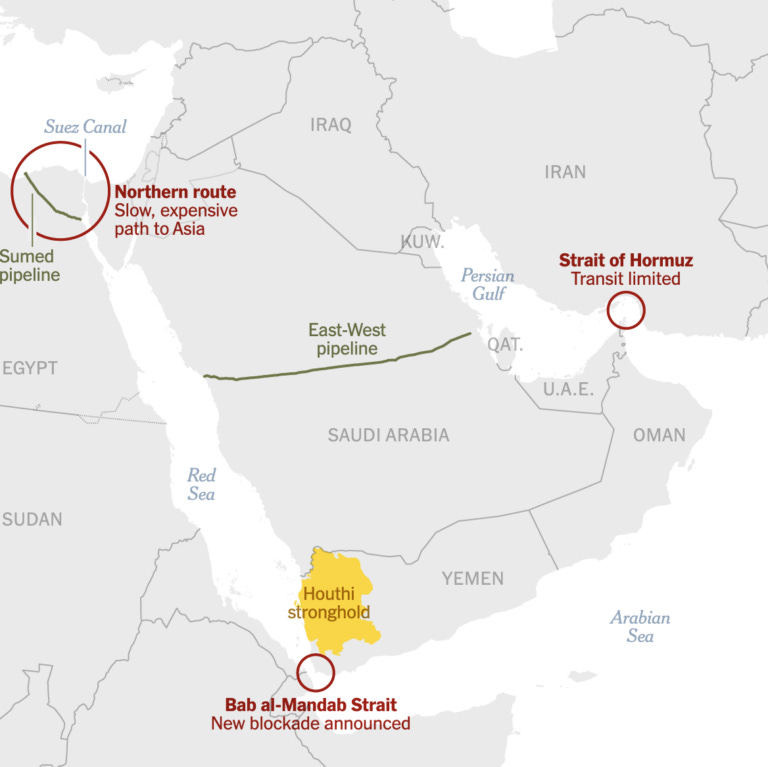
With the Strait of Hormuz already under pressure, the world now has another oil chokepoint sitting within reach of an Iran-aligned force.
The Houthis reportedly moved thousands of troops and weapons around Mokha beginning in August, then used their control over Yemeni telecommunications to monitor opponents, spread confusion, and intimidate rival forces. They captured Mokha on Thursday and Perim Island the following day. The island sits in the middle of the roughly 18-mile-wide Bab al-Mandeb, the gateway connecting the Red Sea to the Gulf of Aden.
“They feel they’ve won the civil war,” Yemen expert Elisabeth Kendall told the Journal. “They aren’t afraid of the United States, and most importantly they’re pretty adaptive.”
Helping the Houthis was an opposition that looks less like an army than a committee meeting with artillery. A dispute between Saudi Arabia and the UAE fractured the anti-Houthi coalition, and the UAE withdrew from the war. Yemen analyst Mohammed al-Basha summed up the imbalance neatly: “The Houthis have one leader, one ideology, and a clear vision. The anti-Houthi forces have eight armies and multiple commands.” Saudi Arabia, already focused on Iran, reportedly declined pleas from anti-Houthi forces for air support as the offensive unfolded.
The consequences extend far beyond Yemen. Saudi oil exports are already threatened by fighting around the Strait of Hormuz, and disruption at Bab al-Mandeb could further squeeze energy supplies and push oil prices higher. Removing the Houthis from Perim Island could drag outside powers back into Yemen, yet even losing the island wouldn’t eliminate the threat: The group retains missiles and drones capable of targeting Red Sea shipping. As Kendall put it, “They are always going to be able to hold bits of the Red Sea to ransom. The world only pays attention when it affects their wallets.”
Editor: While the region’s bigger players were busy watching Iran, the Houthis quietly upgraded themselves from Yemen problem to global-energy problem. Geography remains undefeated—and unfortunately, the Houthis appear to have read the map.
Source: The Wall Street Journal (free)
Iran’s foreign minister is heading to Beijing as China pushes for a ceasefire and reopening the Strait of Hormuz—because apparently the diplomatic table is now being set in China.
Iran’s Foreign Minister Heads to China as Beijing Steps Into the Iran War
Iranian Foreign Minister Abbas Araqchi will travel to China on September 16 for talks with Chinese Foreign Minister Wang Yi, putting Beijing more directly into the diplomatic maneuvering surrounding the Iran war. China has called for a ceasefire and negotiated settlement that protects Iranian sovereignty and reopens the Strait of Hormuz, a critical artery for global energy supplies.
With Washington and Tehran still trading blows, Iran is taking its case to the one major power with both enormous economic exposure to the conflict and significant diplomatic leverage.
China’s Foreign Ministry announced that Wang will hold talks with Araqchi during Wednesday’s visit. Beijing is diplomatically aligned with Tehran but also has a powerful economic incentive to cool things down: Continued instability in the Middle East and disruption around Hormuz threaten energy supplies and global trade. The visit comes as Iran’s ability to inflict damage on American forces has become clearer, with a Pentagon report documenting extensive damage to U.S. bases, aircraft losses, and growing pressure on American munitions inventories.
There’s also an increasingly complicated U.S.-China subplot. President Donald Trump on Sunday rejected a Wall Street Journal report that China supplied Iran with satellite imagery of a U.S. base in Jordan that assisted an Iranian attack that killed three American troops in July. That allegation now hangs over the Araqchi-Wang talks, even as Beijing publicly advocates negotiations rather than an expansion of the war.
And the diplomatic calendar makes Araqchi’s trip especially interesting: Trump is expected to meet Chinese President Xi Jinping in the United States on September 24, although Beijing has not yet confirmed that meeting. That gives China an opportunity to hear directly from Tehran before any Trump-Xi encounter—and potentially position itself as an intermediary between two governments that aren’t exactly exchanging holiday cards.
Editor: Araqchi going to Beijing eight days before a possible Trump-Xi meeting isn’t just another diplomatic road trip. China gets to hear Iran’s pitch first, then potentially sit across from Trump with considerably more information in its pocket.
Source: CNBC
A 16-year-old San Francisco boy died after taking a synthetic opioid authorities say can be 10 times stronger than fentanyl and invisible to fentanyl test strips.
San Francisco Teen Dies in City’s First Fatal Cychlorphine Overdose
The death of 16-year-old Dante Lacourte has become San Francisco’s first fatal overdose linked to cychlorphine, a synthetic opioid health officials estimate is 10 times more potent than fentanyl and cannot be detected by fentanyl test strips. Lacourte was found dead by his mother at their Lower Nob Hill home on April 7, launching a police investigation into where the pills came from and who supplied them.
Even a fraction of a counterfeit pill containing this drug can be fatal.
Police searched Lacourte’s phone, identified suspected sources of the pills, and conducted controlled drug purchases before serving warrants. San Francisco police subsequently arrested four suspected dealers and searched three residences. During searches connected to two suspects, officers said they seized approximately 20,000 pills containing suspected fentanyl, counterfeit Xanax, oxycodone, hydrocodone, and cyclobenzaprine, along with MDMA, black tar heroin, firearms, and cash. All four suspects face multiple drug-related charges.
The frightening wrinkle is cychlorphine itself. San Francisco’s Department of Public Health said, “Even a fraction of a counterfeit pill can kill someone.” Police have since retested counterfeit pills from earlier cases and found some containing cychlorphine, suggesting the substance may have been circulating before authorities knew exactly what they were dealing with. Investigators are now working with the FDA to determine whether pills seized in the latest searches also contain the synthetic opioid.
Behind all those drug names and police seizures is a 16-year-old kid. His family described Lacourte as a former gymnast who loved performing aerial stunts while skiing. That’s worth remembering because “first cychlorphine overdose” sounds like a statistic until you remember what created it: A teenager went home with a pill, his mother later found him dead, and an entirely new drug threat suddenly had a name.
Editor: Counterfeit pills were already Russian roulette with fentanyl in the chamber. Now authorities are finding something potentially far more potent that the standard fentanyl test strip can’t even see. That’s not a new drug trend. That’s a new layer of horror.
Source: KRON4
WIRED’s book excerpt argues Silicon Valley’s Trump turn grew from a potent cocktail of layoffs, regulation, worker activism, and bruised billionaire egos.
How Silicon Valley’s Tech Bust Helped Drive Billionaires Toward Trump
A new book excerpt published by WIRED argues that Silicon Valley’s political shift toward Donald Trump accelerated after the pandemic tech boom collapsed, mass layoffs changed the balance of power between workers and executives, and the Biden administration adopted a tougher approach toward Big Tech. Authors Js Tan and Clarissa Redwine portray the transformation as more than ordinary partisan politics: They argue that executives facing pressure from regulators and their own increasingly activist employees began viewing politics as another battlefield over corporate control.
The authors’ thesis is that Silicon Valley didn’t simply move right—it went looking for political protection after discovering that workers, regulators, and politicians were no longer reliably on its side.
The economic reversal was dramatic. Pandemic demand and cheap money fueled enormous hiring, with Amazon and Facebook nearly doubling their head counts between 2019 and 2022. Then interest rates rose, tech valuations cratered, and layoffs followed: Nearly 93,000 U.S. tech workers were fired in 2022 and more than 191,000 in 2023, according to figures cited in the excerpt. Executives increasingly emphasized efficiency and productivity, while investors frequently rewarded layoffs with higher share prices. The authors contend that what began as economic retrenchment evolved into a longer-lasting strategy for restoring management’s leverage over employees.
Politics supplied the other half of their argument. Progressive politicians including Bernie Sanders, Elizabeth Warren, and Alexandria Ocasio-Cortez attacked Big Tech over monopoly power and other concerns, while the Biden administration pursued antitrust actions and greater scrutiny of cryptocurrency and AI. At the same time, tech employees organized unions and challenged management over military contracts, fossil-fuel partnerships, and workplace issues. Venture capitalist Marc Andreessen described employees in a 2025 interview as “going feral” and said some companies had feared “full-blown violent riots” on their campuses during Trump’s first term. The excerpt presents that combination of external regulation and internal worker resistance as central to the political (d)evolution of some tech executives and investors.
The piece is an excerpt from Tan and Redwine’s Against Tech Oligarchy: Worker Resistance in the World’s Most Powerful Industry, so its broader conclusions are the authors’ argument rather than neutral findings established by WIRED. Their case is that regulatory conflict, cultural disputes, employee activism, and the post-pandemic economic reckoning combined to push parts of Silicon Valley toward Trump’s coalition. Whatever weight one gives each factor, the political relationship between the tech industry and Washington clearly changed—and this book argues the story begins as much inside Silicon Valley’s workplaces as inside the voting booth.
Editor: The authors’ version of Silicon Valley’s political awakening has an unmistakable subplot: The people accustomed to disrupting every other industry became considerably less enthusiastic when employees and regulators started disrupting them. And Marc Andreessen is a chud.
Source: WIRED