


🛫 The Trip to Jonestown
In late November 1978, U.S. Congressman Leo Ryan, a Democrat from California, became involved in investigating the controversial People’s Temple, a religious cult led by Jim Jones. Ryan was concerned about reports of abuse, coercion, and mistreatment of the members of the group, who had relocated to a remote commune in Jonestown, Guyana, under Jones’s control.
Ryan, who represented California’s 11th district, was known for his advocacy for human rights. When several people began escaping the compound, claiming they were being held against their will, he decided to take action.
🚁 The Congressional Delegation to Jonestown
Ryan, along with a small delegation of aides and journalists, flew to Jonestown on November 17, 1978. Their goal was to investigate the allegations and meet with Jones’s followers. Ryan was accompanied by a team including reporter Greg Robinson, photographer Charles Krause, and Temple defectors, including a few who had managed to escape and sought help from the U.S. embassy. Future long-time Congresswoman Jackie Speier was on the trip as well. More on her below.
Upon arrival, Ryan and his team were initially met with a warm welcome, though it quickly became apparent that things were not as they seemed. The conditions in Jonestown were harsh, and many of the residents seemed disillusioned or afraid, confirming the reports of abusive behavior and manipulation by Jones.
🏃♂️ The Escape Attempts
During the visit, a handful of Temple members tried to flee, some asking for help to leave the compound. This was a turning point. A few members—those who were able to escape—started to openly beg for help, signaling that they were trapped under Jones’s tyrannical rule. As Ryan was preparing to leave, a group of defectors tried to escape with him, but it was clear that they wouldn’t leave Jonestown unscathed.
💥 The Murder of Leo Ryan
On the day of their departure, November 18, 1978, tragedy struck. As Ryan and his group were boarding a plane at the nearby airstrip in Port Kaituma, they were ambushed by gunmen. The gunmen were part of Jim Jones’s inner circle, and they opened fire on the group, killing Congressman Leo Ryan, three journalists (Greg Robinson, Charles Krause, and photographer Bob Brown), and one defector. Ryan had been a beacon of hope for the people inside Jonestown, and his murder sent shockwaves through the world.
🍹 The Mass Suicide: “Drinking the Kool-Aid”
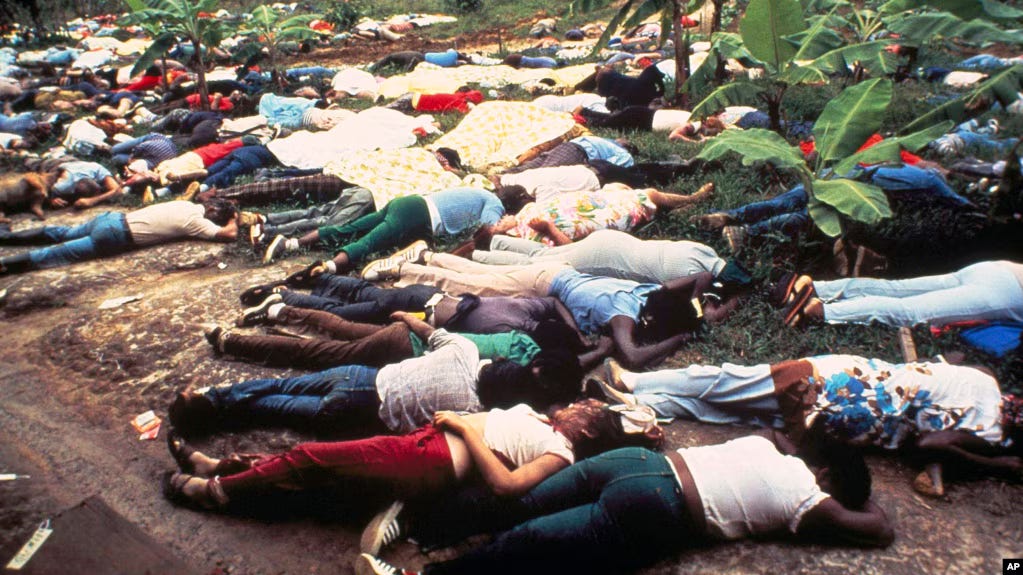
Following the assassination of Ryan, Jim Jones ordered his followers to commit mass suicide. In a chilling speech, Jones described how the U.S. government would come to punish them for their actions, and he advocated for a “revolutionary suicide” as a way to avoid capture and persecution.
Approximately 918 people, including children, followed Jones’s orders and ingested cyanide-laced fruit punch, a mass murder disguised as a suicide. The phrase “drinking the Kool-Aid” emerged from this tragedy, though it’s often misused today in popular culture to describe blind obedience to a cause or leader.
Jim Jones, who orchestrated the deaths, was found dead from a gunshot wound in what many believe was a suicide, though some speculate it was a murder carried out by his loyal followers. The massacre remains one of the largest mass suicides in modern history.
🎗️ Legacy of Leo Ryan and Jonestown
Leo Ryan’s assassination and the Jonestown massacre had profound impacts. Ryan is remembered as a hero who stood up for human rights, even at the cost of his life. His death led to increased scrutiny of cults and prompted the U.S. government to implement stronger laws surrounding cults and religious organizations, including the introduction of new immigration and cult-related laws.
The tragedy also served as a sobering reminder of the dangers of unchecked authoritarian power, psychological manipulation, and blind loyalty to a leader. Jim Jones’s control over the People’s Temple members was absolute, and their deaths underscore how destructive charisma and manipulation can be when wielded by someone with a power-hungry agenda.
🧑⚖️ Jackie Speier: Survivor, Advocate, and Political Powerhouse
Jackie Speier, who would later become a prominent political figure, was directly affected by the Jonestown massacre in a way few people could imagine. In 1978, Speier was serving as a staffer for Congressman Leo Ryan, who led the ill-fated mission to Jonestown. Speier was accompanying Ryan and the delegation when the gunmen ambushed their group at the Port Kaituma airstrip.
She was shot five times during the attack—once in the arm, once in the stomach, and three times in the legs. Miraculously, she survived, though her wounds were severe, and she would spend months in recovery. During this traumatic experience, Speier showed incredible strength and resilience, and her survival became a symbol of her future commitment to justice and public service.
Speier’s near-death experience had a profound effect on her political career. After her recovery, she would go on to become a U.S. Congresswoman, known for her tireless advocacy for women’s rights, sexual assault victims, and military reforms. She used her platform to address issues like sexual harassment in the military and the importance of protecting human rights.
Leo Ryan’s assassination and the Jonestown massacre are woven into Jackie Speier’s personal story. The tragedy not only took Ryan’s life but also shaped the future of Speier, who emerged as a courageous survivor and one of the most passionate human rights advocates in the U.S. House of Representatives.
Praying for the safe return of Senator Van Hollen and all the men unjustly imprisoned in El Salvador!