



The Morning Sixpack stays free because the news that shapes your life should not be hidden behind a paywall. Paid subscribers are not paying for access. They are helping fund the research, writing, and independent voice that goes into every issue. Become a paid subscriber and help keep smart, honest news analysis free for everyone.
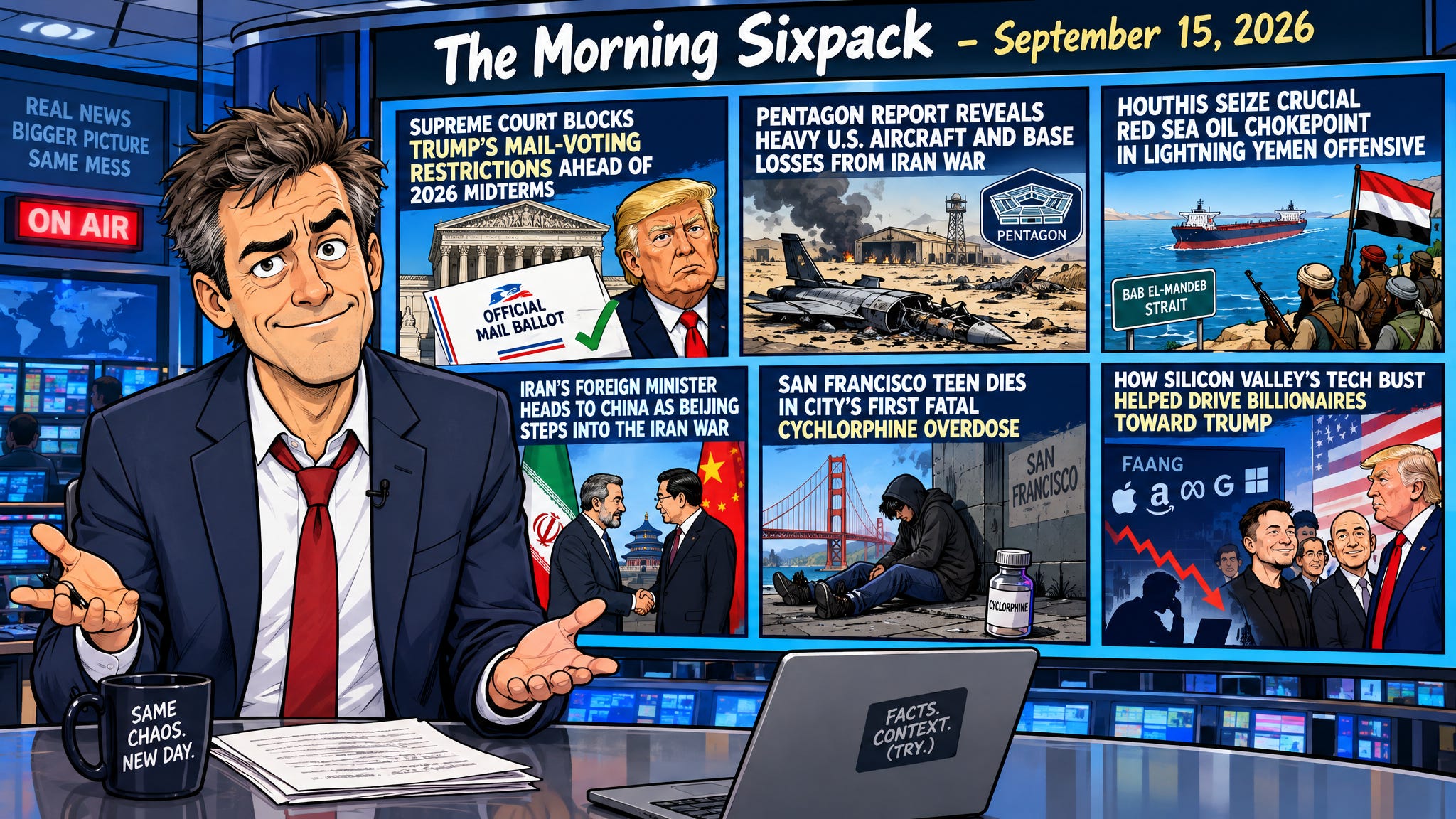
Grab your coffee, because today’s lineup ranges from the Supreme Court to a Beijing summit to a warning every parent needs to hear.
The Supreme Court told Trump his midterm mail-ballot overhaul can wait, leaving states free to run their existing vote-by-mail systems just weeks before the 2026 midterms. The administration wanted standardized envelopes and a federal voter-upload portal, backed by the threat of the Postal Service refusing noncompliant ballots, but election officials said there simply wasn’t time, and the Court agreed the plan was likely to fail legally. Justices Alito and Thomas dissented, while Kavanaugh left the door open for a future fight. With a whistleblower warning that a single barcode error could knock out an entire batch of ballots, and mail-ballot fraud occurring in roughly four cases per 10 million ballots cast, the ruling lets officials finish this election under rules everyone already knows. Source: Washington Post (free)
A Pentagon inspector general report has revealed that Iran’s retaliatory strikes cost the U.S. far more than previously acknowledged, including dozens of destroyed or damaged aircraft, hundreds of damaged buildings, and hundreds of wounded troops. As many as 30 MQ-9 Reaper drones were destroyed, along with F-15Es, an A-10, and multiple helicopters, while at least 11 troops were killed in action and 417 wounded through June 30. Diplomatic facilities across the region absorbed an estimated $184 million in damage, and the watchdog flagged real strain on U.S. munitions supply chains, even as Trump insists America’s weapons stockpiles are “virtually unlimited.” The numbers make one thing hard to spin away: Iran managed to impose real costs on American forces across a remarkably wide footprint. Source: Al Jazeera
Yemen’s Iran-backed Houthis pulled off a lightning offensive, seizing the port city of Mokha and the strategically vital Perim Island, handing them control of a key position in the Bab al-Mandeb Strait. They exploited months of planning, a fractured Saudi-UAE coalition, and their grip on Yemeni telecoms to outmaneuver a badly divided opposition, described by one analyst as “eight armies and multiple commands” against the Houthis’ single unified command. With the Strait of Hormuz already under pressure, the world now faces a second Iran-aligned chokepoint threatening global oil shipping, and even retaking Perim Island wouldn’t eliminate the group’s ability to threaten Red Sea traffic with missiles and drones. Source: The Wall Street Journal (free)
Iran’s Foreign Minister Abbas Araqchi is heading to Beijing to meet his Chinese counterpart, pulling China more directly into the diplomacy surrounding the Iran war. China has called for a ceasefire that protects Iranian sovereignty and reopens the Strait of Hormuz, motivated by its own massive economic exposure to Middle East instability. The trip is complicated by Trump’s recent denial that China supplied Iran with satellite imagery used in a deadly July attack on U.S. troops, and by timing: it comes just eight days before Trump is expected to meet Chinese President Xi Jinping, giving Beijing a chance to hear Iran’s position before sitting down with Washington. Source: CNBC
A 16-year-old San Francisco boy’s death has become the city’s first confirmed fatal overdose linked to cychlorphine, a synthetic opioid estimated to be 10 times more potent than fentanyl and invisible to standard fentanyl test strips. Dante Lacourte was found dead by his mother in April, triggering a police investigation that led to four arrests and the seizure of roughly 20,000 counterfeit pills, along with fentanyl, MDMA, heroin, firearms, and cash. Health officials warn that even a fraction of a counterfeit pill containing cychlorphine can be fatal, and retesting of pills from earlier cases suggests the drug may have been circulating undetected for some time. Behind the drug names and seizures is a teenager remembered by his family as a former gymnast who loved aerial ski stunts. Source: KRON4
A new book excerpt from Js Tan and Clarissa Redwine argues that Silicon Valley’s shift toward Trump grew out of the postpandemic tech bust, mass layoffs, and a tougher regulatory and labor climate. Tech companies overhired during the pandemic boom, then shed nearly 93,000 jobs in 2022 and over 191,000 in 2023 as investors rewarded layoffs with higher stock prices. Meanwhile, progressive lawmakers pushed antitrust action and increased scrutiny of AI and crypto, while employees organized unions and pushed back on military contracts, prompting venture capitalist Marc Andreessen (chud) to describe workers as “going feral.” The authors argue the resulting squeeze from both regulators and employees is what really pushed parts of the industry toward Trump’s coalition. Source: WIRED
From a stalled ballot overhaul to a strait falling into new hands, today’s stories are a reminder that the machinery of power, whether electoral, military, or economic, rarely stays still for long.
Prefer to read The Morning Sixpack? Do that here:


