


The Morning Sixpack stays free because the news that shapes your life should not be hidden behind a paywall. Paid subscribers are not paying for access. They are helping fund the research, writing, and independent voice that goes into every issue. Become a paid subscriber and help keep smart, honest news analysis free for everyone.
Republicans had the money, the maps, and the machinery to win the midterms. Unfortunately for them, they also had Donald Trump.
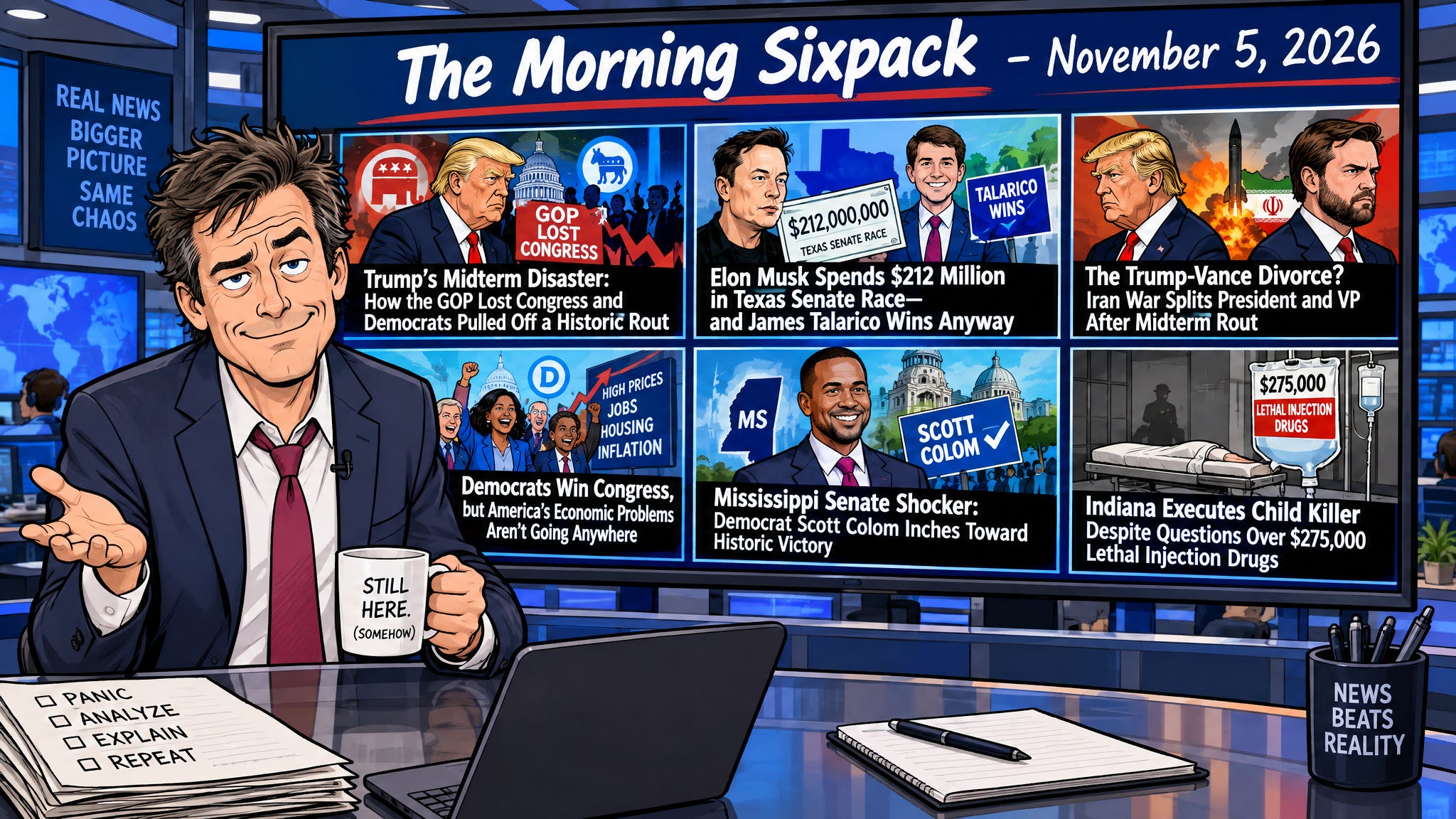
Trump’s Midterm Disaster: How the GOP Lost Congress and Democrats Pulled Off a Historic Rout
President Donald Trump’s Republican Party suffered a historic defeat in the 2026 midterm elections, losing control of both the House and Senate as Democrats swept through traditional Republican strongholds. The GOP is on track to lose the national congressional popular vote by approximately 13 percentage points, potentially its worst midterm performance in half a century. According to an extensive New York Times investigation involving more than 70 political insiders, the collapse resulted from an unpopular war with Iran, rising consumer prices, questionable candidate choices, and a president increasingly disconnected from voters’ concerns. Six days before Election Day, Trump’s top strategists were already joking privately about funeral arrangements, presidential pardons, and fleeing the country. They knew what was coming.
The war in Iran proved particularly devastating for Republicans, turning Trump’s promise to avoid new foreign conflicts into a political liability. The prolonged fighting closed the Strait of Hormuz, pushed gasoline prices above $4 per gallon, and drove inflation higher. Internal Republican polling showed Democrats gaining a 10-point advantage by July, with strategists warning that the GOP could lose the Senate unless the fighting stopped and fuel prices declined. A potential diplomatic breakthrough negotiated by Vice President JD Vance collapsed under pressure from Republican Iran hawks, allowing the conflict to drag into Election Day. Meanwhile, Trump’s tariffs continued hurting American farmers, corruption allegations dogged his administration, and voters watched the president devote attention to White House renovations while household expenses climbed.
Democrats capitalized on Republican vulnerabilities by recruiting strong candidates and focusing relentlessly on affordability, government corruption, and Trump’s broken promises. Senate Democratic leader Chuck Schumer persuaded former North Carolina Governor Roy Cooper and former Ohio Senator Sherrod Brown to run, and both won. Democrats also captured Senate seats in previously unlikely states, including South Carolina and Texas, where Trump-backed Republican Ken Paxton lost by 12 points despite nearly $300 million in Republican spending. In House races, Democrats recruited military veterans, farmers, doctors, and other candidates with backgrounds outside professional politics, enabling them to compete in districts Trump had carried comfortably in 2024. Republican efforts to redraw congressional districts in their favor were countered by Democratic redistricting initiatives and ultimately overwhelmed by the scale of the electoral backlash.
Trump’s personal involvement repeatedly complicated Republican efforts to defend their congressional majorities. His pressure on Republican senators helped push Joni Ernst of Iowa and Thom Tillis of North Carolina into retirement, creating competitive open seats. He backed controversial candidates over more established Republicans, including Paxton in Texas, while delaying approval of spending from his roughly $400 million political operation until late summer. That hesitation forced Republican groups to purchase advertising at dramatically higher prices than Democrats who had reserved airtime earlier. At a September Republican convention in Dallas, Trump unexpectedly proposed sending $5,000 to every American adult if Republicans won—an announcement that caught even senior party leaders off guard and subsequently proved ineffective in internal polling.
By the final weeks, Republican strategists were diverting resources from familiar battlegrounds to defend seats in Kansas, South Carolina, and Mississippi, where Democrats had previously faced enormous disadvantages. Even Elon Musk’s spending of more than $450 million to support Republicans could not reverse the political tide. Democrats expanded their House campaign into deeply Republican districts, while Hakeem Jeffries positioned himself to become the first Black speaker of the House in American history. The New York Times investigation portrays a Republican operation crippled by internal disagreements, expensive strategic mistakes, and a president whose political instincts failed to recognize the depth of public dissatisfaction. During one private strategy call, Trump adviser James Blair offered a concise assessment: “I have seen the enemy, and it is us.”
Editor: Republicans spent hundreds of millions trying to overcome the political damage caused by their own president. Trump promised cheaper living, no new wars, and a government that would put Americans first. Instead, voters got higher prices, a prolonged war, and a president preoccupied with his personal projects. Democrats didn’t have to invent a case against the GOP. Trump spent two years building it for them.
Source: The New York Times
Elon Musk poured at least $212 million into a Texas Senate race to elect Ken Paxton. Texas voters decided they had other plans.
Elon Musk Spends $212 Million in Texas Senate Race—and James Talarico Wins Anyway
Democrat James Talarico defeated Republican Attorney General Ken Paxton in the most expensive Senate race in American history, becoming the first Democrat to win a statewide election in Texas in 32 years. The 37-year-old state representative pulled off the victory despite at least $212 million in spending by Elon Musk to support Paxton. Talarico built his campaign around government corruption, economic inequality, and the influence of billionaire political donors, making Musk himself a central target. His victory brought Democrats another seat closer to controlling the Senate and demonstrated that even extraordinary campaign spending cannot guarantee an election result.
Musk’s massive financial intervention became one of the defining issues of the campaign, reinforcing Talarico’s argument that wealthy donors were trying to purchase political influence. Outside groups funded overwhelmingly by Musk saturated Texas with advertisements attacking Talarico over immigration, transgender rights, and other contentious issues. Some ads accused the Democrat of wanting to ban meat or force gender-transition surgeries on minors, claims presented as attacks rather than established facts. Musk also used his social media platform, X, to warn that Talarico’s immigration policies would undermine American democracy. But the spending ultimately helped illustrate the very problem Talarico was campaigning against: billionaires exercising enormous influence over American politics.
Paxton, meanwhile, proved an unusually vulnerable Republican candidate in a state his party had dominated for decades. After defeating incumbent Senator John Cornyn in the Republican primary runoff, the scandal-plagued attorney general largely avoided interviews and refused to debate Talarico. His limited public campaigning left outside organizations to conduct much of the political battle on his behalf. Talarico took advantage by portraying Paxton as an example of a political system serving wealthy benefactors rather than ordinary Texans. His message connected government corruption to rising living costs, arguing that powerful donors and their political allies had shaped economic policies to benefit themselves.
Musk’s involvement carried particular significance because of his extensive business interests in Texas, including operations near Austin and Brownsville and his interest in acquiring control of state parkland. In the final weeks of the campaign, Paxton’s office also sued OpenAI and its chief executive, Sam Altman, a major Musk rival, alleging inadequate safeguards for ChatGPT. Talarico increasingly challenged Musk directly, accusing him of seeking control over Texas land, water, public resources, and political representation. “He wants his very own personal United States senator,” Talarico told voters. His populist message did not depend on embracing democratic socialism; he maintained pragmatic positions on border security and fossil fuel production while challenging the influence of concentrated wealth.
The election represented a major political breakthrough for Texas Democrats and a costly defeat for Musk’s political ambitions. Talarico’s campaign successfully combined criticism of corruption with an economic message aimed at voters frustrated by the influence of powerful donors. Paxton’s personal controversies, limited campaign appearances, and dependence on outside spending left Republicans defending a candidate whose weaknesses became increasingly difficult to overcome. Despite an unprecedented financial commitment, Musk could not deliver the Senate seat for his preferred candidate. Talarico’s victory offered a clear demonstration that a candidate willing to confront billionaire influence can turn an opponent’s financial advantage into a political liability.
Editor: Elon Musk spent $212 million trying to elect a senator who would represent his interests, and Texas voters handed him a very expensive rejection. Talarico made the billionaire’s spending part of the campaign itself—and it worked. Maybe the lesson here is that voters don’t particularly appreciate being treated like another corporate acquisition.
Now it’s time for Congress to nationalize Space-X and send Musk back to where he came from. He can move Tesla to South Africa. We don’t care.
Source: Mother Jones
JD Vance spent election night watching Republicans lose Congress alongside Donald Trump. By the next morning, he was publicly blaming the president’s war in Iran.
The Trump-Vance Divorce? Iran War Splits President and VP After Midterm Rout
Vice President JD Vance publicly broke with President Donald Trump over the war in Iran following Republicans’ devastating midterm election losses, blaming the conflict for the party’s defeat in both chambers of Congress. After watching the election results unfold alongside Trump at the White House, Vance issued an unusually direct criticism of the administration’s military campaign. “The reason we lost is the war,” he wrote on social media, arguing that Republican voters were angry about rising energy prices and the administration’s departure from its America First agenda. The comments exposed a policy disagreement that had been building privately for months, even as Vance continued publicly defending the administration. For a vice president whose political career has been closely tied to Trump, the public disagreement marked a significant departure from their usual united front.
The disagreement extends well beyond election-night finger-pointing, reflecting months of internal White House debate over whether to continue fighting Iran or negotiate an end to the conflict. Vance, who was assigned to lead peace negotiations, had privately raised concerns that the war could continue through the remainder of Trump’s presidency. During a September Situation Room meeting, senior officials discussed the political damage caused by ongoing military operations and agreed that publicizing additional strikes could hurt Republican candidates. Trump subsequently approved an approach that kept smaller military actions largely out of the spotlight. Meanwhile, Defense Secretary Pete Hegseth reportedly continued advocating military pressure, frequently finding himself at odds with Vance, Secretary of State Marco Rubio, and others who favored negotiations.
Trump acknowledged that the war contributed to Republican losses but defended his decision to launch it. He conceded that the conflict had increased gasoline prices, while maintaining that preventing Iran from obtaining a nuclear weapon justified the military campaign. Vance framed the issue differently, suggesting that Americans deserved an honest accounting of whether the war’s costs—including losing Senate control for six years—were worthwhile. Despite the disagreement, Trump publicly praised Vance’s statement, saying, “I thought it was good,” and acknowledged that he had long understood his vice president’s opposition to the conflict. The president also said he had no plans to replace Hegseth or make broader cabinet changes before Democrats take control of Congress in January.
Inside the administration, the debate over Iran’s future has become increasingly contentious. Some advisers want Trump to launch another round of military strikes before pursuing negotiations, while others favor winding down operations rather than risking further escalation. The Pentagon has been preparing for the possibility of renewed major combat, moving additional ships, air defenses, and military equipment toward the Middle East. A third aircraft-carrier strike group and another Marine expeditionary unit could add approximately 9,000 to 10,000 American troops to the region. Iranian officials have meanwhile celebrated the Republican midterm defeat as a political victory, further complicating an already difficult diplomatic and military situation.
The disagreement also raises questions about Vance’s political future as Republicans begin confronting the consequences of losing Congress. The vice president campaigned extensively for Republican candidates and has positioned himself as a defender of the political coalition Trump assembled, but his criticism now places him publicly at odds with one of the president’s defining foreign-policy decisions. Asked about Vance potentially running for president, Trump offered no endorsement, saying, “Maybe he won’t run. I don’t know who’s going to run.” The Wall Street Journal reported that the White House knew about Vance’s message before publication, although it remains unclear whether he coordinated the statement with the administration. For now, the disagreement is over policy rather than a formal political separation, but it has exposed competing visions of what America First should mean after a costly war and an electoral defeat.
Editor: Calling this a Trump-Vance divorce may be premature, but the honeymoon over Iran is clearly finished. Vance says the war cost Republicans Congress, while Trump insists he’d make the same decision again. That’s a pretty fundamental disagreement between two men who have spent years presenting themselves as political partners. And with 2028 approaching, Vance may have more reasons than ever to establish where Trump’s decisions end and his own political future begins.
And let’s not forget: Trump didn’t defend his last VP even after an angry mob tried to hang Mike Pence.
Source: The Wall Street Journal
Democrats won Congress, but they didn’t inherit a magic wand. Inflation, tariffs, a costly war, and a $40.5 trillion national debt will still be waiting when the celebrations end.
Democrats Win Congress, but America’s Economic Problems Aren’t Going Anywhere
Democrats swept the 2026 midterm elections, taking control of both the House and Senate, but economists warn that the nation’s biggest economic problems are unlikely to disappear with the change in congressional leadership. Inflation, rising living costs, massive federal deficits, and an economy increasingly dependent on artificial intelligence investment remain serious concerns. Mark Zandi, chief economist at Moody’s Analytics, described the economy as fragile, with risks from inflation, a weak underlying labor market, and geopolitical instability. Although President Donald Trump has indicated a willingness to work with Democrats, many of his most consequential economic policies—including tariffs, immigration restrictions, and the war in Iran—are controlled largely through executive authority. That means Democrats may have limited ability to reverse the policies they criticized throughout the campaign.
The central economic problem remains affordability, even as headline economic statistics suggest the country is experiencing solid growth. Gross domestic product expanded at a 3.4% annualized rate in the third quarter, consumer spending increased 3.8%, and unemployment stood at 4.2%. But inflation reached 3.7% in September, compared with 2.3% in April 2025, when Trump announced sweeping tariffs against American trading partners. The war in Iran has compounded those pressures by driving gasoline prices higher, while inflation-adjusted wages fell 0.7% over the previous year. For households struggling with groceries, fuel, housing, and other essentials, respectable GDP numbers offer little comfort when purchasing power continues to decline.
The economy’s growing reliance on artificial intelligence investment presents another potential vulnerability. Massive spending by technology companies on data centers and computing infrastructure has become an important driver of economic growth, but economists worry that the expansion depends heavily on elevated stock-market valuations. Zandi warned that weakness in AI investment or financial markets could expose broader economic vulnerabilities, particularly with the labor market already showing signs of strain beneath otherwise favorable employment statistics. Local opposition to data-center construction also emerged as an election issue, potentially complicating future expansion. Meanwhile, economists expect the administration’s existing tariffs, trade restrictions, and other executive policies to continue contributing to economic uncertainty even after Democrats assume congressional control.
There may be opportunities for bipartisan cooperation, particularly on trade policy and government spending priorities. Gary Cohn, who directed the National Economic Council during Trump’s first administration, suggested that Democrats and Republicans could reach agreements on targeted tariffs designed to protect American manufacturing and workers, especially against competition from China. Democrats are also expected to pursue reversals of Republican-approved reductions in Medicaid and SNAP food assistance, while potentially using debt-ceiling negotiations to demand changes to tariffs, healthcare spending, and the Iran war. But the federal government’s financial position leaves little room for easy solutions. The national debt has climbed to $40.5 trillion, increasing by more than $4 trillion since Trump returned to office, while annual interest payments reached $1.05 trillion and the fiscal 2026 deficit approached $2 trillion.
Despite those challenges, economists generally expect the economic expansion to continue, although they disagree about the severity of the risks ahead. Joseph Brusuelas, chief economist at RSM, forecasts growth near 2.5% and estimates a 15% probability of recession over the next 12 months, a projection he says was unaffected by the election results. He also sees an opportunity to repair trade relationships with Canada and Mexico after prolonged tariff disputes. Other economists remain concerned that inflation, dependence on AI investment, and persistent policy uncertainty could undermine the expansion. The Democratic takeover of Congress may change negotiations over spending, trade, and healthcare, but it does not automatically change the economic forces shaping American households and businesses.
Editor: Democrats won the election by convincing voters they understood the affordability crisis. Now comes the harder part: doing something about it. Trump still controls much of the economic policy that helped create the political backlash, Congress inherits a mountain of debt, and Americans are still paying more while their inflation-adjusted wages shrink. Winning Congress is one thing. Making life affordable again is quite another.
Source: CNBC
Mississippi hasn’t elected a Democratic senator since 1982 or a Black senator since Reconstruction. Scott Colom is now within reach of breaking both streaks—and Cindy Hyde-Smith isn’t ready to concede.
Mississippi Senate Shocker: Democrat Scott Colom Inches Toward Historic Victory
Democrat Scott Colom has expanded his narrow lead over Republican Senator Cindy Hyde-Smith in Mississippi, threatening to deliver one of the biggest political upsets of the 2026 midterm elections. As of late Wednesday, Colom led the incumbent by 1,138 votes in a state Donald Trump carried with nearly 61% of the vote just two years earlier. Mississippi hasn’t elected a Democrat to the U.S. Senate since 1982, and a Colom victory would make him the state’s first Black senator since Reconstruction. Thousands of provisional and late-arriving mail ballots may still be counted before the November 10 deadline, leaving the outcome unresolved. Mississippi does not provide automatic or candidate-requested recounts, meaning any formal challenge would require court intervention.
The unexpectedly competitive race has attracted national Democratic attention, with party leaders preparing for a possible legal battle over the final vote count. Senate Democratic leader Chuck Schumer contacted Colom on Wednesday and arranged legal and campaign support to help protect the election process. Colom, a district attorney from northeastern Mississippi, expressed confidence that the remaining ballots would favor him based on their geographic distribution. He also said he had an “army of lawyers” ready if the election ended up in court. Hyde-Smith, meanwhile, told supporters she believed she was ahead and would continue serving as their senator, despite the reported tally showing Colom in front. Asked about her assertion, Colom offered a distinctly Southern response: “Bless her heart.”
Hyde-Smith entered the election with substantial advantages as a Republican incumbent in one of America’s most reliably conservative states. Appointed to the Senate in 2018, she subsequently won elections that year and in 2020, defeating her Democratic opponent by 10 percentage points in the latter contest. But her campaign provided Colom with an effective affordability message when she responded to complaints about expensive beef by suggesting consumers choose another protein. Colom turned the remark into a campaign slogan, “Pick a new senator,” and even deployed a taco truck offering voters different protein choices. The Democrat also benefited from an unusual political background: His father was a prominent Republican attorney who worked on Ronald Reagan’s presidential transition team, giving Colom connections beyond traditional Democratic circles.
The contest also carried a personal history between the candidates. In 2022, President Joe Biden nominated Colom for a federal judgeship in Mississippi, with support from several state Republicans, but Hyde-Smith blocked the nomination while accusing him of holding extreme left-wing views. Four years later, Colom challenged her directly, mounting an aggressive statewide campaign that attracted support from prominent Democrats, including Kamala Harris, Raphael Warnock, Pete Buttigieg, and Bill Clinton. His fundraising advantage helped finance an unconventional campaign featuring creative advertising, extensive voter outreach, and a Halloween video parodying the movie “Sinners,” in which Colom and his twin brother appeared opposite a vampire-like Hyde-Smith stand-in. Trump traveled to Mississippi in late October to rally support for the incumbent as the race tightened.
The final result could carry consequences beyond Mississippi, adding another Democratic seat to a Senate already transformed by the party’s nationwide midterm gains. The close margin creates the possibility of litigation over disputed ballots, particularly because Mississippi’s election rules do not permit the conventional recount procedures available in many other states. If the dispute cannot be resolved through the courts, the Senate itself could ultimately face questions about which candidate should be seated. For now, Colom’s narrow lead represents a remarkable political development in a state where Republicans have dominated federal elections for decades. Whether that lead survives the remaining ballot count will determine if Mississippi makes history or returns Hyde-Smith to Washington.
Editor: Cindy Hyde-Smith told Mississippi voters struggling with beef prices to try another protein. Scott Colom told them to try another senator!
Now he’s leading a race almost nobody expected Democrats to win, and Hyde-Smith insists she’s still ahead. With more ballots to count and lawyers standing by, this one isn’t over. But if Colom pulls it off, “Pick a new senator” will go down as one of the more effective campaign slogans in recent memory.
Source: The Washington Post
Indiana executed a convicted child murderer using lethal injection drugs allegedly supplied through a pharmacy facing possible license suspension. The state insisted the process was lawful, but questions about the drugs remained unanswered.
Indiana Executes Child Killer Despite Questions Over $275,000 Lethal Injection Drugs
Indiana executed convicted murderer Jeffrey Weisheit early Thursday despite an emergency legal challenge raising serious questions about the state’s secretive lethal injection drug supply. Weisheit, 50, was put to death at Indiana State Prison for the 2010 murders of Alyssa Lynch, 8, and her brother Caleb, 5, who died in a house fire he deliberately set. The Indiana Supreme Court voted 3-2 late Wednesday to allow the execution to proceed, rejecting a proposed 10-day delay that would have permitted further examination of the drugs. Weisheit offered no final words and was pronounced dead 45 minutes after the execution began. His attorneys had argued that the state’s execution chemicals may have come through a pharmacy facing disciplinary action over serious drug-handling and sanitation violations.
The controversy centered on six vials of pentobarbital that Indiana purchased for $275,000, an extraordinary price compared with the roughly $15,000 to $16,000 typically charged for commercially manufactured injectable pentobarbital. Records obtained through legal proceedings suggested that the supplier may have been Pharmaneek, an Indianapolis pharmacy whose license and controlled-substance registration were already on probation. State and federal inspections had documented expired medications, unlabeled drug containers, inconsistent temperature records, and unsanitary conditions that could potentially contaminate pharmaceutical products. An FDA inspection report from March described significant maintenance and sanitation problems, although the agency emphasized that its findings were not a final compliance determination. Pharmaneek was scheduled to appear before the Indiana Board of Pharmacy just four days after Weisheit’s execution to address allegations that could lead to suspension of its license.
Indiana law protects the identities of pharmacies and other participants involved in executions, making independent scrutiny of the state’s drug procurement difficult. But a partially redacted invoice appeared to reveal an address associated with Pharmaneek, prompting Weisheit’s attorneys to challenge the reliability and legality of the execution chemicals. The pharmacy was prohibited from compounding custom medications, and the defense alleged it had instead served as an intermediary for manufactured pentobarbital that correctional officials could not obtain directly from pharmaceutical companies. Major drug manufacturers prohibit their products from being used in executions, and one manufacturer contacted by NBC News denied having a purchase agreement with Pharmaneek. Indiana officials maintained that the execution could be conducted safely and legally, while declining to answer several questions about the alleged supplier.
Weisheit’s crimes were horrific and undisputed in his final appeals. Prosecutors said he bound and gagged five-year-old Caleb, placed railroad flares in his clothing and near his body, and set fire to the family’s Evansville home while the children’s mother was at work. Alyssa was discovered in a closet, and both children died from smoke inhalation. During his clemency hearing, Weisheit acknowledged responsibility, saying, “There is no excuse or explanation for what I did.” The children’s mother, Lisa Lynch, urged officials to uphold his death sentence, describing the lasting grief caused by their deaths. Their father, Steven Lynch, took a different position, telling the parole board that he had forgiven Weisheit and supported commuting his sentence to life imprisonment.
Governor Mike Braun denied clemency following the parole board’s recommendation, and the state proceeded with the execution despite the unresolved questions surrounding its drug supply. Weisheit’s attorneys had also cited Tennessee’s failed September execution of Christa Pike, which reportedly left her in a coma, as evidence of the potential consequences of unreliable lethal injection procedures. Indiana Attorney General Todd Rokita defended the execution as justice for the murdered children, while defense attorneys argued that the state had failed to provide adequate transparency about the chemicals it intended to use. Indiana generally excludes media witnesses from executions, further limiting independent observation of the procedure. The case highlights an unresolved conflict between states’ efforts to carry out capital punishment and the public’s ability to verify that execution procedures meet appropriate legal and medical standards.
Editor: Jeffrey Weisheit committed an appalling crime, and nothing about questions over lethal injection drugs diminishes what happened to Alyssa and Caleb Lynch. But when the government exercises its ultimate power—taking a human life—it should be held to the highest standards of transparency and accountability. Paying $275,000 for six vials of execution drugs allegedly obtained through a pharmacy facing possible suspension deserves serious scrutiny. Justice and government secrecy should never be comfortable partners.
AND—for the record—I am against the death penalty.
Source: NBC News
Read The Morning Sixpack here: