

The Morning Sixpack stays free because the news that shapes your life should not be hidden behind a paywall. Paid subscribers are not paying for access. They are helping fund the research, writing, and independent voice that goes into every issue. Become a paid subscriber and help keep smart, honest news analysis free for everyone.
ICE’s biggest summer enforcement surge didn’t arrive with one blockbuster raid—it spread through ordinary American life, one arrest at a time.
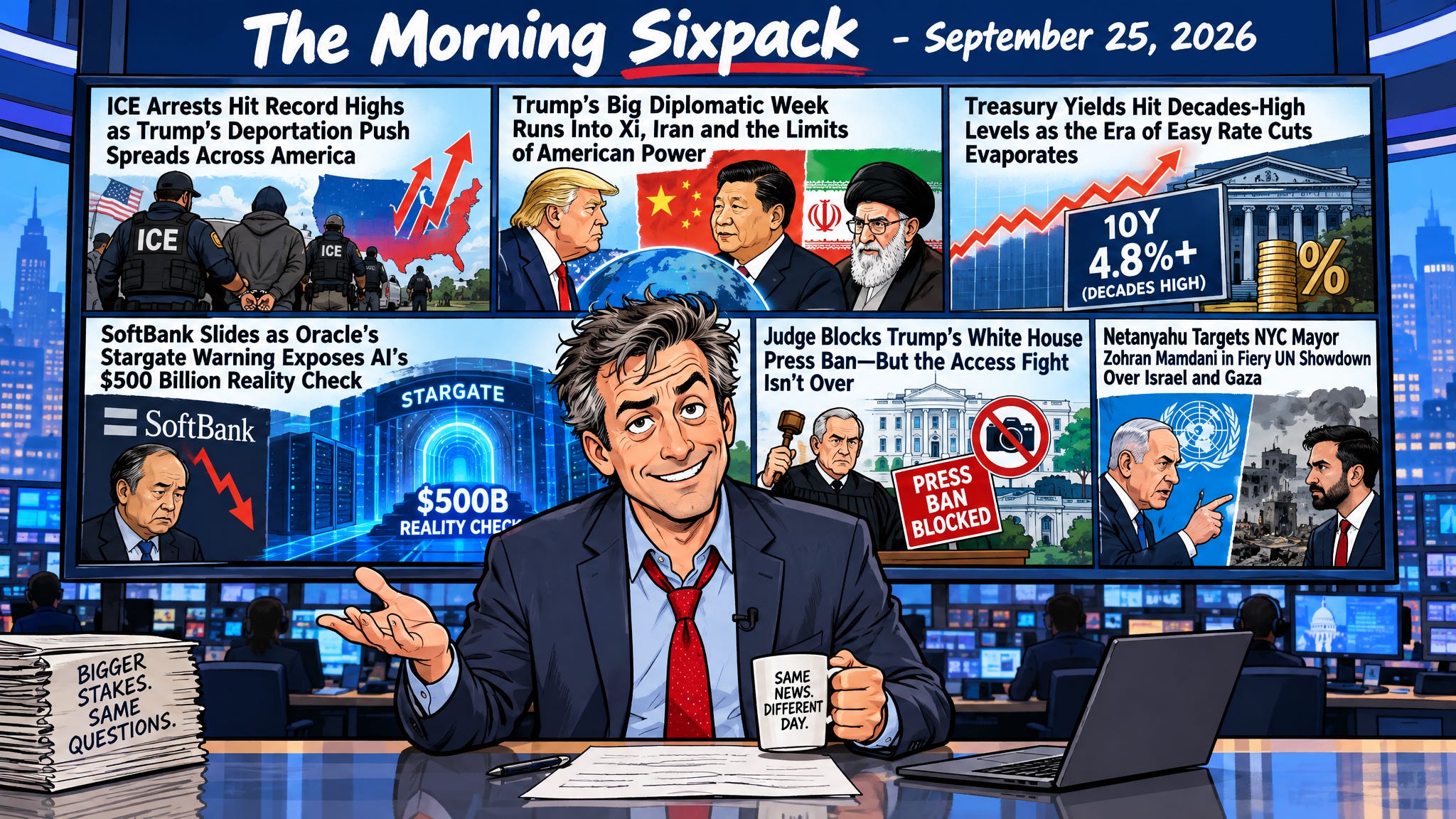
ICE Arrests Hit Record Highs as Trump’s Deportation Push Spreads Across America
Immigration arrests surged across the United States this summer, with ICE making about 43,000 arrests in June, more than 49,000 in July and nearly 51,000 in August as the Trump administration expanded enforcement and the pool of people eligible for deportation. The striking part wasn’t just the numbers—it was how routinely federal agents began appearing at homes, traffic stops, airports, courthouses, hospitals and other everyday locations.
This wasn’t one giant immigration raid—it was a nationwide enforcement system becoming part of the scenery.
The New York Times reviewed videos, photographs and court records from more than 50 incidents and found arrests occurring across the country, including in states where immigration enforcement had previously generated far more visible opposition. Partnerships with local law enforcement helped extend federal reach in Republican-led states, while operations also increased in Democratic strongholds despite state and local restrictions. Cato Institute immigration-policy director David Bier described why the expansion has attracted comparatively less attention: “This gradual rise everywhere all at once, through a lot of means, is enabling the operation to fly under the radar.”
The encounters described in the report range from the mundane to the traumatic: arrests at laundromats, after traffic stops, inside homes, at airports and during hospital treatment. ICE says its officers are conducting lawful, targeted enforcement and argues that courthouse arrests conserve resources. Families and witnesses interviewed by the Times describe frightened children, disrupted businesses and confrontations involving force. The report also notes an important distinction often lost in the immigration debate: most of those arrested were accused of civil immigration violations and had not been charged with or convicted of crimes.
That decentralized approach may be the biggest development here. High-profile raids can produce demonstrations, cameras and headlines; thousands of smaller encounters scattered across dozens of states can produce comparable—or greater—enforcement with much less national attention. ICE summarized the administration’s position this way: “This is promises made and promises kept in action. The results speak for themselves.” Whatever one thinks of the policy, the numbers show the machinery of immigration enforcement operating at a scale that is increasingly difficult to dismiss as a temporary surge.
Editor: The spectacle may have faded, but the enforcement certainly hasn’t. Turns out a dragnet doesn’t need a press conference when it can simply become part of the daily routine.
Source: New York Times
Trump spent the week projecting American power at the UN and across a White House table from Xi Jinping, but the diplomatic receipts were considerably less muscular than the sales pitch.
Trump’s Big Diplomatic Week Runs Into Xi, Iran and the Limits of American Power
President Donald Trump used a packed week of diplomacy to declare American strength, threaten Iran and host Chinese President Xi Jinping—but Reuters reports the meetings also highlighted resistance from allies and adversaries and unresolved conflicts abroad. The centerpiece summit with Xi produced a two-month extension of the U.S.-China trade truce, while major disputes involving Taiwan, artificial intelligence and trade remained unresolved.
The message was “America is back.” The week’s results showed that everybody else still gets a vote.
Trump’s UN speech was characteristically forceful. He threatened to “annihilate” Iran if Tehran failed to reach an agreement, defended his administration’s use of American military power and argued that his policies had advanced U.S. interests. The White House disputed the idea that his foreign policy had stalled, telling Reuters that Trump was focused on results rather than diplomatic “posturing.” Meanwhile, the nearly seven-month Iran war continues to disrupt energy supplies and remains a major challenge for the administration.
Then came Xi. The Chinese leader arrived in Washington with leverage of his own, including China’s dominant position in rare-earth minerals. The summit delivered plenty of ceremony but comparatively little in concrete agreements beyond extending the trade truce. Chinese state media said Xi pressed Trump privately to oppose Taiwan independence, while Taiwan remains a central source of friction between Washington and Beijing. Brett Bruen, a former Obama administration foreign-policy adviser, offered Reuters this assessment: “But it’s noteworthy that he goes all wobbly when it comes to Xi Jinping and ascendant Chinese power.”
The larger problem for Trump is that other governments are increasingly willing to resist U.S. demands. Reuters pointed to European and Asian allies declining requests for help in the Iran conflict, stalled efforts involving Russia and Ukraine, and an agreement expanding America’s military presence in Greenland that stopped short of Trump’s earlier demand to own the territory. With November’s midterms approaching, domestic politics could further affect the administration’s room to maneuver. Trump himself supplied perhaps the week’s most fitting line while pitching a new name for AI: “Let’s see if I have any power. Maybe I do and maybe I don’t. We’re going to find out pretty soon.”
Editor: Trump wanted a week that advertised American leverage. Instead, much of the world appeared to read the fine print—and discovered that “Art of the Deal” still requires somebody on the other side to sign.
Source: Reuters
The bond market is sending the economy a rather expensive memo: inflation isn’t finished, rate cuts aren’t coming to the rescue, and borrowing money is about to hurt more.
Treasury Yields Hit Decades-High Levels as the Era of Easy Rate Cuts Evaporates
The 30-year U.S. Treasury yield surged as high as 5.5% Thursday—its highest level since 2004—while the benchmark 10-year yield touched 5.22%, a level not seen since 2007. Rising energy prices, persistent inflation and a resilient U.S. economy have dramatically changed expectations for Federal Reserve policy, with traders now pricing in a 71% chance of an October rate hike, according to the CME FedWatch tool.
Wall Street started the year dreaming about rate cuts. Now it’s pricing in another hike while oil trades above $100. That escalated quickly.
The immediate trouble is energy. Brent crude settled Thursday at $106.60 a barrel, up 3.41%, as the Iran war and disruption surrounding the Strait of Hormuz continue feeding inflation concerns. The bond sell-off isn’t confined to America, either. Ten-year yields in France and Germany reached roughly 15-year highs, while Japan’s 10-year yield climbed to 3.08%, its highest level since 1996. “Every major bond market’s feeling the heat at once,” deVere Group CEO Nigel Green said.
That matters well beyond trading desks because Treasury yields influence borrowing costs throughout the economy. Higher yields can translate into more expensive mortgages, auto loans and business financing, while also increasing the government’s financing burden. The two-year Treasury yield, particularly sensitive to expectations for Fed policy, has climbed from 3.48% at the beginning of the year to 4.93% this month. As Green put it, “Anyone positioned for a global easing cycle has had the ground pulled from under them.”
There is still plenty that could change. Oil prices dropped temporarily Thursday after a Reuters report that U.S. and Iranian negotiators had discussed a possible route toward reopening the Strait of Hormuz, demonstrating just how headline-driven these markets have become. But even the Treasury Department’s roughly $4.08 billion purchase of long-term bonds Thursday did little to contain yields. ING strategist Padhraic Garvey summed up the problem: “None of the drivers that brought us the increase in rates are going away.” For homeowners, businesses and Uncle Sam, that’s the sentence worth remembering.
Editor: The soft-landing crowd ordered lower rates and got $100 oil, 5%-plus Treasury yields and another possible Fed hike instead. Somewhere, a mortgage calculator just requested hazard pay.
Source: CNN
The AI boom has reached the stage where the grand plans are colliding with something less glamorous than artificial intelligence: electricity, construction schedules and enormous piles of borrowed money.
SoftBank Slides as Oracle’s Stargate Warning Exposes AI’s $500 Billion Reality Check
SoftBank Group shares fell 3.1% Friday after Oracle reportedly issued a force-majeure notice tied to possible power-related delays at Project Jupiter, a massive New Mexico data-center campus connected to the $500 billion Stargate AI infrastructure initiative involving Oracle, OpenAI and SoftBank. Oracle is reportedly seeking protection from payment obligations if the facility cannot begin operating in 2028 as planned.
Apparently, building the AI future requires more than GPUs and gigantic checks—you also have to find enough electricity to turn the thing on.
The warning puts a spotlight on an increasingly important constraint facing the AI infrastructure race. Developers are planning enormous data centers, but actually delivering them requires power generation, transmission capacity, construction crews and financing on schedules that may stretch for years. Project Jupiter’s potential delay is therefore bigger than one campus: it raises questions about how quickly hundreds of billions of dollars in promised AI investment can become functioning infrastructure.
The timing is especially awkward for SoftBank, which is taking on more leverage as it pursues its AI ambitions. The company raised $11.1 billion through dollar- and euro-denominated bonds this week, with proceeds intended partly to finance its investment in OpenAI. At the same time, investors are becoming more discriminating about AI-related debt, with spreads reportedly around 115 basis points compared with 78 basis points for the broader market. That’s bond-market language for: enthusiasm is wonderful, but lenders would still like their money back.
SoftBank’s exposure extends further through SB Energy, which is preparing for a potential U.S. listing and reportedly has a $430 billion data-center backlog. Much of that business, however, is long-dated and concentrated among SoftBank and OpenAI. None of this means the AI infrastructure boom is finished; it does mean the next phase will be measured less by splashy investment announcements and more by whether companies can secure power, finish construction and finance these projects without making their balance sheets resemble science experiments.
Editor: Silicon Valley spent years telling us AI would solve problems humans couldn’t. First assignment: locate several gigawatts of electricity, a few hundred billion dollars and a construction crew that can promise Tuesday and actually mean Tuesday.
Source: Yahoo Finance
Trump barred three news organizations from the White House, a federal judge ordered their credentials restored, and the morning still somehow featured confiscated press passes. Washington can turn even “let the reporters back in” into a multistage production.
Judge Blocks Trump’s White House Press Ban—but the Access Fight Isn’t Over
A federal judge ordered the Trump administration to restore White House credentials for journalists from CNN, MS NOW and Politico, finding the outlets had shown a “high likelihood of success” on their claim that their passes were revoked without due process. U.S. District Judge Timothy Kelly, a Trump appointee, issued a 14-day temporary restraining order while the organizations’ lawsuit proceeds.
The judge said restore the credentials. By sunrise, some reporters were still outside and some of their badges were in Secret Service hands.
The confusion eventually eased. Journalists from all three organizations regained general White House access around midday Thursday, according to the Post. But CNN and MS NOW later said some of their journalists were denied entry to cover Chinese President Xi Jinping’s arrival for the state dinner. Trump subsequently claimed the outlets had “refused to cover” the arrival, a characterization contradicted by their accounts that journalists had been denied access.
The underlying court fight is more consequential than Thursday’s credential scramble. The outlets argue that banning them because of their coverage violates the First Amendment and that revoking their credentials without proper procedures violates Fifth Amendment due-process protections. The White House says its actions are lawful and has invoked national-security concerns. Kelly was skeptical, writing: “This is a high bar, but Plaintiffs have met it.” He also questioned whether national security was actually behind the bans, noting that Trump publicly focused on what he regarded as false and negative coverage when announcing them.
The temporary order doesn’t resolve the lawsuit, and questions remain about access to particular events and participation in the television pool. But there’s some history here: Kelly was also the judge who ordered the restoration of then-CNN reporter Jim Acosta’s credentials in 2018 on due-process grounds. Eight years later, different reporters and a different lawsuit have landed him in familiar territory. Apparently some Washington sequels don’t even bother changing directors.
Editor: The White House wanted to decide which reporters deserved a seat in the room. Judge Kelly’s temporary answer was considerably less complicated: you don’t get to yank credentials first and figure out due process later.
Source: Washington Post
Benjamin Netanyahu used the UN podium in New York to unload on New York’s own mayor, turning a General Assembly speech into a very public fight over Israel, Gaza, antisemitism and who gets to claim the moral high ground.
Netanyahu Targets NYC Mayor Zohran Mamdani in Fiery UN Showdown Over Israel and Gaza
Israeli Prime Minister Benjamin Netanyahu directly attacked New York City Mayor Zohran Mamdani during his UN General Assembly speech Thursday, accusing the longtime Israel critic of antisemitism and saying Jewish New Yorkers no longer feel safe under his leadership. Mamdani fired back afterward, accusing Netanyahu of using “baseless lies” to defend Israel’s conduct toward Palestinians. Their confrontation brought a long-running political feud onto one of the world’s biggest diplomatic stages.
Nothing says international diplomacy quite like the Israeli prime minister flying to New York and publicly fighting with the mayor of New York.
Netanyahu told Mamdani, “Shame on you for distorting the facts, shame on you for inverting victim and aggressor, shame on you for spitting in the face of truth.” He also rejected allegations of genocide against Israel, declaring, “Israel didn’t commit genocide. Israel prevented genocide.” Netanyahu and his government deny genocide allegations. Mamdani responded that Netanyahu remained subject to an International Criminal Court arrest warrant alleging war crimes and crimes against humanity.
Mamdani has long criticized Israel’s government and supports Palestinian independence. He previously said he wanted Netanyahu arrested under the ICC warrant if the Israeli leader visited New York, though in July Mamdani said city officials lacked the legal authority to make that arrest. At Thursday’s UN session, many delegates walked out before Netanyahu spoke, while supporters remained and chanted. Just before the speech, Mamdani posted video of an olive tree being planted at Gracie Mansion with Palestinian families from Gaza, writing, “May peace be our future.”
For Netanyahu, the New York confrontation gave him an opportunity to challenge one of America’s most prominent elected critics of his government while defending Israel’s conduct before an international audience. For Mamdani, it offered an equally visible opportunity to restate his opposition to Netanyahu’s policies. Neither man appears interested in lowering the temperature, and the UN General Assembly just supplied them with a considerably larger thermostat.
Editor: Netanyahu came to address the United Nations and wound up addressing the mayor. Mamdani planted an olive tree and responded with a flamethrower. So much for symbolism doing the heavy lifting.
Source: UPI