


Trump Administration Declares DHS Shootings ‘Justified’—Before the Evidence Is Even In
Sixteen shootings, zero officer charges, and a White House that keeps grading its own homework in public.
The Trump administration has publicly declared DHS officers justified in 16 separate shootings since July, often before investigations were completed, even as videos, judges, and prosecutors later undercut the government’s claims. The rush to absolution has intensified outrage in cities like Minneapolis, Los Angeles, and Chicago—where federal immigration enforcement has surged and murder has followed.

At least 10 people were shot, including four U.S. citizens, and three were killed, yet no officers from Immigration and Customs Enforcement, U.S. Border Patrol, or Homeland Security Investigations have faced criminal charges. In contrast, targets of those shootings were often charged immediately—only to see cases later dropped or dismissed when evidence contradicted DHS narratives.
One attorney put it bluntly:
“Here, they are charging people first and asking questions later. There’s such pressure from the administration to charge right away and make headlines so they can put out false press releases.”
That’s Christopher Parente, a former federal prosecutor now representing a woman shot by Border Patrol—hardly a fringe critic.
The credibility gap keeps widening. In Minneapolis, officials labeled two people killed by federal officers as “domestic terrorists,” only for witness videos to raise serious questions about whether they posed an imminent threat at all. In Chicago, body-cam footage showed a Border Patrol agent ramming a driver’s car before shooting her five times—charges against the driver were tossed, and the agent still hasn’t been charged.
Legal experts say federal immunity makes accountability difficult, but not impossible. States can prosecute, civil courts remain an option, and judges are increasingly skeptical when DHS stories don’t line up with video. What’s eroding fastest isn’t just trust—it’s the assumption that federal investigators are neutral when political leaders have already declared the verdict.
Source: The Washington Post (free)
Editor: When the government announces the conclusion before the investigation, that’s not law enforcement—it’s narrative control. Accountability doesn’t weaken public safety; pretending nothing went wrong does.
Greg Bovino Loses His Job—and Washington Blinks
The Border Patrol’s most visible enforcer just got sidelined, and it’s the clearest sign yet the administration knows Minneapolis went too far.
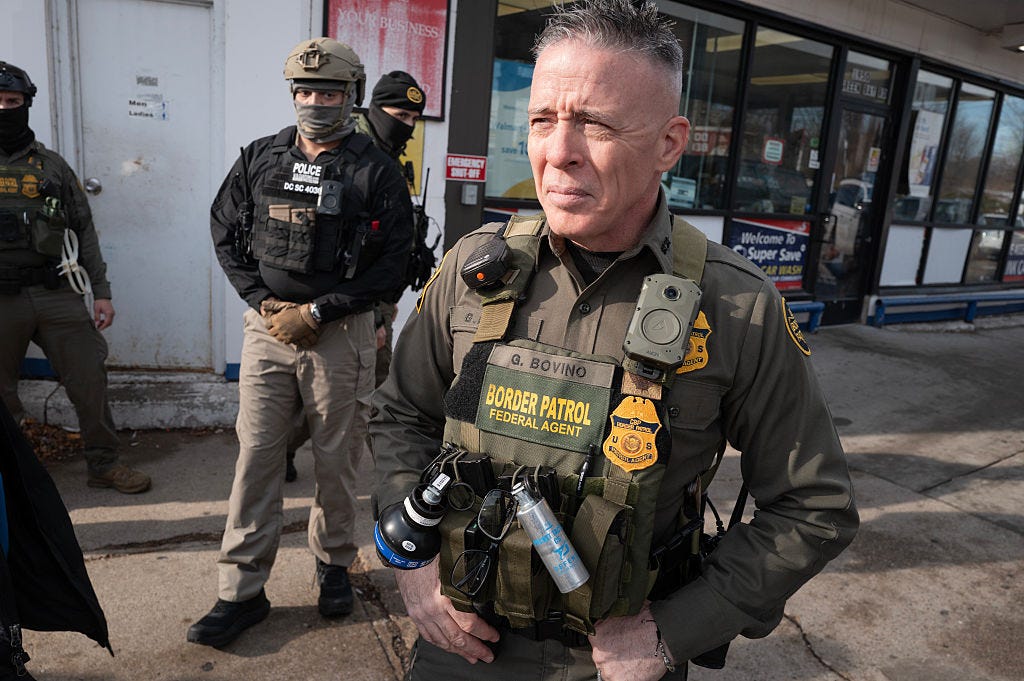
Greg Bovino has been removed from his role as Border Patrol “commander at large” and sent back to El Centro, California, where he’s expected to retire. The move comes days after Border Patrol agents under his command killed Alex Pretti in Minneapolis—a shooting Bovino aggressively defended, even as video evidence contradicted his claims.
Bovino’s demotion signals a tactical rethink inside the Trump administration following national backlash. Donald Trump hinted at a softer tone, announcing conversations with Minnesota Gov. Tim Walz and Minneapolis Mayor Jacob Frey, and naming Tom Homan to take over federal operations in Minnesota. Translation: damage control is underway.
For months, Bovino was the face—and megaphone—of a roaming immigration crackdown. Backed by DHS Secretary Kristi Noem, he crisscrossed Democratic-run cities with masked agents, daily press conferences, and a social-media persona that blurred law enforcement with political theater. Career officials inside ICE and Border Patrol were uneasy as Bovino bypassed normal chains of command and leaned hard into partisan combat.
That approach collapsed after Pretti’s killing. Bovino publicly claimed Pretti intended to “massacre” agents and insisted officers were the real victims. Videos told a different story: Pretti never drew his legally carried weapon and was shot in the back after being disarmed. The credibility gap became impossible to ignore.
DHS hasn’t explained Bovino’s removal, and the White House is still publicly backing Noem. But the message is unmistakable: when the footage doesn’t match the script, even loyal enforcers become expendable.
Source: The Atlantic
Editor: When your job requires a ring light, eye liner (I’m looking at you, JD Vance), and daily press conferences, it’s probably not “just law enforcement” anymore. Bovino didn’t fall because he was too aggressive—he fell because the video didn’t cooperate.
India and the EU Cut a Massive Trade Deal—and It’s Really About the U.S.
India and Europe just locked in a sweeping trade pact designed to slash tariffs, supercharge exports, and quietly hedge against Washington’s trade chaos.
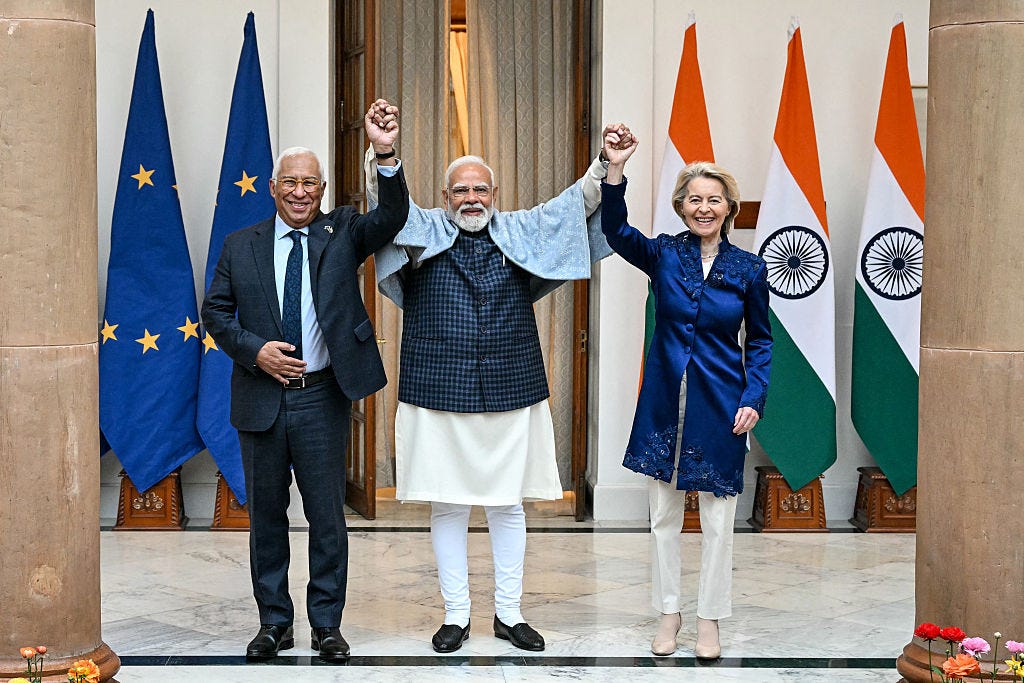
India and the European Union have struck a long-delayed trade agreement that will eliminate or reduce tariffs on nearly all goods traded between them, a move both sides are openly framing as economic opportunity—and implicitly as insurance against rising U.S. trade tensions. The deal aims to double EU exports to India by 2032 while loosening access to one of the world’s most protected major markets.
Under the agreement, the EU will remove tariffs on 99.5% of imports from India over seven years, while India will slash or eliminate duties on 96.6% of EU goods by value, saving European firms an estimated €4 billion annually. Agriculture was deliberately carved out, keeping politically sensitive products like beef, dairy, rice, and sugar off the table.
“This is the mother of all deals,” said Indian Prime Minister Narendra Modi, arguing the agreement would unlock major growth for 1.4 billion Indians and millions of Europeans. European Commission President Ursula von der Leyen echoed the moment’s significance, calling it “only the beginning.”
Autos are the headline prize. India will cut car tariffs from as high as 110% down to 10% over five years, benefiting European brands like Volkswagen, Renault, Mercedes-Benz, and BMW. India will also lower tariffs on wines, spirits, machinery, chemicals, metals, and luxury goods—while keeping carbon taxes firmly in place for now.
The timing is not subtle. The deal gained momentum after Washington slapped 50% tariffs on some Indian goods and as allies push back against President Donald Trump’s tariff threats and geopolitical brinkmanship. With trade between India and the EU already topping $136.5 billion, both sides are betting that closer alignment beats getting caught in someone else’s trade war.
Formal signing will follow legal vetting later this year, but officials expect implementation within twelve months.
Source: Reuters
Editor: This isn’t just a trade deal—it’s a quiet vote of no confidence in America’s reliability as a trading partner. When middle powers start locking arms, it’s usually because Trump keeps flipping the table and throwing the ketchup.
Bari Weiss Plans a CBS News Overhaul—and It Looks Like a Purge
CBS News is about to get flooded with paid commentators while veteran journalists quietly get shown the door.
New CBS News editor-in-chief Bari Weiss is preparing to unveil a sweeping reorganization that would bring in 18 paid commentators, shrink the newsroom, and sideline reporters who don’t align with her vision. According to NPR, the plan will be presented in an all-staff meeting and is already rattling longtime journalists inside the network.
Multiple CBS sources say Weiss wants to keep only “top-flight performers” who support her editorial approach—a phrase that’s landing less like a merit standard and more like a loyalty test. The strategy, described by insiders speaking anonymously, would dramatically reshape the newsroom culture and tilt CBS News away from traditional reporting toward opinion-driven programming.
Weiss, a former New York Times and Wall Street Journal opinion writer, was hired after Paramount’s new owner Larry Ellison took control of the company—shortly after the network settled a $16 million lawsuit brought by President Donald Trump over a 2024 interview with Kamala Harris. The timing has not gone unnoticed inside the building.
Her hands-on approach has already angered staffers at 60 Minutes and fueled upheaval at CBS Evening News, where new anchor Tony Dokoupil publicly distanced himself from the legacy of Walter Cronkite—a moment many colleagues reportedly viewed as sacrilege inside one of broadcast journalism’s most tradition-bound newsrooms.
If implemented, Weiss’ plan would mark a sharp break from CBS’s historical model, replacing institutional memory with curated commentary—and betting that viewers want fewer reporters and more ideological clarity.
Source: Raw Story
Editor: When a news division starts talking about “paid commentators” before reporters, it’s not reform—it’s rebranding. CBS isn’t modernizing the newsroom; it’s auditioning for the cable-news hunger games.
The CIA Moves into Venezuela—and Washington Still Hasn’t Decided Why
The CIA is quietly laying the groundwork for a permanent U.S. presence inside Venezuela, even as the White House struggles to explain what comes next.
According to multiple officials, the Trump administration is leaning heavily on the CIA to spearhead America’s return to Venezuela following the capture of former president Nicolás Maduro earlier this month. While the State Department is expected to eventually reestablish a formal diplomatic mission, intelligence officials are moving first—focused on security, influence, and shaping the post-Maduro political landscape.
Planning discussions envision U.S. personnel initially operating out of a CIA annex, not an embassy, allowing intelligence officers to build relationships, liaise with Venezuelan intelligence services, and hold conversations diplomats legally cannot. One former official described the approach bluntly: “State plants the flag but CIA is really the influence.” The model mirrors early U.S. operations in Ukraine, where intelligence channels preceded traditional diplomacy.
CIA Director John Ratcliffe has already visited Venezuela, meeting interim president Delcy Rodríguez and military leaders. The agency is expected to brief Venezuelan officials on U.S. intelligence regarding China, Russia, and Iran—and assess whether the new leadership it helped install is performing to Washington’s expectations.
What’s missing is a clearly articulated endgame. Despite President Donald Trump publicly claiming the U.S. would “run” Venezuela, officials involved in planning say they’re still waiting for concrete mission objectives. Embassy reopening timelines remain unclear, and diplomats acknowledge they’re preparing to deploy without firm direction from the White House.
For now, the CIA is moving ahead anyway—establishing presence first, purpose later.
Source: CNN
Editor: Nothing says “well-thought-out foreign policy” like sending the CIA in first and deciding the mission afterward. Influence without strategy isn’t leadership—it’s improvisation with consequences.
Maxwell Frost Physically Battered at Sundance—Court Docs Detail Racist Attack
A sitting member of Congress was punched in the face after being told he’d be “deported,” and the court record is even uglier than the headline.
Court documents show a 28-year-old man has been charged with multiple felonies after allegedly assaulting Rep. Maxwell Frost at a bar in Park City during the Sundance Film Festival. Prosecutors say the attacker used racist language, threatened deportation, and struck Frost before fleeing the scene.
According to a probable-cause affidavit, Christian Joel Young told Frost and another patron, “we are going to deport you and your kind,” yelled a racial slur, and then punched Frost in the face. Frost later confirmed the attack on social media, saying the suspect screamed racist remarks while running off before being arrested. Frost said he was shaken but physically okay.
Police say Young had already been denied entry to the private event, jumped a fence, was confronted by security, and somehow got back inside anyway. Once inside, he repeatedly tried to engage Frost and the woman in what witnesses described as “weird conversations,” then turned violent when rebuffed—also allegedly shoving the woman against the bar.
Young now faces charges including aggravated burglary, assaulting an elected official, and simple assault. A county judge ordered him held without bail, citing convincing evidence he poses both a flight risk and a danger to the community—language that’s becoming depressingly familiar as political violence continues to spill out of Washington and into public life.
Source: Axios
Editor: When “deport you and your kind” turns into a punch at a film festival, it’s no longer abstract vitriol—it’s consequences. This is what happens when violent language gets normalized and nobody bothers to dial it back.
BONUS: ICE, Minneapolis, and a Shutdown Clock—Congress Is Playing Chicken Again
Congress is barreling toward a government shutdown because ICE operations in Minneapolis have turned a funding vote into a full-blown political standoff.
Senate Republicans are scrambling to pass a must-approve funding package by Friday night, but Democrats are threatening to block it unless Homeland Security—and ICE funding specifically—is stripped out. The flashpoint is Minneapolis, where the killing of 37-year-old Alex Pretti by a Border Patrol agent has detonated bipartisan concern and Democratic fury.
GOP leaders, including Senate Majority Leader John Thune, are floating the idea that President Donald Trump could take executive action to calm tensions—possibly by pulling agents out of Minneapolis or sidelining controversial Border Patrol leader Gregory Bovino. But time is short, and Democrats say what’s on offer doesn’t come close to real reform.
Republicans argue Democrats are misreading the bill. Sen. Katie Britt says the Homeland Security funding Democrats want to kill would actually reduce ICE spending compared to a stopgap, while expanding body cameras, de-escalation training, and inspector-general oversight. Democrats aren’t buying it and want tougher rules, including banning masks during operations and requiring judicial warrants for home entries.
Senate Democratic Leader Chuck Schumer says Democrats are ready to fast-track the rest of the funding bills immediately—as long as Homeland Security is cut loose. If not, he says, Republicans own the shutdown. GOP senators counter that carving out DHS guts the package and risks national security.
The first procedural vote is expected Thursday, one day before funding expires for DHS, Defense, and several other agencies. A deal is still possible—but at this point, Congress looks less interested in governing than in daring the other side to blink.
Source: The Hill
Editor: Nothing brings Washington together like a looming shutdown and a refusal to admit the real problem: ICE has become politically radioactive, and no one wants to touch the handle—even as the clock hits zero.