


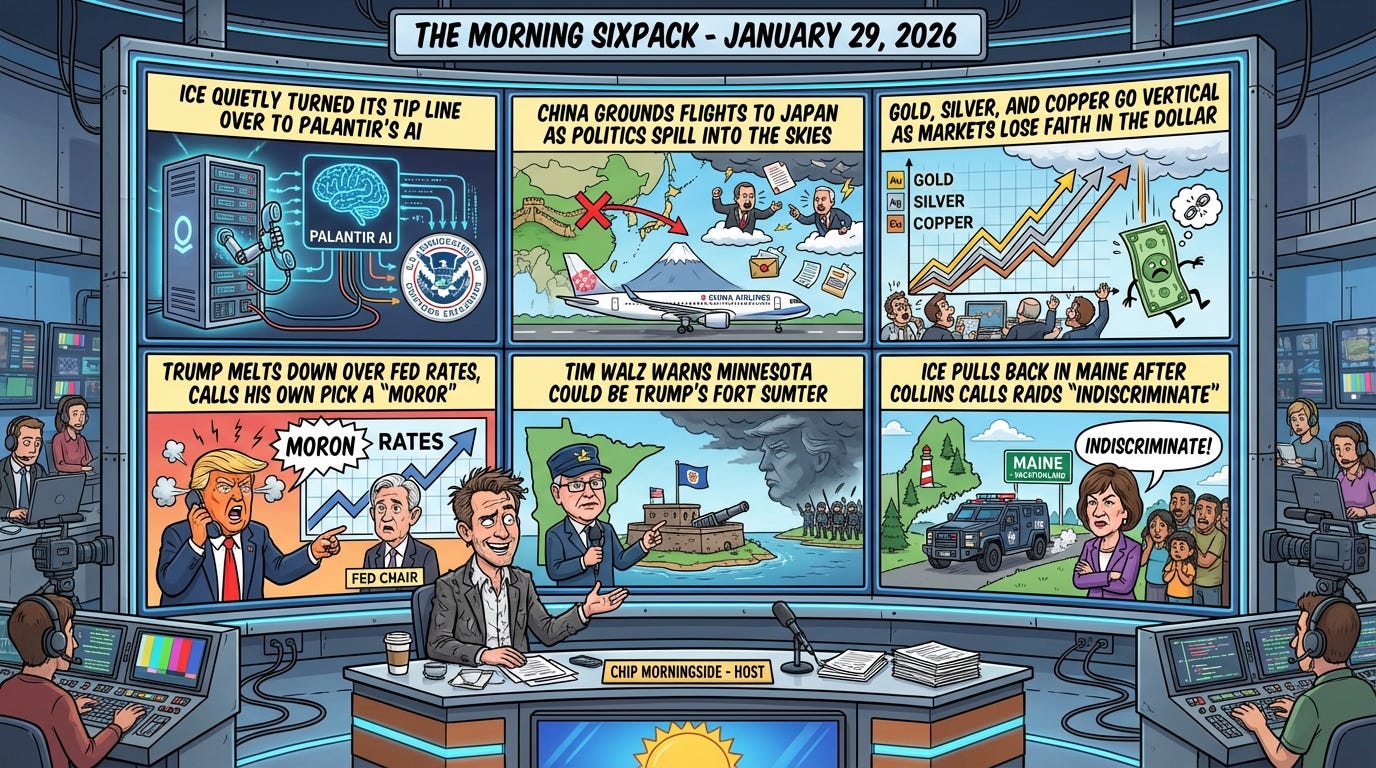
ICE Quietly Turned Its Tip Line Over to Palantir’s AI
ICE is now using Palantir-powered generative AI to sort, translate, and summarize immigration enforcement tips from the public—and it’s already live.
United States Immigration and Customs Enforcement is leaning on AI to speed up how it processes tips submitted through its public webform, according to a newly released 2025 Department of Homeland Security AI inventory. The tool, built with help from Palantir Technologies, creates quick summaries—known internally as “BLUFs”—and flags urgent cases so investigators can move faster.
The system, officially called “AI Enhanced ICE Tip Processing,” is described as “actively authorized” and has been operational since May 2, 2025. DHS says it cuts down the manual work of reviewing tips, translates non-English submissions, and generates a high-level snapshot for investigators. BLUF, short for “bottom line up front,” is a military term—and one Palantir employees also use internally.
The inventory notes that ICE relies on “commercially available large language models” trained on public-domain data, with no additional training on agency data. “There was no additional training using agency data on top of what is available in the models’ base set of capabilities,” the document states. During use, however, the AI directly interacts with incoming tip submissions.
Palantir has been a major ICE contractor since 2011, but its role in tip-line processing has largely stayed out of public view. The work surfaced once before, buried in a $1.96 million payment tied to modifications of ICE’s case management system, Gotham, including a “Tipline and Investigative Leads Suite.” The new AI tool may be an upgrade to the long-running FALCON Tipline system, which routes public and law enforcement tips to Homeland Security Investigations.
The disclosure comes amid internal unrest at Palantir, where employees have pushed leadership for clarity about the company’s ICE work following a fatal shooting by federal agents in Minneapolis. Leadership defended the relationship, arguing the software improves “ICE’s operational effectiveness,” while acknowledging the reputational risk. ICE and DHS, meanwhile, continue to encourage the public to submit tips—now with AI quietly helping decide what rises to the top.
Source: WIRED
Editor: AI summarizing anonymous tips for immigration enforcement is being sold as efficiency, not expansion—but when the funnel gets wider and faster, the outcomes usually do, too. Calling it a BLUF doesn’t make the stakes any smaller.
China Grounds Flights to Japan as Politics Spill Into the Skies
China has effectively shut down air travel to Japan, canceling every flight on 49 routes as diplomatic tensions harden into something travelers can’t ignore.
Chinese airlines have pulled all scheduled flights to Japan, a sweeping move that underscores just how strained relations have become between Beijing and Tokyo. The cancellations come after months of escalating rhetoric and official warnings aimed squarely at discouraging Chinese tourism to Japan.

The flashpoint traces back to comments last year by Japan’s prime minister suggesting Tokyo could be drawn into a conflict over Taiwan—a red line for Beijing, which claims the island as its own. Since then, China has urged citizens to avoid Japan entirely, with its foreign ministry this week warning of “serious safety threats” facing Chinese tourists.
That doesn’t mean Chinese travelers are staying put. Flight data shows South Korea is poised to overtake Japan as the top destination for Chinese tourists during the Lunar New Year, while Vietnam is also enjoying a noticeable bump. When politics blocks one runway, tourism simply finds another.
The cancellations mark one of the clearest examples yet of geopolitical tensions directly reshaping travel patterns in Asia. For Japan, the loss is tangible—Chinese tourists were a major driver of pre-pandemic travel revenue. For China, it’s another lever pulled in a widening campaign of pressure that increasingly touches everyday life.
Source: Semafor
Editor: Nothing says “cooler heads prevail” like grounding 49 air routes and calling it a safety advisory. Tourists adapt, airlines comply, and diplomacy gets another reminder that economics is always collateral damage.
Gold, Silver, and Copper Go Vertical as Markets Lose Faith in the Dollar
Hard assets are on a tear as investors run for cover, pushing gold, silver, and copper to fresh record highs almost overnight.
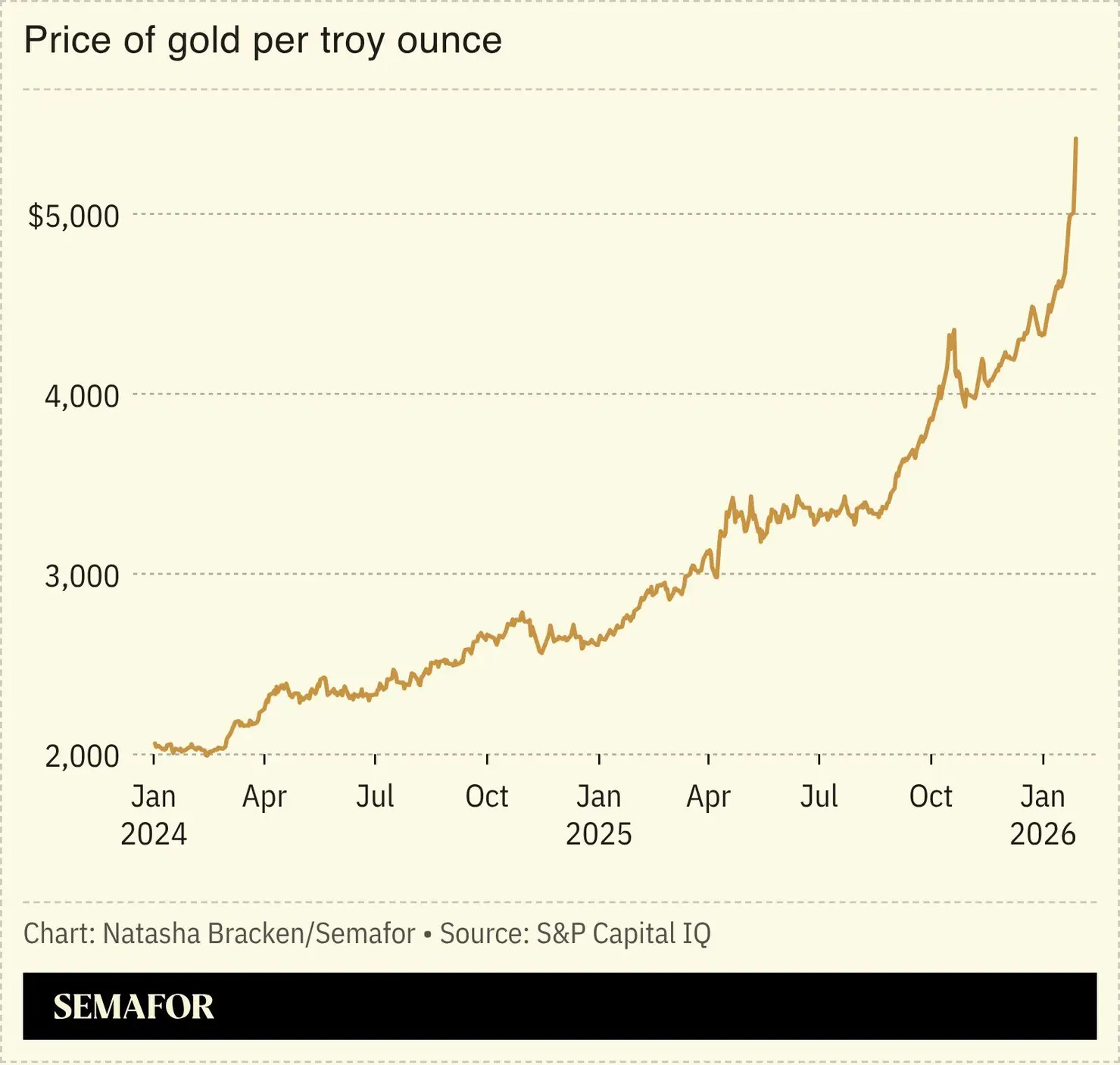
Gold surged past expectations after confidence in the US dollar wobbled, following renewed attacks on the Federal Reserve by Donald Trump, according to Bloomberg. Investors responded the old-fashioned way—by buying things you can actually hold. Gold blew past even bullish forecasts, hitting $5,600 an ounce after Goldman Sachs had predicted $5,400 by the end of 2026.
Silver wasn’t far behind, extending what analysts called a “frantic” rally. Prices are now up nearly 60% since the start of the year, a reminder that silver doesn’t move quietly when momentum takes hold—it sprints.
Copper, meanwhile, is pulling double duty as both industrial workhorse and speculative darling. Already in demand for electrification and energy transition projects, copper jumped another 6% overnight as traders piled in, the Financial Times reported.
Put it all together and the message from markets is blunt: when politics shake trust in institutions like the Federal Reserve, money doesn’t debate—it relocates. And right now, it’s relocating into metals.
Source: Semafor
Editor: When gold outruns Wall Street’s own optimism and silver goes parabolic, that’s not enthusiasm—it’s a confidence vote against everything else. Copper joining the party just means speculation has found a hard hat.
Trump Melts Down Over Fed Rates, Calls His Own Pick a “Moron”
Donald Trump is publicly torching the Federal Reserve chairman he appointed—because the Fed won’t bend to his demands.
In a pre-dawn Truth Social rant, Donald Trump unloaded on Jerome Powell after the central bank held interest rates steady despite months of political pressure. The president accused Powell of sabotaging the country, national security included, in a 284-word tirade that read less like economic policy and more like a personal grievance.
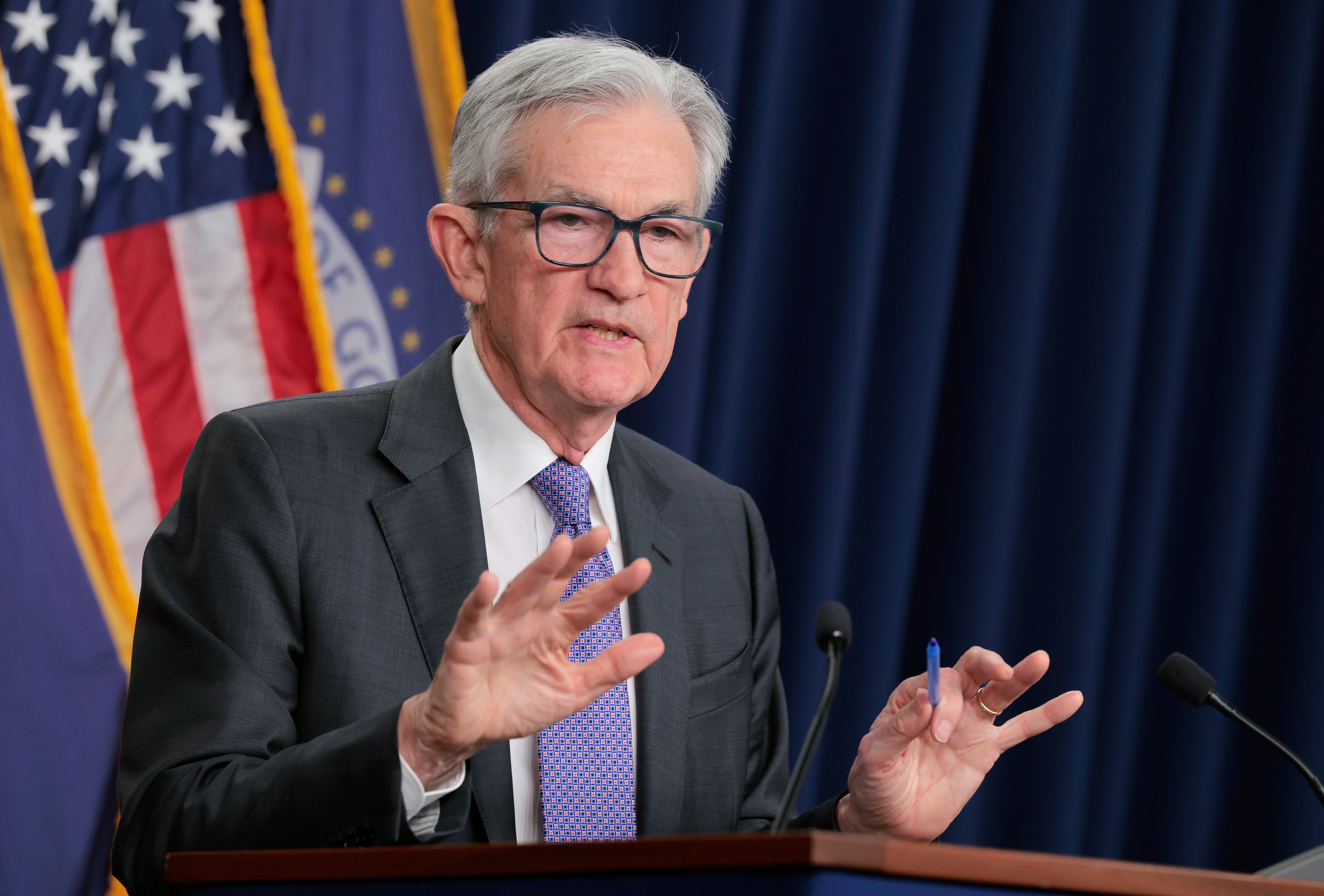
“Jerome ‘Too Late’ Powell again refused to cut interest rates… He is hurting our Country, and its National Security,” Trump wrote, adding, “We should have a substantially lower rate now that even this moron admits inflation is no longer a problem or threat.”
Powell, for his part, said the Fed is staying the course to “finish the job” of bringing inflation back to its 2% target, noting recent progress but warning of potential economic risks. Inflation has cooled from about 3% in September to roughly 2.7% by year’s end—close, but not mission accomplished.
Trump rejected that logic outright, arguing tariffs are flooding the U.S. with cash and insisting America should have “the LOWEST INTEREST RATE OF ANY COUNTRY IN THE WORLD.” He framed the Fed’s resistance as costing “Hundreds of Billions of Dollar a year” and portrayed himself as unusually “nice, kind, and gentle” to trading partners—a characterization doing some heavy lifting.
The episode underscores the growing collision between the White House and the supposedly independent Federal Reserve, with rate policy now openly litigated in social media insults. Monetary policy by tantrum may not move markets—but it does say plenty about the moment.
Source: RawStory
Editor: When a president calls his own appointee a “moron” for not obeying, that’s not policy debate—it’s a stress test of institutional independence. The Fed may hold rates steady, but the volume keeps going up.
Tim Walz Warns Minnesota Could Be Trump’s Fort Sumter
Minnesota Gov. Tim Walz is openly asking whether federal violence in his state is the opening shot of something far darker.
Speaking from his office at the state capitol, Tim Walz compared the killing of two Minneapolis residents by federal agents to Fort Sumter—the moment the Civil War began. “It’s a physical assault,” Walz said. “It’s an armed force that’s assaulting, that’s killing my constituents, my citizens.” He let the analogy hang, unanswered and unmistakable.
The remarks follow the deaths of Renee Good and Alex Pretti, an ICU nurse, both shot by ICE officers during what the Trump administration has branded the largest immigration-enforcement operation in history. State authorities were blocked from investigating, while Walz himself became the target of a federal probe. At the same time, the Justice Department demanded Minnesota’s voter rolls, framing the extraordinary request as a condition for restoring “law and order.”
Walz says he refuses to escalate. He deployed the National Guard not to confront ICE, but to hand out doughnuts and hot chocolate to peaceful protesters. “Guns pointed, American at American,” he said, invoking both Fort Sumter and John Brown, “is certainly not where we want to go.” His restraint, he believes, may be the only thing keeping the crisis from detonating.
President Donald Trump has alternated between insults—calling Walz “seriously retarded”—and claims of cooperation, saying they were on “a similar wavelength” after a phone call. Walz disputes that framing, saying Trump never mentioned the victims, never offered condolences, and instead complained that Minnesotans weren’t cooperating enough with ICE.
Walz now warns other states to pay attention. What’s happening in Minnesota, he says, is a test run—and it’s coming elsewhere. “That assault will come to your state soon,” he said. The question he keeps hearing from voters isn’t about November’s election. It’s simpler and far more unsettling: “What makes you think we can get to November?”
Source: The Atlantic
Editor: When a sitting governor starts name-checking Fort Sumter, that’s not rhetorical excess—it’s a warning flare. If federal force, blocked investigations, and election pressure are the new normal, history isn’t being invoked for drama. It’s being invoked for context.
ICE Pulls Back in Maine After Collins Calls Raids “Indiscriminate”
ICE has ended its enforcement surge in Maine after bipartisan backlash—and a pointed intervention from Sen. Susan Collins.
Sen. Susan Collins said Thursday that Homeland Security Secretary Kristi Noem told her the Trump administration has halted its intensified immigration operations in the state. The move follows mounting criticism over aggressive tactics, including the arrest of legal immigrants in Maine and fatal ICE-related shootings elsewhere.
Collins, who chairs the Senate Appropriations Committee as a DHS funding deadline looms, had urged Noem earlier this week to pause operations in both Maine and Minnesota. More than 200 arrests were made in Maine in just one week, a pace Collins called “too sweeping and indiscriminate,” saying frightened constituents flooded her office with calls.
She also broke with the administration’s rhetoric by rejecting claims that Alex Pretti—the Minneapolis nurse shot by a Border Patrol agent—was involved in “domestic terrorism.” While Collins stopped short of calling for Noem’s resignation, she confirmed that the surge in Maine is over, writing on X that she had been personally informed by the secretary.
The retreat comes with political gravity attached. Collins faces a difficult reelection in a blue state that Kamala Harris carried in 2024, making her seat Democrats’ top Senate target in 2026. For now, at least, Maine’s message appears to have landed: enforcement without restraint has consequences.
Source: Axios
Editor: When even Susan Collins says an operation is “too sweeping,” you’ve blown past the caution lights. ICE didn’t change course out of principle—it did it because the politics finally caught up.