


The Morning Sixpack stays free because the news that shapes your life should not be hidden behind a paywall. Paid subscribers are not paying for access. They are helping fund the research, writing, and independent voice that goes into every issue. Become a paid subscriber and help keep smart, honest news analysis free for everyone.
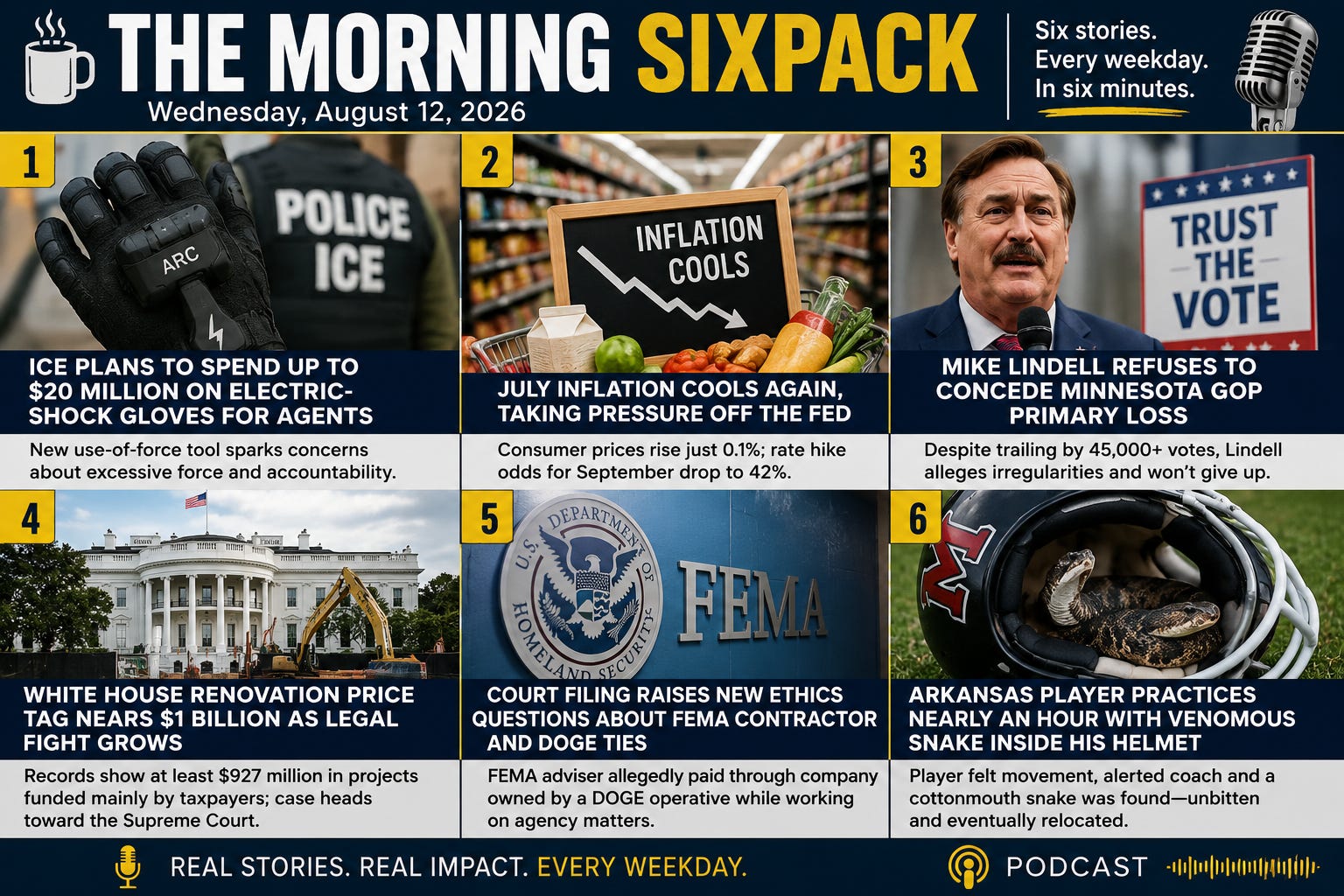
ICE wants to equip officers with electric-shock gloves—because apparently adding another use-of-force tool is being marketed as “de-escalation.”
ICE Plans to Spend Up to $20 Million on Electric-Shock Gloves for Agents
ICE is moving to buy thousands of electric-shock gloves that can deliver painful shocks to gain compliance during arrests and detention operations.
The agency is preparing a no-bid contract worth up to $20 million for a device supporters call a safer alternative to physical force while critics warn it opens the door to more abuse.
The gloves, known as the G.L.O.V.E. (Generated Low Output Voltage Emitter), are manufactured by Kentucky-based Compliant Technologies. Officers activate the electrical mode with a switch, and the gloves only work through direct skin contact. The company says the pain stimulus typically gains compliance within seconds and warns they should not be used as punishment or on vulnerable populations such as children, pregnant women, the elderly, or people with disabilities.
“It’s immediate and sharp, and it will distract you. I call it like a bee sting,” said John Peters, president of the Institute for the Prevention of In-Custody Deaths, who said the technology can help officers end physical confrontations more quickly. Peters also believes ICE’s purchase would likely be the company’s largest to date and said proper training and clear policies will be critical.
Civil liberties groups aren’t buying the sales pitch. The ACLU argues ICE already faces criticism over its use of force and says giving agents a concealed electric-shock device raises accountability concerns.
“ICE spent the last year showing this country they are too quick to use force. Now they will be able to deploy electric shocks with the slight push of a button that maybe nobody else can see them do,” said Jenn Rolnick Borchetta of the ACLU.
Source: AP News
Editor: Washington says this is about reducing injuries and ending confrontations faster. Critics see another tool that could be misused behind closed doors. Either way, a pair of gloves just became the latest front in the immigration enforcement debate.
Inflation cooled again in July, giving the Fed one less reason to pull the rate-hike trigger—at least for now.
July Inflation Cools Again, Taking Pressure Off the Fed
Consumer prices rose just 0.1% in July, reinforcing expectations that the Federal Reserve can afford to keep interest rates on hold next month.
The inflation scare that rattled markets earlier this year is losing steam, even if Americans are still paying more than the Fed wants.
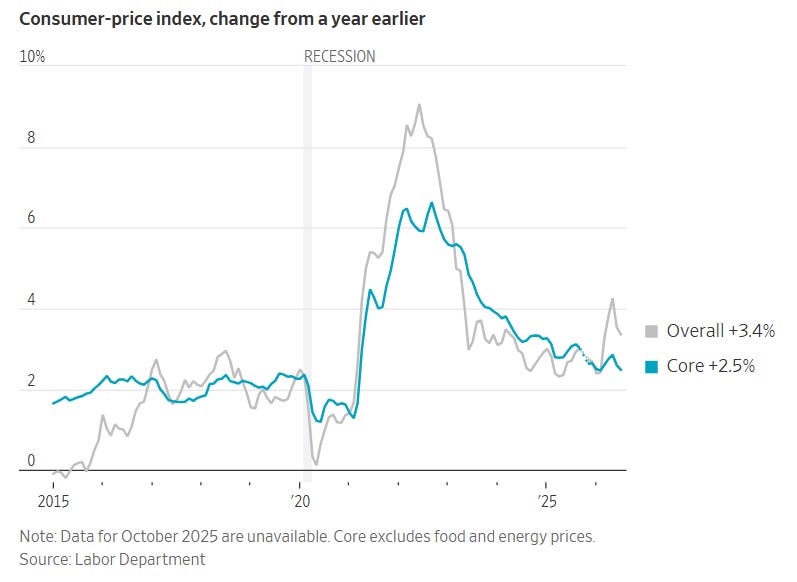
The Consumer Price Index increased 0.1% in July, matching expectations, while core inflation—which strips out food and energy—rose 0.2%. On an annual basis, headline inflation came in at 3.4%, with core inflation at 2.5%. The numbers remain above the Fed’s 2% target, but they’ve cooled enough to ease fears of an immediate rate hike.
Energy prices fell another 1.5% during the month after June’s sharp decline, helping offset increases elsewhere. Shelter and food each rose just 0.1%, though housing continued to account for roughly two-thirds of the overall monthly increase. Airline fares climbed 2.2%, while medical care, new vehicles, and used cars also posted modest gains.
Morgan Stanley Wealth Management’s Ellen Zentner summed up the market’s reaction: “In-line inflation will keep the ‘no need to hike rates’ narrative that took hold after last week’s jobs report intact.”
With one more inflation report due before the Federal Reserve’s September meeting, policymakers still have time to change course—but for now, markets are dialing back expectations of another hike.
Source: CNBC
Editor: Inflation is cooling, but don’t expect a victory lap at the grocery store. Prices aren’t falling—they’re just rising a little less quickly. For families watching every receipt, that’s progress measured in inches, not miles.
Mike Lindell isn’t conceding Minnesota’s GOP primary—even after losing by tens of thousands of votes.
Mike Lindell Refuses to Concede Minnesota GOP Primary Loss
Mike Lindell is rejecting the results of Minnesota’s Republican gubernatorial primary despite trailing by roughly 45,000 votes and about 11 percentage points.
The MyPillow founder says he’ll keep fighting until every vote is counted, continuing a familiar pattern of questioning election results after a defeat.
Lindell, who was endorsed by President Donald Trump before Election Day, lost the Republican nomination to Minnesota House Speaker Lisa DeMuth, according to Decision Desk HQ. During a livestream on LindellTV, he dismissed calls to concede, saying, “Why would I listen to the AP?” and insisting there were still votes left to be counted.
The former MyPillow CEO has long challenged election outcomes, most notably by promoting claims that the 2020 presidential election was stolen. Trump had urged Minnesota Republicans to support Lindell, writing before the election that he “deserves a BIG WIN IN MINNESOTA today” and praising his efforts on election integrity.
DeMuth called her victory a “major milestone” while making it clear her focus has shifted to November, when she’ll face Democratic nominee Amy Klobuchar in the race to succeed retiring Gov. Tim Walz. She told supporters, “Tonight, Minnesotans made it clear they are ready for real change—at the top.”
Source: The Hill
Editor: Losing by 45,000 votes and saying the race isn’t over is one strategy. Whether it changes the outcome is another matter entirely.
The White House makeover now carries a price tag approaching $1 billion—and the fight over who gets to approve it is headed toward the Supreme Court.
White House Renovation Price Tag Nears $1 Billion as Legal Fight Grows
The Trump administration has assembled at least $900 million for White House construction projects, far more than previously disclosed and with taxpayers covering much of the bill.
The biggest battle isn’t just over the money—it’s whether the president can remake the White House without Congress signing off first.
According to documents reviewed by The Washington Post, the administration has routed hundreds of millions of dollars through the Executive Residence’s maintenance account to fund what it calls “modernization projects.” The plans include the now-famous East Wing ballroom, along with a helipad, visitor screening center, upgrades to Lafayette Square, and additional security improvements.
The records show roughly $875 million has been directed into the normally modest White House Repair and Restoration account since President Trump took office. Funding includes about $500 million transferred from the Secret Service and the White House Military Office, more than $300 million in private donations, and other sources that have not been publicly identified. The White House maintains the spending is consistent with Congress’s original intent and says the ballroom itself will be financed with private donations. Sure…
A federal appeals court recently ruled that construction of the East Wing ballroom requires congressional approval, writing, “Congress has exclusive authority to regulate the construction and demolition of White House structures.”
The administration has vowed to appeal, setting up what could become a major Supreme Court case over presidential authority and control of federal spending.
Source: The Washington Post
Editor: Every president leaves a mark on the White House. Most don’t leave behind a construction bill approaching a billion dollars—or a constitutional showdown over who gets to pick up the tab.
A new court filing is raising ethics questions about FEMA’s former “shadow administrator” and a contractor tied to a DOGE operative.
Court Filing Raises New Ethics Questions About FEMA Contractor and DOGE Ties
New court filings allege that a key FEMA adviser continued working on agency matters while being paid through a company owned by a member of the Department of Government Efficiency, fueling fresh conflict-of-interest concerns.
The allegations don’t prove wrongdoing—but they add another layer of scrutiny to an already controversial shake-up at FEMA.
According to a WIRED report based on deposition testimony and court records, Kara Voorhies, who was described as FEMA’s “shadow administrator,” worked as a special government employee before later becoming a subcontractor through AnchorCode Technologies, a company owned by DOGE operative Kyle Schutt. The filings show Voorhies’ consulting company was paid $325 an hour through the arrangement while she continued serving as a senior adviser at the agency.
Ethics experts interviewed by WIRED questioned whether the arrangement could create conflicts of interest, particularly because Schutt was also working in government while his company was involved in DHS contracting. One former federal ethics attorney told the publication the situation “raises red flags,” while another argued the facts described “appear” to violate post-government employment restrictions if no waiver existed. DHS, Voorhies, Schutt and the companies involved did not respond to WIRED’s requests for comment, according to the report.
The allegations emerge as FEMA remains under intense political scrutiny and amid ongoing lawsuits over the agency’s operations. No court has found Voorhies or Schutt liable for any ethics violations, and the claims remain part of active litigation. The filings, however, are likely to intensify congressional and legal scrutiny over the Trump administration’s use of contractors and special government employees within DHS.
Source: WIRED
Editor: Washington has enough revolving doors without installing one between government offices and contractor payrolls. If the facts in these filings hold up, expect ethics lawyers to stay very busy.
Arkansas football already has enough hazards—finding a venomous snake inside your helmet shouldn’t be one of them.
Arkansas Player Practices Nearly an Hour with Venomous Snake Inside His Helmet
A high school football player in Arkansas unknowingly practiced for nearly an hour with a live cottonmouth snake hiding inside his helmet.
The player never got bitten, but it’s hard to imagine a more terrifying equipment check after practice.
The incident happened during football practice at Maumelle High School, where the player eventually felt something moving inside his helmet and alerted an assistant coach. When the helmet was inspected, a roughly two-foot cottonmouth—a venomous water moccasin—was found tucked beneath the interior padding.
Police initially responded believing the snake might be a copperhead, but quickly identified it as a cottonmouth. Officers tried submerging the helmet in a tub of water to coax it out, but the semi-aquatic snake wasn’t impressed. It eventually surfaced, allowing an officer to safely remove it with a grabber tool before animal control relocated it to a wooded area away from the school.
Maumelle Animal Services Director Chris Davis said he’d never encountered anything like it. “I’ve removed a snake out of a car vent, in the engine, purses, backpacks. In a helmet? Never. It was very unreal. You had to kind of be there and take pictures to say this was real.”
The player grabbed another helmet and returned to practice without injury.
Source: Yahoo Sports
Editor: Coaches always tell players to keep their heads in the game. They probably didn’t mean sharing the helmet with one of Arkansas’ most venomous residents.