


A U.S. president can order a nuclear strike on Iran without Congress, without a court, and without anyone else’s approval—and the only thing standing between that order and launch is whether someone in the chain of command decides it’s illegal.
That means we’re one decision away from either nuclear war—or a full-blown constitutional crisis inside the Pentagon.
Let’s be clear about the context. This isn’t Cold War retaliation doctrine. This is about a first-use nuclear order against Iran, a non-nuclear state, after rhetoric about wiping out “an entire civilization.”
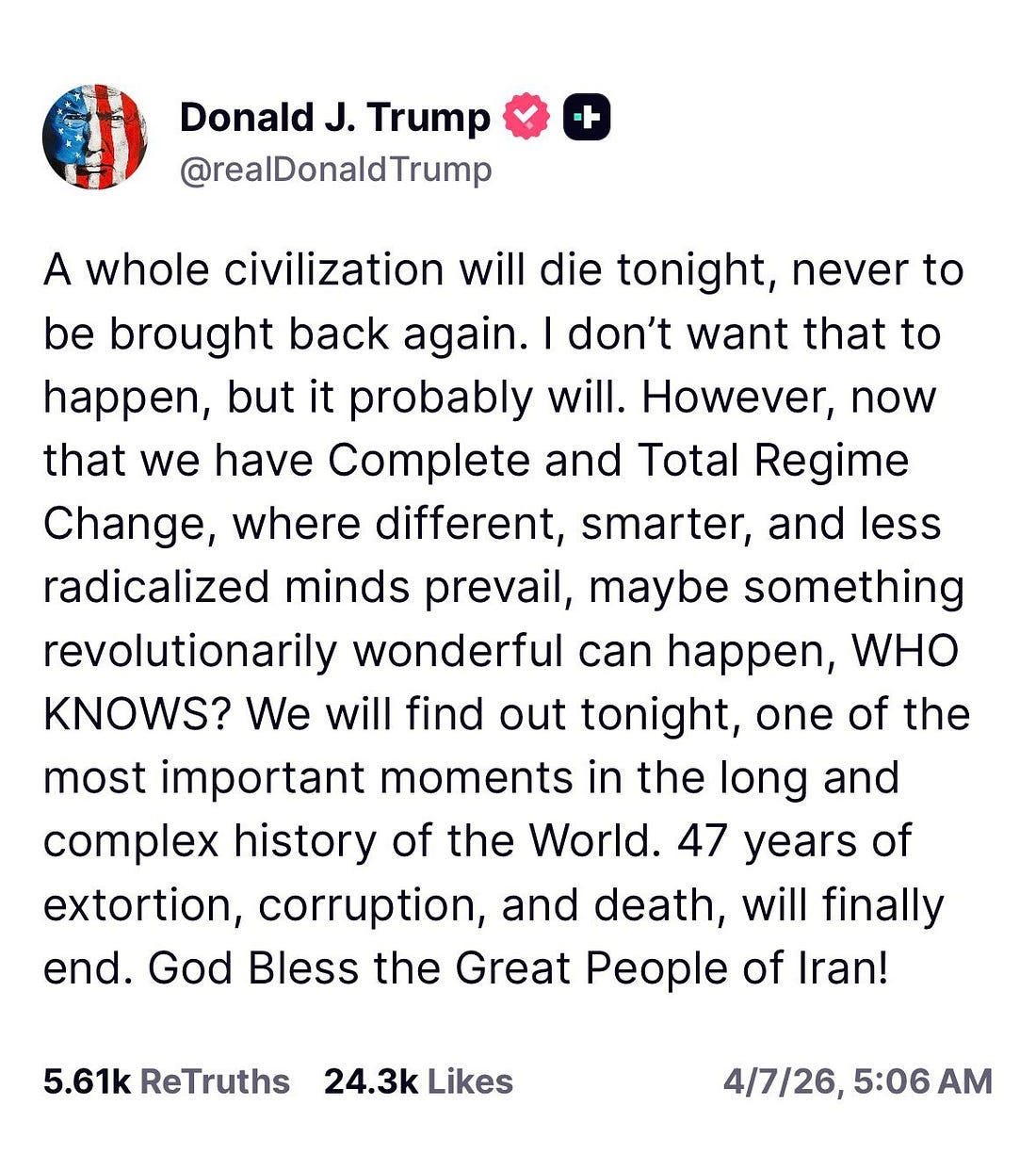
Under the current U.S. system, the president has sole launch authority. The order would go from the White House to the National Military Command Center, be authenticated, transmitted to Strategic Command, and then down to submarines, silos, and/or bombers. The system is designed for speed. Debate is not part of the architecture.
If the chain functions normally, the strike happens within minutes. Missiles launch. There is no recall button. Iran responds—likely through regional escalation at minimum, possibly through broader retaliation if allies are pulled in.
Oil markets implode.
NATO is forced into emergency posture.
The nuclear taboo that has held since 1945 is shattered.
The legal arguments about proportionality and war powers would come afterward, while the world burns.
What If…?
Now here’s the scenario people whisper about but don’t map out publicly: What if someone refuses?
Under U.S. military law, service members have a duty to refuse unlawful orders. An order that targets civilian population centers or seeks to “end a civilization” would immediately raise red flags under the laws of armed conflict.
If the Secretary of Defense, a combatant commander, or a senior officer determines the order is illegal and refuses to transmit it, we enter terrain the nuclear system was never designed to handle.
The president could would fire that person on the spot and install someone compliant. Then we start over and hope that the chain would break somewhere else.
Or the refusal could slow the process just enough to trigger emergency cabinet meetings, 25th Amendment conversations, congressional panic, and market chaos.
NOTE: Congress is not in session.
Foreign governments, watching in real time, would see confusion at the top of the U.S. nuclear command structure. In nuclear strategy, uncertainty is gasoline.
And here’s the core problem: The system assumes obedience. It does not contain a clean arbitration mechanism for “the president ordered it, but we believe it’s unlawful.” There’s no rapid-response Supreme Court hearing for nuclear launches. No bipartisan congressional timeout button. The timeline is minutes, not weeks.
So we’re left with two destabilizing outcomes.
If the chain holds, the world changes physically—millions at risk, escalation almost guaranteed, global order fractured. World War III is a surety.
If the chain breaks, the world changes institutionally—the commander-in-chief versus elements of his own military in an open legitimacy fight, adversaries calculating whether America’s nuclear command is intact, allies wondering who’s actually in control.
At that point in time, the President of the United States would be neutered.
Either way, the damage is profound.
The nuclear system was built to ensure retaliation if the United States was attacked—not to manage a dispute over whether a first strike on Iran is lawful. Once you introduce doubt into a structure built for certainty, you are no longer operating inside stable deterrence theory. You are improvising at the edge of catastrophe.
Source: The Guardian
Editor: We built a nuclear system for speed and obedience, as a “second strike”. We never built one for “What if the president is the destabilizing variable?” That gap should terrify every serious adult in the room.
And yes, Trump is the destabilizing force here. NO DOUBT.
He MUST BE IMPEACHED.
I feel he is just posturing…..
I don't have enough undies to cover the amount of times I change them because Donnie made me shit my britches again.