


The Morning Sixpack Podcast: Power Plays, Pressure Points, and Political Crosswinds
Let’s dig into the stories shaping the week—each one a reminder that when institutions bend, people feel the snap. Buckle up; this is a rough ride through law enforcement overreach, political theater, geopolitical maneuvering, and one very expensive breakup with a social media giant.
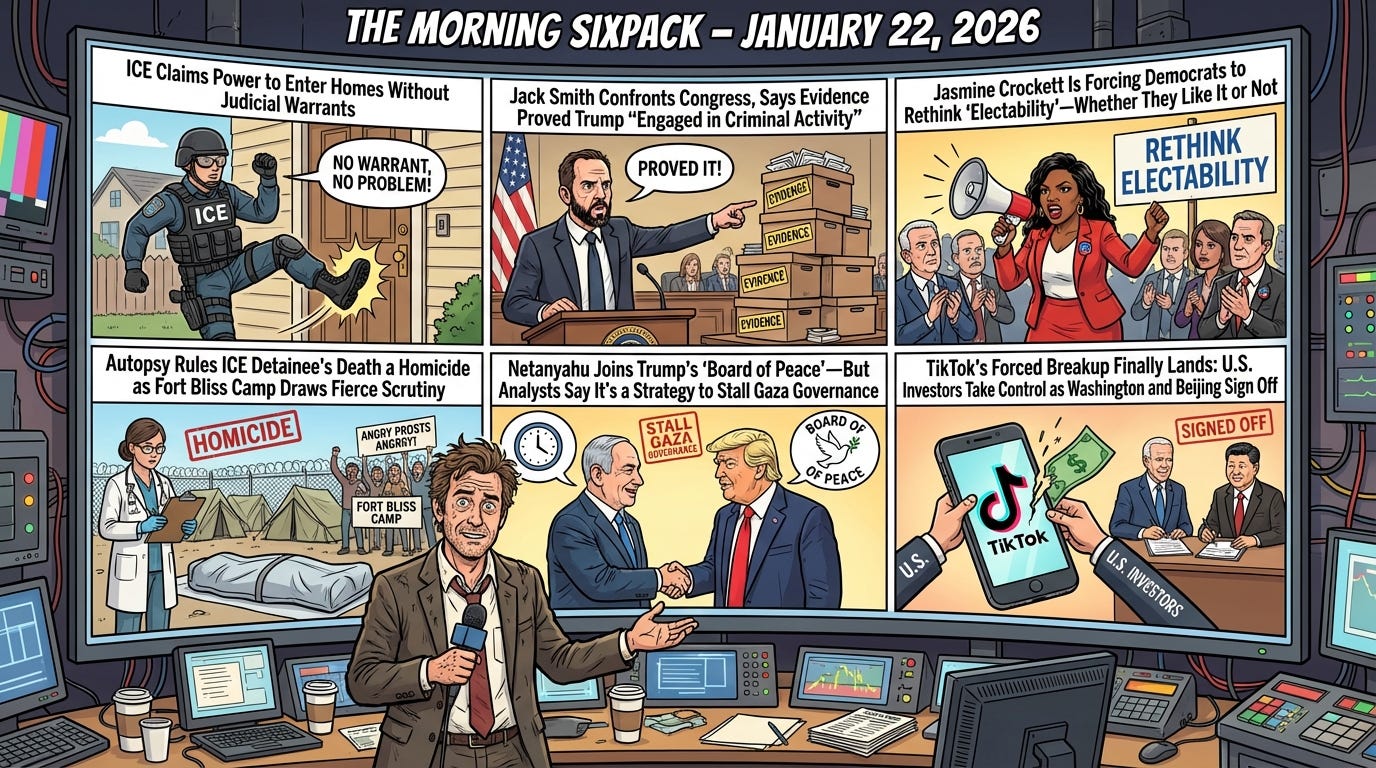
ICE is pushing into unprecedented territory, asserting the power to enter homes without judicial warrants. The administration quietly rewrote decades of practice by elevating administrative warrants—documents that have never held the constitutional weight of a judge’s signature—into a license to knock down doors. Minnesota became the pilot ground, and the result was predictable: ICE agents forcing entry, detaining people without judicial authority, and triggering federal judges to call it what it is—an assault on the Fourth Amendment. One immigrant’s case, in particular, exposed the policy’s fragility: no criminal record, no judicial warrant, and a federal judge ruling his detention unlawful. The administration calls it efficiency; everyone else calls it unconstitutional.
A Cuban migrant’s death at a Texas detention camp has now been officially ruled a homicide—and the autopsy contradicts ICE’s shifting stories. Geraldo Lunas Campos died from asphyxia after guards restrained him until he stopped breathing. Witnesses say he was handcuffed while at least five guards piled on and one choked him unconscious. ICE initially omitted any mention of an altercation, then tried to reframe it as a suicide attempt. The facility where he died—Camp East Montana—is already under fire after two other recent deaths and a $1.2 billion contract awarded to a contractor headquartered in a suburban house with zero detention experience. Congress is now demanding answers. ICE, meanwhile, is hoping no one asks the right questions.
Jack Smith marched into Congress and stated plainly that Trump “engaged in criminal activity,” refusing to let Republicans rewrite history in real time. In his first public testimony since the cases were dropped post–Trump reelection, Smith reminded the committee that facts—pesky things—don’t become partisan just because they’re politically inconvenient. He defended prosecuting Trump on election interference and classified documents, saying he’d bring the same charges again regardless of party. Republicans accused him of political persecution; Smith replied that the First Amendment doesn’t shield criminal schemes. The hearing was less about uncovering truth and more about who can posture the hardest, but Smith didn’t waver.
Netanyahu’s sudden decision to join Trump’s ‘Board of Peace’ is less a pivot toward diplomacy and more a calculated roadblock. Analysts say the Israeli prime minister isn’t looking to rebuild Gaza—he’s looking to stall any governance structure that dilutes Israeli control. Even as he accepts a seat beside Marco Rubio, Jared Kushner, and Tony Blair, Israeli forces are preventing the very Palestinian experts tasked with reconstruction from entering Gaza. Israel objects, delays, and eventually “compromises”—a strategy cushioned by extracting concessions from Washington. Elections loom, Netanyahu is cornered at home, and he’s playing both Trump and the board for time. Gaza’s reconstruction hasn’t even started, and Israel is already raising “security concerns” about imagined high-rise towers. Translation: the obstruction isn’t going anywhere.
Jasmine Crockett is blowing up Democrats’ long-standing myth of electability—and forcing a reckoning in Texas. After a podcast host dismissed her chances, Crockett flipped the criticism into a referendum on who gets deemed “realistic.” Her argument is blunt: white men have tried and lost for 35 years—so why not try someone with a pulse? Critics say her razor-edged rhetoric will energize Republicans. She says Republicans were never going to vote for her anyway. The Democratic primary against James Talarico has become a proxy war over the future of the party: play-it-safe pragmatism versus unfiltered authenticity. Crockett DJs at clubs on Saturday and worships on Sunday; the establishment can’t decide whether that’s a liability or a lifeline.
TikTok’s long-anticipated U.S. spinoff is finally happening—and not because anyone reached a harmonious agreement. Washington forced ByteDance to divest or face a ban, and Beijing ultimately yielded. Oracle, Silver Lake, MGX, and other U.S.-aligned investors will take control, leaving ByteDance with under 20%. The algorithm question—the nuclear core of TikTok—remains deliberately murky. But the message is clear: the U.S. is done pretending Chinese tech can operate freely inside its borders. This is political surgery disguised as a transaction, and everyone is trying to claim victory.
Thanks for listening to The Morning Sixpack. Six stories, one throughline: power gets exercised in the shadows long before the public feels the impact. Stay sharp—we’ll be back with more.


