


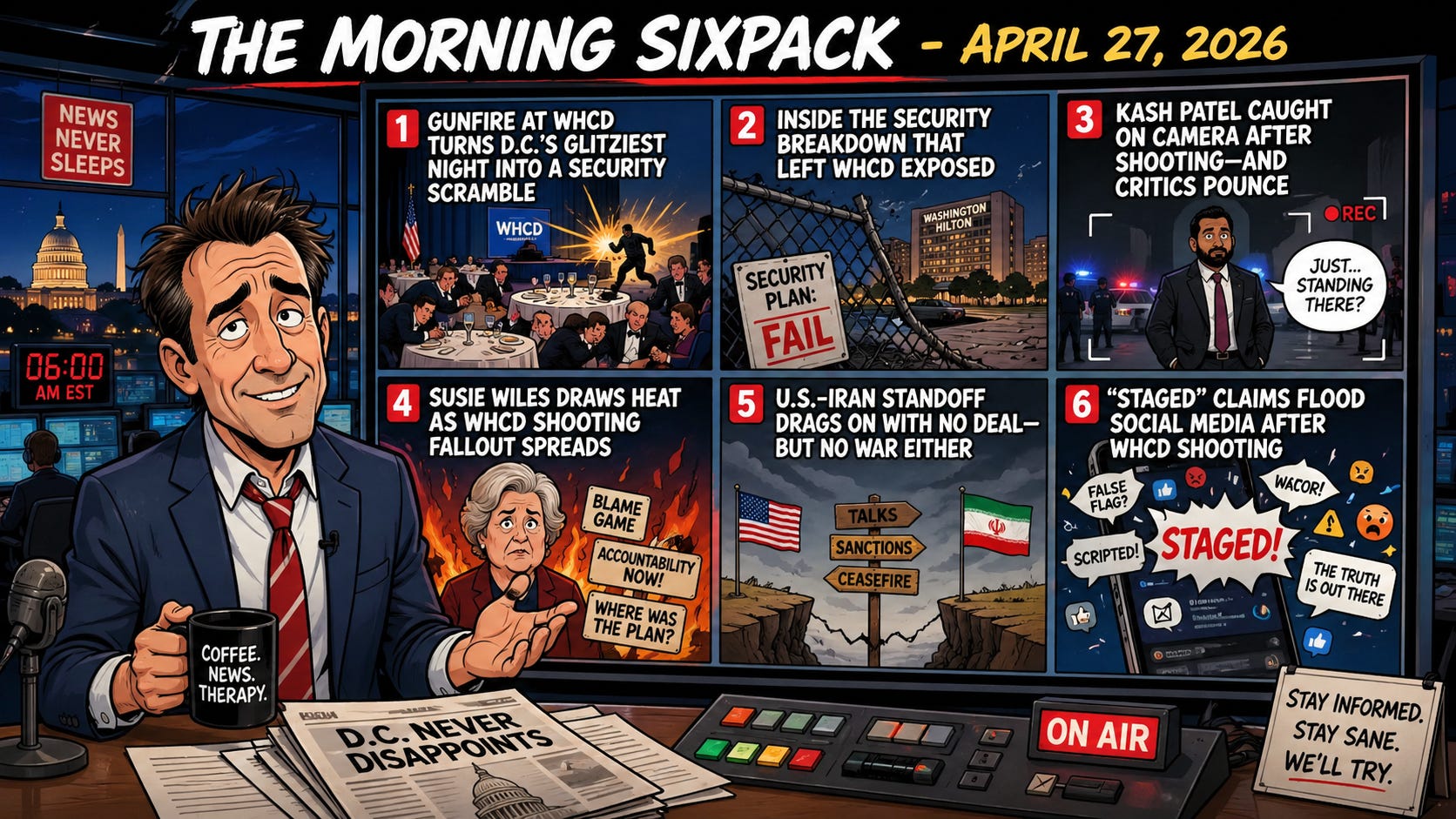
Chaos at the White House Correspondents’ Dinner as Gunfire Sends Press and Power Players Under Tables
A gunman charging a security checkpoint outside the White House Correspondents’ Dinner triggered panic inside the ballroom, sending journalists, officials, and even Donald Trump scrambling for cover. The polished D.C. ritual turned into a duck-and-cover drill in seconds, with Secret Service flooding the room and shouting commands as confusion ruled.
One moment it was dinner and stage tricks—the next it was agents yelling “down, down, down” as people hit the floor.
CBS News reporters inside the room described a scene that shifted instantly from routine to survival mode. Weijia Jiang, seated near Trump on the dais, said agents “multiplied quickly” and rushed the stage as she followed the president to the ground. “I got on my hands and knees too…we were ushered behind the stage,” she recounted, later noticing a bruised knee from the scramble.
Others never even confirmed what they heard in the moment. Nancy Cordes said agents ordered everyone under tables while top officials were pulled from the room, adding, “At this point, no one really knows whether it’s safe to leave.” Ed O’Keefe described a “huge rush of security officials,” noting how quickly seasoned السياسي figures reacted—some, like Steve Scalise, hitting the floor instantly as trained instinct took over.
The sensory details drove home how real it felt. Olivia Rinaldi said, “We heard what sounded like three to four successive shots…we could also smell the gunpowder,” while others initially mistook the noise for dropped plates before the commands and chaos clarified the situation. Margaret Brennan summed it up simply: “We got down…It was clear something had happened.”
The suspect was ultimately tackled and detained outside, but inside the ballroom, nobody knew that in real time. That uncertainty—no windows, no clear intel, just shouted orders—turned one of Washington’s most choreographed nights into a raw reminder that even the most buttoned-up events can unravel fast.
Source: CBS News
Editor: Nothing says “elite D.C. gathering” like everyone crawling under banquet tables while salad plates crash—turns out the only thing less secure than the jokes that night was the perimeter.
Security Gap Exposed: Why the White House Correspondents’ Dinner Was More Vulnerable Than Anyone Knew
The White House Correspondents’ Dinner lacked the highest level of federal security designation—even with Donald Trump and top officials packed into one room. That decision is now under a microscope after a gunman nearly breached the event, raising uncomfortable questions about how a gathering of that magnitude wasn’t treated like the high-risk target it clearly was.
When power, press, and politics converged in one ballroom, the security plan didn’t match the stakes.
Here’s the crux: The dinner was not designated a “National Special Security Event,” the classification typically used for moments like inaugurations or State of the Union addresses. That designation hands full coordination to the Secret Service and locks down every layer of protection. Instead, officials say security responsibility was fragmented—Secret Service handled the ballroom, D.C. police managed the streets, and everything in between was a gray area.
That gap mattered. The suspect allegedly made it past parts of the perimeter and had even booked a room inside the hotel. According to officials, the concentration of leadership—Trump, Vice President JD Vance, Cabinet members, and congressional leaders—created a scenario where a worst-case outcome could have rattled the line of presidential succession itself.
And yet, the official spin is already in motion. Acting Attorney General Todd Blanche called the response “a massive security success story,” arguing the system worked because the suspect was stopped before reaching the ballroom. Technically true. But it’s also a low bar—success defined by what didn’t happen rather than how close it came.
The reality is attendees moved through the hotel with little more than a ticket before hitting metal detectors, and thousands mingled in a space where no single agency had full control. That’s not exactly the airtight setup you’d expect when the president and much of the government are sharing dinner rolls.
Source: Washington Post
Editor: Calling this a “success story” feels like grading a fire alarm on how well it worked after the flames got close—sure, it rang, but maybe don’t let the match get that far next time.
Kash Patel Under Fire After Shooting Video Shows Him Standing Idle Outside WHCD
FBI Director Kash Patel is facing backlash after video appeared to show him standing outside the White House Correspondents’ Dinner moments after gunfire erupted nearby. At a time when chaos unfolded and agents were actively securing the scene, Patel’s apparent lack of urgency is now drawing heat—and a lot of second-guessing.
When others were reacting, Patel looked like he was waiting for the after-action report.
The footage, captured by ABC News journalist Linsey Davis, shows Patel lingering outside the Washington Hilton after a gunman exchanged fire with Secret Service near the event attended by Donald Trump and top officials. Critics quickly seized on the optics, questioning why the nation’s top law enforcement official didn’t appear more engaged in the immediate aftermath.
This latest moment adds to Patel’s growing pile of scrutiny, with detractors arguing that perception matters—especially in a high-stakes security incident involving the president and senior leadership. Even if there’s a reasonable explanation, standing still while others scramble isn’t exactly the visual you want circulating.
To be fair, short clips rarely tell the full story. It’s unclear what Patel had been told, what role he was playing, or whether he had already been briefed to stay put. But in Washington, optics often become reality before facts catch up.
And right now, the optics aren’t doing him any favors.
Source: The Daily Beast
Editor: If you’re running the FBI, “just standing there” during a crisis is the kind of freeze-frame that writes your critics’ talking points for them—no spin required.
Pressure Mounts on Susie Wiles After Shooting Near Trump Sparks Blame Game
White House Chief of Staff Susie Wiles is facing growing calls for accountability after a gunman got dangerously close to Donald Trump during the White House Correspondents’ Dinner. Even though she wasn’t in the room, the fallout is landing squarely on her desk—as it tends to when security failures brush up against the Oval Office.
In Washington, you don’t have to be present to take the blame—you just have to be in charge.
Wiles, a longtime political operator now serving as Trump’s top aide, is being pulled into the widening circle of scrutiny after the shooting rattled one of the most high-profile gatherings of media and government elites. The fact that a gunman was able to get that close—again—has critics asking who’s ultimately responsible for ensuring the president’s safety.
The pressure is less about where Wiles was that night and more about what her role represents. As chief of staff, she sits at the center of operations, coordination, and crisis response. When something this serious happens, the expectation in D.C. is simple: accountability flows upward, fast.
This latest incident only adds fuel to an already simmering debate about security planning and oversight inside the administration. With investigations and finger-pointing underway, Wiles has now entered the familiar Washington ritual—the blame game, where proximity to power is all it takes to become the story.
Source: The Daily Beast
Editor: Being nowhere near the scene doesn’t buy much cover when your job is literally to keep the whole machine running—D.C. loves a scapegoat, and right now her name’s at the top of the list.
Stalled, Not Dead: Why United States-Iran Talks Are Frozen—but Far From Finished
U.S.-Iran negotiations have hit a wall, but the ceasefire is holding and backchannel diplomacy is still quietly alive. The lack of a deal isn’t a collapse—it’s the messy middle of high-stakes negotiations where neither side is ready to blink.
This isn’t diplomacy failing—it’s diplomacy doing exactly what it usually does: dragging, stalling, and inching forward anyway.
Tensions remain high after Donald Trump canceled a planned round of talks, dismissing Iran’s offer as not worth the time. Tehran fired back, accusing Washington of making “excessive demands,” particularly over its nuclear program and control of the Strait of Hormuz—a global النفط choke point that’s now partially shut and rattling energy markets.
But here’s the part that matters: Neither side actually wants to go back to war. Experts say the current standoff looks more like a strategic pause than a breakdown. Iran is signaling through intermediaries, sending written messages and working regional channels, while the U.S. is leaving the door open—Trump even hinted at a “much better plan” emerging.
History backs this up. Deals like the 2015 nuclear agreement took years of dead ends, secret talks, and political brinkmanship before anything stuck. What we’re seeing now fits the pattern—public posturing paired with quiet, ongoing contact.
The bottom line: This could drag on indefinitely. Both sides think they have leverage, neither wants to concede, and the result is a tense middle ground—no peace deal, no full-scale conflict, just a fragile status quo that keeps the world guessing.
Source: Al Jazeera
Editor: Everyone’s declaring talks “dead” like it’s a headline sport, but in reality this is what diplomacy looks like—slow, stubborn, and just functional enough to keep things from blowing up again.
“Staged” Takes Over: Conspiracies Explode After White House Correspondents’ Dinner Shooting
Conspiracy theories claiming the White House Correspondents’ Dinner shooting was “staged” spread like wildfire across social media within hours of the incident. With little verified information early on, influencers and armchair analysts filled the vacuum—pushing narratives that had no evidence but plenty of engagement.
Before facts could settle, the internet had already written its own version of events.
Across platforms like X, Bluesky, and Instagram, users from both the left and right jumped to the same conclusion: The attack must have been orchestrated. Some pointed to the presence of Donald Trump and top officials as suspicious timing, while others spun elaborate theories about political motives or media manipulation.
The “evidence”? Mostly vibes and viral clips. A dropped video feed, an offhand comment from press secretary Karoline Leavitt about “shots will be fired”, and even a reporter’s phone cutting out mid-broadcast were all recast as supposed proof of a coordinated plot. As one viral post put it: “Is this another staged event?”—a question viewed millions of times.
Even prominent online figures couldn’t resist dipping a toe into the speculation pool, amplifying questions rather than answers. Meanwhile, actual authorities said the suspect acted alone and was quickly detained.
This is the new playbook: Major event happens, facts lag, and conspiracy theories sprint ahead. By the time reality catches up, millions have already picked a side.
Source: WIRED
Editor: The internet doesn’t wait for facts anymore—it just grabs a headline, slaps “staged” on it, and lets the algorithm do the rest. Truth shows up later, usually out of breath and ignored. And the “fake news” BS can only be blamed on Trump. He did this to himself.