


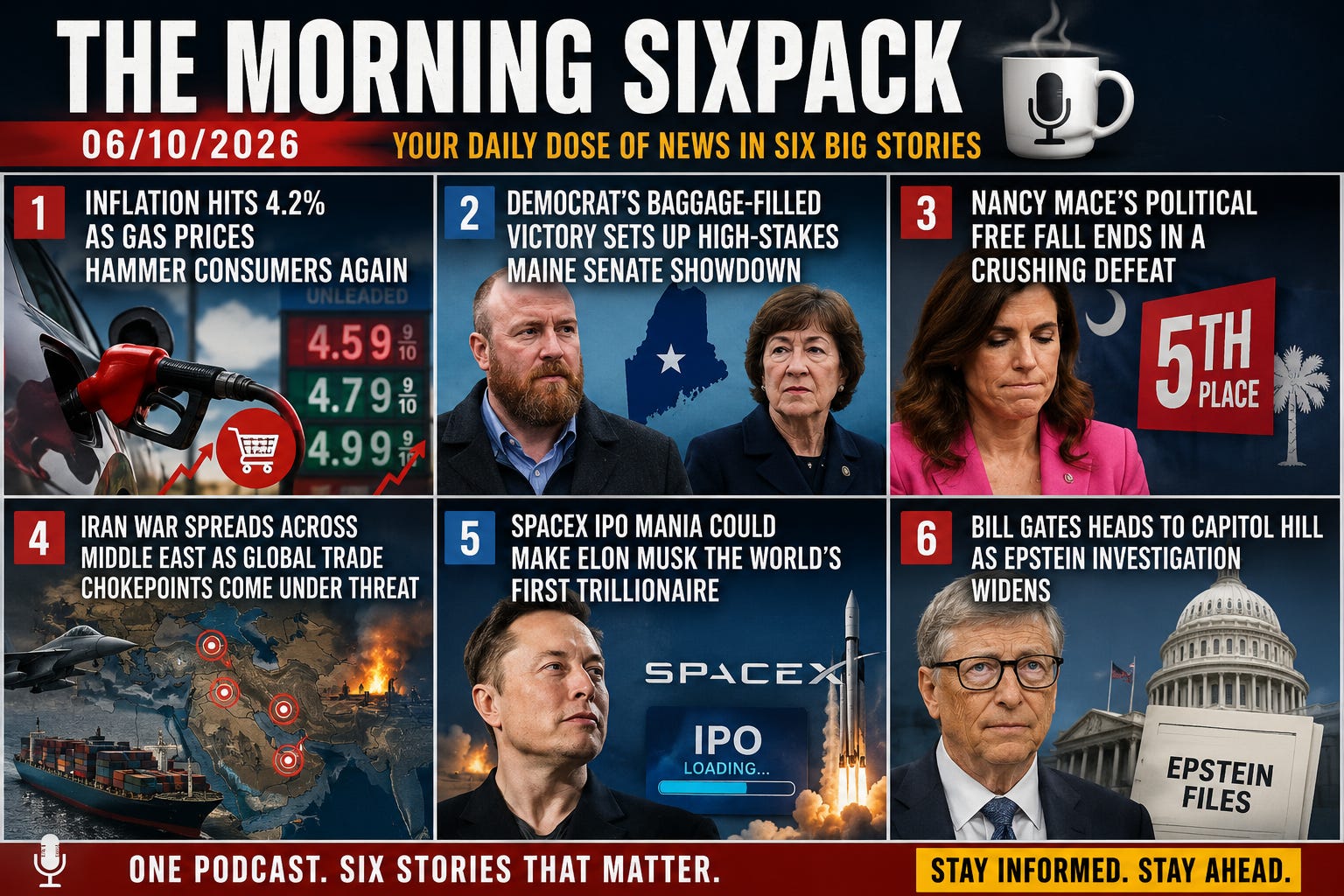
Inflation’s latest jump wasn’t driven by a shopping spree—it was driven by a trip to the gas station.
Inflation Hits 4.2% as Gas Prices Hammer Consumers Again
Inflation climbed to 4.2% in May, the highest annual rate in three years, as energy costs continued to squeeze households already stretched thin. Consumers got little relief from rising fuel costs, and wages once again failed to keep pace with inflation.
The bad news for Washington: prices are still rising faster than paychecks.
While economists believe inflation may be nearing a peak if gasoline prices continue easing, the damage is already showing up in household budgets. Credit-card delinquencies are climbing, borrowing is slowing, and consumers are increasingly relying on debt to maintain spending.
The biggest culprit remains energy. Gasoline prices surged more than 40% from a year ago, accounting for the majority of May’s inflation increase. As one economist put it, “I think that we’re approaching the peak” in year-over-year inflation, but lingering energy costs and AI-driven supply-chain bottlenecks could keep pressure on prices.
For the Federal Reserve, the report creates another headache. Rate cuts that once seemed inevitable are now looking much less certain, and some policymakers may even reopen discussions about whether higher rates are needed. Meanwhile, Wall Street keeps humming along while Main Street keeps paying more at the pump.
Source: Wall Street Journal report (gift)
Editor: The economy keeps producing two very different report cards: Investors are celebrating, while consumers are discovering that a tank of gas now feels like a luxury purchase.
Maine Democrats just nominated a candidate carrying enough political baggage to fill a lobster boat—and now they’ll find out whether voters care.
Democrat’s Baggage-Filled Victory Sets Up High-Stakes Maine Senate Showdown
Graham Platner survived months of damaging headlines and won Maine’s Democratic Senate primary, setting up one of the most closely watched races of 2026 against Republican Sen. Susan Collins.
The victory answers one question and creates another. Democratic primary voters were willing to look past controversies involving Platner’s past, including allegations about former relationships and scrutiny over a tattoo he later covered up. The bigger test comes in November, when Collins will seek a sixth term in a state that often splits its ticket.
Platner’s margin mattered almost as much as the win itself. Political observers watched closely for signs of a protest vote, and suspended candidate Janet Mills still drew roughly 20 percent of the vote. That’s not exactly a ringing endorsement from every corner of the Democratic coalition.
In his victory speech, Platner acknowledged the controversy, saying he had made “mistakes that I regret, that I live with, that I continue to learn from.” He added: “It is my job to earn your trust, faith, and support. And I will spend every day of this campaign, and if I have the privilege, every day in the United States Senate, doing exactly that.”
The primary night delivered other political casualties. In South Carolina, Rep. Nancy Mace’s bid for governor collapsed as Trump-backed Lt. Gov. Pamela Evette advanced to a runoff. Meanwhile, Sen. Lindsey Graham avoided a runoff of his own, proving once again that staying in Donald Trump’s good graces remains one of the safest investments in Republican politics.
Source: Washington Post election coverage
Editor: Primary voters are often willing to forgive almost anything. General-election voters, on the other hand, tend to arrive with a calculator, a magnifying glass, and a much shorter attention span.
It turns out there’s a difference between getting attention and getting votes—and Nancy Mace just learned it the hard way.
Nancy Mace’s Political Free Fall Ends in a Crushing Defeat
Once viewed as a rising Republican star, Nancy Mace finished a distant fifth in South Carolina’s gubernatorial primary, losing even in her own backyard after years of headline-grabbing political reinventions.
Mace built her career as a pragmatic conservative who could win swing voters. But over time she transformed into one of the most polarizing figures in Republican politics, feuding with allies, attacking former supporters, and chasing controversy with increasing frequency. Her campaign never recovered after President Trump endorsed rival Pamela Evette, leaving Mace isolated in a race where no major Republican figure came to her rescue.
Former House Speaker Kevin McCarthy, who once helped launch Mace’s rise, offered one of the sharpest assessments after her defeat. “I helped her win. But I just watched her change along the way,” he said. Another former adviser described her as someone who embraced being a “caucus of one” while steadily burning bridges throughout Washington and South Carolina.
The article details a remarkable political unraveling. From clashes with airport employees and public confrontations with family members to dramatic reversals on policy and alliances, Mace became known as much for spectacle as substance. Even longtime supporters questioned whether the attention she generated translated into actual political strength.
Mace’s loss serves as a reminder that media visibility isn’t the same as voter loyalty. For years she dominated headlines, social media feeds and cable news segments. On Tuesday, voters delivered a much simpler verdict: they were ready to move on.
Source: Washington Post political analysis
Editor: Political careers usually end with a loss. Few end with former allies lining up to explain, in vivid detail, exactly why they saw it coming.
What started as a war between Israel & the United States against Iran is looking more like a regional war—with the global economy caught in the crossfire.
Iran War Spreads Across Middle East as Global Trade Chokepoints Come Under Threat
Fresh attacks across Bahrain, Jordan, Kuwait, Lebanon, and the Red Sea are fueling fears that the Iran conflict is expanding beyond its original battlefield and becoming a broader Middle East crisis.
According to reports, Iran claimed strikes against U.S. bases in multiple Gulf countries while Israel continued operations in southern Lebanon. At the same time, shipping routes near Yemen came under threat after suspected Houthi attacks targeted a cargo vessel in the Red Sea, one of the world’s most important trade corridors.
The growing list of flashpoints is creating headaches for the Trump administration’s efforts to negotiate an end to the conflict. Iran is demanding an Israeli withdrawal from Lebanon as part of any peace arrangement, while Hezbollah has rejected discussions between Israel and Lebanon, making diplomacy increasingly difficult.
The economic stakes are enormous. With traffic through the Strait of Hormuz already heavily disrupted, the Red Sea has become even more critical to global commerce. Roughly 12% of world trade moves through that route, meaning any sustained disruption could drive up shipping costs, energy prices, and inflation around the globe.
The concern now isn’t just who wins the war. It’s whether the region can avoid a chain reaction that pulls in more countries, threatens global trade and turns a dangerous conflict into a much bigger one.
Source: Semafor via Yahoo News
Editor: Markets spent years worrying about supply chains. Now they’re getting a reminder that geography still matters—and there aren’t many backup routes when some of the world’s most important waterways start looking like war zones.
Wall Street is about to find out whether retail investors can launch a stock the same way they launch meme coins—only this time the company actually builds rockets.
SpaceX IPO Mania Could Make Elon Musk the World’s First Trillionaire
Elon Musk’s SpaceX IPO is expected to become the biggest stock market debut in history, with a valuation so massive it could push Musk into trillionaire territory.
The offering isn’t just a test of SpaceX. It’s a test of the retail-investor revolution that has transformed Wall Street over the last several years. Millions of everyday traders who missed SpaceX’s meteoric rise as a private company are lining up for a chance to buy shares, many motivated as much by faith in Musk as by traditional financial analysis.
Musk is leaning into that enthusiasm. Reports indicate SpaceX plans to allocate an unusually large portion of IPO shares to individual investors, potentially four times the typical allocation. That’s a significant bet on the same retail crowd that helped turn Tesla into one of the most valuable companies in the world despite endless skepticism from professional investors.
The challenge is valuation. SpaceX reportedly lost billions last year and is being priced at levels that make even some Wall Street veterans nervous. One analyst warned retail investors should “avoid trading this like the plague,” while others expect wild price swings once shares begin trading. The company may dominate space launches, satellite internet, and future space infrastructure, but believers are paying today for profits that may arrive years from now.
For Musk fans, none of that seems to matter. They’re buying the vision: rockets, satellites, artificial intelligence, robots, and humanity’s future beyond Earth. Wall Street veterans call it speculation. Musk’s supporters call it obvious.
Source: Wall Street Journal report (gift)
Editor: Every market bubble has a story. This one happens to involve rockets, Mars, AI, a cult-like fan base, and a CEO who convinced millions of people that “valuation” is mostly a suggestion. Musk is the penultimate conman.
Not saying you’ll lose money if you buy the stock. Not at all. It’s just that he’s really good at making a so-so company look really really good.
Couple this with the fact that today looks SO MUCH like the Dot Com Bubble… a LOT of people may lose their shirts, pants, closet, and house… and a global war (WWIII?) and sky-high inflation…
History often repeats. The signs are here.
The Epstein files keep pulling famous names back into the spotlight—and now Bill Gates is getting his turn under congressional questioning.
Bill Gates Heads to Capitol Hill as Epstein Investigation Widens
Microsoft co-founder Bill Gates appeared before the House Oversight Committee on Wednesday to answer questions about his relationship with Jeffrey Epstein, becoming the latest high-profile figure drawn into Congress’ expanding investigation.
Gates arrived voluntarily and told reporters he hoped his testimony would help lawmakers “find justice for the victims.” While Gates has repeatedly denied any knowledge of Epstein’s criminal activities, his ties to the disgraced financier have remained a source of public scrutiny for years. Congressional investigators are examining contacts, meetings, and communications involving a wide range of influential figures connected to Epstein.
The hearing comes as lawmakers continue releasing transcripts from interviews with other major figures tied to the investigation. Gates’ name appears numerous times in Justice Department documents, including references to meetings with Epstein after Epstein’s 2008 conviction and plans for travel aboard Epstein’s private aircraft. Gates has consistently maintained that he neither witnessed nor participated in any illegal conduct.
One of the more uncomfortable aspects of the investigation involves allegations contained in Epstein’s own communications regarding Gates and his former wife, Melinda French Gates. Representatives for Gates have flatly rejected those claims as “absolutely absurd and completely false,” arguing the documents reflect Epstein’s efforts to manipulate and damage people who distanced themselves from him.
For survivors of Epstein’s abuse, the focus remains on transparency and accountability. Annie Farmer, who publicly testified about Epstein’s abuse, said the public still has unanswered questions about the relationships Epstein maintained with powerful individuals. Whether Gates provides new information or simply reiterates prior denials, his testimony ensures that one of the most politically sensitive investigations in Washington remains very much alive.
Source: NPR report
Editor: The Epstein story has become Washington’s version of a giant group project—everyone insists they barely knew the guy, yet somehow their names keep showing up on the attendance sheet.
But let’s not forget: The biggest whale in the Epstein saga is Trump. He needs to go before Congress. He’ll implode.