


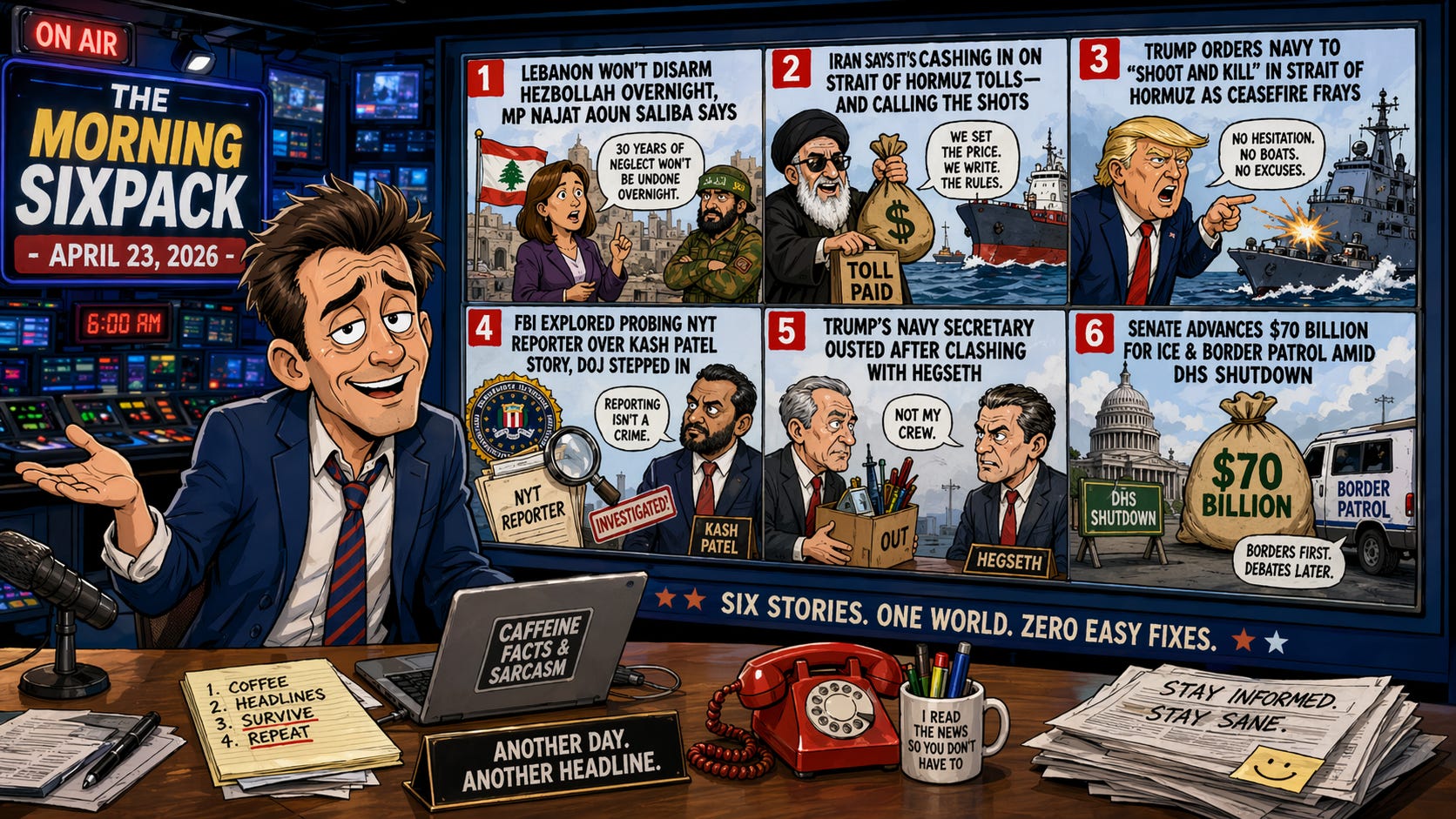
Lebanon Won’t Disarm Hezbollah Overnight, MP Najat Aoun Saliba Says
After 30 years of neglecting the Lebanese army while Hezbollah grew stronger, disarming the militia is no quick fix, says independent MP Najat Aoun Saliba.
You don’t undo three decades of imbalance with a press release and a handshake.
In an interview with Al Jazeera, Saliba warned that putting the Lebanese Armed Forces “at the forefront” won’t magically happen when they’ve been outmatched for years by a heavily armed militia. Hezbollah’s firepower didn’t materialize overnight, and neither will the army’s ability to dismantle it.
“It is going to be very difficult to say overnight that the Lebanese armed forces are now at the forefront, when they do not have enough resources or manpower after 30 years of a militia being strengthened above them,” she said. She added: “We cannot put the blame on the Lebanese armed forces. They are doing an excellent job, but they need help.”
Saliba pointed to Lebanon’s president and prime minister seeking international backing—resources, financial assistance, and the technical capacity to dismantle Hezbollah’s armaments and ballistic missiles. Translation: reform is happening, but it needs muscle and money from abroad.
As for chatter that Lebanon could join the Abraham Accords as a reward for disarming Hezbollah, Saliba shut that down—for now. “Lebanon will decide its own fate,” she said, noting the country’s role in the Arab League and calling such talk premature. In other words, Beirut isn’t about to freelance its foreign policy to win applause.
Source: Al Jazeera
Editor: If anyone thought untangling Lebanon’s militia problem would be quick, they haven’t been paying attention since 1994. This is a slow grind, not a Netflix reboot.
Iran Says It’s Cashing In on Strait of Hormuz Tolls—and Calling the Shots
Iranian lawmakers say the first revenues from new shipping tolls in the Strait of Hormuz are already in the central bank, flipping the script on Washington.
When 20% of the world’s oil passes your doorstep, you don’t whisper—you invoice.
Hamidreza Hajibabaei, deputy speaker of Iran’s parliament, declared that Tehran—not the U.S.—is now making demands after toll payments were deposited.
“We have control over this Strait,” he said at a public event, according to ABC News. “If the United States continues on its current course, no vessels will pass through the Strait of Hormuz. We are not engaged in negotiations--rather, we are making demands.”
Fellow lawmaker Alireza Salimi confirmed the deposits to Tasnim News Agency. “The amount collected from each ship depends on its cargo and level of risk they pose,” he said. “Iran determines how much and how these fees are collected, in other words, we determine the rules.” In short: Tehran sets the meter.
The tolls follow Iran’s blockade of the Strait of Hormuz, a chokepoint responsible for roughly 20% of the world’s oil shipments. The move came after U.S. and Israeli strikes under Operation Epic Fury and amid renewed tensions tied to Israel’s failed truce with Lebanon. Oil has surged past $100 per barrel multiple times, and U.S. drivers are feeling it at the pump.
The comments also land days after Donald Trump agreed to extend a ceasefire deadline with Iran. Trump said he ordered the military to continue the blockade posture while awaiting a “unified proposal” from Tehran’s leadership, even after earlier suggesting he expected “to be bombing” if no deal emerged. So yes, the Strait is now both a military flashpoint and a toll booth.
Source: iHeart
Editor: Nothing says global stability like turning the world’s busiest oil artery into a pay-to-play lane. Hope everyone likes premium—because it’s about to cost you.
Trump Orders Navy to “Shoot and Kill” in Strait of Hormuz as Ceasefire Frays
President Donald Trump says he has directed the U.S. Navy to open fire on any boats laying mines in the Strait of Hormuz—escalating a war he insists is nearly over.
It’s hard to declare victory while simultaneously ordering live fire in one of the world’s most volatile waterways.
In a Thursday morning post on Truth Social, Donald Trump wrote: “I have ordered the United States Navy to shoot and kill any boat, small boats though they may be (Their naval ships are ALL, 159 of them, at the bottom of the sea!), that is putting mines in the waters of the Strait of Hormuz. There is to be no hesitation.”
He added, “Additionally, our mine ‘sweepers’ are clearing the Strait right now. I am hereby ordering that activity to continue, but at a tripled up level! Thank you for your attention to this matter. President DONALD J. TRUMP.”
The threat comes as fighting with Iran drags on despite White House claims of a ceasefire. Skirmishes have continued in and around the Strait of Hormuz, a chokepoint for global oil shipments and a flashpoint that has already rattled energy markets. Trump has repeatedly said the U.S. has “already won” the war, even as hostilities persist.
For now, the message from Washington is simple: negotiations may be on paper, but the Navy’s rules of engagement just got sharper. And in a region where miscalculation is practically a tradition, that’s not exactly calming.
Source: Raw Story
Editor: If this is what “winding down” looks like, I’d hate to see the ramp-up. Nothing steadies oil markets like an all-caps shoot-first policy.
FBI Explored Probing NYT Reporter Over Kash Patel Story, DOJ Stepped In
The FBI searched databases and weighed further action against a New York Times reporter after she wrote about agents protecting FBI Director Kash Patel’s girlfriend.
When routine reporting gets labeled “stalking,” the First Amendment isn’t just rattled—it’s on trial.
According to the The New York Times, the bureau examined whether reporter Elizabeth Williamson had violated anti-stalking laws after her Feb. 28 story detailed how federal agents were assigned to protect and chauffeur Patel’s girlfriend, country singer Alexis Wilkins. The FBI ultimately took no action, and the U.S. Department of Justice blocked any further pursuit.
The paper said it learned of the internal scrutiny only after a tip to reporter Michael S. Schmidt. Executive editor Joseph Kahn didn’t mince words: “The FBI’s attempt to criminalize routine reporting is a blatant violation of Elizabeth’s First Amendment rights and another attempt by this administration to prevent journalists from scrutinizing its actions. It’s alarming. It’s unconstitutional. And it’s wrong.”
An FBI spokesperson, Ben Williamson, posted that investigators were “concerned about how the aggressive reporting techniques crossed lines of stalking,” but confirmed that “no further action regarding Williamson or the reporting was ever pursued by the FBI.” The initial contact reportedly stemmed from a death threat Wilkins received after publication; agents interviewed her but stopped there.
Meanwhile, Kash Patel has shown little patience for unfavorable press. This week he filed a $250 million defamation lawsuit against The Atlantic over an article detailing allegations about his conduct at the agency. So yes, the tension between law enforcement power and press freedom isn’t theoretical—it’s active.
Source: Associated Press
Editor: If digging into how taxpayer-funded agents spend their time now qualifies as “stalking,” investigative journalism better lawyer up. This is how watchdogs get muzzled—quietly, bureaucratically, and with a straight face.
Trump’s Navy Secretary Ousted After Clashing with Hegseth
Navy Secretary John Phelan was forced out after just 13 months amid repeated clashes with Defense Secretary Pete Hegseth and frustration over stalled shipbuilding reforms.
When the Pentagon turns into a reality show, someone’s getting voted off the island.
According to The Washington Post, Phelan—a billionaire art collector and major Trump fundraiser—was asked to step down after battles with Hegseth and Deputy Defense Secretary Steve Feinberg over management, priorities, and who actually runs the building. The exit was announced as “effective immediately.”
Pete Hegseth has been presiding over what looks less like a steady command structure and more like a purge. Senior generals and admirals have been shown the door with little explanation. Phelan’s departure adds to a growing list of high-level exits across the administration, including Cabinet officials pushed out since March.
At the center of the friction: shipbuilding. The administration has been impatient with the Navy’s lagging progress and ballooning timelines. Phelan didn’t help his standing when he floated the idea that outsourcing some U.S. warship production abroad might be “on the table”—a comment critics said undercut Trump’s push to revive domestic shipyards. That didn’t go over well in a Pentagon already bristling with internal turf wars.
Navy Undersecretary Hung Cao will step in as acting secretary. The message to the rest of the building seems clear: Align—or update your résumé.
Source: The Washington Post
Editor: Turns out campaign donations don’t guarantee job security when the shipbuilding numbers don’t move. In this Pentagon, loyalty lasts right up until it doesn’t.
Senate Advances $70 Billion for ICE and Border Patrol Amid DHS Shutdown
The U.S. Senate voted 50-48 to move forward with a $70 billion plan to fund ICE and Border Patrol, breaking a partial Homeland Security shutdown triggered by protests and Democratic demands for reform.
If you thought the shutdown would force policy changes, think again—this fight is about to get louder.
The United States Senate approved a budget framework early Thursday to restart funding for key immigration enforcement agencies, sending the measure to the House. The Department of Homeland Security has been partially shuttered since mid-February after Democrats pushed for policy changes following the fatal shootings of protesters in Minneapolis by federal agents.
The proposal would fund U.S. Immigration and Customs Enforcement and the Border Patrol for three years—covering the remainder of Donald Trump’s term. Republicans are using budget reconciliation, a maneuver that allows passage with a simple majority instead of the usual 60 votes needed to break a filibuster.
Senate Majority Leader John Thune framed the vote as a border security imperative, saying Republicans would prevent Democrats from defunding “these important agencies.” Senate Democratic leader Chuck Schumer fired back, arguing that instead of “pumping hundreds of billions of dollars into ICE and Border Patrol,” lawmakers should focus on lowering household costs.
A separate bipartisan measure to reopen the rest of DHS has already passed the Senate, but House Republican leaders are refusing to take it up until ICE and Border Patrol funding moves forward. Translation: immigration enforcement is the price of reopening the lights.
Source: Al Jazeera
Editor: Washington can’t agree on much—but give it a border fight and suddenly everyone finds their voice. Meanwhile, the shutdown becomes just another bargaining chip.