


The Morning Sixpack stays free because the news that shapes your life should not be hidden behind a paywall. Paid subscribers are not paying for access. They are helping fund the research, writing, and independent voice that goes into every issue. Become a paid subscriber and help keep smart, honest news analysis free for everyone.
The world’s diplomats are gathering in New York with wars spreading, alliances shifting, and predictability having missed its connecting flight.
World Leaders Descend on the UN as Wars Spread and the Global Order Gets Messier
World leaders are arriving at the United Nations General Assembly amid escalating wars in Europe and the Middle East, economic uncertainty, and a shifting international order that diplomats say has become even less stable over the past year. The annual gathering begins Tuesday in New York with conflicts, climate risks, artificial intelligence, and the (in)effectiveness of international diplomacy crowding the agenda.
The uncomfortable question hanging over the whole thing: Can the United Nations still solve major international problems when its members increasingly can’t agree on what the problems are? It’s not like they’ve been super successful in the past, even with an agreeable US President…
U.N. Secretary-General António Guterres summed up the moment: “World leaders will be gathering at the United Nations in an era of deep uncertainty.” He added that global power is shifting and international institutions need to change with it. The backdrop includes the continuing Russia-Ukraine war and the widening Middle East conflict, with diplomats also confronting maritime security concerns and the rapid development of artificial intelligence.
Former U.S. Ambassador Robert Wood told the AP that diplomacy still has an opening, but described the institution as being at an “inflection point.” Officials interviewed by AP pointed to attacks on international law, stalled mediation efforts, and persistent disagreements over climate, peace, and security. Beyond the headline speeches from President Donald Trump, Ukrainian President Volodymyr Zelenskyy, and Iranian President Masoud Pezeshkian, much of the consequential work may happen in meetings away from the microphones.
Slovenian Foreign Minister Tone Kajzer captured the broader challenge: “In international relations, everything is changing: The friendships are changing, and alliances are changing.”
Governments still have interests to protect, of course. The trick is aligning enough of them to prevent what Kajzer called “permanent conflict”—which is a considerably tougher assignment than issuing another carefully worded communiqué.
Editor: The U.N. was built around getting countries into the same room. In 2026, getting them into the room remains the easy part.
Source: AP News
American Research Group’s September poll puts President Trump’s overall approval at 29% and economic approval at 26%, while Americans’ assessments of the economy and their own finances are overwhelmingly negative.
Trump Approval Falls to 29% as Americans Sour on the Economy
President Donald Trump’s job approval stands at 29%, with 68% disapproving, according to American Research Group’s September 2026 national survey. His rating on handling the economy is lower: 26% approve and 71% disapprove. Both measures slipped from August, when overall approval was 30% and economic approval was 28%.
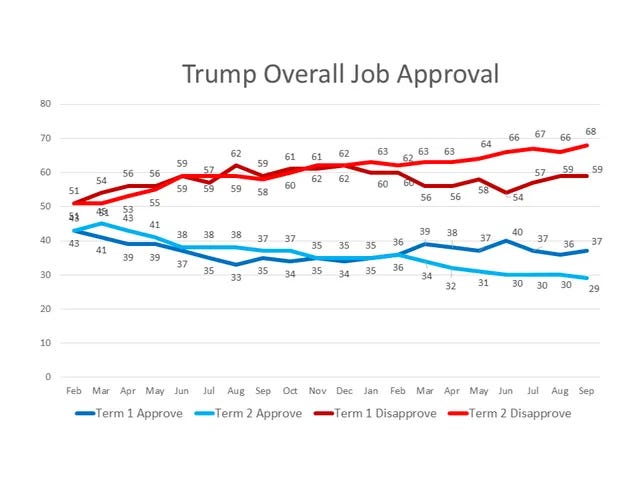
The economic numbers are particularly bleak: Just 5% say the economy is getting better, while 72% say it’s getting worse. Only 6% expect the national economy to be better a year from now, compared with 70% who expect it to be worse. And 67% of respondents say they believe the country is currently in a recession—an assessment of public opinion, not an official determination that a recession exists.
The pessimism crosses an interesting political line. Among people who approve of Trump’s overall job performance, 56% nevertheless expect the national economy to be worse a year from now. The same 56% say they expect their own household financial situation to be worse. Among Republicans, 63% approve of Trump’s handling of the economy; among independents, that figure is 19%, while 75% disapprove.
Household finances look equally grim in the poll. Only 18% rate their household financial situation as excellent, very good, or good, while 75% rate it bad, very bad, or terrible. Just 3% say their finances are getting better, versus 71% who say they’re getting worse. A year ago, in September 2025, 41% rated their household finances positively and 55% negatively, according to ARG’s historical results.
The survey was conducted September 16-20 among 1,100 adults in the continental United States and carries a theoretical margin of error of ±3 percentage points when opinion is evenly divided. As with any individual poll, it is a snapshot based on one organization’s methodology rather than a definitive measurement of public opinion.
Editor: The politically awkward number here isn’t merely 29%. It’s that 56% of Trump approvers themselves expect both the national economy and their household finances to be worse a year from now. That’s not an opposition talking point—it’s what respondents who approve of the president told the pollster.
Source: American Research Group — And the guy thought a 24x7 Trump TV was a great idea
Iran says the Strait of Hormuz could reopen within seven days if Washington eases military pressure and its blockade, putting a concrete offer on the table while everybody happens to be in New York.
Iran Offers to Reopen Strait of Hormuz as US Talks Get a New Opening at the UN
Iran and the United States are signaling that negotiations could restart as President Donald Trump and Iranian President Masoud Pezeshkian attend the U.N. General Assembly, with Tehran offering to reopen the Strait of Hormuz within seven days if Washington meets specified conditions. A senior Iranian official told Reuters there are no plans for Trump and Pezeshkian to meet directly, but said Iran’s delegation has authority to revive negotiations.
That matters well beyond the negotiating table: Before the current conflict, roughly one-fifth of the world’s daily crude oil and liquefied natural gas supply moved through Hormuz. Iran’s conditions include easing U.S. military pressure and lifting the American blockade on Iranian ports. Secretary of State Marco Rubio, meanwhile, said Washington remains open to talks if they have a prospect of producing a positive result.
The diplomatic opening comes after an interim agreement collapsed in July, and both sides are still publicly staking out hard positions. Iran’s parliament speaker Mohammed Baqer Qalibaf said Tuesday that Iran would not surrender to U.S. pressure, while Rubio reiterated Washington’s opposition to Iran obtaining nuclear weapons. So, yes, there’s a negotiating window—but nobody has exactly started ordering the celebratory champagne.
Trump is also meeting with leaders from Saudi Arabia, the United Arab Emirates, Qatar, Oman, Bahrain, and Kuwait as Gulf governments seek restored shipping through Hormuz. Reuters reports that Qatar has proposed a broader security framework that would include Iran and the Arab Gulf states, with Iran reviewing the proposal. Meanwhile, Saudi Arabia has restarted its East-West Pipeline, an alternative export route that bypasses Hormuz, providing some additional breathing room for energy markets.
Markets noticed. Oil fell more than 2% Tuesday to a two-week low following Iran’s Hormuz proposal and the Saudi pipeline restart. The diplomacy remains conditional, the military conflict continues, and no Trump-Pezeshkian meeting is scheduled—but after months of escalation, Washington and Tehran are at least publicly talking about talking again.
Editor: When reopening one narrow strip of water can move oil prices around the planet, “let’s talk” suddenly becomes considerably more persuasive. For now, though, this is an offer to negotiate—not a peace deal, ceasefire, or open Strait.
Source: Reuters
Flock Safety is offering voluntary buyouts as customer losses, camera vandalism, and privacy controversies put new pressure on the $8 billion surveillance-tech company.
Flock Safety Offers Employee Buyouts as Backlash Hits Its Surveillance Business
Flock Safety has opened a voluntary separation program for employees, offering what it calls its most generous severance package yet as the license-plate surveillance company faces lost contracts, rising expenses and sustained criticism over privacy and alleged misuse of its technology. Employees have until October 2 to apply, and Flock expects to approve most requests, according to an internal email obtained by WIRED.
For a startup valued at more than $8 billion earlier this year, paying employees to leave is a notable turn in the story.
Flock employs roughly 1,500 people, and sources told WIRED they believe a significant number could apply for the program. The company reportedly described the package as roughly twice as generous as previous severance offers, with some employees receiving offers worth tens of thousands of dollars, several months of health coverage and two years to exercise stock options. Accepted employees are expected to find out October 9, with most departures scheduled by October 29.
The buyouts come as Flock’s nationwide network of automated license-plate readers faces intensifying scrutiny. WIRED has reported allegations of officers using the system to track former romantic partners and colleagues, broad sharing of Flock data among agencies, and questions about what its cameras collect. An advocacy group identified 93 city and county governments that ended relationships with Flock in August alone, while WIRED reports that contract losses could leave the company short of revenue targets. Flock has also faced added costs from vandalism targeting its cameras.
CEO Garrett Langley recently said the backlash has particularly affected employees: “The biggest damage” has been “internal morale.”
Flock, meanwhile, is expanding beyond license-plate readers into AI-powered investigative tools capable of searching data and camera feeds for people and patterns of movement. That makes the company’s current predicament especially consequential: Flock is trying to expand what its surveillance technology can do at the same time some communities, customers, and employees are reconsidering their relationship with it.
Editor: Nothing complicates an $8 billion valuation quite like customers walking away, cameras getting vandalized, and employees being offered money to head for the exits. Flock calls it “greater agency” for workers. The next few weeks should provide a pretty good head count on how many decide to exercise it.
Source: WIRED
Senate Republicans are fighting over whether Washington should restrict diesel exports as record pump prices collide with farm-state pressure—and oil-state senators say the proposed cure could make the problem worse.
Diesel Hits a Record $6.51 as Republicans Clash Over an Export Ban
National diesel prices reached a record $6.51 a gallon Monday, prompting Republican senators from agricultural states to push for restrictions on U.S. diesel exports in hopes of increasing domestic supplies and lowering prices. Sen. Chuck Grassley of Iowa has publicly called for an embargo, while Senate Majority Leader John Thune said an export ban makes more sense to him than temporarily suspending the federal gasoline tax.
Diesel averaged $3.52 before the U.S.-Israel strikes against Iran—meaning the national average has risen nearly $3 a gallon during the ensuing conflict, according to The Hill. Grassley wrote that high diesel prices “ARE KILLING FARMERS INCOME,” while Rep. Ashley Hinson called for pausing diesel exports, suspending the gas tax, and easing restrictions on higher-ethanol fuel. The Hill reports that higher fuel and fertilizer costs, combined with trade pressures on agricultural commodities, have increased economic concerns in farm states.
But Republicans representing major energy-producing states are pushing in the other direction. Texas Sen. John Cornyn called the export proposal a “gimmick,” while Alaska Sen. Lisa Murkowski questioned whether restricting exports would “move the needle.” American Petroleum Institute CEO Mike Sommers argues that because much U.S. diesel production is concentrated along the Gulf Coast while other regions depend on imports, an export restriction could create regional supply imbalances rather than broadly reducing prices.
Thune said reopening the Strait of Hormuz would be a preferable solution. The Hill reports that Iranian threats have reduced traffic through the crucial energy corridor, while Agriculture Secretary Brooke Rollins discussed diesel prices with Trump on Monday. Wyoming Sen. John Barrasso said the administration is considering several options and pointed to the complexity of U.S.-Canadian fuel trade. South Dakota Sen. Mike Rounds, meanwhile, suggested restoring refinery capacity in California as another approach.
The argument revives a debate Washington knows well: The United States maintained restrictions on crude-oil exports from 1975 until Congress lifted them in 2015 following the domestic shale-production boom. Today’s dispute is essentially over whether keeping more fuel at home would actually lower American prices or merely disrupt an interconnected energy market. For now, it remains a proposal rather than enacted policy.
Editor: Nothing gets Washington brainstorming like $6.51 diesel. The farm-state solution is “keep more here,” the oil-state response is “that won’t work,” and everyone appears to agree that reopening Hormuz would make this particular argument considerably less urgent.
I mean, Trump could surrender and things may go “back to normal.”
Source: The Hill
Beijing is courting Taiwan’s opposition while amplifying doubts about American support, betting that political pressure may accomplish what military pressure has not.
Xi Sees an Opening on Taiwan as Trump’s China Summit Approaches
Chinese leader Xi Jinping sees President Trump’s second term as what a senior Taiwanese official calls a “rare window of opportunity” to shift public opinion in Taiwan toward Beijing, according to The Wall Street Journal. China is combining military pressure with political outreach, online influence campaigns, and closer engagement with Taiwan’s opposition Kuomintang, or KMT.
The strategy isn’t simply to threaten Taiwan—it’s to convince its 23 million people that resisting Beijing is ultimately futile. Taiwan’s Mainland Affairs Council Minister Chiu Chui-cheng told the Journal that Beijing believes Trump’s unpredictability regarding U.S. commitments gives Xi additional room to operate. A Brookings Institution poll cited by the Journal found only 24% of Taiwanese voters regarded the United States as a trustworthy ally. At the same time, U.S.-Taiwan military cooperation has become more public, including acknowledgment of American military training on the island.
China is also cultivating KMT chairwoman Cheng Li-wun, who traveled to the mainland in April and met Xi. The Journal reports that Chinese officials and KMT negotiators discussed language for the trip beforehand, and Cheng provided prepared remarks opposing Taiwanese independence in advance.
Cheng has defended closer engagement with Beijing, saying, “Why can’t I choose both? Why must I choose a side?”
The KMT says its approach is intended to preserve cross-strait peace while protecting Taiwan’s democracy and way of life.
Then there’s the information war. Taiwan’s National Security Bureau says Beijing conducted an “all-out” cognitive-warfare campaign using online platforms and fake websites, identifying 45,000 suspected accounts in 2025 compared with about 28,000 in 2024. Taiwanese officials have also accused China of using deepfakes and AI-generated material to undermine the governing Democratic Progressive Party and spread doubts about whether Washington would stand by Taiwan. Beijing has long denied involvement in disinformation campaigns.
Xi is expected to raise Taiwan when he meets Trump in Washington this week. According to Chinese policy advisers cited by the Journal, Beijing wants Trump to state clearer opposition to Taiwanese independence. But China faces a substantial obstacle inside Taiwan itself: Long-running polling cited by the Journal puts support for unification below 8%. So Beijing’s approach appears to be less about demonstrating that Taiwanese voters already want unification and more about changing the political environment in which they make that choice.
Editor: Beijing’s apparent calculation is straightforward—if Taiwanese voters won’t embrace unification, make them question whether the alternative is sustainable. The unanswered question is whether that campaign persuades people—or reminds them exactly why they distrust Beijing in the first place.
Source: The Wall Street Journal (no paywall)